
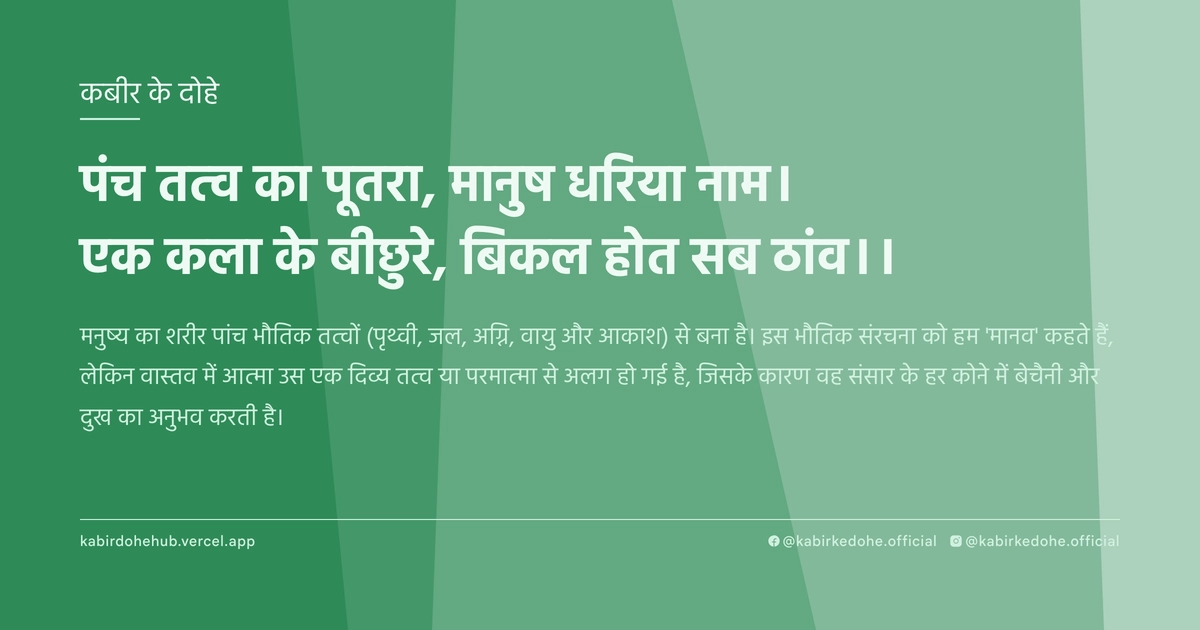
पंच तत्व का पूतरा, मानुष धरिया नाम।
एक कला के बीछुरे, बिकल होत सब ठांव।।
Panch tatv ka putra, manush dhariya naam. Ek kala ke beechure, bikal hot sab thaanv.
इस पृष्ठ पर इस कबीर दोहे का अर्थ (meaning), हिंदी व्याख्या और अंग्रेज़ी अनुवाद, दार्शनिक विश्लेषण और व्यावहारिक जीवन सीख दी गई है। यह दोहा आत्मा और शरीर (Soul and Body) विषय से जुड़ा है — Kabir doha meaning and explanation in Hindi and English.
अर्थ (Meaning):
मनुष्य का शरीर पांच भौतिक तत्वों (पृथ्वी, जल, अग्नि, वायु और आकाश) से बना है। इस भौतिक संरचना को हम 'मानव' कहते हैं, लेकिन वास्तव में आत्मा उस एक दिव्य तत्व या परमात्मा से अलग हो गई है, जिसके कारण वह संसार के हर कोने में बेचैनी और दुख का अनुभव करती है।
The human body is a composite of five primordial elements: earth, water, fire, air, and ether. While we identify this physical form as 'human,' the essence within is a fragment of the Divine. Having been severed from that singular, primordial Source, the soul wanders in perpetual restlessness and longing across all realms of existence.
व्याख्या (Interpretation):
कबीर यहाँ शरीर की नश्वरता और आत्मा की शाश्वत प्यास के बीच के विरोधाभास को दर्शाते हैं। 'पंच तत्त्व' भौतिक माया का प्रतीक हैं, जो अस्थायी हैं। 'एक कला' उस अद्वैत ब्रह्म या निराकार परमात्मा को संदर्भित करता है जिससे हम अलग हुए हैं। यह विछोह ही संसार के समस्त दुखों का मूल कारण है। जब तक मनुष्य स्वयं को केवल शरीर मानता है, वह अधूरा महसूस करता है। यह अधूरापन ही उसे भौतिक सुखों में शांति खोजने पर मजबूर करता है, जबकि शांति केवल उस 'एक कला' यानी आत्म-साक्षात्कार में निहित है। यह दोहा जीव और ईश्वर के बीच के द्वैत को मिटाकर अद्वैत की ओर संकेत करता है।
Kabir illuminates the paradox between the perishable body and the eternal longing of the soul. The 'five elements' symbolize the realm of Maya—the illusory, transient physical world. The 'one art' or 'single element' refers to the Non-dual Brahman or the Formless Divine from which the soul has become estranged. This perceived separation is the ontological root of all human suffering. As long as the individual identifies solely with the physical vessel, they experience an existential void. This void drives the frantic search for fulfillment in material pursuits, whereas true peace resides only in the realization of that singular Divine essence. The verse points toward the collapse of duality, urging the seeker to recognize their inherent oneness with the Absolute.
दार्शनिक विश्लेषण (Philosophical Analysis):
कबीर का यह दर्शन निर्गुण भक्ति और अद्वैत वेदांत का एक सुंदर संगम है। वे शरीर को केवल एक 'पुतारा' या पुतली मानते हैं, जो यह संकेत देता है कि भौतिक पहचान वास्तव में एक मुखौटा है। ऐतिहासिक रूप से, कबीर ने उस समय के कर्मकांडों का विरोध किया जो शरीर की शुद्धता या जातिगत श्रेष्ठता पर जोर देते थे। वे तर्क देते हैं कि यदि हम सब उन्हीं पांच तत्वों से बने हैं, तो जाति या धर्म का कोई आधार नहीं रह जाता।
सूफी मत के 'वहदत-अल-वजूद' (अस्तित्व की एकता) के समान, कबीर यहाँ आत्मा की परमात्मा से विरह की स्थिति का वर्णन कर रहे हैं। यह विरह केवल भावनात्मक नहीं, बल्कि आध्यात्मिक है। यह 'बीछुरना' अज्ञानता (Avidya) का परिणाम है, जहाँ आत्मा स्वयं को ब्रह्म से अलग मान बैठती है।
मनोवैज्ञानिक स्तर पर, यह दोहा आधुनिक अस्तित्ववाद की याद दिलाता है। मनुष्य की अंतहीन इच्छाएं वास्तव में उस खोए हुए पूर्णत्व की खोज हैं। कबीर कहते हैं कि जब तक हम बाहरी दुनिया में समाधान ढूंढेंगे, हम 'बिकल' (बेचैन) ही रहेंगे।
वे इस बात पर जोर देते हैं कि मोक्ष किसी बाहरी तीर्थयात्रा या कठिन तपस्या से नहीं, बल्कि इस सत्य को पहचानने से मिलता है कि हम उस एक दिव्य तत्व का हिस्सा हैं। यह अहंकार का विसर्जन है, जहाँ 'मैं' मिटकर 'वह' हो जाता है।
अंततः, यह विश्लेषण हमें सिखाता है कि भौतिकता एक माध्यम है, लक्ष्य नहीं। शरीर की सीमाओं को पहचानना ही उन सीमाओं से मुक्त होने का पहला कदम है।
Kabir’s philosophy here is a sophisticated synthesis of Nirgun Bhakti and Advaita Vedanta. By describing the body as a 'putara' (a puppet or vessel), he suggests that physical identity is merely a mask. Historically, Kabir challenged the ritualistic obsession with bodily purity and caste hierarchies of his era. He posits that since every human is composed of the same five primordial elements, any claim of caste-based superiority is logically and spiritually void.
Parallel to the Sufi concept of 'Wahdat-al-Wujud' (The Unity of Being), Kabir describes the soul's state as one of separation from the Divine. This 'estrangement' is not merely emotional but ontological, resulting from Avidya (spiritual ignorance), where the Atman mistakenly perceives itself as distinct from Brahman.
On a psychological plane, this verse resonates with existentialist thought. The endless cycle of human desire is, in reality, a misplaced longing for the lost wholeness of the Source. Kabir asserts that as long as the seeker looks outward for fulfillment, they will remain 'bikal' (restless), for the void cannot be filled by the finite.
He emphasizes that liberation (Mukti) is not achieved through external pilgrimages or rigorous asceticism, but through the internal realization that one is an extension of the singular Divine element. This process requires the annihilation of the ego—the transition from the 'I' to the 'Thou.'
Ultimately, this analysis reveals that materiality is a vehicle, not the destination. Recognizing the limitations of the physical form is the first essential step toward transcending those very limitations to achieve oneness.
मूल संदेश (Core Message):
- शरीर नश्वर है, लेकिन चेतना शाश्वत है।
- बाहरी खोज केवल भ्रम और थकान पैदा करती है।
- अद्वैत का अनुभव ही वास्तविक शांति का मार्ग है।
- अहंकार का विसर्जन ही परमात्मा से मिलन है।
- हम सब एक ही दिव्य स्रोत की अलग-अलग लहरें हैं।
- The body is transient, but consciousness is eternal.
- External searching yields only illusion and exhaustion.
- The experience of Non-duality is the only path to true peace.
- The dissolution of ego is the union with the Divine.
- We are all distinct waves of the same primordial ocean.
व्यावहारिक उदाहरण (Practical Example):
वाराणसी के घाटों पर रहने वाला एक वृद्ध कुम्हार था, जिसका नाम माधव था। माधव अपनी कला में निपुण था, लेकिन उसका मन हमेशा अशांत रहता था। वह सोचता था कि यदि उसके पास और अधिक धन हो, या उसके बेटे विदेश से लौट आएं, तो वह सुखी होगा। वह दिन भर मिट्टी के बर्तन बनाता, लेकिन उसकी नजरें हमेशा क्षितिज पर टिकी रहती थीं, जैसे वह कुछ ढूंढ रहा हो।
एक दिन उसने एक फकीर को देखा जो केवल एक फटे हुए कंबल पर बैठा था, फिर भी उसके चेहरे पर ऐसी शांति थी जो माधव ने अपने जीवन के सबसे समृद्ध दिनों में भी नहीं देखी थी। माधव ने उससे पूछा, 'बाबा, मैं सब कुछ पाकर भी अधूरा क्यों महसूस करता हूँ?'
फकीर ने मुस्कुराते हुए माधव के हाथ में पकड़ी मिट्टी की ढेली की ओर इशारा किया और कहा, 'यह मिट्टी पांच तत्वों का मेल है, और तुम्हारा शरीर भी। तुम इस मिट्टी को आकार देकर बर्तन बनाते हो, लेकिन तुम अपने भीतर के उस तत्व को भूल गए हो जो कभी नहीं बदलता। तुम उस एक कला को ढूंढ रहे हो जो तुम्हारे भीतर ही है, लेकिन तुम उसे बाहर की दुनिया में खोज रहे हो।'
माधव को पहले तो यह बात समझ नहीं आई। लेकिन उस रात, उसने अपनी आँखें बंद कीं और केवल अपनी सांसों पर ध्यान केंद्रित किया। उसने महसूस किया कि वह जिसे 'मैं' कह रहा था—एक पिता, एक कुम्हार, एक गरीब व्यक्ति—वह सब केवल बाहरी आवरण थे।
उसने महसूस किया कि उसकी बेचैनी किसी व्यक्ति या वस्तु की कमी के कारण नहीं थी, बल्कि अपनी वास्तविक प्रकृति को भूल जाने के कारण थी। उसने महसूस किया कि वह मिट्टी का बर्तन नहीं, बल्कि वह शून्य है जिसमें वह बर्तन समाया हुआ है।
अगली सुबह, माधव ने फिर से चाक घुमाना शुरू किया, लेकिन अब उसकी नजरें क्षितिज पर नहीं थीं। वह वर्तमान क्षण में पूरी तरह उपस्थित था। उसने पाया कि जब उसने बाहर खोजना बंद किया, तो वह आंतरिक पूर्णता जिसे वह सालों से ढूंढ रहा था, स्वतः प्रकट हो गई।
उसका व्यवहार बदल गया। अब वह अपने बेटों के लौटने की प्रतीक्षा में दुखी नहीं था, बल्कि उनके प्रति प्रेम महसूस करता था, बिना किसी अपेक्षा के। उसने अपने आस-पास के अन्य गरीब कारीगरों की मदद करना शुरू किया, यह जानते हुए कि वे सब उसी एक दिव्य तत्व के अंश हैं।
माधव की कला अब केवल जीविका का साधन नहीं रही, बल्कि एक ध्यान बन गई। वह अब मिट्टी को नहीं गूंथ रहा था, बल्कि अपनी आत्मा को उस परमात्मा के साथ जोड़ रहा था।
In the ancient ghats of Varanasi lived an elderly potter named Madhav. Madhav was a master of his craft, yet his mind was a storm of restlessness. He believed that if he possessed more wealth, or if his estranged sons returned from abroad, he would finally find peace. He spent his days shaping clay, but his eyes were always fixed on the distant horizon, searching for something he could not name.
One afternoon, he encountered a wandering dervish sitting on a tattered blanket. Despite having nothing, the dervish radiated a serenity that Madhav had never experienced even in his most prosperous years. Madhav asked, 'Baba, why do I feel incomplete despite my skills and my life?'
The dervish smiled and pointed to the lump of clay in Madhav's hand. 'This clay is a blend of the elements, just as your body is. You give shape to this earth to make a pot, but you have forgotten the element within you that never changes. You are longing for that one Divine Art, yet you seek it in the external world.'
At first, Madhav was perplexed. However, that night, he closed his eyes and focused solely on the rhythm of his breath. He began to realize that the identities he clung to—a father, a potter, a struggling man—were merely outer shells, temporary masks.
He understood that his restlessness was not caused by the absence of people or things, but by the forgetting of his own true nature. He realized he was not the clay pot, but the vast space within the pot that connects to the infinite sky.
The next morning, Madhav returned to his wheel, but his gaze no longer wandered to the horizon. He was entirely present in the moment. He discovered that once he stopped searching externally, the inner wholeness he had craved for decades manifested spontaneously.
His behavior transformed. He no longer grieved for his sons' absence; instead, he felt a pure, unconditional love for them without the burden of expectation. He began supporting other struggling artisans, recognizing that they were all fragments of the same Divine Light.
Madhav's pottery ceased to be a mere means of survival; it became a form of meditation. He was no longer just kneading clay; he was weaving his soul back into the fabric of the Absolute.
अभ्यास मार्गदर्शन (Practice Guidance):
- दैनिक ध्यान: प्रतिदिन 20 मिनट शांत बैठकर यह अनुभव करें कि आपका शरीर पांच तत्वों से बना है और आप इन तत्वों के साक्षी (Observer) हैं।
- आत्म-पूछताछ: जब भी बेचैनी महसूस हो, स्वयं से पूछें, 'यह अधूरापन कहाँ से आ रहा है? क्या मैं किसी बाहरी वस्तु की तलाश में हूँ या अपने स्वयं के केंद्र की?'
- व्यवहार परिवर्तन: दिन में कम से कम एक बार किसी ऐसे व्यक्ति की मदद करें जिसे आप 'अलग' या 'पराया' मानते हैं, यह याद रखते हुए कि आप दोनों एक ही तत्व से बने हैं।
- डायग्नोस्टिक चेकलिस्ट: यदि आप अभी भी दूसरों की प्रशंसा या आलोचना से विचलित होते हैं, तो इसका अर्थ है कि आप अभी भी 'पुतारे' (शरीर/अहंकार) से जुड़े हैं, 'एक कला' (आत्मा) से नहीं।
- Daily Meditation: Spend 20 minutes in silence, consciously observing that your body is a composition of five elements and that you are the Witness (Sakshi) of this physical form.
- Self-Inquiry: Whenever restlessness arises, ask yourself: 'Where is this void coming from? Am I seeking an external object, or am I longing for my own center?'
- Behavioral Shift: At least once a day, perform an act of kindness for someone you perceive as 'different' or 'other,' consciously acknowledging your shared elemental origin.
- Diagnostic Checklist: If you still find your peace dependent on external praise or criticism, it is a sign that you are still identified with the 'putara' (the ego/body) rather than the 'one art' (the soul).
चिंतन प्रश्न (Reflection Questions):
- यदि मेरा शरीर और मेरी सामाजिक पहचान छीन ली जाए, तो 'मैं' वास्तव में कौन हूँ?
- मेरी कौन सी इच्छाएं वास्तव में भौतिक हैं, और कौन सी उस 'एक कला' की आध्यात्मिक प्यास हैं?
- मैं अपनी डिजिटल पहचान (सोशल मीडिया) को कितना सच मानता हूँ, और यह मेरे वास्तविक स्वरूप से कितना अलग है?
- क्या मैं दूसरों में अपनी ही छवि देख पा रहा हूँ, या मैं अभी भी भेदभाव की दीवारों में कैद हूँ?
- मेरी बेचैनी का मूल कारण क्या है—संसाधनों की कमी या स्वयं से अलगाव?
- If my physical body and social identities were stripped away, who would 'I' actually be?
- Which of my desires are truly material, and which are actually spiritual longings for the 'one art'?
- To what extent do I mistake my digital persona for my true self, and how does this distort my reality?
- Am I capable of seeing my own reflection in others, or am I still imprisoned by the walls of prejudice?
- Is the root of my restlessness a lack of resources, or a profound alienation from my own essence?