
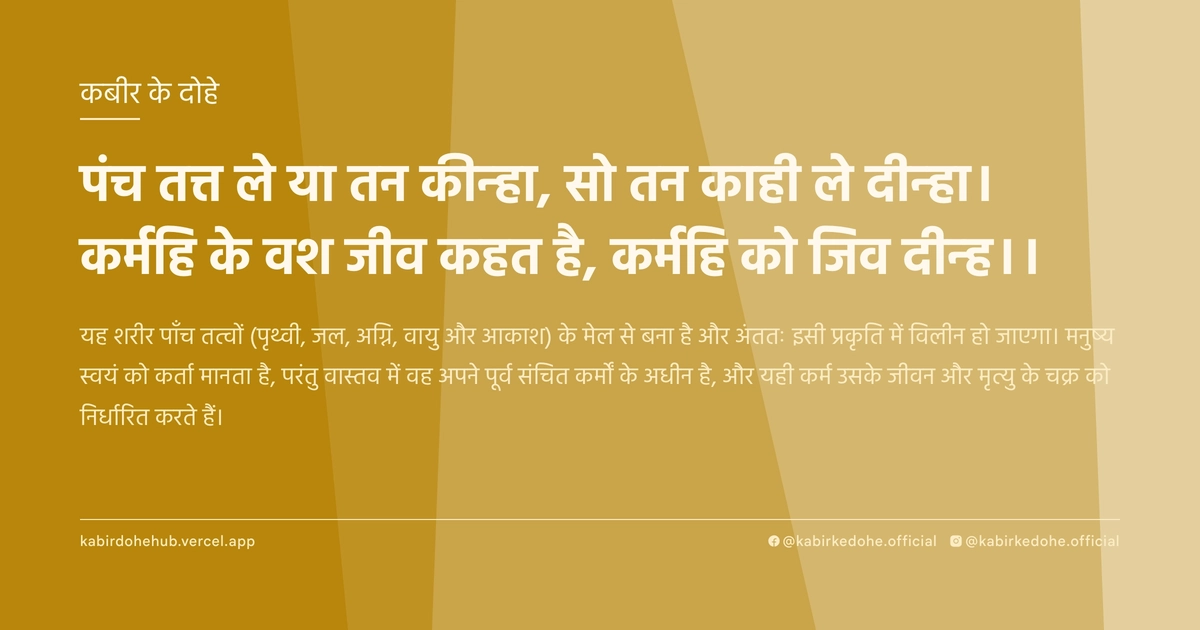
पंच तत्त ले या तन कीन्हा, सो तन काही ले दीन्हा।
कर्महि के वश जीव कहत है, कर्महि को जिव दीन्ह।।
Panch tatt le ya tan kinha, so tan kaahi le dinha. Karamhi ke vash jeev kahat hai, karamhi ko jiv dinha.
इस पृष्ठ पर इस कबीर दोहे का अर्थ (meaning), हिंदी व्याख्या और अंग्रेज़ी अनुवाद, दार्शनिक विश्लेषण और व्यावहारिक जीवन सीख दी गई है। यह दोहा कर्म (Karma) विषय से जुड़ा है — Kabir doha meaning and explanation in Hindi and English.
अर्थ (Meaning):
यह शरीर पाँच तत्वों (पृथ्वी, जल, अग्नि, वायु और आकाश) के मेल से बना है और अंततः इसी प्रकृति में विलीन हो जाएगा। मनुष्य स्वयं को कर्ता मानता है, परंतु वास्तव में वह अपने पूर्व संचित कर्मों के अधीन है, और यही कर्म उसके जीवन और मृत्यु के चक्र को निर्धारित करते हैं।
This physical body is composed of the five primordial elements—earth, water, fire, air, and ether—and shall eventually return to them. While the soul identifies as the doer, it is actually bound by the laws of karma, which govern the cycle of existence and the destiny of the living being.
व्याख्या (Interpretation):
कबीर यहाँ शरीर की नश्वरता और कर्म के अटल सिद्धांत का विश्लेषण कर रहे हैं। 'पंच तत्व' का उल्लेख यह दर्शाता है कि मनुष्य केवल भौतिक प्रकृति का एक अस्थायी संयोजन है, न कि कोई स्थायी इकाई। जब हम कहते हैं कि 'मैंने यह किया', तो हम अहंकार (Maya) के प्रभाव में होते हैं। वास्तव में, जीव अपने कर्मों के वश में है, जिसका अर्थ है कि हमारी वर्तमान परिस्थितियाँ पिछले कार्यों का परिणाम हैं। यह द्वैत—शरीर की भौतिकता और आत्मा की कर्म-बद्धता—मानव अस्तित्व का केंद्रीय विरोधाभास है। निर्गुण भक्ति के परिप्रेक्ष्य में, जब साधक यह समझ लेता है कि शरीर केवल एक यंत्र है, तब वह 'अहंकार' से मुक्त होकर उस निराकार ब्रह्म में विलीन होने की क्षमता प्राप्त करता है।
Kabir analyzes the transience of the physical form and the immutable law of karma. The mention of the 'five elements' emphasizes that a human is merely a temporary assembly of material nature, not a permanent entity. When we claim 'I did this,' we are operating under the influence of Maya (illusion). In reality, the soul is bound by its actions, meaning current circumstances are the fruition of past deeds. This duality—the materiality of the body and the karmic bondage of the soul—represents the central paradox of human existence. From the perspective of Nirgun Bhakti, once the seeker realizes the body is but a vessel, they transcend the ego to merge with the formless Brahman.
दार्शनिक विश्लेषण (Philosophical Analysis):
कबीर का यह दोहा मध्यकालीन भारत के उस सामाजिक-धार्मिक परिवेश से उपजा है जहाँ कर्मकांड और जातिगत श्रेष्ठता चरम पर थी। कबीर ने शरीर को पाँच तत्वों का मिश्रण बताकर सभी मनुष्यों को एक ही स्तर पर ला खड़ा किया; चाहे वह ब्राह्मण हो या चर्मकार, अंततः सबका अंत मिट्टी और हवा में ही होना है। यह दृष्टिकोण सीधे तौर पर जाति व्यवस्था के उस दावे को चुनौती देता है जो जन्म के आधार पर श्रेष्ठता बताता है।
दार्शनिक रूप से, यह अद्वैत वेदांत के करीब है, जहाँ शरीर को 'माया' या मिथ्या माना गया है। कबीर समझाते हैं कि जिसे हम 'मैं' कहते हैं, वह वास्तव में कर्मों का एक पुंज है। जब तक मनुष्य स्वयं को शरीर मानता है, वह जन्म-मृत्यु के चक्र (संसार) में फँसा रहता है। यह सूफी मत के 'फना' (अहंकार का विनाश) के विचार से भी मेल खाता है, जहाँ स्वयं को मिटाकर ही ईश्वर को पाया जा सकता है।
यहाँ 'कर्म' का अर्थ केवल पुरस्कार या दंड नहीं है, बल्कि यह एक मनोवैज्ञानिक श्रृंखला है। कबीर का तर्क है कि मनुष्य अपनी आदतों और प्रवृत्तियों का दास है। जब तक हम यह नहीं पहचानते कि हम कर्मों के वश में हैं, हम मुक्ति की खोज नहीं कर सकते। यह बोध ही अहंकार के विसर्जन की पहली सीढ़ी है।
कबीर ritualism (कर्मकांड) का विरोध करते हैं क्योंकि वे जानते हैं कि बाहरी पूजा शरीर को नहीं बचा सकती। यदि शरीर पंच तत्वों का है, तो उसे किसी मंदिर या मस्जिद में नहीं, बल्कि आत्म-साक्षात्कार के माध्यम से मुक्त किया जा सकता है। वे भौतिकता के मोह को त्यागकर आंतरिक सत्य की ओर मुड़ने का आह्वान करते हैं।
अंततः, यह विश्लेषण हमें सिखाता है कि जीवन का उद्देश्य कर्मों का संचय करना नहीं, बल्कि कर्मों के प्रभाव से ऊपर उठना है। जब जीव यह जान लेता है कि वह शरीर नहीं बल्कि वह चेतना है जो इन तत्वों का अवलोकन कर रही है, तब वह वास्तव में 'जीव' से 'शिव' की ओर अग्रसर होता है।
This couplet emerges from the socio-religious landscape of medieval India, where ritualism and caste hierarchy were pervasive. By defining the body as a mixture of five elements, Kabir levels the playing field for all humanity; whether a Brahmin or a tanner, everyone eventually returns to dust and air. This perspective directly challenges the caste system's claim of inherent superiority based on birth.
Philosophically, this aligns with Advaita Vedanta, where the body is viewed as 'Maya' or an illusion. Kabir explains that what we call 'I' is actually a cluster of karmic imprints. As long as a human identifies with the body, they remain trapped in the cycle of birth and death (Samsara). This mirrors the Sufi concept of 'Fana' (annihilation of the self), where the ego must be erased to realize the Divine.
Here, 'Karma' is not merely about reward or punishment, but a psychological chain. Kabir argues that humans are slaves to their tendencies and habits. Until we recognize that we are governed by these forces, the quest for liberation remains futile. This realization is the first step toward the dissolution of the ego.
Kabir rejects ritualism because he understands that external worship cannot preserve the perishable body. If the body is composed of five elements, it cannot be saved by temples or mosques, but only through self-realization. He calls for a shift from material attachment to internal truth.
Ultimately, this analysis teaches us that the purpose of life is not to accumulate karmas, but to transcend their influence. When the soul realizes it is not the body, but the consciousness observing these elements, it moves from the state of 'Jiva' (individual soul) toward 'Shiva' (universal consciousness).
मूल संदेश (Core Message):
- शरीर नश्वर है, केवल चेतना शाश्वत है।
- अहंकार ही वह पर्दा है जो हमें सत्य से अलग करता है।
- हम कर्ता नहीं, बल्कि कर्मों के माध्यम हैं।
- तत्वों का विसर्जन ही अंतिम सत्य है।
- विनम्रता ही मुक्ति का एकमात्र द्वार है।
- प्रकृति के साथ सामंजस्य ही वास्तविक शांति है।
- The body is transient; only consciousness is eternal.
- Ego is the veil that separates us from the Truth.
- We are not the doers, but instruments of karma.
- The dissolution into elements is the ultimate reality.
- Humility is the only gateway to liberation.
- Harmony with nature is the path to true peace.
व्यावहारिक उदाहरण (Practical Example):
वाराणसी के एक पुराने घाट पर रहने वाले माधव नाम के एक वृद्ध बुनकर थे। माधव अपनी कला में निपुण थे और उन्हें अपनी श्रेष्ठता का बहुत गर्व था। वे मानते थे कि उनकी बुनाई की कला उन्हें अन्य बुनकरों से ऊपर रखती है और यह उनके कुल का विशेष गुण है।
एक समय ऐसा आया जब माधव गंभीर रूप से बीमार पड़ गए। उनके हाथ कांपने लगे और वे अब वह महीन काम नहीं कर पा रहे थे जिसके लिए वे जाने जाते थे। उनकी सारी प्रतिष्ठा और अहंकार धीरे-धीरे ढहने लगा।
एक शाम, जब वे घाट पर बैठे सूर्यास्त देख रहे थे, उन्होंने देखा कि पास ही एक छोटा बच्चा रेत का घर बना रहा था। जैसे ही लहर आई, वह घर पल भर में ढह गया और रेत वापस पानी में मिल गई।
माधव को अचानक कबीर का वह दोहा याद आया कि शरीर केवल पंच तत्वों का मेल है। उन्हें अहसास हुआ कि जिस 'कला' और 'कुल' पर उन्हें गर्व था, वह भी इसी तरह की एक अस्थायी रचना थी।
उन्होंने महसूस किया कि उनका अहंकार केवल इस भ्रम पर टिका था कि वे इस शरीर और अपनी कुशलता के स्वामी हैं, जबकि वे केवल समय और कर्मों के अधीन थे।
इस बोध ने उनके भीतर के क्रोध और हताशा को शांत कर दिया। उन्होंने अब अपनी बीमारी को एक सजा के रूप में नहीं, बल्कि प्रकृति के एक स्वाभाविक चक्र के रूप में देखना शुरू किया।
माधव ने अपनी बची हुई ऊर्जा उन युवा बुनकरों को सिखाने में लगा दी जिन्हें वे पहले तुच्छ समझते थे। उन्होंने अब 'मैं' के बजाय 'हम' के भाव से काम करना शुरू किया।
उनकी जीवन की दिशा बदल गई। अब वे अपनी पहचान अपनी कला से नहीं, बल्कि अपनी करुणा और विनम्रता से जोड़ने लगे।
जब अंततः उनका समय आया, तो वे बिना किसी डर या मोह के शांत थे, क्योंकि उन्होंने जान लिया था कि वे केवल तत्वों को वापस लौटा रहे हैं।
यह 'कबीर ट्विस्ट' था—जहाँ भौतिक हानि ने उन्हें आध्यात्मिक समृद्धि की ओर धकेल दिया और अहंकार का विनाश उनके जीवन का सबसे बड़ा लाभ बन गया।
In the ancient ghats of Varanasi lived an elderly weaver named Madhav. Madhav was a master of his craft and took immense pride in his superiority. He believed his weaving skill set him above all other weavers, viewing it as an inherent trait of his noble lineage.
There came a time when Madhav fell seriously ill. His hands began to tremble, and he could no longer perform the intricate work for which he was renowned. His prestige and ego slowly crumbled.
One evening, while sitting on the ghat watching the sunset, he noticed a small child building a house of sand. As a wave crashed in, the house vanished in an instant, the sand merging back into the water.
Suddenly, Madhav recalled Kabir's verse about the body being a mere combination of five elements. He realized that the 'art' and 'lineage' he was so proud of were equally temporary constructions.
He felt that his ego had been anchored in the illusion that he was the master of his body and skill, whereas he was merely subject to time and karma.
This realization calmed the anger and frustration within him. He stopped viewing his illness as a punishment and began to see it as a natural cycle of nature.
Madhav spent his remaining energy teaching the young weavers whom he had previously looked down upon. He shifted his focus from 'I' to 'we'.
The trajectory of his life changed. He no longer defined his identity by his craft, but by his compassion and humility.
When his time finally came, he was peaceful, without fear or attachment, knowing he was simply returning the elements to their source.
This was the 'Kabir Twist'—where physical loss pushed him toward spiritual abundance, and the annihilation of the ego became the greatest gain of his life.
अभ्यास मार्गदर्शन (Practice Guidance):
- दैनिक ध्यान: प्रतिदिन 15 मिनट शांत बैठें और विचार करें कि आपका शरीर कैसे प्रकृति के तत्वों (हवा, पानी, मिट्टी) से बना है। यह भावना विकसित करें कि आप इन तत्वों के स्वामी नहीं, बल्कि केवल एक ट्रस्टी हैं।
- आत्म-पूछताछ जर्नल: हर शाम लिखें—'आज मैंने किस कार्य में 'मैं' (अहंकार) को प्रधानता दी?' और 'क्या यह कार्य मेरे नियंत्रण में था या परिस्थितियों के वश में?'
- व्यवहार परिवर्तन: जब भी आप किसी सफलता का श्रेय लें, सचेत रूप से याद करें कि इसमें अनगिनत बाहरी कारकों और पूर्व कर्मों का हाथ है। श्रेय को स्वयं से हटाकर ब्रह्मांडीय ऊर्जा को समर्पित करें।
- निदान चेकलिस्ट: यदि आप छोटी बातों पर अत्यधिक क्रोधित होते हैं या अपनी उपलब्धियों पर गर्व करते हैं, तो समझें कि आप अभी भी शरीर और अहंकार के भ्रम में हैं। यदि आप परिवर्तन को सहजता से स्वीकार कर रहे हैं, तो आप इस ज्ञान को जी रहे हैं।
- Daily Meditation: Sit in silence for 15 minutes daily, contemplating how your body is composed of nature's elements. Cultivate the feeling that you are not the owner of these elements, but merely a trustee.
- Self-Inquiry Journal: Every evening, write—'In which action today did I prioritize the 'I' (ego)?' and 'Was this action truly under my control or governed by circumstances?'
- Behavioral Shift: Whenever you take credit for a success, consciously acknowledge the countless external factors and past karmas involved. Redirect the credit from yourself to the universal energy.
- Diagnostic Checklist: If you find yourself reacting with intense anger to small things or feeling excessive pride in achievements, you are still under the illusion of the body and ego. If you accept change with equanimity, you are living this wisdom.
चिंतन प्रश्न (Reflection Questions):
- यदि आपका सामाजिक पद, धन और शारीरिक सुंदरता आज छीन ली जाए, तो आपके पास 'मैं' कहने के लिए क्या बचेगा?
- आप अपनी सफलताओं का श्रेय खुद लेते हैं, लेकिन अपनी विफलताओं के लिए परिस्थितियों को दोष देते हैं—यह विरोधाभास आपके अहंकार के बारे में क्या बताता है?
- क्या आप वास्तव में अपने जीवन के निर्णय ले रहे हैं, या आप केवल अपनी पुरानी आदतों और सामाजिक कंडीशनिंग (संस्कारों) के वश में हैं?
- मृत्यु का विचार आपको डराता है या यह आपको जीवन की क्षणभंगुरता के प्रति जागरूक करता है?
- आपकी डिजिटल पहचान (सोशल मीडिया) आपके वास्तविक अस्तित्व को कितना ढक चुकी है?
- क्या आप दूसरों के प्रति अपनी करुणा में उनके 'तत्वों' को देखते हैं, या उनके 'पद' और 'जाति' को?
- If your social status, wealth, and physical beauty were stripped away today, what would remain for you to call 'I'?
- You take credit for your successes but blame circumstances for your failures—what does this paradox reveal about your ego?
- Are you truly making your own life decisions, or are you merely acting under the influence of old habits and social conditioning?
- Does the thought of death terrify you, or does it awaken you to the transience of life?
- To what extent has your digital identity (social media) obscured your actual existence?
- When you feel compassion for others, do you see their shared 'elements' or their 'status' and 'caste'?