
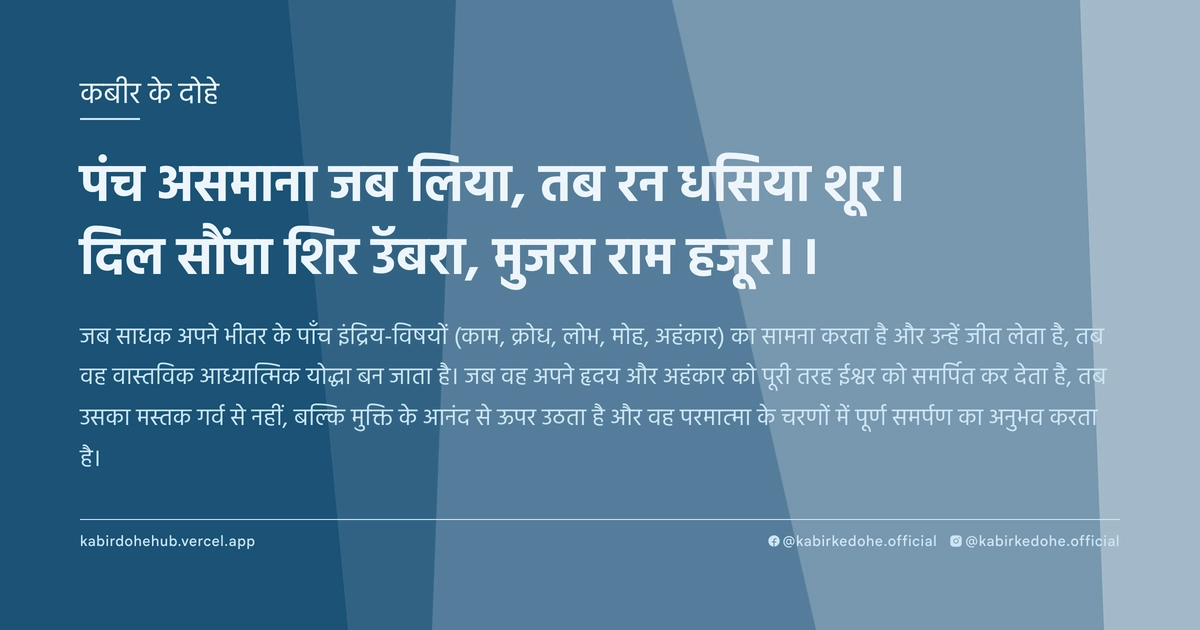
पंच असमाना जब लिया, तब रन धसिया शूर।
दिल सौंपा शिर उॅबरा, मुजरा राम हजूर।।
Panch asmana jab liya, tab ran dhasia shoor. Dil saunpa shir ubra, mujra Ram hazoor.
इस पृष्ठ पर इस कबीर दोहे का अर्थ (meaning), हिंदी व्याख्या और अंग्रेज़ी अनुवाद, दार्शनिक विश्लेषण और व्यावहारिक जीवन सीख दी गई है। यह दोहा प्रपत्ति (Surrender) विषय से जुड़ा है — Kabir doha meaning and explanation in Hindi and English.
अर्थ (Meaning):
जब साधक अपने भीतर के पाँच इंद्रिय-विषयों (काम, क्रोध, लोभ, मोह, अहंकार) का सामना करता है और उन्हें जीत लेता है, तब वह वास्तविक आध्यात्मिक योद्धा बन जाता है। जब वह अपने हृदय और अहंकार को पूरी तरह ईश्वर को समर्पित कर देता है, तब उसका मस्तक गर्व से नहीं, बल्कि मुक्ति के आनंद से ऊपर उठता है और वह परमात्मा के चरणों में पूर्ण समर्पण का अनुभव करता है।
When a seeker confronts and overcomes the five sensory impulses—lust, anger, greed, attachment, and ego—they become a true spiritual warrior. By surrendering the heart and the ego entirely to the Divine, the seeker's consciousness is elevated, and they find ultimate liberation in the presence of the Formless One, bowing in total surrender.
व्याख्या (Interpretation):
यह दोहा इंद्रिय निग्रह और पूर्ण समर्पण के बीच के संबंध को दर्शाता है। 'पंच असमाना' यहाँ पाँच विकारों या इंद्रियों का प्रतीक हैं जो मनुष्य को सत्य से दूर ले जाते हैं। 'रण' या युद्ध बाहरी नहीं, बल्कि आंतरिक है, जहाँ अहंकार और आत्मा के बीच संघर्ष चलता है। जब साधक इन विकारों को 'धसिया' यानी नष्ट कर देता है, तब वह 'शूर' या वीर कहलाता है। यहाँ 'शिर उॅबरा' का अर्थ केवल भौतिक सिर का उठना नहीं, बल्कि चेतना का उच्च स्तर पर पहुँचना है। यह अद्वैत वेदांत के उस सिद्धांत को पुष्ट करता है जहाँ 'मैं' का विलोपन ही 'ब्रह्म' का मिलन है। अंततः, 'मुजरा' या प्रणाम वह स्थिति है जहाँ द्वैत समाप्त हो जाता है और केवल परमात्मा शेष रहता है।
This couplet illustrates the profound relationship between sensory control and total surrender. The 'five inequalities' or 'panch asmana' symbolize the five poisons—lust, anger, greed, attachment, and ego—that veil the soul from truth. The 'battlefield' described is not a physical war but an internal psychological struggle between the ego and the eternal spirit. By 'trampling' these vices, the seeker transforms into a spiritual warrior. The phrase 'shir ubara' (the head rose) does not signify pride, but the elevation of consciousness from the mundane to the transcendental. It aligns with Advaita Vedanta, where the annihilation of the individual 'I' is the only gateway to the realization of Brahman. The final 'mujra' or bow represents the dissolution of duality, where the seeker and the Sought become one in a state of absolute surrender.
दार्शनिक विश्लेषण (Philosophical Analysis):
कबीर का यह दर्शन निर्गुण भक्ति और सूफी मत के संगम पर स्थित है। ऐतिहासिक रूप से, कबीर ने उस समय के कर्मकांडीय धर्म का विरोध किया जहाँ बाहरी दिखावे को मोक्ष का साधन माना जाता था। उन्होंने तर्क दिया कि वास्तविक तीर्थयात्रा अपने भीतर के विकारों को जीतना है। यह दृष्टिकोण अद्वैत वेदांत के 'माया' सिद्धांत से मेल खाता है, जहाँ इंद्रियाँ हमें भ्रमित करती हैं और सत्य को ढक देती हैं।
सूफीवाद के 'फना' (अहंकार का विनाश) की अवधारणा यहाँ स्पष्ट है। जब तक 'मैं' जीवित है, तब तक 'वह' (ईश्वर) नहीं मिल सकता। कबीर कहते हैं कि जब तक व्यक्ति अपनी इच्छाओं और अहंकार के अधीन है, वह वास्तव में एक गुलाम है। वास्तविक वीरता शारीरिक बल में नहीं, बल्कि मन के नियंत्रण में है।
यह दोहा जाति और वर्ग के भेदभाव को भी नकारता है। एक योद्धा केवल वह नहीं है जिसने तलवार उठाई है, बल्कि वह है जिसने अपनी वासनाओं पर विजय पाई है। यह संदेश उस समय के सामंती समाज के लिए एक क्रांतिकारी प्रहार था, जो वीरता को केवल युद्ध के मैदान से जोड़ता था।
मनोवैज्ञानिक स्तर पर, यह 'छाया' (shadow) के साथ एकीकरण की प्रक्रिया है। जब हम अपने क्रोध और लोभ को पहचानते हैं और उन्हें रूपांतरित करते हैं, तब हम मानसिक शांति प्राप्त करते हैं। यह आत्म-साक्षात्कार की वह यात्रा है जहाँ व्यक्ति अपनी सीमित पहचान को छोड़कर सार्वभौमिक चेतना में विलीन हो जाता है।
अंततः, कबीर यह समझाते हैं कि समर्पण (Surrender) कमजोरी नहीं, बल्कि सर्वोच्च शक्ति है। जब हम अपना 'दिल' (हृदय/अहंकार) परमात्मा को सौंप देते हैं, तो हम उस बोझ से मुक्त हो जाते हैं जो हमें नीचे खींच रहा था। यही वह क्षण है जब आत्मा का वास्तविक उत्थान होता है।
Kabir's philosophy in this doha stands at the intersection of Nirgun Bhakti and Sufi mysticism. Historically, Kabir challenged the ritualistic religion of his era, which prioritized external ceremonies over internal purity. He argued that the true pilgrimage is the conquest of one's own internal vices, shifting the locus of spirituality from the temple or mosque to the human heart.
This perspective mirrors the Advaita Vedanta concept of 'Maya,' where the five senses act as veils that obscure the ultimate reality. The Sufi concept of 'Fana' (the annihilation of the self) is vividly present here. Kabir posits that as long as the 'I' exists, the 'Divine' remains hidden. True bravery is not found in physical combat but in the mastery over the mind's chaotic impulses.
By redefining the 'warrior,' Kabir dismantles the caste and class hierarchies of his time. In a feudal society that equated valor with military conquest, Kabir suggests that the highest form of courage is the internal struggle against ego. This was a radical democratization of spirituality, making liberation accessible to the weaver, the laborer, and the outcast.
Psychologically, this process represents the integration of the 'shadow.' By confronting and transforming anger, greed, and lust, the seeker achieves a state of psychic equilibrium. It is a journey from a fragmented, ego-driven identity to a unified, universal consciousness, where the boundaries between the self and the other dissolve.
Ultimately, Kabir teaches that surrender is not an act of weakness but the pinnacle of spiritual strength. By offering the 'heart' (the seat of ego) to the Divine, the seeker is liberated from the gravitational pull of worldly attachments. This surrender is the catalyst for the elevation of the soul, leading to a state of eternal peace and presence.
मूल संदेश (Core Message):
- आंतरिक युद्ध ही वास्तविक युद्ध है।
- इंद्रियों पर विजय ही सच्ची वीरता है।
- अहंकार का विसर्जन ही आत्मा का उत्थान है।
- समर्पण कमजोरी नहीं, सर्वोच्च शक्ति है।
- परमात्मा का मिलन स्वयं के विलोपन में है।
- The only war worth winning is the internal one.
- True valor lies in the mastery of the senses.
- The dissolution of ego is the elevation of the soul.
- Surrender is not weakness; it is the ultimate power.
- Union with the Divine requires the vanishing of the self.
व्यावहारिक उदाहरण (Practical Example):
वाराणसी के घाटों पर एक वृद्ध विधवा, जानकी, रहती थी। समाज की नजरों में वह एक उपेक्षित स्त्री थी, लेकिन उसके भीतर एक गहरा असंतोष था। वह अक्सर अपने अतीत के दुखों, समाज के तिरस्कार और अपने भीतर की कड़वाहट से लड़ती रहती थी। उसका क्रोध और मोह उसे चैन से जीने नहीं देते थे।
एक दिन उसने कबीर के इस दोहे को सुना। उसे समझ आया कि उसका असली युद्ध किसी बाहरी व्यक्ति या समाज से नहीं, बल्कि उसके अपने भीतर के 'पंच असमाना' से है। उसने महसूस किया कि उसका क्रोध वास्तव में उसकी अपनी असुरक्षा का प्रतिबिंब था।
जानकी ने तय किया कि वह अब अपनी कड़वाहट को पालने के बजाय उसे ईश्वर को समर्पित करेगी। जब भी उसे किसी पर गुस्सा आता, वह अपनी आँखें बंद करती और सोचती, "यह क्रोध मेरा नहीं, बल्कि मेरे अहंकार का है।"
शुरुआत में यह बहुत कठिन था। कई बार वह पुराने दुखों में डूब जाती, लेकिन उसने हार नहीं मानी। उसने अपने दैनिक कार्यों को ही एक साधना बना लिया।
वह घाट पर आने वाले अजनबियों को बिना किसी अपेक्षा के पानी और भोजन देने लगी। उसने पाया कि जब वह दूसरों की सेवा करती है, तो उसका अपना अहंकार धीरे-धीरे घटने लगता है।
एक समय ऐसा आया जब उसे अब समाज के तिरस्कार से कोई फर्क नहीं पड़ता था। उसने अपने भीतर के लोभ और मोह को पूरी तरह त्याग दिया था।
उसका चेहरा अब एक अलौकिक शांति से चमकने लगा था। लोग जो पहले उसे उपेक्षित करते थे, अब उसके पास शांति और मार्गदर्शन के लिए आने लगे।
जानकी ने अनुभव किया कि जब उसने अपना 'दिल' (अपनी सारी पीड़ा और अहंकार) परमात्मा को सौंप दिया, तब उसका मस्तक वास्तव में ऊंचा हो गया।
वह अब एक ऐसी योद्धा थी जिसने बिना किसी हथियार के अपने सबसे बड़े शत्रु—अपने स्वयं के अहंकार—को हरा दिया था।
उसकी मुक्ति किसी स्वर्ग की प्राप्ति में नहीं, बल्कि वर्तमान क्षण में पूर्ण समर्पण और प्रेम के अनुभव में थी।
In the ancient alleys of Varanasi lived Janaki, an elderly widow. To the world, she was a marginalized figure, but internally, she was embroiled in a relentless war. She carried the heavy burdens of past traumas, social rejection, and a simmering bitterness that clouded her existence.
Her days were spent fighting invisible battles against anger and attachment. She felt cheated by life and resentful toward those who ignored her. Her internal 'five enemies'—specifically anger and ego—kept her in a state of perpetual unrest.
One evening, while sitting by the Ganges, she heard a recitation of this specific Kabir doha. The words struck a chord: the realization that her true battlefield was not the society that shunned her, but the turmoil within her own heart.
Janaki decided to stop fighting the world and start conquering her internal vices. She realized that her anger was merely a shield for her vulnerability. She began a practice of observing her emotions without judgment.
Whenever a wave of resentment rose, she would whisper, "This anger is not mine; it is the ego's attempt to survive." She consciously chose to offer these emotions to the Divine, treating them as offerings in a sacred fire.
This transition was not easy. There were days of relapse and deep sorrow. However, she persisted, turning her mundane chores into acts of mindfulness and devotion.
She started serving water and simple meals to the pilgrims and the homeless on the ghats, asking for nothing in return. In this selfless service, she found the ego slowly eroding, replaced by a profound sense of kinship with all beings.
Eventually, the social stigma that once wounded her became irrelevant. She had transcended the need for external validation, having found an internal anchor of peace.
Her countenance transformed; a luminous serenity radiated from her. People who once looked past her now sought her company for the stillness she embodied.
Janaki discovered that by surrendering her 'heart'—all her pain and pride—to the Formless One, her spirit was finally elevated. She had become a warrior of the soul, winning a victory that no sword could ever achieve.
अभ्यास मार्गदर्शन (Practice Guidance):
- दैनिक आत्म-निरीक्षण: प्रतिदिन 20 मिनट मौन बैठें और पहचानें कि आज किन पांच विकारों (काम, क्रोध, लोभ, मोह, अहंकार) ने आपके व्यवहार को प्रभावित किया।
- समर्पण अभ्यास: जब भी कोई तीव्र भावना (जैसे गुस्सा या ईर्ष्या) उठे, उसे दबाने के बजाय कहें, "मैं इस भावना को परमात्मा को सौंपता हूँ," और गहरी सांस लें।
- अहंकार की डायरी: एक जर्नल लिखें जिसमें उन क्षणों को दर्ज करें जब आपने अपनी 'सही होने की जिद' को छोड़ा और शांति को चुना।
- निदान चेकलिस्ट: क्या मैं दूसरों की आलोचना कर रहा हूँ? (अहंकार), क्या मैं किसी वस्तु से चिपका हूँ? (मोह), क्या मैं प्रतिक्रिया दे रहा हूँ या प्रतिक्रिया चुन रहा हूँ? (इंद्रिय नियंत्रण)।
- Daily Self-Observation: Spend 20 minutes in silence daily to identify which of the five vices (lust, anger, greed, attachment, ego) dominated your reactions today.
- Surrender Practice: Whenever a strong negative emotion arises, instead of suppressing it, mentally state, "I offer this emotion to the Divine," and take a deep, conscious breath.
- Ego Journaling: Maintain a journal recording moments where you consciously let go of the 'need to be right' in favor of inner peace.
- Diagnostic Checklist: Am I judging others? (Ego), Am I clinging to a specific outcome? (Attachment), Am I reacting impulsively or responding consciously? (Sensory Control).
चिंतन प्रश्न (Reflection Questions):
- मेरे जीवन का वह कौन सा 'अदृश्य युद्ध' है जिसे मैं जीत नहीं पा रहा हूँ?
- मैं अपनी सार्वजनिक छवि (Public Image) को बनाए रखने के लिए अपने भीतर कितना झूठ बोलता हूँ?
- यदि मेरा अहंकार पूरी तरह समाप्त हो जाए, तो मेरे व्यक्तित्व में क्या बचेगा?
- क्या मेरी भक्ति वास्तव में समर्पण है, या यह केवल एक और तरीका है खुद को श्रेष्ठ महसूस कराने का?
- मैं किन चीजों से इतना चिपका हूँ कि उनका खोना मुझे मेरी पहचान खोने जैसा लगता है?
- What is the 'invisible war' in my life that I am currently failing to win?
- How much internal dishonesty do I maintain just to preserve my public image?
- If my ego were completely annihilated, what would remain of my personality?
- Is my spirituality true surrender, or is it just another way to feel superior to others?
- What am I clinging to so tightly that losing it feels like losing my very identity?