
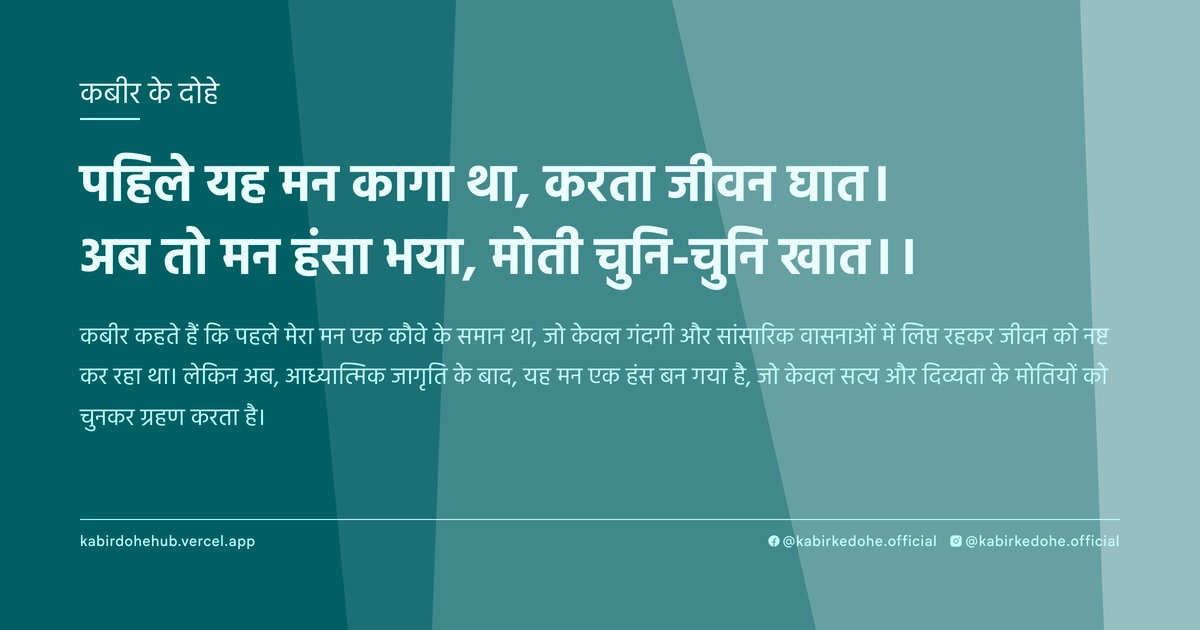
पहिले यह मन कागा था, करता जीवन घात।
अब तो मन हंसा भया, मोती चुनि-चुनि खात।।
Pahile yeh man kaga tha, karta jeevan ghat. Ab to man hansa bhaya, moti chuni-chuni khat.
इस पृष्ठ पर इस कबीर दोहे का अर्थ (meaning), हिंदी व्याख्या और अंग्रेज़ी अनुवाद, दार्शनिक विश्लेषण और व्यावहारिक जीवन सीख दी गई है। यह दोहा मन नियंत्रण (Mind Control) विषय से जुड़ा है — Kabir doha meaning and explanation in Hindi and English.
अर्थ (Meaning):
कबीर कहते हैं कि पहले मेरा मन एक कौवे के समान था, जो केवल गंदगी और सांसारिक वासनाओं में लिप्त रहकर जीवन को नष्ट कर रहा था। लेकिन अब, आध्यात्मिक जागृति के बाद, यह मन एक हंस बन गया है, जो केवल सत्य और दिव्यता के मोतियों को चुनकर ग्रहण करता है।
Kabir reflects on the transformation of his consciousness, stating that his mind was once like a crow, scavenging in the filth of worldly desires and causing spiritual decay. Now, through divine grace and awakening, the mind has evolved into a swan, capable of discerning and consuming only the pearls of eternal truth.
व्याख्या (Interpretation):
इस दोहे का शाब्दिक अर्थ मन की अवस्था में परिवर्तन है। कौवा यहाँ अज्ञानता, लोभ और तामसिक प्रवृत्तियों का प्रतीक है, जो केवल निम्न इच्छाओं की खोज करता है। हंस विवेक और पवित्रता का प्रतीक है, जो नीर-क्षीर विवेक (दूध और पानी को अलग करने की क्षमता) रखता है। यह परिवर्तन 'अविद्या' से 'विद्या' की ओर संक्रमण है। निर्गुण भक्ति के संदर्भ में, यह दर्शाता है कि जब साधक माया के मोह को त्याग देता है, तो उसकी चेतना ब्रह्म के साथ एकाकार होने लगती है। यह द्वैत से अद्वैत की यात्रा है, जहाँ मन बाहरी शोर को छोड़कर आंतरिक मौन और सत्य को खोजने लगता है।
Literally, the verse describes a shift in the mind's nature. The crow symbolizes ignorance, greed, and tamasic tendencies, scavenging through the debris of material attachment. The swan represents Viveka (discernment) and purity, possessing the mythical ability to separate milk from water. This transition signifies the movement from Avidya (ignorance) to Vidya (true knowledge). In the context of Nirgun Bhakti, it illustrates the moment a seeker transcends Maya, moving from the fragmented ego to the unified Atman-Brahman consciousness. The central paradox is that the 'crow' and 'swan' are not two different minds, but two states of the same consciousness—one bound by illusion, the other liberated by truth.
दार्शनिक विश्लेषण (Philosophical Analysis):
कबीर का यह दोहा मध्यकालीन भारत के सामाजिक और धार्मिक परिवेश में एक क्रांतिकारी विचार प्रस्तुत करता है। उस समय धर्म बाहरी कर्मकांडों और जातिगत श्रेष्ठता तक सीमित था। कबीर ने इन कृत्रिम विभाजनों को नकारते हुए आंतरिक रूपांतरण पर जोर दिया। उनका दृष्टिकोण सूफी मत के 'फना' (अहंकार का विनाश) और अद्वैत वेदांत के 'सोऽहम्' (मैं वही हूँ) के करीब है।
कौवे की उपमा उस मानसिक अवस्था को दर्शाती है जहाँ मनुष्य अपनी पहचान अपनी सामाजिक स्थिति, संपत्ति या शरीर से जोड़ता है। यह 'अहंकार' ही है जो जीवन को 'घात' करता है, अर्थात उसे आध्यात्मिक मृत्यु की ओर ले जाता है। कबीर तर्क देते हैं कि जब तक मन बाहरी दुनिया के 'कचरे' (मोह, क्रोध, ईर्ष्या) में उलझा रहेगा, वह कभी भी सत्य का अनुभव नहीं कर पाएगा।
हंस का बनना केवल एक मानसिक बदलाव नहीं, बल्कि एक अस्तित्वगत पुनर्जन्म है। यह सूफीवाद के 'इश्क-ए-हकीकी' (ईश्वरीय प्रेम) के समान है, जहाँ प्रेमी अपने अस्तित्व को मिटाकर परमात्मा में विलीन हो जाता है। यहाँ 'मोती' का अर्थ वे सूक्ष्म सत्य हैं जो केवल शांत और शुद्ध मन को ही दिखाई देते हैं।
कबीर ritualism (कर्मकांड) का विरोध करते हैं क्योंकि वे जानते हैं कि मंदिर या मस्जिद जाने से मन कौवे से हंस नहीं बनता। रूपांतरण केवल आत्म-साक्षात्कार और निरंतर सजगता से आता है। यह मनोवैज्ञानिक परिवर्तन है जहाँ व्यक्ति अपनी वासनाओं का दास होने के बजाय उनका साक्षी बन जाता है।
अंततः, यह दोहा हमें बताता है कि मुक्ति कहीं बाहर नहीं, बल्कि भीतर के परिप्रेक्ष्य को बदलने में है। जब दृष्टि बदलती है, तो जगत का स्वरूप बदल जाता है। जो कल तक गंदगी लगता था, वह अब ईश्वरीय लीला प्रतीत होने लगता है।
Kabir’s verse emerges from a socio-religious crucible in medieval India, challenging the hegemony of ritualism and caste hierarchy. By focusing on the internal alchemy of the soul, he aligns himself with the core of Advaita Vedanta and the mystical essence of Sufism. The transition from a crow to a swan is not merely a metaphor for 'improvement' but for a fundamental ontological shift.
The 'crow' represents the state of the ego-driven mind, trapped in the cycle of Samsara. In this state, the individual identifies with the transient—wealth, status, and bodily desires. This identification is the 'ghaat' (destruction) of life, as it anchors the soul to the illusory world of Maya, preventing it from recognizing its own divine nature.
The 'swan' symbolizes the awakened consciousness. In Indian mythology, the Hamsa (swan) is the vehicle of Brahma and the symbol of the breath (Soham). To become a swan is to achieve 'Viveka'—the spiritual discernment to distinguish the Eternal from the ephemeral. This mirrors the Sufi concept of 'Fana,' where the lower self is annihilated to make room for the Divine Presence.
Kabir rejects the notion that spiritual liberation is achieved through external pilgrimages or rigid adherence to scripture. He asserts that the 'pearls' of truth are accessible only when the mind is purged of its scavenging nature. The 'pearls' are the realizations of non-duality, where the seeker realizes that the observer and the observed are one.
Psychologically, this represents the movement from a reactive state of mind to a reflective one. The crow reacts to hunger and instinct; the swan chooses based on purity and truth. This is the essence of the Bhakti movement—the democratization of spirituality, suggesting that any soul, regardless of caste, can transform its nature through devotion and self-awareness.
मूल संदेश (Core Message):
- अज्ञानता एक मानसिक आदत है जिसे जागरूकता से बदला जा सकता है।
- बाहरी दुनिया का कचरा केवल तब तक आकर्षित करता है जब तक भीतर गंदगी हो।
- विवेक ही वह उपकरण है जो हमें साधारण से असाधारण बनाता है।
- अहंकार का विसर्जन ही वास्तविक आध्यात्मिक उन्नति की पहली सीढ़ी है।
- सत्य के मोती केवल शांत और शुद्ध हृदय में ही मिलते हैं।
- Ignorance is a mental habit that can be overwritten by conscious awareness.
- The debris of the external world only attracts those who carry filth within.
- Discernment (Viveka) is the only tool that transforms the mundane into the divine.
- The dissolution of the ego is the primary step toward spiritual evolution.
- The pearls of truth are accessible only to a heart cleansed of desire.
व्यावहारिक उदाहरण (Practical Example):
वाराणसी के एक पुराने घाट पर रामदीन नाम का एक नाविक रहता था। रामदीन स्वभाव से अत्यंत क्रोधी और लालची था। वह पर्यटकों से अधिक पैसे वसूलता और छोटी-छोटी बातों पर अन्य नाविकों से झगड़ा करता था। उसका मन उस 'कौवे' की तरह था जो केवल अपने लाभ और दूसरों की कमियों को देखता था। वह हमेशा इस तनाव में रहता कि कोई उससे बेहतर नाविक न बन जाए।
एक दिन, उसकी नाव एक वृद्ध संन्यासी के साथ किनारे लगी। संन्यासी ने रामदीन के क्रोध को देखा और उसे कुछ नहीं कहा, बस उसे एक छोटा सा दर्पण दिया और कहा, 'इसमें वह देखो जो तुम दूसरों में देखते हो।'
शुरुआत में रामदीन को यह मजाक लगा। लेकिन संन्यासी के शांत स्वभाव और उसकी आँखों की गहराई ने रामदीन को सोचने पर मजबूर कर दिया। उसने महसूस किया कि उसका क्रोध वास्तव में उसकी अपनी आंतरिक असुरक्षा का प्रतिबिंब था। वह दूसरों को नीचा दिखाकर खुद को बड़ा महसूस करना चाहता था।
अगले कुछ महीनों तक, रामदीन ने संन्यासी के सानिध्य में रहकर मौन का अभ्यास किया। उसने गौर करना शुरू किया कि कैसे उसका मन हर समय किसी न किसी शिकायत या लालच की तलाश में रहता था। उसने अपने भीतर के 'कौवे' को पहचान लिया।
धीरे-धीरे, उसका व्यवहार बदलने लगा। अब वह केवल पैसे के लिए नाव नहीं चलाता था, बल्कि यात्रियों की थकान मिटाने और उन्हें गंगा की शांति का अनुभव कराने का प्रयास करता था। उसने नाविकों के बीच के झगड़ों को सुलझाना शुरू किया।
एक दिन, एक यात्री ने उसे बहुत अधिक बख्शीश दी, लेकिन रामदीन ने उसे एक गरीब विधवा को दे दिया जो घाट पर फूल बेच रही थी। उस समय उसे जो आनंद मिला, वह किसी भी धन से बड़ा था।
उसने महसूस किया कि अब वह 'मोती' चुन रहा है—दया, करुणा और संतोष के मोती। उसका मन अब शांत था, जैसे एक सफेद हंस जो झील के शांत जल में तैर रहा हो।
रामदीन की पहचान अब एक 'लालची नाविक' से बदलकर एक 'परोपकारी मार्गदर्शक' की हो गई थी। उसने सीखा कि जब हम दूसरों की सेवा में अपना अहंकार मिटाते हैं, तो जीवन का असली स्वाद मिलता है।
उसका जीवन अब संघर्ष नहीं, बल्कि एक उत्सव बन गया था। उसने जान लिया कि असली संपत्ति वह नहीं जो तिजोरी में हो, बल्कि वह है जो हृदय में शांति के रूप में बसे।
यह रूपांतरण किसी बाहरी चमत्कार से नहीं, बल्कि स्वयं के अवलोकन और अहंकार के त्याग से आया था।
On the ancient ghats of Varanasi lived a boatman named Ramdeen. Ramdeen was known for his volatile temper and insatiable greed. He would overcharge tourists and engage in petty brawls with fellow boatmen. His mind was like the 'crow' Kabir described—constantly scavenging for profit and focusing on the flaws of others. He lived in a state of perpetual anxiety, fearing that someone might surpass his influence.
One day, he ferried an elderly sanyasi. The monk observed Ramdeen's anger but remained undisturbed. He handed Ramdeen a small mirror and whispered, 'Look into this and see that which you seek in others.'
Initially, Ramdeen dismissed this as a riddle. However, the sanyasi's profound stillness and the depth of his gaze haunted him. He began to realize that his anger was merely a reflection of his own internal insecurity. He had been trying to elevate himself by pulling others down.
Over the following months, Ramdeen spent time in the company of the monk, practicing silence. He started observing the patterns of his mind, noticing how it instinctively sought out complaints or opportunities for greed. He finally recognized the 'crow' within him.
Slowly, his behavior shifted. He no longer rowed the boat merely for money; he began to care for the comfort of his passengers, helping them experience the serenity of the Ganges. He started mediating disputes among the other boatmen instead of instigating them.
One afternoon, a wealthy traveler offered him a lavish tip. Instead of pocketing it, Ramdeen gave the money to a widowed flower-seller on the ghat. The surge of joy he felt in that moment of giving far outweighed any financial gain he had ever known.
He realized he was now 'picking pearls'—the pearls of compassion, kindness, and contentment. His mind had become like a swan, gliding peacefully on the still waters of consciousness.
Ramdeen's identity transformed from a 'greedy boatman' to a 'benevolent guide.' He discovered that the true essence of life is found not in accumulation, but in the dissolution of the ego through service.
His life ceased to be a struggle for survival and became a celebration of existence. He understood that true wealth is not what is stored in a chest, but the peace that resides in the heart.
This transformation did not come from a miracle, but from the disciplined observation of his own shadows and the conscious choice to let them go.
अभ्यास मार्गदर्शन (Practice Guidance):
- दैनिक अवलोकन: दिन में तीन बार रुकें और पूछें, 'क्या इस समय मेरा मन कौवे की तरह शिकायत/लालच कर रहा है, या हंस की तरह शांति/कृतज्ञता खोज रहा है?'
- विवेक अभ्यास: जब भी कोई नकारात्मक विचार आए, उसे तुरंत प्रतिक्रिया देने के बजाय उसे एक 'कौवे' की तरह देखें और उसे धीरे से विदा करें।
- आत्म-पूछताछ जर्नलिंग: हर रात लिखें कि आज आपने कौन सा 'मोती' (सकारात्मक अनुभव या सत्य) पाया और किस 'कचरे' (नकारात्मकता) को पीछे छोड़ा।
- निदान चेकलिस्ट: यदि आप छोटी बातों पर चिड़चिड़े हो रहे हैं, दूसरों की सफलता से जल रहे हैं, या केवल भौतिक लाभ सोच रहे हैं, तो समझें कि 'कौवा' सक्रिय है। यदि आप दूसरों की खुशी में खुश हैं और मौन का आनंद ले रहे हैं, तो 'हंस' जागृत है।
- Daily Observation: Three times a day, pause and ask, 'Is my mind currently acting as a crow (seeking complaint/greed) or as a swan (seeking peace/gratitude)?'
- Discernment Practice: When a negative thought arises, instead of reacting, observe it as a 'crow' passing by and consciously let it go without attachment.
- Self-Inquiry Journaling: Each night, record one 'pearl' (a positive realization or truth) you discovered and one piece of 'debris' (negativity) you released.
- Diagnostic Checklist: You are in 'Crow Mode' if you feel irritable over trifles, envious of others' success, or obsessed with material gain. You are in 'Swan Mode' if you find joy in others' happiness and feel comfortable in your own silence.
चिंतन प्रश्न (Reflection Questions):
- मेरे जीवन का वह कौन सा 'कचरा' है जिसे मैं बार-बार कुरेदता हूँ, जबकि वह मुझे केवल दुख देता है?
- क्या मेरी सार्वजनिक छवि एक 'हंस' की है, जबकि मेरा आंतरिक संवाद अभी भी एक 'कौवे' जैसा है?
- मैं किन भौतिक सुखों को 'मोती' समझकर पकड़ रहा हूँ, जो वास्तव में केवल पत्थर हैं?
- मेरे भीतर का वह कौन सा डर है जो मुझे पूरी तरह से शुद्ध और निस्वार्थ होने से रोकता है?
- यदि मेरा अहंकार आज पूरी तरह मिट जाए, तो मेरे व्यक्तित्व का क्या बचेगा?
- What is the specific 'debris' in my life that I keep scavenging, even though it only brings me pain?
- Is my public persona that of a 'swan' while my internal dialogue remains that of a 'crow'?
- Which material attachments am I mistaking for 'pearls,' when they are actually just stones?
- What is the hidden fear that prevents me from being completely pure and selfless?
- If my ego were to vanish entirely today, what would remain of my identity?