
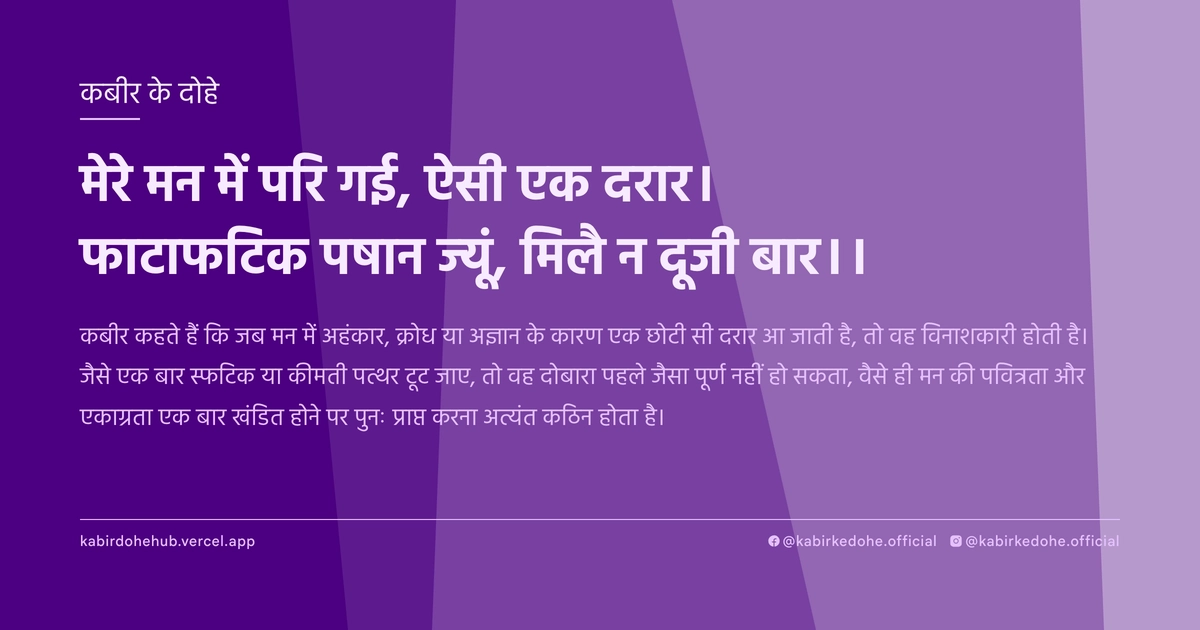
मेरे मन में परि गई, ऐसी एक दरार।
फाटाफटिक पषान ज्यूं, मिलै न दूजी बार।।
Mere man mein pari gai, aisi ek darar. Phataphatik pashan jyun, milai na dooji baar.
इस पृष्ठ पर इस कबीर दोहे का अर्थ (meaning), हिंदी व्याख्या और अंग्रेज़ी अनुवाद, दार्शनिक विश्लेषण और व्यावहारिक जीवन सीख दी गई है। यह दोहा आत्मनिरीक्षण (Self-introspection) विषय से जुड़ा है — Kabir doha meaning and explanation in Hindi and English.
अर्थ (Meaning):
कबीर कहते हैं कि जब मन में अहंकार, क्रोध या अज्ञान के कारण एक छोटी सी दरार आ जाती है, तो वह विनाशकारी होती है। जैसे एक बार स्फटिक या कीमती पत्थर टूट जाए, तो वह दोबारा पहले जैसा पूर्ण नहीं हो सकता, वैसे ही मन की पवित्रता और एकाग्रता एक बार खंडित होने पर पुनः प्राप्त करना अत्यंत कठिन होता है।
Kabir warns that once a crack of ego, anger, or ignorance enters the mind, it becomes catastrophic. Just as a crystal or a precious stone, once shattered, can never be restored to its original seamless wholeness, the purity and singular focus of the mind, once fractured, are nearly impossible to regain in their pristine state.
व्याख्या (Interpretation):
यहाँ 'दरार' केवल एक भौतिक क्षति नहीं, बल्कि चेतना का विखंडन है। कबीर स्फटिक (Phatik) का उदाहरण देते हैं जो अपनी पारदर्शिता और शुद्धता के लिए जाना जाता है। जब साधक 'अहं' (Ego) के वशीभूत होकर द्वैत में गिरता है, तो उसकी आत्मा का परमात्मा के साथ जो अभेद संबंध था, वह टूट जाता है। यह निरगुण भक्ति का संकेत है जहाँ मन को एक अखंड ज्योति की तरह होना चाहिए। माया का प्रभाव मन में संदेह और मोह की दरारें पैदा करता है, जिससे आत्मा और ब्रह्म की एकता (Advaita) बाधित होती है। यह विरोधाभास है कि जिस मन को हम सुधारने की कोशिश करते हैं, वह वास्तव में केवल शुद्ध होने की प्रतीक्षा कर रहा है, लेकिन एक बार जब यह सांसारिक वासनाओं से खंडित होता है, तो इसकी मूल अखंडता खो जाती है।
Here, the 'crack' is not a physical flaw but a fragmentation of consciousness. Kabir uses the metaphor of the 'Phatik' (quartz crystal), renowned for its transparency and purity. When a seeker falls into duality under the influence of 'Ahankar' (ego), the seamless bond between the Atman and the Paramatman is severed. This aligns with Nirgun Bhakti, where the mind must remain a singular, undivided flame. Maya introduces cracks of doubt and attachment, disrupting the non-duality (Advaita) of the soul and the Absolute. The central paradox lies in the fact that while we strive to 'fix' the mind, it is actually the original wholeness that is lost; once the mind is fractured by worldly desires, its primordial integrity is compromised.
दार्शनिक विश्लेषण (Philosophical Analysis):
कबीर का यह दोहा उनके समय के धार्मिक पाखंड और बाहरी कर्मकांडों के प्रति एक तीखा प्रहार है। वे बताते हैं कि बाहरी पूजा-पाठ से अधिक महत्वपूर्ण मन की आंतरिक स्थिति है। यदि मन में द्वेष या अहंकार की एक भी दरार है, तो हज़ारों तीर्थयात्राएं व्यर्थ हैं। यह विचार अद्वैत वेदांत के करीब है, जहाँ अज्ञान (Avidya) को ही एकमात्र बाधा माना गया है। अज्ञान वह दरार है जो हमें यह विश्वास दिलाती है कि हम ईश्वर से अलग हैं।
सूफी मत के 'फना' (अहंकार का विनाश) के सिद्धांत से जोड़कर देखें तो, जब तक 'मैं' की दरार मौजूद है, तब तक 'वह' (ईश्वर) का अनुभव नहीं हो सकता। कबीर का दर्शन यह है कि मन की शुद्धि कोई क्रमिक प्रक्रिया नहीं, बल्कि एक पूर्ण समर्पण है। वे चेतावनी देते हैं कि एक बार जब मनुष्य भौतिक सुखों और अहंकार के जाल में फंसकर अपनी आध्यात्मिक दृष्टि खो देता है, तो वह वापसी की यात्रा अत्यंत कठिन हो जाती है।
ऐतिहासिक रूप से, कबीर ने जाति और धर्म के भेदों को इसी 'दरार' के रूप में देखा। समाज को बांटने वाली दीवारें वास्तव में मन की दरारें ही थीं। वे तर्क देते हैं कि सत्य अखंड है, और जो इसे टुकड़ों में ढूंढता है, वह कभी सत्य तक नहीं पहुँच सकता। यह मनोवैज्ञानिक रूपांतरण की मांग करता है जहाँ व्यक्ति अपनी पहचान को सामाजिक लेबल से हटाकर सार्वभौमिक चेतना में विलीन करे।
अक्सर लोग इस दोहे को केवल 'सावधानी' के रूप में लेते हैं, लेकिन इसका गहरा अर्थ 'सतर्कता' (Mindfulness) है। यह उस क्षण की बात करता है जब एक छोटा सा विचार—जैसे कि 'मैं श्रेष्ठ हूँ'—पूरे आध्यात्मिक ढांचे को ढहा सकता है। यह अहंकार की सूक्ष्मता को दर्शाता है; अहंकार कोई विशाल पर्वत नहीं, बल्कि एक सूक्ष्म दरार है जो धीरे-धीरे पूरे अस्तित्व को लील लेती है।
अंततः, कबीर यह समझाते हैं कि आत्मा का स्वभाव अखंडता है। जब हम स्वयं को खंडित महसूस करते हैं, तो हम वास्तव में माया के भ्रम में होते हैं। इस दरार को भरने का एकमात्र तरीका है 'शून्य' में विलीन होना, जहाँ न कोई दरार हो और न ही कोई पत्थर, केवल एक अनंत प्रकाश शेष रहे।
This couplet is a sharp critique of the religious hypocrisy and external ritualism prevalent during Kabir's era. He asserts that the internal state of the mind is far more critical than outward displays of piety. If a single crack of malice or ego exists within, thousands of pilgrimages remain futile. This resonates with Advaita Vedanta, where ignorance (Avidya) is viewed as the primary obstacle; ignorance is the very 'crack' that convinces us we are separate from the Divine.
Connecting this to the Sufi concept of 'Fana' (annihilation of the self), the experience of the Divine is impossible as long as the crack of 'I-ness' persists. Kabir's philosophy suggests that the purification of the mind is not a gradual process but a total surrender. He warns that once a human loses their spiritual vision by becoming entangled in material pleasures and ego, the journey back to wholeness becomes excruciatingly difficult.
Historically, Kabir viewed the divisions of caste and creed as manifestations of this internal 'crack.' The walls dividing society were merely reflections of the fragmented mind. He argued that Truth is indivisible, and those seeking it in fragments will never find it. This demands a psychological transformation where one shifts identity from social labels to universal consciousness.
Common literalist interpretations view this as a mere warning, but it is actually a lesson in profound Mindfulness. It speaks to the precise moment when a subtle thought—such as 'I am superior'—can collapse an entire spiritual edifice. It highlights the subtlety of the ego; the ego is not a mountain, but a microscopic fissure that slowly consumes the entire existence.
Ultimately, Kabir explains that the nature of the Soul is wholeness. When we feel fragmented, we are merely under the illusion of Maya. The only way to mend this crack is to merge into the 'Shunya' (Void), where neither the crack nor the stone exists, leaving only an infinite, undivided light.
मूल संदेश (Core Message):
- अहंकार एक सूक्ष्म दरार है जो आध्यात्मिक पूर्णता को नष्ट कर देती है।
- बाहरी शुद्धता व्यर्थ है यदि आंतरिक चेतना खंडित है।
- सत्य अखंड है; इसे टुकड़ों या श्रेणियों में नहीं खोजा जा सकता।
- अहंकार का विसर्जन ही आत्मा की मूल अखंडता को पुनः प्राप्त करने का मार्ग है।
- जागरूकता ही वह गोंद है जो मन की दरारों को भर सकती है।
- Ego is a subtle fissure that destroys spiritual wholeness.
- External purity is futile if the internal consciousness is fragmented.
- Truth is indivisible; it cannot be sought in fragments or categories.
- The dissolution of the 'I' is the only path to reclaiming the soul's original integrity.
- Mindfulness is the only adhesive capable of sealing the cracks of the mind.
व्यावहारिक उदाहरण (Practical Example):
एक समय की बात है, वाराणसी के घाटों पर माधव नाम का एक अत्यंत कुशल मूर्तिकार रहता था। माधव अपनी मूर्तियों की बारीकियों के लिए प्रसिद्ध था, लेकिन उसके भीतर एक सूक्ष्म अहंकार था कि उसके जैसा कलाकार पूरे शहर में कोई नहीं है। वह अपनी कला को ईश्वर की सेवा नहीं, बल्कि अपनी श्रेष्ठता का प्रमाण मानता था।
एक दिन, एक वृद्ध संन्यासी उसके पास आए और उसकी सबसे सुंदर संगमरमर की मूर्ति को देखा। संन्यासी ने मुस्कुराते हुए कहा, 'कला अद्भुत है, लेकिन कलाकार के मन में एक दरार है।' माधव को यह बात चुभी। उसने क्रोध में आकर कहा, 'मेरी कला में कोई कमी नहीं है, आप मेरी श्रेष्ठता को क्यों नहीं देख पा रहे?'
उस रात, माधव ने एक अत्यंत दुर्लभ और महंगे स्फटिक पत्थर पर काम करना शुरू किया। वह इतना उत्साहित था कि उसने अपनी एकाग्रता खो दी और एक क्षण के लिए सोचा कि इस मूर्ति को बनाकर वह दुनिया का सबसे महान कलाकार कहलाएगा। इसी अहंकार के क्षण में, उसका हाथ फिसला और उस बेशकीमती पत्थर पर एक महीन सी दरार आ गई।
माधव घबरा गया। उसने दिन-रात एक कर दिया उस दरार को भरने के लिए। उसने दुनिया के सबसे महंगे गोंद, मोम और रसायनों का उपयोग किया। उसने पत्थर को घिसा, पॉलिश किया, लेकिन वह दरार नहीं गई। बल्कि, उसे ठीक करने की कोशिश में पत्थर और अधिक खंडित होता गया।
हफ्तों तक माधव उस पत्थर को देखता रहा। उसे एहसास हुआ कि वह दरार पत्थर में नहीं, बल्कि उसके उस अहंकार में थी जिसने उसे यह सोचने पर मजबूर किया कि वह पत्थर का स्वामी है। वह दरार उसके विश्वास की थी, जो अब टूट चुकी थी।
वह वापस उसी संन्यासी के पास गया और उनके चरणों में गिर पड़ा। उसने स्वीकार किया कि उसकी कला उसकी अपनी पहचान बनाने का साधन बन गई थी, न कि सत्य की खोज का। संन्यासी ने कहा, 'जब तक तुम खुद को 'महान' मानते रहोगे, तुम्हारी आत्मा में वह दरार रहेगी। जिस दिन तुम खुद को शून्य मानोगे, वह दरार गायब हो जाएगी।'
माधव ने अपनी सारी उपलब्धियों का मोह छोड़ दिया। उसने अब मूर्तियों को अपनी प्रसिद्धि के लिए नहीं, बल्कि निस्वार्थ भाव से बनाना शुरू किया। उसने सीखा कि पूर्णता बाहरी चमक में नहीं, बल्कि आंतरिक अखंडता में है।
वर्षों बाद, माधव की मूर्तियाँ और भी अधिक जीवंत हो गईं, क्योंकि अब उन्हें बनाने वाला हाथ अहंकार से नहीं, बल्कि करुणा और समर्पण से संचालित था। उसने जान लिया था कि मन की एक छोटी सी दरार पूरे जीवन की दिशा बदल सकती है, और उसे भरने का एकमात्र तरीका 'मैं' का विसर्जन है।
Once, on the ghats of Varanasi, lived a master sculptor named Madhav. He was renowned for the intricate detail of his work, but within him resided a subtle ego—a belief that no artist in the city could match his skill. He viewed his art not as service to the Divine, but as a testament to his own superiority.
One day, an elderly monk visited and gazed upon Madhav's most beautiful marble sculpture. The monk smiled and remarked, 'The art is wonderful, but there is a crack in the artist's mind.' This stung Madhav. He replied angrily, 'There is no flaw in my art; why can you not see my greatness?'
That night, Madhav began working on an extremely rare and expensive piece of quartz crystal. In his excitement, he lost his mindfulness, thinking for a moment that this piece would cement his status as the greatest artist in the world. In that fleeting moment of ego, his hand slipped, and a hairline crack appeared in the precious stone.
Madhav panicked. He spent days and nights trying to mend that crack. He used the most expensive glues, waxes, and chemicals available. He sanded it and polished it, but the crack remained. In fact, the more he tried to 'fix' it, the more the stone fragmented.
For weeks, Madhav stared at the stone. He eventually realized that the crack was not in the crystal, but in the ego that made him believe he owned the stone. The crack was in his own faith, which had now shattered.
He returned to the monk and fell at his feet. He confessed that his art had become a tool for building his identity rather than a path to Truth. The monk replied, 'As long as you consider yourself "great," that crack will remain in your soul. The day you perceive yourself as zero, the crack will vanish.'
Madhav let go of the desire for acclaim. He began sculpting not for fame, but with selfless devotion. He learned that perfection does not lie in external luster, but in internal integrity.
Years later, Madhav's sculptures became even more lifelike, for the hand that carved them was no longer driven by ego, but by compassion and surrender. He understood that a tiny crack in the mind could alter the course of a lifetime, and the only way to heal it was the dissolution of the 'I'.
अभ्यास मार्गदर्शन (Practice Guidance):
- दैनिक आत्म-निरीक्षण: प्रतिदिन 15 मिनट मौन बैठें और देखें कि दिन भर में किस क्षण आपके भीतर 'अहंकार' या 'श्रेष्ठता' का भाव आया। उस सूक्ष्म दरार को पहचानें।
- साक्षी भाव का अभ्यास: जब क्रोध या ईर्ष्या महसूस हो, तो प्रतिक्रिया करने के बजाय स्वयं को एक तीसरे व्यक्ति की तरह देखें। पूछें, 'यह दरार कहाँ से आई?'
- सेवा बिना अपेक्षा: सप्ताह में एक बार ऐसा कार्य करें जिसके लिए आपको कोई श्रेय न मिले और जिसे आप गुप्त रखें। यह अहंकार की दरार को भरने का सबसे प्रभावी तरीका है।
- डायरी लेखन: उन घटनाओं को लिखें जहाँ आपने अपनी गलती स्वीकार करने के बजाय उसे छिपाने की कोशिश की। विश्लेषण करें कि उस समय आपके मन में कौन सा भ्रम था।
- डायग्नोस्टिक चेकलिस्ट: क्या मैं दूसरों की सफलता से विचलित होता हूँ? क्या मैं अपनी उपलब्धियों का बार-बार जिक्र करता हूँ? क्या मैं दूसरों को सुधारने की तीव्र इच्छा रखता हूँ? यदि हाँ, तो मन में दरार मौजूद है।
- Daily Self-Inquiry: Sit in silence for 15 minutes daily and observe the exact moments when feelings of 'ego' or 'superiority' surfaced. Identify that subtle crack.
- Practice of the Witness: When anger or jealousy arises, instead of reacting, observe yourself as a third party. Ask, 'Where did this crack originate?'
- Service Without Expectation: Once a week, perform an act of kindness for which you receive no credit and keep it secret. This is the most effective way to seal the cracks of ego.
- Journaling: Record instances where you tried to hide a mistake rather than admitting it. Analyze the specific illusion that governed your mind at that moment.
- Diagnostic Checklist: Do I feel unsettled by others' success? Do I frequently mention my own achievements? Do I have an intense urge to 'correct' others? If yes, a crack exists in the mind.
चिंतन प्रश्न (Reflection Questions):
- मेरी वह कौन सी 'छवि' है जिसे मैं दुनिया के सामने बनाए रखने के लिए अपने आंतरिक सत्य का गला घोंटता हूँ?
- क्या मेरी डिजिटल पहचान (सोशल मीडिया) मेरे वास्तविक स्वरूप और मेरी आत्मा के बीच एक नई दरार पैदा कर रही है?
- मैं किन लोगों को अपने से 'कम' मानता हूँ, और यह धारणा मेरे अपने विकास को कैसे रोक रही है?
- यदि आज मेरी सारी उपलब्धियाँ और पद छीन लिए जाएँ, तो क्या मेरे भीतर कुछ ऐसा बचेगा जो अखंड और अविभाज्य है?
- मेरे जीवन का वह कौन सा 'टूटा हुआ हिस्सा' है जिसे मैं ठीक करने की कोशिश कर रहा हूँ, जबकि वास्तव में मुझे उसे स्वीकार कर विलीन होना चाहिए?
- What is the 'image' I project to the world that forces me to stifle my internal truth?
- Is my digital identity (social media) creating a new crack between my projected self and my authentic soul?
- Whom do I perceive as 'inferior,' and how is this perception hindering my own spiritual evolution?
- If all my achievements and titles were stripped away today, would there be anything left within me that is whole and indivisible?
- Which 'broken part' of my life am I desperately trying to fix, when I should instead be accepting and dissolving it into the Absolute?