
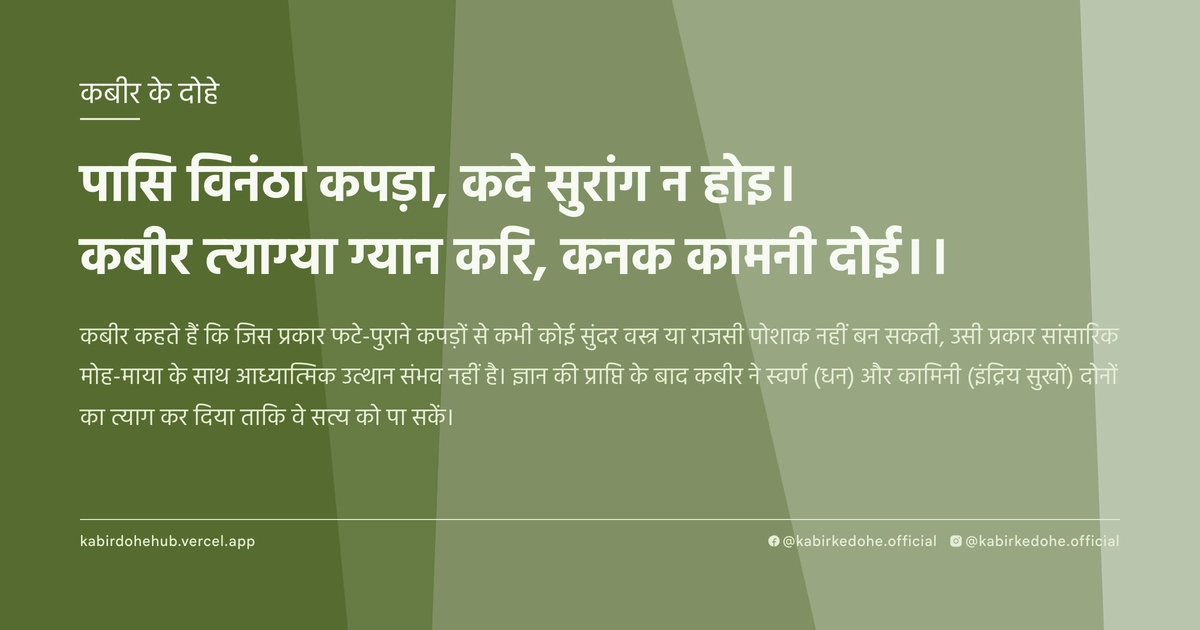
पासि विनंठा कपड़ा, कदे सुरांग न होइ।
कबीर त्याग्या ग्यान करि, कनक कामनी दोई।।
Paasi vinantha kapda, kade surang na hoye. Kabir tyagya gyan kari, kanak kaamni doee.
इस पृष्ठ पर इस कबीर दोहे का अर्थ (meaning), हिंदी व्याख्या और अंग्रेज़ी अनुवाद, दार्शनिक विश्लेषण और व्यावहारिक जीवन सीख दी गई है। यह दोहा वैराग्य (Detachment) विषय से जुड़ा है — Kabir doha meaning and explanation in Hindi and English.
अर्थ (Meaning):
कबीर कहते हैं कि जिस प्रकार फटे-पुराने कपड़ों से कभी कोई सुंदर वस्त्र या राजसी पोशाक नहीं बन सकती, उसी प्रकार सांसारिक मोह-माया के साथ आध्यात्मिक उत्थान संभव नहीं है। ज्ञान की प्राप्ति के बाद कबीर ने स्वर्ण (धन) और कामिनी (इंद्रिय सुखों) दोनों का त्याग कर दिया ताकि वे सत्य को पा सकें।
Kabir asserts that just as tattered, worn-out rags can never be transformed into a royal garment, spiritual transcendence is impossible while clinging to worldly attachments. Upon attaining true gnosis, Kabir renounced both gold (material wealth) and sensual pleasures, recognizing them as barriers to the ultimate realization of the Divine.
व्याख्या (Interpretation):
इस दोहे का शाब्दिक अर्थ भौतिक त्याग से है, परंतु इसका गहरा आध्यात्मिक संकेत 'अहंकार' के विसर्जन की ओर है। 'पासि विनंठा कपड़ा' यहाँ उस पुराने मानसिक ढांचे और संकीर्ण सोच का प्रतीक है जिसे हम ढोते रहते हैं। जब तक हम पुराने संस्कारों और वासनाओं के मोह में रहते हैं, हम 'सुरांग' यानी दिव्य प्रकाश या मोक्ष को प्राप्त नहीं कर सकते। यह निरगुण भक्ति का मूल सिद्धांत है जहाँ ईश्वर किसी बाहरी आडंबर में नहीं, बल्कि आंतरिक शुद्धि में बसता है। माया (कनक और कामिनी) केवल भ्रम है जो आत्मा को ब्रह्म से अलग करता है। अद्वैत वेदांत के अनुसार, जब तक द्वैत (मैं और मेरा) बना रहता है, तब तक सत्य का अनुभव असंभव है। कबीर यहाँ विरोधाभास प्रस्तुत करते हैं कि त्याग ही वास्तव में सबसे बड़ी प्राप्ति है।
Literally, this verse speaks of renunciation, but metaphorically, it addresses the dissolution of the ego. The 'tattered clothes' symbolize the obsolete mental constructs and conditioned patterns of the human psyche. As long as one clings to these worn-out attachments, the 'surang'—the divine radiance or liberation—remains unattainable. This aligns with Nirgun Bhakti, where the formless Divine is found not in external rituals, but in internal purification. Maya, represented by 'Kanak' (gold) and 'Kamini' (sensual desire), acts as a veil obscuring the non-duality of Atman and Brahman. In the framework of Advaita Vedanta, the illusion of separation must be incinerated to realize the Absolute. Kabir presents a spiritual paradox: only through the act of letting go does one truly possess the Infinite.
दार्शनिक विश्लेषण (Philosophical Analysis):
कबीर का यह दृष्टिकोण उनके समय के कट्टरपंथी धार्मिक वातावरण के विरुद्ध एक सशक्त प्रतिक्रिया था। उन्होंने देखा कि लोग तीर्थयात्राओं और बाहरी दिखावे में उलझे थे, जबकि उनका हृदय वासनाओं से भरा था। कबीर का 'त्याग' केवल भौतिक वस्तुओं का नहीं, बल्कि उस 'मानसिक पहचान' का है जो हमें दूसरों से श्रेष्ठ या अलग महसूस कराती है। यह सूफी मत के 'फना' (अहंकार का विनाश) के विचार से मिलता-जुलता है, जहाँ साधक स्वयं को ईश्वर की इच्छा में विलीन कर देता है।
वेदांत के परिप्रेक्ष्य में, कनक (धन) और कामिनी (काम) केवल इंद्रियजन्य सुख हैं जो क्षणभंगुर हैं। कबीर तर्क देते हैं कि जो चीज़ नष्ट होने वाली है, उसके प्रति आसक्ति केवल दुख का कारण बनती है। उन्होंने जाति और वर्ण के भेदभाव को भी इसी 'पुराने कपड़े' की तरह देखा, जिसे उतार फेंकना आवश्यक है ताकि मानवता का वास्तविक स्वरूप उभर सके।
यहाँ 'ज्ञान' का अर्थ किताबी शिक्षा नहीं, बल्कि 'अपरोक्षानुभूति' है—सत्य का प्रत्यक्ष अनुभव। जब यह ज्ञान घटित होता है, तो त्याग बोझ नहीं लगता, बल्कि एक स्वाभाविक आवश्यकता बन जाता है। यह मनोवैज्ञानिक रूपांतरण है जहाँ व्यक्ति बाहरी सत्यापन (validation) की खोज बंद कर देता है।
कबीर का यह दर्शन हमें सिखाता है कि आध्यात्मिक प्रगति के लिए 'खाली होना' आवश्यक है। यदि बर्तन पहले से ही गंदे पानी से भरा है, तो उसमें अमृत नहीं डाला जा सकता। अतः, पुराने संस्कारों का विसर्जन अनिवार्य है।
अंततः, यह दोहा हमें चेतावनी देता है कि हम अपनी पहचान को अपनी संपत्ति या संबंधों से न जोड़ें। जब हम स्वयं को इन बाहरी आवरणों से अलग देखते हैं, तब हम उस शाश्वत सत्य के करीब पहुँचते हैं जो समय और स्थान से परे है।
Kabir's perspective serves as a potent critique of the rigid religious orthodoxy of his era. He observed a society obsessed with external rituals and pilgrimages while the heart remained enslaved to primal desires. His concept of 'renunciation' is not merely the abandonment of physical objects, but the shedding of the 'mental identity' that fosters a sense of superiority or separation. This resonates deeply with the Sufi concept of 'Fana'—the annihilation of the self in the Divine Will.
From the lens of Advaita Vedanta, 'Kanak' (wealth) and 'Kamini' (lust) are transient sensory gratifications. Kabir argues that attachment to the ephemeral is the primary source of human suffering. He viewed caste and creed as 'tattered clothes'—artificial social constructs that must be discarded to reveal the inherent purity of the human soul.
Crucially, 'Gyan' (knowledge) here does not refer to scholarly erudition, but to 'Aparokshanubhuti'—the direct, intuitive experience of Truth. When this realization occurs, renunciation is no longer a forced sacrifice but a spontaneous necessity. It is a psychological metamorphosis where the seeker ceases to seek external validation.
Kabir's philosophy emphasizes the necessity of 'emptiness' for spiritual growth. If a vessel is filled with stagnant water, it cannot hold the nectar of immortality. Thus, the purging of old conditioning is a prerequisite for enlightenment.
Ultimately, this verse warns against equating one's identity with possessions or relationships. By detaching from these external veneers, the individual aligns with the Eternal Truth that transcends the limitations of time and space.
मूल संदेश (Core Message):
- बाहरी चमक अक्सर आंतरिक अंधकार को छिपाने का एक मुखौटा होती है।
- सच्चा ज्ञान वह है जो हमें वस्तुओं के मोह से मुक्त करे।
- अहंकार का त्याग ही दिव्य चेतना के द्वार खोलता है।
- भौतिक समृद्धि आत्मा की प्यास नहीं बुझा सकती।
- शुद्धता बाहरी वस्त्रों में नहीं, बल्कि आंतरिक वैराग्य में है।
- जब 'मैं' मिटता है, तभी 'सत्य' प्रकट होता है।
- External brilliance is often a mask concealing internal darkness.
- True gnosis is that which liberates us from the grip of possessions.
- The surrender of the ego is the only key to divine consciousness.
- Material abundance cannot quench the spiritual thirst of the soul.
- Purity resides not in outward attire, but in inner detachment.
- Only when the 'I' dissolves does the 'Truth' manifest.
व्यावहारिक उदाहरण (Practical Example):
वाराणसी के घाटों पर रहने वाले एक वृद्ध बुनकर, माधव, की कहानी है। माधव अपने काम में निपुण थे, लेकिन उनका मन हमेशा इस चिंता में रहता था कि उनके पास और अधिक रेशम और सोना हो ताकि वे शहर के सबसे अमीर बुनकर बन सकें। वे दिन-रात केवल लाभ और प्रतिष्ठा के बारे में सोचते थे, जिससे उनका स्वभाव चिड़चिड़ा और अहंकारी हो गया था।
एक दिन माधव ने एक फकीर को देखा जो फटे कपड़ों में था, लेकिन उसके चेहरे पर एक ऐसी शांति थी जो माधव ने अपने जीवन के सबसे महंगे कपड़ों में भी महसूस नहीं की थी। माधव ने उनसे पूछा, "आप इतने अभाव में भी इतने प्रसन्न कैसे हैं?"
फकीर ने मुस्कुराते हुए माधव के हाथ में मौजूद एक पुराने, मैले कपड़े के टुकड़े की ओर इशारा किया और कहा, "इस फटे कपड़े को देखो। क्या तुम इसे धोकर या रंगकर कभी राजसी रेशम बना सकते हो? नहीं। ठीक वैसे ही, तुम्हारा मन लालच और अहंकार के पुराने कपड़ों से ढका है। जब तक तुम इस 'पुराने कपड़े' को नहीं उतारोगे, तब तक तुम्हारे भीतर की शांति कभी नहीं चमक पाएगी।"
माधव को यह बात गहरे तक लगी। उन्हें अहसास हुआ कि उनकी धन की लालसा वास्तव में उनके आंतरिक खालीपन को भरने की एक नाकाम कोशिश थी। उन्होंने महसूस किया कि वे अपनी पहचान अपने कपड़ों और धन से जोड़ रहे थे, जबकि उनकी आत्मा इन सबसे अलग थी।
अगले कुछ महीनों में, माधव ने अपना जीवन बदल दिया। उन्होंने अपनी कमाई का एक बड़ा हिस्सा गरीब बच्चों की शिक्षा में लगाना शुरू किया। उन्होंने रेशम के महंगे कपड़ों के बजाय सादगी को अपनाया।
जैसे-जैसे उन्होंने भौतिक वस्तुओं के प्रति अपना मोह कम किया, उनका मानसिक तनाव गायब होने लगा। वे अब केवल लाभ के लिए नहीं, बल्कि आनंद के लिए बुनने लगे।
उनके काम में अब एक नई गहराई और पवित्रता आ गई थी। लोग अब उनके धन के कारण नहीं, बल्कि उनकी आंतरिक शांति और करुणा के कारण उनके पास आने लगे।
माधव ने पाया कि जिस 'सुरांग' (दिव्य प्रकाश) की तलाश वे धन में कर रहे थे, वह वास्तव में उनके अहंकार के त्याग में छिपा था। उन्होंने जान लिया कि असली अमीरी वह है जहाँ कुछ भी खोने का डर न रहे।
अंततः, माधव एक ऐसे इंसान बन गए जिन्होंने भौतिकता के फटे कपड़ों को त्यागकर आत्मा के दिव्य वस्त्र धारण कर लिए थे।
Consider the story of Madhav, an elderly weaver living on the ghats of Varanasi. Madhav was a master of his craft, yet his mind was perpetually consumed by the desire for more silk and gold, hoping to become the wealthiest weaver in the city. His obsession with profit and prestige rendered him irritable and arrogant.
One day, Madhav encountered a wandering dervish clad in tattered rags, yet possessing a serenity that Madhav had never felt, even in his most expensive attire. Madhav asked, "How can you be so content in such extreme poverty?"
The dervish smiled and pointed to a piece of old, soiled cloth in Madhav's hand. "Look at this rag," he said. "Can you ever wash or dye this into royal silk? No. Similarly, your mind is draped in the tattered clothes of greed and ego. Until you shed this 'old garment,' the inner light of peace will never shine through."
This realization struck a chord deep within Madhav. He understood that his craving for wealth was merely a futile attempt to fill an internal void. He had been equating his identity with his possessions, oblivious to the fact that his soul was entirely separate from them.
Over the following months, Madhav transformed his life. He began dedicating a significant portion of his earnings to the education of underprivileged children and embraced a life of profound simplicity.
As he loosened his grip on material attachments, his chronic stress vanished. He stopped weaving for profit and started weaving for joy.
His work acquired a new depth and sanctity. People began visiting him not for his wealth, but for the aura of peace and compassion he radiated.
Madhav discovered that the 'surang' (divine light) he had sought in gold was actually hidden in the act of relinquishing his ego.
He realized that true abundance is the state where there is no longer any fear of loss.
Ultimately, Madhav became a man who had discarded the tattered rags of materialism to don the divine garment of the soul.
अभ्यास मार्गदर्शन (Practice Guidance):
- प्रतिदिन 20 मिनट मौन ध्यान करें, जहाँ आप अपने विचारों को 'पुराने कपड़ों' की तरह देखें जिन्हें आप धीरे-धीरे उतार रहे हैं।
- एक 'मोह-डायरी' बनाएँ: उन तीन चीजों की सूची लिखें जिनसे आप सबसे अधिक जुड़े हैं और विश्लेषण करें कि यदि वे कल चले जाएँ, तो आपकी पहचान पर क्या प्रभाव पड़ेगा।
- व्यवहार परिवर्तन: सप्ताह में एक दिन 'अपरिग्रह' का अभ्यास करें—ऐसी किसी वस्तु का दान करें जिसकी आपको आवश्यकता नहीं है, लेकिन जिसे आप केवल संग्रह के लिए रखे हुए थे।
- निदान चेकलिस्ट: क्या मैं अपनी सफलता को दूसरों की तुलना से माप रहा हूँ? क्या मैं अपनी भौतिक वस्तुओं के खोने के डर से ग्रस्त हूँ? यदि हाँ, तो आप अभी भी 'पुराने कपड़ों' में हैं।
- Practice 20 minutes of silent meditation daily, visualizing your intrusive thoughts as 'tattered clothes' that you are consciously shedding.
- Maintain an 'Attachment Journal': List three things you are most clinging to and analyze how your identity would be affected if they were gone tomorrow.
- Behavioral Shift: Practice 'Aparigraha' (non-possessiveness) once a week—donate an item you don't need but have kept solely for the sake of accumulation.
- Diagnostic Checklist: Am I measuring my success by comparing myself to others? Am I plagued by the fear of losing my material possessions? If yes, you are still wearing the 'tattered clothes' of ego.
चिंतन प्रश्न (Reflection Questions):
- यदि आपकी सारी संपत्ति और सामाजिक पद छीन लिए जाएँ, तो आपके पास ऐसा क्या बचेगा जिसे आप गर्व से 'मैं' कह सकें?
- आपकी कौन सी ऐसी आदतें या विचार हैं जो 'पुराने कपड़ों' की तरह आपकी आत्मा की चमक को ढके हुए हैं?
- क्या आप वास्तव में स्वतंत्र हैं, या आपकी स्वतंत्रता केवल आपकी पसंद के बंधनों का एक भ्रम है?
- डिजिटल युग में, आपकी 'ऑनलाइन छवि' वह मुखौटा है या वह सत्य है जिसे आप दुनिया को दिखाना चाहते हैं?
- क्या आप प्रेम करते हैं, या आप केवल उस भावना से प्रेम करते हैं जो आपको कोई और प्रेम करता हुआ महसूस कराती है?
- If all your wealth and social status were stripped away, what would remain that you could proudly call 'I'?
- Which habits or thought patterns are like 'tattered clothes' obscuring the radiance of your soul?
- Are you truly free, or is your freedom merely an illusion created by the choice of your chains?
- In the digital age, is your 'online persona' a mask or the truth you wish the world to see?
- Do you actually love, or do you merely love the feeling of being loved by another?