
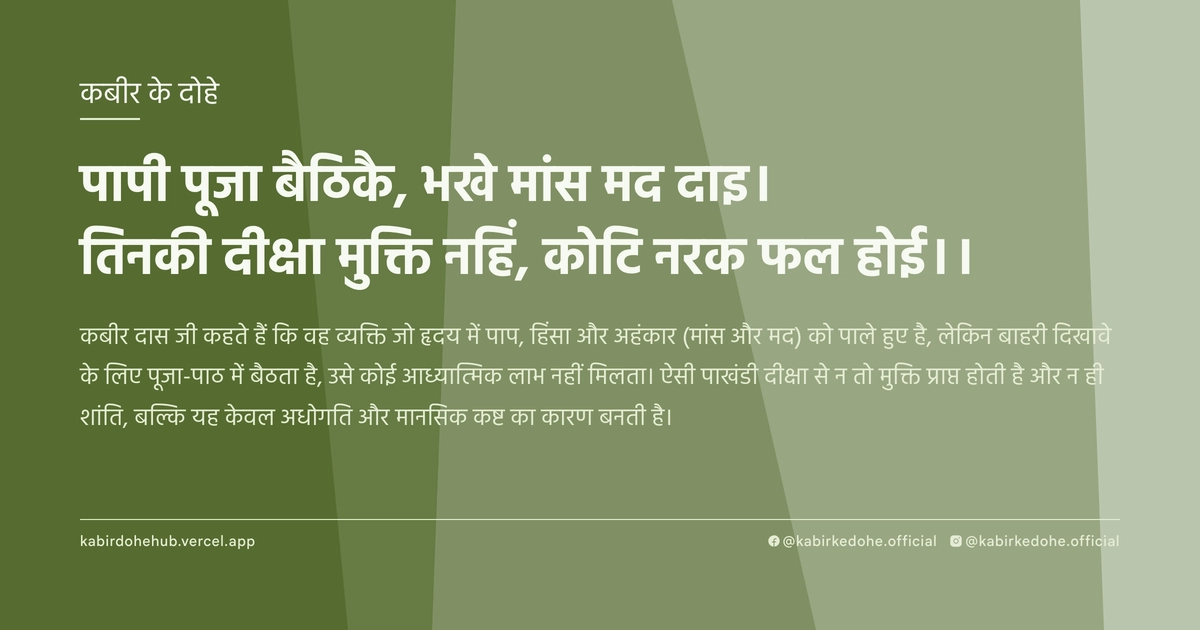
पापी पूजा बैठिकै, भखे मांस मद दाइ।
तिनकी दीक्षा मुक्ति नहिं, कोटि नरक फल होई।।
Paapi pooja baithikai, bhakhe maans mad daai. Tinki diksha mukti nahin, koti narak phal hoi.
इस पृष्ठ पर इस कबीर दोहे का अर्थ (meaning), हिंदी व्याख्या और अंग्रेज़ी अनुवाद, दार्शनिक विश्लेषण और व्यावहारिक जीवन सीख दी गई है। यह दोहा धार्मिक पाखंड (Religious Hypocrisy) विषय से जुड़ा है — Kabir doha meaning and explanation in Hindi and English.
अर्थ (Meaning):
कबीर दास जी कहते हैं कि वह व्यक्ति जो हृदय में पाप, हिंसा और अहंकार (मांस और मद) को पाले हुए है, लेकिन बाहरी दिखावे के लिए पूजा-पाठ में बैठता है, उसे कोई आध्यात्मिक लाभ नहीं मिलता। ऐसी पाखंडी दीक्षा से न तो मुक्ति प्राप्त होती है और न ही शांति, बल्कि यह केवल अधोगति और मानसिक कष्ट का कारण बनती है।
Kabir asserts that a person who harbors sin, violence, and arrogance—symbolized by the craving for flesh and intoxication of ego—while pretending to be pious through ritual worship, achieves no spiritual liberation. Such hypocritical initiation does not lead to salvation; instead, it results in profound spiritual decay and the suffering of a thousand hells.
व्याख्या (Interpretation):
इस दोहे का शाब्दिक अर्थ है कि बाहरी कर्मकांड तब तक व्यर्थ हैं जब तक आंतरिक शुद्धि न हो। यहाँ "मांस" और "मद" केवल भोजन या शराब नहीं, बल्कि क्रूरता और अहंकार के प्रतीक हैं। कबीर निर्गुण भक्ति के माध्यम से समझाते हैं कि ईश्वर मंदिर या मस्जिद में नहीं, बल्कि शुद्ध अंतःकरण में बसते हैं। जब एक व्यक्ति भीतर से हिंसक है और बाहर से भक्त होने का ढोंग करता है, तो वह माया के सबसे गहरे जाल में फंसा होता है। यह द्वैत—बाहरी पवित्रता बनाम आंतरिक अशुद्धि—आत्मा को सत्य से दूर ले जाता है। मुक्ति केवल बाहरी दीक्षा से नहीं, बल्कि अहंकार के विसर्जन और करुणा के उदय से संभव है। अंततः, यह दोहा यह स्थापित करता है कि बिना नैतिक आधार के कोई भी आध्यात्मिक अभ्यास केवल एक मानसिक बोझ है।
Literally, the verse argues that external rituals are futile without internal purification. Here, "meat" and "intoxication" are metaphors for cruelty and the arrogance of the ego. Through the lens of Nirgun Bhakti, Kabir explains that the Divine resides not in temples or mosques, but within a purified heart. When an individual remains violent internally while masquerading as a devotee, they are trapped in the deepest layers of Maya (illusion). This duality—outward piety versus inward impurity—distances the Atman from the ultimate Brahman. Liberation is not granted by formal initiation or ritualistic scripts, but by the annihilation of the ego and the birth of universal compassion. Ultimately, the doha establishes that any spiritual practice lacking a foundation of ethics is merely a psychological burden, leading to spiritual stagnation rather than ascent.
दार्शनिक विश्लेषण (Philosophical Analysis):
कबीर का यह प्रहार उनके युग के धार्मिक पाखंड और कर्मकांडीय कट्टरता पर है। उन्होंने देखा कि कैसे लोग जातिगत श्रेष्ठता और बाहरी प्रतीकों (जैसे तिलक, माला या विशेष वस्त्र) का उपयोग करके अपनी आंतरिक बुराइयों को ढंकने का प्रयास करते थे। यह विश्लेषण अद्वैत वेदांत के उस सिद्धांत से मेल खाता है जहाँ अज्ञान (Avidya) को ही सबसे बड़ा बंधन माना गया है। कबीर के अनुसार, जब तक 'मैं' (अहंकार) जीवित है, तब तक कोई भी पूजा केवल अहंकार की तुष्टि है, ईश्वर की प्राप्ति नहीं।
सूफी मत के 'नफ्स' ( lower self) के विचार की तरह, कबीर यहाँ उस निम्न प्रवृत्तियों के विनाश की बात कर रहे हैं जो मनुष्य को पशुता की ओर ले जाती हैं। "मांस और मद" का उल्लेख केवल आहार संबंधी निषेध नहीं है, बल्कि यह उस मानसिक स्थिति का वर्णन है जहाँ मनुष्य दूसरों का शोषण करता है और फिर उस पाप को धोने के लिए पूजा का सहारा लेता है। यह एक मनोवैज्ञानिक विरोधाभास है जहाँ व्यक्ति अपनी ही नजरों में खुद को सही सिद्ध करने के लिए धर्म का उपयोग एक ढाल के रूप में करता है।
भक्ति आंदोलन के भीतर, कबीर ने 'सहज' मार्ग पर जोर दिया। उनके लिए धर्म कोई ऐसी वस्तु नहीं थी जिसे खरीदा जा सके या किसी गुरु से दीक्षा लेकर प्राप्त किया जा सके, बल्कि यह एक निरंतर आंतरिक रूपांतरण की प्रक्रिया थी। वे तर्क देते हैं कि यदि हृदय में करुणा नहीं है, तो मंत्रों का जाप केवल ध्वनि प्रदूषण है। यह दृष्टिकोण उस समय के ब्राह्मणवादी और मौलवी वर्चस्व को चुनौती देता था जो केवल बाहरी नियमों को मोक्ष का मार्ग बताते थे।
दार्शनिक स्तर पर, यह दोहा 'कर्म' और 'भाव' के बीच के अंतर को स्पष्ट करता है। कर्म (Action) यदि भाव (Intention) से शून्य है, तो वह निष्फल है। कबीर यहाँ चेतावनी दे रहे हैं कि पाखंडी व्यक्ति स्वयं को धोखा देता है, और यह आत्म-धोखा ही उसे "कोटि नरक" या मानसिक पीड़ा की ओर ले जाता है। यह नरक कोई भौतिक स्थान नहीं, बल्कि चेतना की वह निम्न अवस्था है जहाँ व्यक्ति सत्य से पूरी तरह कट जाता है।
अंततः, कबीर का संदेश यह है कि सच्ची आध्यात्मिकता का अर्थ है—अपने भीतर के पशु को मारना और मानवता को जगाना। जब तक व्यक्ति दूसरों के प्रति द्वेष रखता है, उसकी सारी प्रार्थनाएं केवल शोर हैं। मुक्ति का मार्ग केवल सत्य, अहिंसा और अहंकार शून्य होने से प्रशस्त होता है, न कि किसी औपचारिक दीक्षा या धार्मिक प्रदर्शन से।
Kabir's critique is a sharp assault on the religious hypocrisy and ritualistic rigidity of his era. He observed how individuals used caste superiority and external symbols—such as tilaks, beads, or specific attire—to mask their internal vices. This analysis aligns with the Advaita Vedanta principle where ignorance (Avidya) is considered the primary bond. According to Kabir, as long as the 'I' (ego) persists, any act of worship is merely a gratification of the ego rather than an attainment of the Divine.
Mirroring the Sufi concept of 'Nafs' (the lower self), Kabir speaks of the necessity to annihilate the base instincts that reduce a human to an animalistic state. The mention of "meat and intoxication" is not merely a dietary prohibition but a description of a psychological state where a person exploits others and then uses ritual worship to cleanse that sin. This creates a psychological paradox where religion is used as a shield to justify one's own righteousness in the eyes of the world while remaining corrupt within.
Within the Bhakti movement, Kabir emphasized the 'Sahaj' path—the natural way. For him, religion was not a commodity to be purchased or a status granted through formal initiation; it was a continuous process of internal transformation. He argues that if the heart lacks compassion, the chanting of mantras is nothing more than sonic pollution. This perspective challenged the Brahmanical and Mullah hegemony of the time, which presented external adherence to rules as the sole gateway to salvation.
On a philosophical level, this doha clarifies the distinction between 'Karma' (Action) and 'Bhava' (Intention). Action, if devoid of pure intention, is fruitless. Kabir warns that the hypocrite deceives themselves, and this self-deception is precisely what leads to "koti narak" or a thousand hells. This hell is not a physical location but a degraded state of consciousness where the individual is completely severed from the Truth.
Ultimately, Kabir's message is that true spirituality means killing the animal within and awakening the human. As long as a person harbors malice toward others, all their prayers are mere noise. The path to liberation is paved only with truth, non-violence, and the voiding of the ego, not through formal initiation or religious performance.
मूल संदेश (Core Message):
- बाहरी आडंबर आंतरिक अशुद्धि को कभी नहीं मिटा सकते।
- अहंकार और क्रूरता के साथ की गई पूजा व्यर्थ है।
- सच्ची दीक्षा केवल हृदय की करुणा और विनम्रता में है।
- धर्म का उपयोग स्वयं को श्रेष्ठ दिखाने के लिए न करें।
- आत्मा की शुद्धि व्यवहार से होती है, कर्मकांड से नहीं।
- अहंकार का विसर्जन ही वास्तविक मोक्ष का एकमात्र मार्ग है।
- External rituals can never erase internal impurity.
- Worship performed alongside arrogance and cruelty is futile.
- True initiation lies only in the heart's compassion and humility.
- Do not use religion as a tool to establish superiority.
- Purification of the soul happens through behavior, not rituals.
- The dissolution of ego is the only true path to liberation.
व्यावहारिक उदाहरण (Practical Example):
वाराणसी के एक पुराने मोहल्ले में माधव नाम का एक व्यक्ति रहता था। वह शहर का सबसे प्रतिष्ठित दानवीर माना जाता था। वह हर सुबह मंदिर जाता, घंटों जाप करता और गरीबों में भोजन बांटता। लोग उसे 'महात्मा' कहकर पुकारते थे। लेकिन माधव का एक काला सच था। वह अपने घर के नौकरों और छोटे व्यापारियों के साथ अत्यंत क्रूर था। वह उन्हें समय पर वेतन नहीं देता था और छोटी सी गलती पर उन्हें गालियां देता और मानसिक रूप से प्रताड़ित करता था।
माधव का मानना था कि उसकी सुबह की पूजा और दान उसके दिन भर के क्रोध और अहंकार को मिटा देते हैं। वह सोचता था कि मंदिर में बिताया गया समय उसे स्वर्ग का टिकट दिला देगा, चाहे वह बाहर दुनिया के साथ कैसा भी व्यवहार करे। उसके लिए धर्म एक व्यापार था—कुछ 'पुण्य' निवेश करो और 'पाप' को काट दो।
एक दिन माधव की मुलाकात एक वृद्ध बुनकर से हुई, जो फटे कपड़ों में था लेकिन उसकी आंखों में एक अजीब सी शांति थी। वह बुनकर कबीर के पदों को गा रहा था। माधव ने उसे कुछ सिक्के दिए और गर्व से कहा, "देखो, मैं कितना दानी हूँ, मेरी भक्ति देखो!"
बुनकर ने मुस्कुराते हुए कहा, "सेठ जी, मंदिर की सीढ़ियां चढ़ने से पहले यह देखिये कि आपके पैरों के नीचे कितने लोग कुचले हुए हैं। जिस हाथ से आप दान देते हैं, उसी हाथ से आप दूसरों का गला घोंट रहे हैं। आपकी पूजा केवल एक मुखौटा है।"
माधव को पहले तो बहुत क्रोध आया, लेकिन वह बुनकर की बात उसके हृदय में चुभ गई। उसने महसूस किया कि वह जिसे 'भक्ति' समझ रहा था, वह वास्तव में उसके अहंकार को पालने का एक तरीका था। वह खुद को श्रेष्ठ महसूस करने के लिए पूजा कर रहा था, न कि ईश्वर को पाने के लिए।
उस रात माधव सो नहीं पाया। उसे अपने उन नौकरों के चेहरे याद आने लगे जिन्हें उसने अपमानित किया था। उसे समझ आया कि वह "मांस और मद" (क्रूरता और अहंकार) का सेवन कर रहा था, जबकि वह खुद को पवित्र समझ रहा था।
अगली सुबह, माधव मंदिर नहीं गया। इसके बजाय, उसने अपने सभी नौकरों को बुलाया, उनसे क्षमा मांगी और उनके बकाया वेतन के साथ कुछ अतिरिक्त धन दिया। उसने महसूस किया कि एक भूखे को सम्मान देना, हजार मंत्रों के जाप से कहीं अधिक शक्तिशाली है।
उसने अब बाहरी दिखावे को छोड़ दिया। उसने सीखा कि सच्ची पूजा वह है जो मनुष्य को विनम्र बनाए, न कि वह जो उसे दूसरों से श्रेष्ठ होने का भ्रम दे। माधव का जीवन अब वास्तव में बदल गया था, क्योंकि उसने दीक्षा बाहरी गुरु से नहीं, बल्कि अपने भीतर की करुणा से ली थी।
In an old neighborhood of Varanasi lived a man named Madhav. He was regarded as the city's most prestigious philanthropist. Every morning he visited the temple, chanted for hours, and distributed food to the poor. People hailed him as a 'Mahatma'. However, Madhav harbored a dark secret. He was extremely cruel to his domestic help and small traders. He would deny them their wages on time and subject them to verbal abuse and mental torture for the slightest mistakes.
Madhav believed that his morning prayers and charity erased the anger and arrogance of his daily interactions. He thought that the time spent in the temple was a ticket to heaven, regardless of how he treated the world outside. For him, religion was a transaction—invest some 'merit' to cancel out the 'sin'.
One day, Madhav encountered an elderly weaver dressed in rags, yet possessing a strange peace in his eyes. The weaver was singing the verses of Kabir. Madhav handed him a few coins and said with pride, "Look how charitable I am; behold my devotion!"
The weaver smiled and replied, "Seth ji, before climbing the temple stairs, look at how many people you have crushed under your feet. The same hand that gives charity is strangling others. Your worship is merely a mask."
Initially, Madhav was enraged, but the weaver's words pierced his heart. He realized that what he perceived as 'devotion' was actually a mechanism to feed his ego. He was praying to feel superior, not to find the Divine.
That night, Madhav could not sleep. He remembered the faces of the servants he had humiliated. He realized he was consuming "meat and intoxication" (cruelty and arrogance) while pretending to be pure.
The next morning, Madhav did not go to the temple. Instead, he called all his employees, asked for their forgiveness, and paid their arrears with additional compensation. He realized that treating a hungry person with dignity was far more powerful than chanting a thousand mantras.
He abandoned the external facade. He learned that true worship is that which makes a human humble, not that which creates the illusion of superiority. Madhav's life truly transformed because he received his initiation not from an external guru, but from the compassion awakened within.
अभ्यास मार्गदर्शन (Practice Guidance):
- दैनिक आत्म-निरीक्षण: हर रात सोने से पहले यह विश्लेषण करें कि क्या आज आपने किसी के प्रति अहंकार दिखाया या किसी का मानसिक शोषण किया।
- करुणा का अभ्यास: दिन में कम से कम एक ऐसा कार्य करें जहाँ आप अपनी श्रेष्ठता को पूरी तरह त्याग कर किसी की निस्वार्थ सेवा करें।
- मौन चिंतन: प्रतिदिन 20 मिनट मौन बैठें और यह विचार करें कि आपकी 'धार्मिक पहचान' आपके वास्तविक व्यवहार को कितना ढक रही है।
- डायरी लेखन: उन क्षणों को लिखें जब आपने 'सही' दिखने के लिए झूठ बोला या दिखावा किया, और फिर उसे सुधारने का तरीका खोजें।
- डायग्नोस्टिक चेकलिस्ट: क्या मैं दूसरों की मदद इसलिए करता हूँ ताकि लोग मेरी प्रशंसा करें? क्या मैं पूजा के बाद भी क्रोधित रहता हूँ? यदि हाँ, तो मेरी भक्ति केवल अहंकार है।
- Daily Self-Audit: Before sleeping, analyze whether you displayed arrogance or caused mental distress to anyone during the day.
- Practice of Compassion: Perform at least one act daily where you completely surrender your sense of superiority to serve another selflessly.
- Silent Contemplation: Sit in silence for 20 minutes daily and reflect on how much your 'religious identity' is masking your actual behavior.
- Journaling: Record moments where you pretended to be virtuous to maintain a public image, and then find a way to rectify that behavior.
- Diagnostic Checklist: Do I help others primarily for praise? Do I remain angry and judgmental after my prayers? If yes, my devotion is merely ego.
चिंतन प्रश्न (Reflection Questions):
- क्या मेरी धार्मिक या आध्यात्मिक पहचान मेरे वास्तविक व्यक्तित्व के लिए एक ढाल है?
- मैं उन लोगों के साथ कैसा व्यवहार करता हूँ जिनसे मुझे जीवन में कुछ नहीं चाहिए?
- क्या मैं अपनी गलतियों को प्रार्थनाओं और दान के माध्यम से 'खरीदने' या 'मिटाने' की कोशिश करता हूँ?
- मेरे भीतर का 'पशु' (क्रोध, ईर्ष्या) कब जागता है, और मैं उसे धर्म के नाम पर कैसे सही ठहराता हूँ?
- यदि मेरी सारी बाहरी पहचान (पद, धर्म, जाति) छीन ली जाए, तो क्या मेरे भीतर कोई वास्तविक करुणा शेष रहेगी?
- क्या मैं वास्तव में ईश्वर की खोज कर रहा हूँ, या केवल अपनी श्रेष्ठता की पुष्टि?
- Is my religious or spiritual identity acting as a shield for my actual personality?
- How do I treat those from whom I have absolutely nothing to gain in life?
- Do I attempt to 'buy' or 'erase' my mistakes through prayers and charity?
- When does the 'animal' within me (anger, jealousy) awaken, and how do I justify it in the name of religion?
- If all my external identities (rank, religion, caste) were stripped away, would any genuine compassion remain within me?
- Am I truly seeking the Divine, or merely seeking validation of my own superiority?