
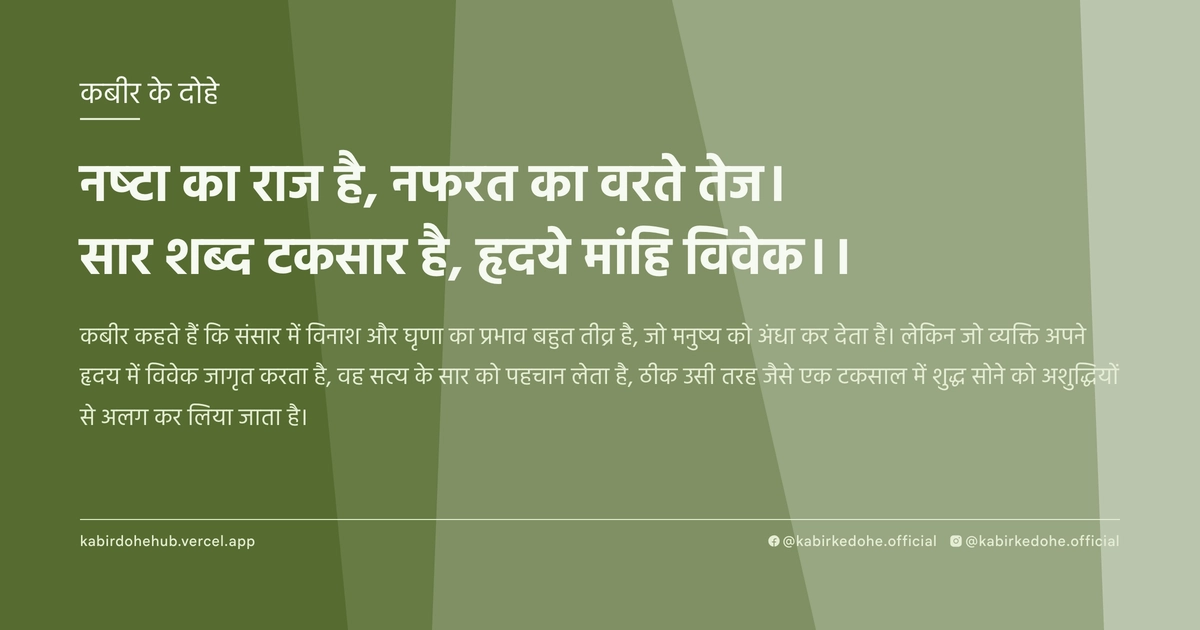
नष्टा का राज है, नफरत का वरते तेज।
सार शब्द टकसार है, हृदये मांहि विवेक।।
Nashta ka raaj hai, nafrat ka varte tej. Saar shabd taksaar hai, hridaye maahi vivek.
इस पृष्ठ पर इस कबीर दोहे का अर्थ (meaning), हिंदी व्याख्या और अंग्रेज़ी अनुवाद, दार्शनिक विश्लेषण और व्यावहारिक जीवन सीख दी गई है। यह दोहा सत्य (Truth) विषय से जुड़ा है — Kabir doha meaning and explanation in Hindi and English.
अर्थ (Meaning):
कबीर कहते हैं कि संसार में विनाश और घृणा का प्रभाव बहुत तीव्र है, जो मनुष्य को अंधा कर देता है। लेकिन जो व्यक्ति अपने हृदय में विवेक जागृत करता है, वह सत्य के सार को पहचान लेता है, ठीक उसी तरह जैसे एक टकसाल में शुद्ध सोने को अशुद्धियों से अलग कर लिया जाता है।
Kabir asserts that the reign of destruction and the intensity of hatred are overwhelming forces that cloud human perception. However, those who cultivate discernment (Vivek) within their hearts can extract the essence of truth, much like a mint or refinery (Taksar) purifies gold from its base impurities.
व्याख्या (Interpretation):
इस दोहे का शाब्दिक अर्थ है कि घृणा का वेग विनाशकारी होता है। रूपकात्मक रूप से, 'नष्ट' और 'नफरत' माया के उन पहलुओं को दर्शाते हैं जो आत्मा को परमात्मा से अलग करते हैं। 'टकसार' (टकसाल) यहाँ आध्यात्मिक शोधन की प्रक्रिया का प्रतीक है। निर्गुण भक्ति के संदर्भ में, यह संदेश है कि ईश्वर बाहरी कर्मकांडों में नहीं, बल्कि हृदय की शुद्धि और विवेक में है। अद्वैत वेदांत के अनुसार, जब अहंकार और द्वेष मिटते हैं, तब जीव को यह अनुभव होता है कि वह और ब्रह्म एक ही हैं। विरोधाभास यह है कि जिसे हम बाहरी शत्रु मानते हैं, वह वास्तव में हमारे अपने भीतर का अज्ञान है।
Literally, the verse warns that the momentum of hatred leads to ruin. Metaphorically, 'destruction' and 'hatred' represent the veils of Maya that sever the soul's connection with the Divine. The 'Taksar' (mint/refinery) symbolizes the spiritual alchemy of the heart. In the context of Nirgun Bhakti, it suggests that the Formless Truth is not found in rituals but in the purification of consciousness. According to Advaita Vedanta, once the ego and hatred are dissolved, the non-duality of Atman and Brahman is revealed. The central paradox lies in the realization that the external enemy is merely a projection of internal ignorance.
दार्शनिक विश्लेषण (Philosophical Analysis):
कबीर का यह दोहा उस सामाजिक और धार्मिक उथल-पुथल के समय का है जब कट्टरता अपने चरम पर थी। उन्होंने देखा कि धर्म के नाम पर लोग एक-दूसरे से घृणा कर रहे थे, जबकि धर्म का वास्तविक उद्देश्य मुक्ति था। कबीर ने स्पष्ट रूप से जाति और कर्मकांडीय श्रेष्ठता को खारिज किया, क्योंकि ये चीजें केवल अहंकार को बढ़ाती हैं और हृदय में 'नफरत का तेज' पैदा करती हैं।
दार्शनिक स्तर पर, यह सूफीवाद के 'फना' (अहंकार का विनाश) और वेदांत के 'विवेक' का संगम है। सूफी संत मानते हैं कि जब तक 'मैं' मौजूद है, तब तक 'वह' (ईश्वर) नहीं मिल सकता। कबीर यहाँ 'सार शब्द' की बात करते हैं, जो वह अविनाशी ध्वनि या सत्य है जो हर जीव के भीतर गूँज रहा है, लेकिन सांसारिक शोर और द्वेष के कारण सुनाई नहीं देता।
यह विश्लेषण हमें बताता है कि मनोवैज्ञानिक रूपांतरण केवल ज्ञान से नहीं, बल्कि भावनात्मक शुद्धि से आता है। घृणा एक मानसिक बंधन है जो चेतना को संकुचित कर देता है। जब हृदय में विवेक आता है, तो वह एक फिल्टर की तरह काम करता है, जो व्यर्थ की बातों को हटाकर केवल सत्य को ग्रहण करता है।
अक्सर लोग इस दोहे को केवल सामाजिक शांति के संदेश के रूप में देखते हैं, लेकिन यह वास्तव में एक गहन आध्यात्मिक प्रक्रिया है। यह 'अविद्या' (अज्ञान) के विनाश की बात करता है। जैसे सोने को आग में तपाकर शुद्ध किया जाता है, वैसे ही साधक को विवेक की अग्नि में अपने अहंकार को जलाना पड़ता है।
अंततः, कबीर यह स्थापित करते हैं कि वास्तविक धर्म वह है जो मनुष्य को करुणा और एकता की ओर ले जाए। जो व्यक्ति घृणा को विवेक में बदलने की क्षमता रखता है, वही वास्तव में मुक्त है। यह मार्ग कठिन है क्योंकि यह व्यक्ति को अपनी सबसे गहरी असुरक्षाओं और पूर्वाग्रहों का सामना करने के लिए मजबूर करता है।
This Doha emerges from an era of intense socio-religious volatility where bigotry was rampant. Kabir observed that in the name of religion, people were fueling hatred, whereas the true purpose of spirituality was liberation. He explicitly rejected caste hierarchies and ritualistic superiority, viewing them as catalysts for the ego that ignite the 'intensity of hatred.'
Philosophically, this is a synthesis of the Sufi concept of 'Fana' (annihilation of the self) and the Vedantic principle of 'Vivek' (discernment). Sufi mystics argue that as long as the 'I' exists, the 'He' (Divine) cannot be realized. Kabir speaks of the 'Saar Shabd'—the primordial sound or essential truth resonating within every being, often drowned out by the noise of worldly conflict.
This analysis reveals that psychological transformation stems not from intellectual accumulation, but from emotional purification. Hatred is a psychic contraction that narrows consciousness. When Vivek awakens, it acts as a spiritual filter, discarding the dross of illusion and retaining only the gold of truth.
Common literalist interpretations often reduce this to a simple plea for social harmony. However, it is a rigorous spiritual directive regarding the destruction of 'Avidya' (ignorance). Just as gold is purified in fire, the seeker must burn their ego in the fire of discernment to reach the essence.
Ultimately, Kabir establishes that true religion is that which leads toward compassion and unity. One who can transmute hatred into wisdom is truly liberated. This path is arduous as it forces the individual to confront their deepest insecurities and ingrained biases.
मूल संदेश (Core Message):
- घृणा एक मानसिक कारागार है जो आत्मा को जकड़ लेती है।
- विवेक वह अग्नि है जो अज्ञान की अशुद्धियों को जला देती है।
- सत्य का सार केवल शांत और शुद्ध हृदय में ही मिलता है।
- अहंकार का विसर्जन ही परमात्मा से मिलन का एकमात्र मार्ग है।
- बाहरी संघर्ष वास्तव में आंतरिक द्वंद्व का प्रतिबिंब मात्र हैं।
- प्रेम और करुणा ही वास्तविक आध्यात्मिक उपलब्धि और सिद्धि हैं।
- Hatred is a psychic prison that shackles the evolving soul.
- Discernment is the fire that incinerates the impurities of ignorance.
- The essence of Truth is found only in a still and pure heart.
- The dissolution of ego is the sole path to union with the Divine.
- External conflicts are merely reflections of internal psychic turmoil.
- Love and compassion are the only authentic spiritual achievements.
व्यावहारिक उदाहरण (Practical Example):
वाराणसी के एक पुराने घाट पर रामदीन नाम का एक वृद्ध बुनकर रहता था। वह अपने काम में निपुण था, लेकिन उसका हृदय कड़वाहट से भरा था। वर्षों पहले, उसके पड़ोसी बुनकर ने एक व्यापारिक विवाद में उसे धोखा दिया था, और तब से रामदीन ने अपने मन में नफरत की एक दीवार खड़ी कर ली थी। वह हर दिन उस व्यक्ति को देखता और मन ही मन उसे कोसता, जिससे उसका अपना मानसिक सुकून छिन गया था।
एक दिन, शहर में एक घुमक्कड़ संत आए जिन्होंने कबीर के इस दोहे का गान किया। रामदीन ने सुना कि कैसे नफरत का तेज केवल विनाश लाता है और विवेक ही असली सोना है। उसे महसूस हुआ कि वह जिस नफरत को पाल रहा था, वह उसके पड़ोसी को नहीं, बल्कि उसकी अपनी आत्मा को जला रही थी।
रामदीन ने तय किया कि वह इस नफरत को 'टकसाल' में डालेगा। उसने अपनी आँखें बंद कीं और यह सोचने की कोशिश की कि वह व्यक्ति भी उसी ईश्वर का अंश है, जिसे वह खोज रहा है। उसने महसूस किया कि उसका क्रोध वास्तव में उसके अपने अहंकार की चोट थी, न कि उस व्यक्ति का अपराध।
अगली सुबह, रामदीन ने एक सुंदर रेशमी वस्त्र बुना और उसे चुपचाप अपने पुराने दुश्मन के दरवाजे पर रख दिया। उसने कोई शब्द नहीं कहे, बस एक मुस्कान दी। वह व्यक्ति, जो खुद भी ग्लानि में जी रहा था, फूट-फूट कर रो पड़ा और उसने रामदीन के पैर पकड़ लिए।
इस छोटे से कार्य ने रामदीन के भीतर के भारीपन को खत्म कर दिया। उसे समझ आया कि क्षमा करना दूसरे पर उपकार नहीं, बल्कि स्वयं की मुक्ति है। उसका काम अब और भी निखर गया था क्योंकि उसका मन शांत था।
उसने पाया कि जब उसने नफरत का त्याग किया, तो उसके जीवन में एक नई ऊर्जा का संचार हुआ। वह अब केवल कपड़े नहीं बुन रहा था, बल्कि लोगों के बीच प्रेम के सूत्र पिरो रहा था।
गाँव के लोग हैरान थे कि जो रामदीन कभी बात नहीं करता था, वह अब सबको प्रेम से समझाता है। उसने अपनी नफरत को विवेक में बदल दिया था।
रामदीन की कहानी यह सिखाती है कि विवेक का अर्थ केवल पढ़ना-लिखना नहीं है, बल्कि यह पहचानना है कि घृणा एक भ्रम है और प्रेम ही एकमात्र सत्य है।
On an ancient ghat in Varanasi lived an elderly weaver named Ramdeen. He was a master of his craft, but his heart was heavy with bitterness. Years ago, a neighboring weaver had cheated him in a business deal, and since then, Ramdeen had built a wall of hatred in his mind. Every day he looked at the man and cursed him internally, robbing himself of all peace.
One day, a wandering saint arrived in the city and sang this specific Doha of Kabir. Ramdeen heard how the intensity of hatred brings only destruction and that discernment (Vivek) is the true gold. He realized that the hatred he nurtured was not burning his neighbor, but consuming his own soul.
Ramdeen decided to put this hatred into the 'Taksar' (refinery). He closed his eyes and tried to perceive that the other man was also a fragment of the same Divine he sought. He realized his anger was actually a wound to his own ego, not just a reaction to a crime.
The next morning, Ramdeen wove a magnificent silk cloth and silently left it at his old enemy's doorstep. He spoke no words, only offered a gentle smile. The other man, who had been living in his own guilt, broke down in tears and fell at Ramdeen's feet.
This simple act dissolved the heaviness within Ramdeen. He understood that forgiveness is not a favor done for another, but a liberation for oneself. His weaving became even more exquisite because his mind was finally still.
He discovered that by relinquishing hatred, a new energy flowed through his life. He was no longer just weaving fabric; he was weaving threads of love between people.
The villagers were astonished that the once-silent and brooding Ramdeen now spoke to everyone with kindness. He had successfully transmuted his hatred into wisdom.
Ramdeen's story teaches that Vivek is not mere literacy or intellectualism, but the realization that hatred is an illusion and love is the only enduring truth.
अभ्यास मार्गदर्शन (Practice Guidance):
- प्रतिदिन 20 मिनट मौन ध्यान करें, जहाँ आप अपने भीतर उठने वाले क्रोध और घृणा के विचारों को बिना किसी निर्णय के केवल देखें।
- एक 'विवेक जर्नल' बनाएँ: जब भी किसी के प्रति नफरत महसूस हो, लिखें कि यह नफरत आपके अहंकार के किस हिस्से को बचा रही है।
- व्यवहार परिवर्तन: दिन में कम से कम एक बार ऐसे व्यक्ति के प्रति दया दिखाएं जिससे आपका वैचारिक मतभेद हो।
- डायग्नोस्टिक चेकलिस्ट: क्या आप अभी भी पुरानी गलतियों को याद कर क्रोधित होते हैं? क्या आपकी शांति दूसरों के व्यवहार पर निर्भर है? यदि हाँ, तो विवेक अभी पूर्णतः जागृत नहीं हुआ है।
- Practice 20 minutes of silent meditation daily, observing arising thoughts of anger or hatred as a detached witness without judgment.
- Maintain a 'Vivek Journal': Whenever hatred arises, write down which part of your ego is trying to protect itself through this emotion.
- Behavioral Shift: Once a day, consciously perform an act of kindness toward someone with whom you have a fundamental ideological disagreement.
- Diagnostic Checklist: Do you still feel sudden rage when recalling old grievances? Is your peace dependent on others' behavior? If yes, discernment has not yet fully awakened.
चिंतन प्रश्न (Reflection Questions):
- मेरे जीवन में वह कौन सा 'नफरत का तेज' है जो मुझे वास्तव में आगे बढ़ने से रोक रहा है?
- क्या मेरी धार्मिक या नैतिक पहचान वास्तव में विवेक पर आधारित है, या यह केवल दूसरों को छोटा दिखाने का एक साधन है?
- यदि मैं अपनी सभी उपलब्धियों और पहचान को हटा दूँ, तो क्या मेरे भीतर कोई ऐसा 'सार' बचेगा जिसे मैं पहचान सकूँ?
- मैं अपनी डिजिटल पहचान (सोशल मीडिया) पर जो क्रोध व्यक्त करता हूँ, वह मेरे वास्तविक स्वरूप का हिस्सा है या केवल एक मुखौटा?
- क्या मैं वास्तव में क्षमा करना चाहता हूँ, या मैं केवल इस बात का इंतज़ार कर रहा हूँ कि दूसरा व्यक्ति अपनी गलती स्वीकार करे?
- What is the specific 'intensity of hatred' in my life that is actually preventing my own growth?
- Is my religious or moral identity based on true discernment, or is it merely a tool to feel superior to others?
- If I stripped away all my achievements and labels, would there be an 'essence' left within me that I could recognize?
- The anger I project through my digital identity—is it a part of my true nature or merely a curated mask?
- Do I truly desire to forgive, or am I simply waiting for the other person to acknowledge their fault first?