
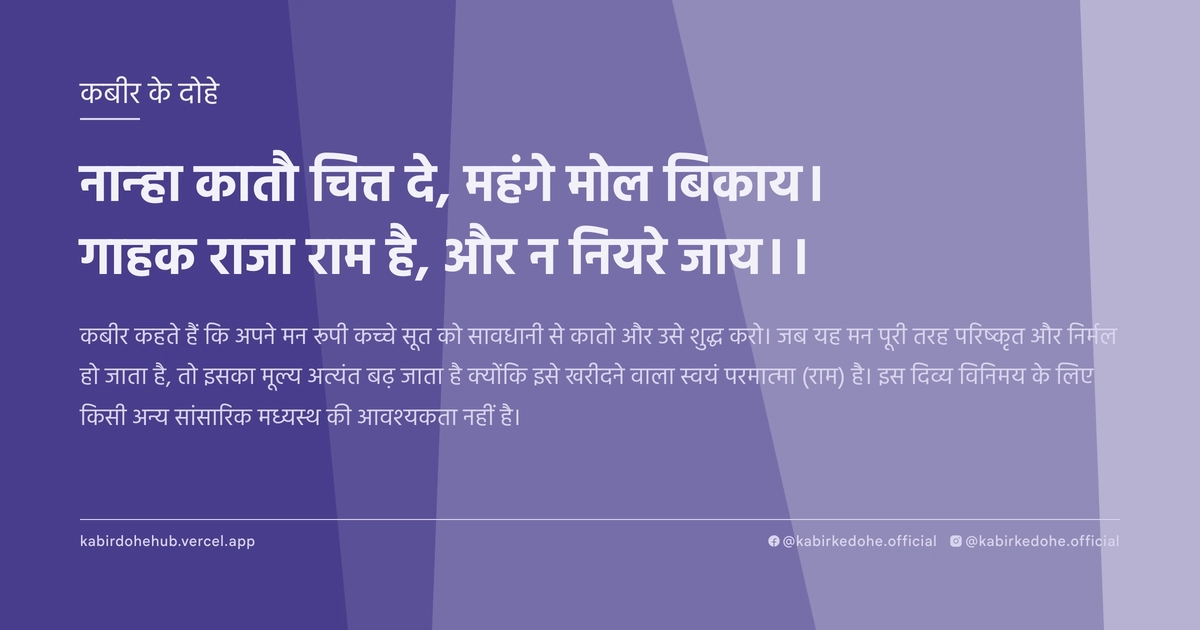
नान्हा कातौ चित्त दे, महंगे मोल बिकाय।
गाहक राजा राम है, और न नियरे जाय।।
Nanha katau chitt de, mehenge mol bikay. Gahak raja ram hai, aur na niyare jaaye.
इस पृष्ठ पर इस कबीर दोहे का अर्थ (meaning), हिंदी व्याख्या और अंग्रेज़ी अनुवाद, दार्शनिक विश्लेषण और व्यावहारिक जीवन सीख दी गई है। यह दोहा भक्ति (Bhakti) विषय से जुड़ा है — Kabir doha meaning and explanation in Hindi and English.
अर्थ (Meaning):
कबीर कहते हैं कि अपने मन रूपी कच्चे सूत को सावधानी से कातो और उसे शुद्ध करो। जब यह मन पूरी तरह परिष्कृत और निर्मल हो जाता है, तो इसका मूल्य अत्यंत बढ़ जाता है क्योंकि इसे खरीदने वाला स्वयं परमात्मा (राम) है। इस दिव्य विनिमय के लिए किसी अन्य सांसारिक मध्यस्थ की आवश्यकता नहीं है।
Kabir suggests that one should meticulously spin the raw thread of the mind, refining it through spiritual discipline. Once the mind is purified and made subtle, its value becomes immeasurable because the only buyer for such a refined consciousness is the Divine (Ram). In this sacred transaction, no worldly intermediary is required.
व्याख्या (Interpretation):
शाब्दिक रूप से, कबीर एक जुलाहे की भाषा का उपयोग कर रहे हैं जहाँ 'कातना' का अर्थ सूत तैयार करना है। आध्यात्मिक स्तर पर, 'नान्हा कातौ' का अर्थ है अहंकार के मोटे रेशों को हटाकर चित्त को सूक्ष्म और कोमल बनाना। यह प्रक्रिया निर्गुण भक्ति का सार है, जहाँ साधक बाहरी कर्मकांडों के बजाय आंतरिक शुद्धि पर ध्यान केंद्रित करता है। जब चित्त में द्वैत समाप्त हो जाता है और वह केवल शुद्ध चेतना बन जाता है, तब वह 'महंगे मोल' यानी मोक्ष का पात्र बनता है। यहाँ 'राम' सगुण ईश्वर नहीं, बल्कि वह सर्वव्यापी ब्रह्म है जो केवल शुद्ध आत्मा को ही स्वीकार करता है। यह माया के आवरण को हटाकर आत्मन और ब्रह्म की एकता को पहचानने की यात्रा है।
Literally, Kabir employs the metaphor of a weaver, where 'spinning' refers to preparing thread. Spiritually, 'nanha kaatau' signifies the process of thinning the coarse fibers of the ego to make the consciousness subtle and refined. This process embodies the essence of Nirgun Bhakti, where the seeker prioritizes internal purification over external rituals. When duality vanishes and the mind becomes pure consciousness, it attains a 'high price,' meaning it becomes eligible for liberation. Here, 'Ram' is not a deity in human form but the omnipresent Brahman who accepts only a purified soul. It is a journey of stripping away the veils of Maya to realize the non-duality of Atman and Brahman.
दार्शनिक विश्लेषण (Philosophical Analysis):
कबीर का यह दोहा उनके युग के सामाजिक और धार्मिक परिवेश पर एक गहरा प्रहार है, जहाँ मोक्ष को कठिन अनुष्ठानों, तीर्थयात्राओं और जातिगत श्रेष्ठता से जोड़ा गया था। कबीर इन सबको नकारते हुए 'चित्त' की आंतरिक तैयारी को ही एकमात्र मार्ग बताते हैं। यह दृष्टिकोण अद्वैत वेदांत के करीब है, जो मानता है कि अज्ञानता (अविद्या) ही बंधन का कारण है और ज्ञान (शुद्धि) ही मुक्ति है।
सूफी मत के 'फना' (अहंकार का विनाश) के सिद्धांत से यह मेल खाता है, जहाँ साधक अपनी व्यक्तिगत पहचान को ईश्वर की इच्छा में विलीन कर देता है। कबीर का 'राम' वह निराकार तत्व है जो किसी मंदिर या मस्जिद में नहीं, बल्कि शुद्ध हृदय में निवास करता है। वे स्पष्ट करते हैं कि ईश्वर किसी बाहरी वस्तु या दान का भूखा नहीं है, बल्कि वह केवल उस मन को चाहता है जो वासनाओं और अहंकार से मुक्त हो चुका हो।
यहाँ 'महंगे मोल' का अर्थ भौतिक धन नहीं, बल्कि आध्यात्मिक पूर्णता है। कबीर यह तर्क देते हैं कि जब तक मन 'मोटा' (अहंकारी और आसक्त) है, वह परमात्मा के योग्य नहीं है। जैसे केवल बारीक सूत ही बेहतरीन वस्त्र बनाता है, वैसे ही केवल सूक्ष्म और निर्मल मन ही परमात्मा का साक्षात्कार कर सकता है।
यह विश्लेषण हमें बताता है कि कबीर के लिए भक्ति कोई बाहरी प्रदर्शन नहीं, बल्कि एक आंतरिक रसायन विज्ञान है। वे कर्मकांडों के प्रति अपनी घृणा को इस बात से सिद्ध करते हैं कि उन्होंने 'ग्राहक' के रूप में केवल राम को रखा है, किसी पुरोहित या मध्यस्थ को नहीं।
अंततः, यह दोहा मनोवैज्ञानिक रूपांतरण की बात करता है। यह सिखाता है कि आत्म-साक्षात्कार के लिए बाहरी दुनिया को जीतने की नहीं, बल्कि अपने भीतर के शोर और अशुद्धियों को शांत करने की आवश्यकता है। जब 'मैं' मिटता है, तभी 'वह' प्रकट होता है।
This couplet is a profound critique of the socio-religious climate of Kabir's era, where salvation was tethered to rigorous rituals, pilgrimages, and caste hierarchies. Kabir rejects these, asserting that the internal preparation of the 'chitt' (consciousness) is the only authentic path. This perspective aligns closely with Advaita Vedanta, which posits that ignorance (Avidya) is the root of bondage and realization (Shuddhi) is the key to liberation.
It resonates with the Sufi concept of 'Fana' (annihilation of the self), where the seeker dissolves their individual identity into the Divine Will. Kabir's 'Ram' is the formless element that resides not in temples or mosques, but within a purified heart. He clarifies that the Divine is not hungry for external offerings or charity, but desires only a mind liberated from cravings and ego.
The 'high price' mentioned here does not refer to material wealth, but to spiritual perfection. Kabir argues that as long as the mind is 'coarse' (egoistic and attached), it is unfit for the Divine. Just as only fine thread produces the finest fabric, only a subtle and pure mind can experience the Absolute.
This analysis reveals that for Kabir, devotion is not an external performance but an internal alchemy. He demonstrates his disdain for ritualism by identifying the 'customer' solely as Ram, bypassing any priestly intermediaries or mediators.
Ultimately, the verse speaks of psychological transformation. It teaches that self-realization requires not the conquest of the external world, but the silencing of internal noise and impurities. When the 'I' vanishes, the 'He' manifests.
मूल संदेश (Core Message):
- अहंकार का त्याग ही वास्तविक आध्यात्मिक उपलब्धि है।
- बाहरी कर्मकांड आंतरिक शुद्धि का विकल्प नहीं हो सकते।
- परमात्मा केवल उस हृदय में बसता है जो वासनामुक्त है।
- चित्त की सूक्ष्मता ही मोक्ष का एकमात्र द्वार है।
- सत्य की खोज बाहर नहीं, बल्कि स्वयं के परिष्करण में है।
- जब 'मैं' मिटता है, तभी अनंत का अनुभव होता है।
- The abandonment of ego is the only true spiritual achievement.
- External rituals can never substitute for internal purification.
- The Divine resides only in a heart free from cravings.
- The subtlety of consciousness is the sole gateway to liberation.
- The search for truth lies in self-refinement, not in external quests.
- Only when the 'I' vanishes does the Infinite manifest.
व्यावहारिक उदाहरण (Practical Example):
वाराणसी के घाटों के पास रहने वाला एक वृद्ध विधवा, जिन्हें समाज ने हाशिए पर धकेल दिया था, अपना समय केवल दूसरों की सेवा और मौन चिंतन में बिताती थीं। उनके पास न धन था, न कोई सामाजिक सम्मान, लेकिन उनका मन एक शांत झील की तरह था।
उसी शहर में एक अत्यंत विद्वान पंडित थे, जिन्होंने वेदों का गहन अध्ययन किया था और बड़े-बड़े अनुष्ठानों का नेतृत्व करते थे। पंडित जी को अपने ज्ञान का बहुत अहंकार था और वे मानते थे कि केवल शास्त्रार्थ से ही ईश्वर प्राप्त होते हैं।
एक दिन पंडित जी ने देखा कि वह वृद्ध महिला एक साधारण सी माला जप रही थी, लेकिन उसके चेहरे पर एक ऐसा असीम संतोष और तेज था जो पंडित जी ने अपने जीवन के कठिन तप के बाद भी महसूस नहीं किया था।
पंडित जी ने उनसे पूछा, "माता, आप तो अनपढ़ हैं, न आपको मंत्र आते हैं न विधि। फिर आपके चेहरे पर यह दिव्य शांति कहाँ से आई?"
वृद्ध महिला ने मंद मुस्कान के साथ उत्तर दिया, "बेटा, मैंने अपनी पूरी उम्र अपने भीतर के क्रोध, ईर्ष्या और 'मैं' को सूत की तरह कातकर बारीक किया है। मैंने शब्दों को नहीं, अपने भावों को शुद्ध किया है।"
पंडित जी को अचानक अहसास हुआ कि उनका ज्ञान केवल 'मोटा सूत' था—भारी, बोझिल और अहंकार से भरा हुआ। उन्होंने केवल सूचनाएं एकत्रित की थीं, लेकिन अपने चित्त को परिष्कृत नहीं किया था।
उस क्षण पंडित जी का अहंकार टूट गया। उन्होंने महसूस किया कि जिसे वे 'ज्ञान' समझ रहे थे, वह वास्तव में एक बाधा थी जो उन्हें परमात्मा से दूर रख रही थी।
उन्होंने उस वृद्ध महिला के चरणों में झुककर अपनी अशुद्धता को स्वीकार किया। यह उनके जीवन का वह 'कबीर ट्विस्ट' था जहाँ उन्होंने शास्त्रों के बोझ को छोड़कर हृदय की सरलता को अपनाया।
इसके बाद पंडित जी ने बाहरी दिखावे और कर्मकांडों को त्याग दिया और मौन साधना की ओर मुड़े। उन्होंने सीखा कि ईश्वर को पाने के लिए पांडित्य की नहीं, बल्कि एक निर्मल और सूक्ष्म हृदय की आवश्यकता होती है।
उनका जीवन अब दूसरों को उपदेश देने के बजाय, स्वयं को शुद्ध करने की एक निरंतर प्रक्रिया बन गया, जिससे उनके जीवन में वास्तविक शांति का उदय हुआ।
In the vicinity of the ghats of Varanasi lived an elderly widow, pushed to the margins of society, who spent her days in selfless service and silent contemplation. She possessed neither wealth nor social status, but her mind was as still as a mountain lake.
In the same city lived a highly learned scholar, a Pandit, who had mastered the Vedas and led grand rituals. The Pandit was consumed by pride in his erudition, believing that God could only be reached through scholarly debate and scriptural mastery.
One day, the Pandit noticed the elderly woman chanting with a simple rosary, yet her face radiated a boundless contentment and luminosity that he had never experienced despite his rigorous austerities.
Curious, the Pandit asked, "Mother, you are unlettered; you know neither the mantras nor the rituals. Where did this divine peace on your face come from?"
The elderly woman replied with a gentle smile, "My son, I have spent my entire life spinning the threads of my anger, jealousy, and 'I-ness' until they became fine and subtle. I did not refine words; I refined my emotions."
The Pandit suddenly realized that his knowledge was merely 'coarse thread'—heavy, burdensome, and laden with ego. He had collected information, but he had not purified his consciousness.
In that moment, the Pandit's ego shattered. He realized that what he perceived as 'knowledge' was actually a barrier separating him from the Divine.
He bowed at the feet of the elderly woman, acknowledging his own impurity. This was the 'Kabir Twist'—the moment he abandoned the weight of scriptures for the simplicity of the heart.
Following this, the Pandit renounced external displays and ritualism, turning instead toward silent meditation. He learned that reaching the Divine requires not scholarship, but a pure and subtle heart.
His life ceased to be about lecturing others and became a continuous process of self-purification, leading to the dawn of genuine peace within him.
अभ्यास मार्गदर्शन (Practice Guidance):
- दैनिक मौन अभ्यास: प्रतिदिन 30 मिनट पूर्ण मौन रहें, जहाँ आप केवल अपने विचारों के आने और जाने को देखें, बिना किसी निर्णय के।
- आत्म-पूछताछ जर्नल: प्रतिदिन एक ऐसी घटना लिखें जहाँ आपके अहंकार (Ego) ने प्रतिक्रिया दी। विश्लेषण करें कि उस समय 'सूत' कितना मोटा था और उसे सूक्ष्म कैसे बनाया जा सकता था।
- सांसारिक विरक्ति का अभ्यास: दिन में एक बार सचेत रूप से यह महसूस करें कि आपकी उपलब्धियां और पहचान अस्थायी हैं, और केवल आपका शुद्ध अस्तित्व ही शाश्वत है।
- डायग्नोस्टिक चेकलिस्ट: क्या मैं दूसरों की प्रशंसा के लिए कार्य कर रहा हूँ? क्या मेरी शांति बाहरी परिस्थितियों पर निर्भर है? क्या मैं स्वयं को दूसरों से श्रेष्ठ या निम्न महसूस करता हूँ? (यदि हाँ, तो चित्त अभी भी 'मोटा' है)।
- Daily Silence Practice: Spend 30 minutes in total silence daily, observing the arrival and departure of thoughts without judgment.
- Self-Inquiry Journaling: Record one daily incident where your ego reacted. Analyze how 'coarse' the thread of your consciousness was in that moment and how it could have been refined.
- Practice of Detachment: Once a day, consciously realize that your achievements and identities are transient, and only your pure existence is eternal.
- Diagnostic Checklist: Am I acting for the praise of others? Is my peace dependent on external circumstances? Do I feel superior or inferior to others? (If yes, the consciousness is still 'coarse').
चिंतन प्रश्न (Reflection Questions):
- मेरी सार्वजनिक छवि और मेरे आंतरिक सत्य के बीच कितना अंतर है?
- मैं अपनी आध्यात्मिक प्रगति का प्रदर्शन करने के लिए किन सूक्ष्म तरीकों का उपयोग करता हूँ?
- यदि मेरी सारी उपाधियाँ और सामाजिक पहचान छीन ली जाएँ, तो मेरा 'मूल' क्या बचेगा?
- क्या मेरी भक्ति वास्तव में ईश्वर के लिए है, या मैं केवल अपनी मानसिक शांति के लिए प्रार्थना करता हूँ?
- मेरे जीवन का वह कौन सा 'मोटा सूत' (अहंकार) है जिसे मैं स्वीकार करने से डरता हूँ?
- क्या मैं वास्तव में मौन हूँ, या मेरा मौन भी एक प्रकार का प्रदर्शन है?
- What is the gap between my public persona and my internal truth?
- In what subtle ways do I perform my spiritual progress for validation?
- If all my titles and social identities were stripped away, what would remain of my 'core'?
- Is my devotion truly for the Divine, or am I merely praying for my own psychological comfort?
- Which 'coarse thread' of ego within me am I most afraid to acknowledge?
- Am I truly silent, or is my silence just another form of performance?