
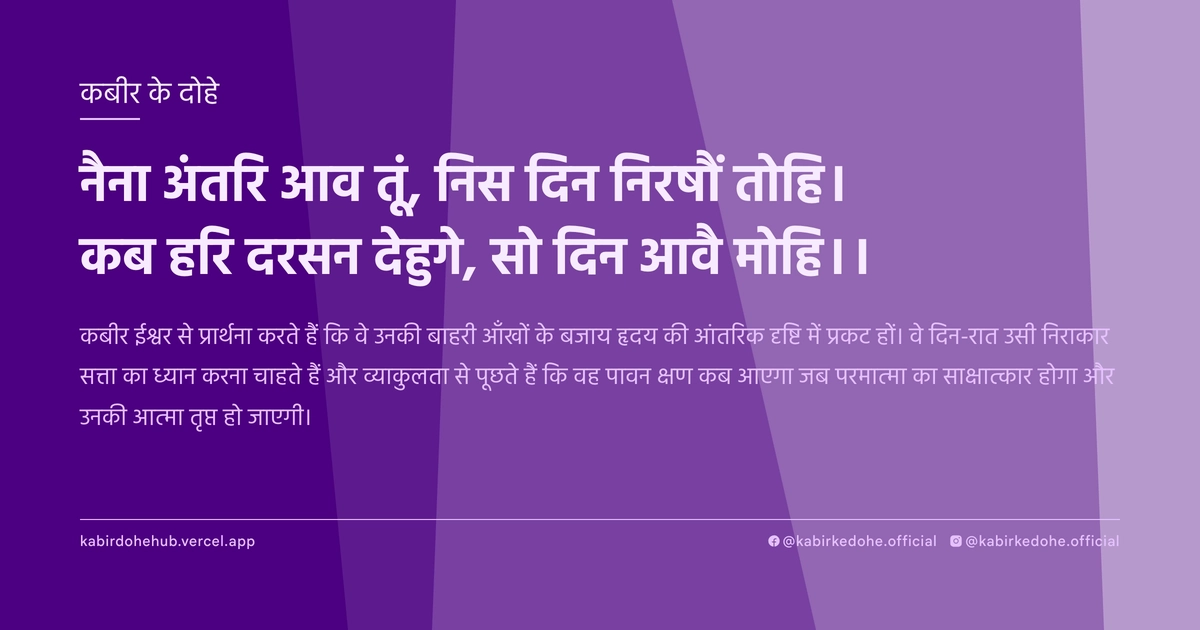
नैना अंतरि आव तूं, निस दिन निरषौं तोहि।
कब हरि दरसन देहुगे, सो दिन आवै मोहि।।
Naina antari aav tun, nis din nirshau tohi. Kab Hari darasan dehuge, so din aavai mohi.
इस पृष्ठ पर इस कबीर दोहे का अर्थ (meaning), हिंदी व्याख्या और अंग्रेज़ी अनुवाद, दार्शनिक विश्लेषण और व्यावहारिक जीवन सीख दी गई है। यह दोहा भक्ति (Bhakti) विषय से जुड़ा है — Kabir doha meaning and explanation in Hindi and English.
अर्थ (Meaning):
कबीर ईश्वर से प्रार्थना करते हैं कि वे उनकी बाहरी आँखों के बजाय हृदय की आंतरिक दृष्टि में प्रकट हों। वे दिन-रात उसी निराकार सत्ता का ध्यान करना चाहते हैं और व्याकुलता से पूछते हैं कि वह पावन क्षण कब आएगा जब परमात्मा का साक्षात्कार होगा और उनकी आत्मा तृप्त हो जाएगी।
Kabir pleads with the Divine to manifest not before the physical eyes, but within the inner vision of the heart. He expresses a profound longing to behold the Formless One day and night, yearning for that transformative moment of divine revelation when the veil of separation finally lifts.
व्याख्या (Interpretation):
यह दोहा बाहरी कर्मकांडों के बजाय आंतरिक अनुभव पर बल देता है। 'नैना अंतरि' का अर्थ है कि परमात्मा बाहर मंदिरों या मस्जिदों में नहीं, बल्कि चेतना के गहरे स्तरों में स्थित है। यहाँ 'हरि' केवल एक देवता नहीं, बल्कि वह शुद्ध चेतना (Brahman) है जो माया के पर्दे के पीछे छिपी है। यह विरह की अवस्था है जहाँ साधक अपनी सीमित पहचान (अहंकार) को मिटाकर उस अनंत में विलीन होना चाहता है। यह निर्गुण भक्ति का सार है जहाँ ईश्वर को रूप और आकार से परे, केवल अनुभव के माध्यम से पाया जाता है।
This couplet emphasizes internal realization over external ritualism. 'Naina antari' signifies that the Divine resides not in temples or mosques, but within the depths of consciousness. Here, 'Hari' is not a mere deity but the Pure Consciousness (Brahman) hidden behind the veil of Maya. It depicts the state of 'Viraha' or longing, where the seeker desires to dissolve the limited ego into the Infinite. This is the essence of Nirgun Bhakti, where the Formless is encountered not through images, but through the direct experience of the soul's non-duality with the Absolute.
दार्शनिक विश्लेषण (Philosophical Analysis):
कबीर का यह दृष्टिकोण अद्वैत वेदांत और सूफी मत के 'फना' होने की प्रक्रिया का संगम है। वे उस युग में लिख रहे थे जब धर्म बाहरी प्रतीकों, जैसे माला, तिलक और तीर्थयात्राओं में सिमट गया था। कबीर ने इस पाखंड पर प्रहार करते हुए यह स्पष्ट किया कि ईश्वर का निवास मनुष्य के भीतर है।
दार्शनिक स्तर पर, यह दोहा 'साक्षी भाव' की मांग करता है। जब साधक कहता है कि वह 'दिन-रात' निहारना चाहता है, तो वह निरंतर जागरूकता (Mindfulness) की बात कर रहा है। यह केवल एक इच्छा नहीं, बल्कि एक आध्यात्मिक अनुशासन है जहाँ मन की चंचलता को शांत कर उसे अंतर्मुखी बनाया जाता है।
सूफीवाद के 'इश्क-ए-हकीकी' (ईश्वरीय प्रेम) की तरह, यहाँ भी विरह की अग्नि है। यह अग्नि अहंकार को जलाकर राख कर देती है, जिससे केवल शुद्ध आत्मा शेष बचती है। जब तक 'मैं' मौजूद है, तब तक 'हरि' का दर्शन संभव नहीं है, क्योंकि द्वैत (Duality) ही सबसे बड़ी बाधा है।
कबीर का 'हरि' निराकार है। वे तर्क देते हैं कि यदि ईश्वर किसी एक आकार में होता, तो वह सीमित हो जाता। इसलिए, वे आंतरिक दृष्टि की बात करते हैं, जो इंद्रियों की सीमाओं से परे है। यह मनोवैज्ञानिक रूपांतरण की प्रक्रिया है जहाँ बाहरी दुनिया का शोर शांत होता है और आंतरिक मौन बोलना शुरू करता है।
अंततः, यह दोहा हमें सिखाता है कि आध्यात्मिक खोज कोई बाहरी यात्रा नहीं, बल्कि एक आंतरिक गोता है। यह उस बिंदु की खोज है जहाँ व्यक्ति और परमात्मा के बीच का अंतर समाप्त हो जाता है और केवल एक अखंड सत्य शेष रहता है।
Kabir's perspective is a confluence of Advaita Vedanta's non-duality and the Sufi concept of 'Fana' (annihilation of the self). Writing in an era where religion was reduced to external symbols—beads, tilaks, and pilgrimages—Kabir challenged this ritualism, asserting that the Divine resides within the human being.
On a philosophical level, this couplet demands the state of 'Sakshi' or the Witness. When the seeker expresses the desire to behold the Divine 'day and night,' he is referring to a state of continuous awareness. This is not merely a wish but a spiritual discipline where the volatility of the mind is stilled and turned inward.
Similar to the Sufi 'Ishq-e-Haqiqi' (Divine Love), there is a searing fire of longing here. This fire incinerates the ego, leaving behind only the pure soul. As long as the 'I' exists, the vision of 'Hari' remains elusive, for duality is the primary obstacle to liberation.
Kabir's 'Hari' is Nirgun, or formless. He argues that if the Divine were confined to a specific form, the Divine would be limited. Thus, he advocates for an inner vision that transcends sensory limitations. This is a process of psychological transformation where the noise of the external world fades, and the inner silence begins to speak.
Ultimately, this couplet teaches that the spiritual quest is not an external journey but an internal plunge. It is the search for that singular point where the distinction between the individual and the Absolute vanishes, leaving only one unbroken Truth.
मूल संदेश (Core Message):
- बाहरी खोज केवल भटकाव है; सत्य भीतर स्थित है।
- अहंकार का विसर्जन ही परमात्मा के दर्शन की एकमात्र कुंजी है।
- भक्ति कर्मकांड नहीं, बल्कि आत्मा का परमात्मा से मिलन है।
- मौन वह भाषा है जिसमें ईश्वर हमसे बात करता है।
- जब 'मैं' मिटता है, तभी 'वह' प्रकट होता है।
- External searching is a diversion; Truth resides within.
- The dissolution of ego is the only key to Divine vision.
- Devotion is not ritualism, but the union of soul with Absolute.
- Silence is the language in which the Divine speaks to us.
- Only when the 'I' vanishes does the 'He' manifest.
व्यावहारिक उदाहरण (Practical Example):
वाराणसी के घाटों पर रहने वाले एक वृद्ध विधवा, जानकी, का जीवन केवल पूजा-पाठ और कठोर नियमों में बीता। वह घंटों मंदिर में बैठती और पत्थर की मूर्तियों से प्रार्थना करती, लेकिन उसके मन में शांति नहीं थी।
वह हमेशा इस बात से परेशान रहती कि भगवान उसे दर्शन क्यों नहीं देते, जबकि वह इतने कठिन व्रत और नियम पालन करती है। उसका जीवन बाहरी शुद्धता का एक प्रदर्शन बन गया था।
एक दिन उसकी मुलाकात एक घुमक्कड़ फकीर से हुई, जिसने उसे कबीर का यह दोहा सुनाया। फकीर ने उससे कहा, "माँ, तुम पत्थर में जिसे ढूंढ रही हो, वह तुम्हारी अपनी सांसों की लय में छिपा है।"
जानकी ने पहली बार अपनी आँखें बंद कीं और बाहर की दुनिया को भूलकर अपने हृदय की धड़कन पर ध्यान केंद्रित किया। उसने महसूस किया कि वह मंदिर की घंटियों में नहीं, बल्कि अपने भीतर के मौन में है।
शुरुआत में उसे डर लगा, क्योंकि उसने जीवन भर बाहरी सहारे खोजे थे। लेकिन धीरे-धीरे उसने पाया कि जब वह चुप होती है, तो उसे एक असीम प्रेम का अनुभव होता है जो किसी मंदिर की दीवार से नहीं बंधा था।
उसने पाया कि उसकी कठोरता वास्तव में उसका अहंकार था, जो उसे यह विश्वास दिला रहा था कि वह 'पवित्र' है। इस अहसास ने उसके भीतर की कड़वाहट को खत्म कर दिया।
अब वह मंदिर तो जाती थी, लेकिन वह वहां मांगने नहीं, बल्कि उस आंतरिक प्रकाश को साझा करने जाती थी जिसे उसने अपने भीतर पाया था।
उसका व्यवहार बदल गया; वह अब अन्य विधवाओं के प्रति अधिक दयालु और प्रेमपूर्ण हो गई, क्योंकि उसने हर इंसान में उसी 'हरि' की झलक देखनी शुरू कर दी।
जानकी ने समझ लिया कि ईश्वर का दर्शन किसी चमत्कार में नहीं, बल्कि स्वयं के अहंकार के विसर्जन और आंतरिक शांति में है।
उसका जीवन अब एक बाहरी प्रदर्शन नहीं, बल्कि एक आंतरिक उत्सव बन गया था, जहाँ हर सांस एक प्रार्थना थी।
Janki, an elderly widow living on the ghats of Varanasi, spent her entire life adhering to rigid rituals and strict penances. She spent hours in temples praying to stone idols, yet her heart remained restless.
She was perpetually troubled by why the Divine did not grant her a vision, despite her rigorous fasting and adherence to every religious law. Her life had become a performance of external purity.
One day, she encountered a wandering fakir who recited this specific doha of Kabir to her. The fakir told her, "Mother, the one you seek in stone is hidden within the very rhythm of your breath."
For the first time, Janki closed her eyes and, forgetting the external world, focused her attention on the beating of her own heart. She realized that the Divine was not in the temple bells, but in the silence within.
Initially, she felt afraid, as she had relied on external supports her entire life. But gradually, she discovered that in the depths of her silence, there was an infinite love that no temple wall could contain.
She realized that her rigidity was actually her ego, masquerading as 'holiness' to keep her feeling superior. This realization dissolved the bitterness she had carried for years.
She continued to visit the temple, but no longer to beg for a miracle; she went to share the inner light she had discovered within herself.
Her behavior transformed; she became profoundly compassionate toward other widows, seeing a glimpse of that same 'Hari' in every human being she encountered.
Janki understood that the vision of God is not a supernatural event, but the result of dissolving the ego and attaining inner stillness.
Her life ceased to be an external display of piety and became an internal celebration, where every breath was a living prayer.
अभ्यास मार्गदर्शन (Practice Guidance):
- प्रतिदिन 20 मिनट 'अंतर्मुखी ध्यान' करें: अपनी आँखें बंद करें और बाहरी दुनिया के शोर को पीछे छोड़कर केवल अपनी सांसों और हृदय की धड़कन को महसूस करें।
- आत्म-पूछताछ जर्नल: प्रतिदिन लिखें कि आज आपने बाहरी दिखावे (Ego) के लिए क्या किया और वास्तव में आपकी आत्मा क्या चाहती थी।
- मौन का अभ्यास: दिन में कम से कम एक घंटा पूर्ण मौन रहें, न केवल वाणी से, बल्कि मानसिक विचारों को भी शांत करने का प्रयास करें।
- निदान चेकलिस्ट: क्या मैं अभी भी ईश्वर को केवल बाहरी प्रतीकों में ढूंढ रहा हूँ? क्या मेरा आध्यात्मिक अभ्यास मुझे दूसरों से श्रेष्ठ महसूस करा रहा है? यदि हाँ, तो आप अभी भी 'माया' के प्रभाव में हैं।
- Practice 20 minutes of 'Inward Meditation' daily: Close your eyes and leave the noise of the external world behind, focusing solely on your breath and heartbeat.
- Self-Inquiry Journaling: Write daily about what you did today for external validation (Ego) versus what your soul truly desired.
- Practice of Silence: Spend at least one hour a day in complete silence, not just of speech, but attempting to still the mental chatter.
- Diagnostic Checklist: Am I still seeking the Divine only in external symbols? Does my spiritual practice make me feel superior to others? If yes, you are still under the influence of Maya.
चिंतन प्रश्न (Reflection Questions):
- मेरा 'धार्मिक' व्यक्तित्व वास्तव में मेरी आत्मा की पुकार है या समाज द्वारा थोपा गया एक मुखौटा?
- मैं ईश्वर को अपने भीतर खोजने से क्यों डरता हूँ? क्या मुझे डर है कि वहाँ मुझे अपनी कमियाँ दिखेंगी?
- क्या मेरी भक्ति मुझे विनम्र बना रही है, या यह मेरे सूक्ष्म अहंकार को पोषण दे रही है?
- यदि मेरे जीवन से सभी बाहरी धार्मिक प्रतीक हटा दिए जाएँ, तो मेरे और सत्य के बीच क्या बचेगा?
- मैं अपनी डिजिटल पहचान (Social Media Ego) को बनाए रखने के लिए अपनी आंतरिक शांति की कितनी बलि दे रहा हूँ?
- क्या मैं वास्तव में सत्य की खोज में हूँ, या मैं केवल अपनी मान्यताओं की पुष्टि चाहता हूँ?
- Is my 'religious' identity truly a call of the soul, or a mask imposed by society?
- Why do I fear seeking the Divine within? Am I afraid of encountering my own shadows?
- Is my devotion making me humble, or is it feeding a subtle, spiritual ego?
- If all external religious symbols were removed from my life, what would remain between me and the Truth?
- How much of my inner peace am I sacrificing to maintain my digital identity and social ego?
- Am I genuinely searching for Truth, or am I merely seeking confirmation of my own biases?