
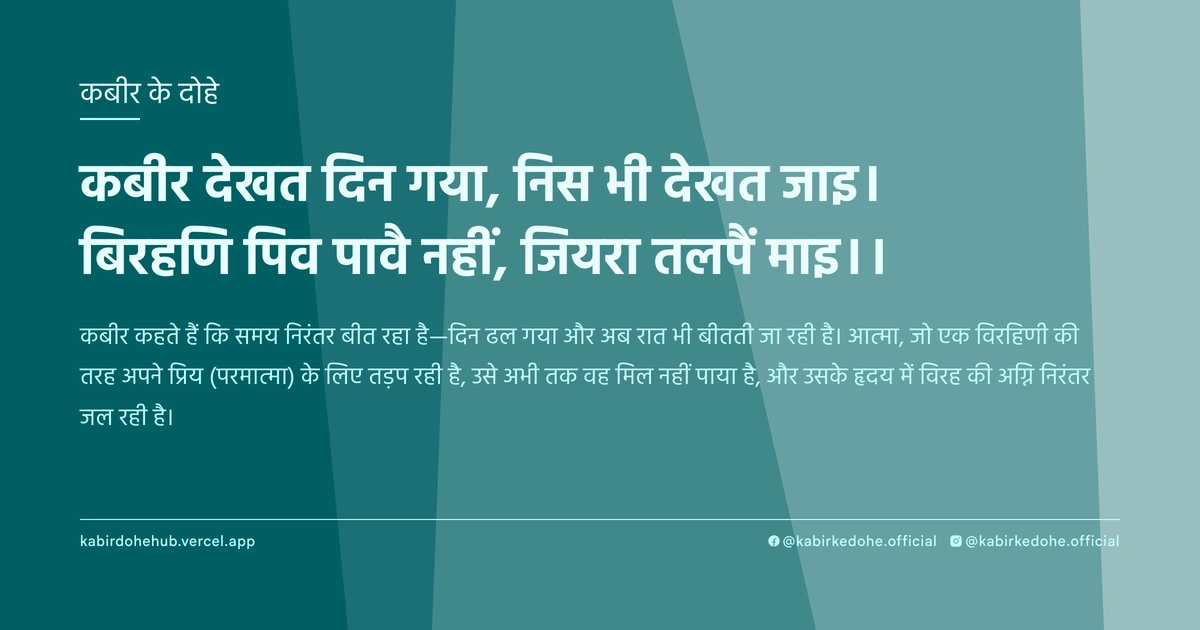
कबीर देखत दिन गया, निस भी देखत जाइ।
बिरहणि पिव पावै नहीं, जियरा तलपैं माइ।।
Kabir dekhat din gaya, nis bhi dekhat jai. Birahni piv pavai nahi, jiyara talpai mai.
इस पृष्ठ पर इस कबीर दोहे का अर्थ (meaning), हिंदी व्याख्या और अंग्रेज़ी अनुवाद, दार्शनिक विश्लेषण और व्यावहारिक जीवन सीख दी गई है। यह दोहा भक्ति (Bhakti) विषय से जुड़ा है — Kabir doha meaning and explanation in Hindi and English.
अर्थ (Meaning):
कबीर कहते हैं कि समय निरंतर बीत रहा है—दिन ढल गया और अब रात भी बीतती जा रही है। आत्मा, जो एक विरहिणी की तरह अपने प्रिय (परमात्मा) के लिए तड़प रही है, उसे अभी तक वह मिल नहीं पाया है, और उसके हृदय में विरह की अग्नि निरंतर जल रही है।
Kabir observes that time is slipping away relentlessly—the day has vanished, and the night too is passing. The soul, like a longing bride separated from her beloved (the Divine), remains unable to find her lover, while the heart continues to burn in the agony of separation.
व्याख्या (Interpretation):
इस दोहे में कबीर ने 'समय' और 'विरह' के माध्यम से आध्यात्मिक जागृति की तात्कालिकता को दर्शाया है। शाब्दिक अर्थ में यह एक प्रेमी की व्यथा है, लेकिन रूपक के स्तर पर 'दिन' और 'निस' (रात) मानव जीवन की क्षणभंगुरता और आयु के घटते समय का प्रतीक हैं। 'बिरहणि' यहाँ जीवात्मा है जो माया के प्रभाव में आकर अपने वास्तविक स्वरूप (ब्रह्म) को भूल गई है। यह विरह केवल दुख नहीं, बल्कि एक तीव्र अभिलाषा है जो साधक को शुद्ध करती है। निर्गुण भक्ति के संदर्भ में, यह दर्शाता है कि जब तक अहंकार का पर्दा नहीं हटता, आत्मा अपने मूल स्रोत से अलग महसूस करती है। यह द्वैत की वह स्थिति है जहाँ जीव स्वयं को ईश्वर से अलग मानता है, जबकि अद्वैत वेदांत के अनुसार वह वास्तव में वही है। हृदय की 'तलप' या तड़प ही वह ईंधन है जो साधक को अंततः आत्म-साक्षात्कार की ओर ले जाती है।
In this couplet, Kabir utilizes 'time' and 'separation' to illustrate the urgency of spiritual awakening. Literally, it depicts the anguish of a lover, but metaphorically, 'day' and 'night' symbolize the fleeting nature of human existence and the dwindling span of a lifetime. The 'longing bride' represents the Jivatma (individual soul) who, clouded by Maya, has forgotten its primordial identity as Brahman. This separation is not merely sorrow but a purifying fire of intense aspiration. In the context of Nirgun Bhakti, it reveals that as long as the veil of ego persists, the soul perceives itself as distinct from the Source. This is the state of duality where the seeker feels estranged from the Divine, despite the Advaita Vedanta truth that they are one and the same. The 'burning' of the heart is the essential catalyst that propels the seeker toward the ultimate realization of non-duality.
दार्शनिक विश्लेषण (Philosophical Analysis):
कबीर का यह दोहा समय की अपरिवर्तनीयता और आध्यात्मिक आलस्य के विरुद्ध एक चेतावनी है। ऐतिहासिक रूप से, कबीर ने उस समय के धार्मिक पाखंडों और कर्मकांडों का विरोध किया जो बाहरी दिखावे में समय व्यतीत करते थे, जबकि आंतरिक रूपांतरण शून्य था। वे सिखाते हैं कि मोक्ष किसी भविष्य की घटना नहीं है, बल्कि वर्तमान क्षण की सघनता है।
दार्शनिक रूप से, यह सूफीवाद के 'इश्क-ए-हकीकी' (ईश्वरीय प्रेम) से गहराई से जुड़ा है, जहाँ विरह (separation) को मिलन (union) की पहली सीढ़ी माना जाता है। जब तक आत्मा को अपनी रिक्तता का अनुभव नहीं होता, वह पूर्णता की खोज नहीं करती। यह 'विरह' वास्तव में अहंकार का विनाश है; जब 'मैं' मिटता है, तभी 'वह' प्रकट होता है।
अद्वैत वेदांत के परिप्रेक्ष्य में, यह दोहा माया के उस भ्रम को उजागर करता है जो हमें विश्वास दिलाता है कि हम अलग हैं। समय का बीतना इस बात का संकेत है कि शरीर नश्वर है, लेकिन आत्मा की प्यास शाश्वत है। कबीर यहाँ चेतावनी दे रहे हैं कि यदि हम केवल सांसारिक गतिविधियों में उलझे रहे, तो जीवन का उद्देश्य बिना प्राप्त हुए ही समाप्त हो जाएगा।
कबीर का दृष्टिकोण यह है कि ईश्वर किसी मंदिर या मस्जिद में नहीं, बल्कि उस तड़प में है जो सत्य की खोज के लिए हृदय को झकझोर देती है। वे ritualism (कर्मकांड) को समय की बर्बादी मानते हैं क्योंकि वह केवल बाहरी आवरण को सजाता है, जबकि आत्मा भीतर से प्यासी रहती है।
अंततः, यह विश्लेषण हमें मनोवैज्ञानिक रूपांतरण की ओर ले जाता है। विरह की अग्नि जब चरम पर होती है, तो वह साधक के भीतर के सभी विकारों को जलाकर राख कर देती है। यह 'शून्य' की स्थिति है, जहाँ से वास्तविक मिलन शुरू होता है। यह केवल एक भावनात्मक स्थिति नहीं, बल्कि एक उच्च चेतना की अवस्था है जहाँ जीव और ब्रह्म का भेद समाप्त हो जाता है।
Kabir's couplet serves as a stark warning against spiritual procrastination and the irreversible nature of time. Historically, Kabir challenged the religious hypocrisy of his era, where practitioners spent lifetimes in external rituals while their internal spiritual growth remained stagnant. He posits that liberation is not a distant event but an immediacy of the present moment.
Philosophically, this aligns profoundly with the Sufi concept of 'Ishq-e-Haqiqi' (Divine Love), where separation (firaq) is viewed as the essential first step toward union (visal). Until the soul experiences its own void, it lacks the impetus to seek the Absolute. This longing is, in essence, the annihilation of the ego; only when the 'I' dissolves does the 'He' manifest.
From the lens of Advaita Vedanta, the poem exposes the illusion of Maya, which convinces the individual that they are separate from the Whole. The passing of day and night signifies the mortality of the physical vessel, contrasting with the eternal thirst of the Atman. Kabir warns that if one remains entangled in worldly distractions, the purpose of existence will vanish without fulfillment.
Kabir asserts that the Divine is not found in temples or mosques, but within the very agony that shakes the heart in search of Truth. He dismisses ritualism as a waste of precious time, arguing that it merely polishes the exterior while the interior remains parched and neglected.
Ultimately, this analysis leads to a psychological transformation. When the fire of longing reaches its zenith, it incinerates all impurities and attachments within the seeker. This creates a state of 'Shunya' (void), the threshold of true union. It is not merely an emotional state but a higher consciousness where the distinction between the seeker and the Sought is obliterated.
मूल संदेश (Core Message):
- समय निरंतर बीत रहा है, आध्यात्मिक आलस्य मृत्यु के समान है।
- बाहरी कर्मकांड केवल भ्रम हैं; वास्तविक मार्ग हृदय की तड़प है।
- विरह दुख नहीं, बल्कि आत्मा की शुद्धि की एक प्रक्रिया है।
- जब तक 'मैं' का अहंकार है, तब तक 'प्रिय' से मिलन असंभव है।
- वर्तमान क्षण ही वह एकमात्र द्वार है जहाँ परमात्मा का साक्षात्कार संभव है।
- Time is slipping away; spiritual procrastination is a form of death.
- External rituals are mere illusions; the true path is the heart's longing.
- Separation is not sorrow, but a process of purifying the soul.
- As long as the ego of 'I' exists, union with the Beloved is impossible.
- The present moment is the only gateway where the Divine can be realized.
व्यावहारिक उदाहरण (Practical Example):
वाराणसी के घाटों पर रहने वाली एक वृद्ध विधवा, जानकी, का जीवन केवल परंपराओं और दूसरों की सेवा में बीता। वह हर दिन गंगा स्नान करती और घंटों मंत्र जाप करती, यह मानते हुए कि यही मोक्ष का मार्ग है।
लेकिन उसके मन के भीतर एक गहरी शून्यता थी। उसे लगता था कि वह ईश्वर के करीब है, फिर भी वह आंतरिक शांति और उस 'प्रिय' के मिलन का अनुभव नहीं कर पा रही थी।
एक दिन उसने एक फकीर को देखा जो बिना किसी माला या किताब के, बस अपनी आँखें बंद किए गहरे विरह में रो रहा था। जानकी ने उससे पूछा, "आप इतने दुखी क्यों हैं? क्या आप ईश्वर को नहीं जानते?"
फकीर ने मुस्कुराकर कहा, "मैं उन्हें जानता हूँ, इसीलिए मैं उनके बिना नहीं रह सकता। आप उन्हें 'पाने' की कोशिश कर रही हैं, जबकि मैं उनके लिए 'तड़प' रहा हूँ।"
यह बात जानकी के हृदय पर बिजली की तरह गिरी। उसे अहसास हुआ कि उसके वर्षों के अनुष्ठान केवल एक मानसिक आदत बन गए थे, जिनमें वास्तविक प्रेम और तड़प का अभाव था।
उसने महसूस किया कि वह 'दिन और रात' केवल बाहरी नियमों का पालन करने में बिता चुकी थी, जबकि उसकी आत्मा वास्तव में कभी जागी ही नहीं थी।
उस रात, जानकी ने पहली बार अपनी माला छोड़ी और अंधेरे में बैठकर केवल उस विरह को महसूस किया। उसने अपनी पूरी जिंदगी के खोखलेपन को स्वीकार किया और रो पड़ी।
उसकी वह तड़प, वह स्वीकारोक्ति ही उसका वास्तविकPrayer बन गई। उसने पाया कि जब उसने 'पाने' की इच्छा छोड़ी और केवल 'विरह' को अपनाया, तब वह शांति उसे मिल गई जिसे वह वर्षों से खोज रही थी।
जानकी का व्यवहार बदल गया। अब वह केवल परंपरा के लिए पूजा नहीं करती थी, बल्कि हर कार्य में उस ईश्वरीय प्रेम को महसूस करती थी।
उसका जीवन अब एक बोझ नहीं, बल्कि एक उत्सव बन गया, क्योंकि उसने समय की बर्बादी को पहचान लिया था और वर्तमान क्षण में जीना सीख लिया था।
Janaki, an elderly widow living on the ghats of Varanasi, spent her entire life adhering to strict traditions and serving others. She bathed in the Ganges daily and spent hours chanting mantras, believing this to be the sole path to salvation.
Yet, a profound emptiness lingered within her. She believed she was close to God, but she never experienced the actual union or the internal peace she craved.
One day, she encountered a wandering fakir who, without any beads or scriptures, sat with closed eyes, weeping in a state of intense longing.
Janaki asked him, "Why are you so distressed? Do you not know God?"
The fakir smiled and replied, "I know Him, and that is why I cannot bear to be without Him. You are trying to 'attain' Him, while I am 'longing' for Him."
These words struck Janaki like a bolt of lightning. She realized that her years of rituals had become mere mental habits, devoid of genuine love and spiritual hunger.
She understood that she had spent her 'days and nights' following external rules, while her soul had never truly awakened.
That night, for the first time, Janaki set aside her prayer beads and sat in the darkness, simply feeling the weight of that separation.
She acknowledged the hollowness of her past and wept. That raw longing, that honest admission of void, became her true prayer.
She discovered that when she stopped trying to 'attain' and instead embraced the 'longing,' the peace she had sought for decades finally descended upon her.
Janaki's behavior transformed. She no longer performed rituals for the sake of tradition, but infused every action with a sense of divine love.
Her life ceased to be a burden and became a celebration, for she had recognized the waste of time and learned to live in the absolute presence of the now.
अभ्यास मार्गदर्शन (Practice Guidance):
- प्रतिदिन 20 मिनट मौन बैठें और अपने भीतर की उस 'अपूर्णता' या 'तड़प' को महसूस करें जिसे आप अक्सर दुनिया की व्यस्तताओं से दबा देते हैं।
- एक डायरी लिखें जिसमें आप यह दर्ज करें कि आप किन बाहरी दिखावों या कर्मकांडों में अपना समय व्यतीत कर रहे हैं जो आपको आपकी आत्मा से दूर ले जा रहे हैं।
- स्व-पूछताछ (Self-Inquiry) का अभ्यास करें: "मैं वास्तव में किसे खोज रहा हूँ? क्या मेरी खोज केवल एक मानसिक इच्छा है या हृदय की गहरी पुकार?"
- डायग्नोस्टिक चेकलिस्ट: क्या आप अभी भी ईश्वर को एक बाहरी सत्ता मानकर उसे 'पाने' की कोशिश कर रहे हैं? क्या आप समय के बीतने से डरते हैं? यदि हाँ, तो आप अभी भी द्वैत में हैं।
- Spend 20 minutes daily in silence, consciously feeling the 'incompleteness' or 'longing' within you that is often suppressed by worldly distractions.
- Maintain a journal to identify the external pretenses or rituals you engage in that act as barriers between you and your authentic soul.
- Practice Self-Inquiry: "Whom am I truly seeking? Is my search a mere intellectual desire or a profound cry from the heart?"
- Diagnostic Checklist: Do you still perceive the Divine as an external entity to be 'attained'? Do you fear the passing of time? If so, you are still operating within the realm of duality.
चिंतन प्रश्न (Reflection Questions):
- आप अपनी सार्वजनिक छवि (Public Identity) को बनाए रखने के लिए अपने आंतरिक सत्य की कितनी बलि देते हैं?
- क्या आपकी आध्यात्मिक साधना वास्तव में समर्पण है, या यह केवल एक और उपलब्धि (Achievement) पाने की कोशिश है?
- यदि आज आपकी आयु का अंतिम दिन हो, तो क्या आप अपनी 'तड़प' से संतुष्ट होंगे या अपने 'अनुष्ठानों' की सूची से?
- आपके जीवन में वह कौन सा 'डिजिटल अहंकार' है जो आपको वास्तविक मौन और विरह का अनुभव करने से रोक रहा है?
- क्या आप वास्तव में ईश्वर को चाहते हैं, या आप केवल उस शांति को चाहते हैं जो ईश्वर के नाम पर बेची जाती है?
- How much of your internal truth do you sacrifice to maintain your curated public identity?
- Is your spiritual practice a genuine surrender, or is it just another achievement you are trying to acquire?
- If today were the final day of your life, would you be satisfied with your 'longing' or with your list of 'rituals'?
- What is the 'digital ego' in your life that prevents you from experiencing true silence and divine separation?
- Do you truly desire the Divine, or do you merely desire the peace that is marketed in the name of God?