
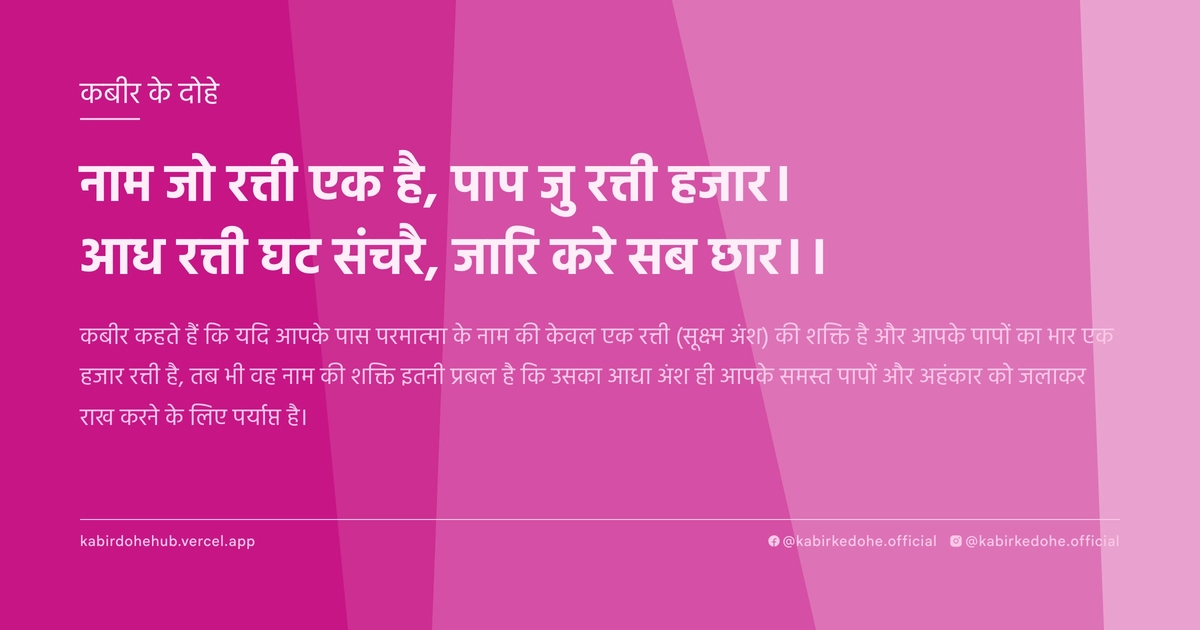
नाम जो रत्ती एक है, पाप जु रत्ती हजार।
आध रत्ती घट संचरै, जारि करे सब छार।।
Naam jo ratti ek hai, paap ju ratti hazaar. Aadh ratti ghat sanchrai, jaari kare sab chhaar.
इस पृष्ठ पर इस कबीर दोहे का अर्थ (meaning), हिंदी व्याख्या और अंग्रेज़ी अनुवाद, दार्शनिक विश्लेषण और व्यावहारिक जीवन सीख दी गई है। यह दोहा भक्ति (Bhakti) विषय से जुड़ा है — Kabir doha meaning and explanation in Hindi and English.
अर्थ (Meaning):
कबीर कहते हैं कि यदि आपके पास परमात्मा के नाम की केवल एक रत्ती (सूक्ष्म अंश) की शक्ति है और आपके पापों का भार एक हजार रत्ती है, तब भी वह नाम की शक्ति इतनी प्रबल है कि उसका आधा अंश ही आपके समस्त पापों और अहंकार को जलाकर राख करने के लिए पर्याप्त है।
Kabir asserts that even if the power of the Divine Name is but a single 'ratti' (the smallest unit of weight) and your accumulated sins weigh a thousand ratti, the potency of that Name is so immense that even half a ratti of spiritual awareness is sufficient to incinerate the entirety of your karmic burdens and ego into ashes.
व्याख्या (Interpretation):
शाब्दिक अर्थ यह है कि ईश्वरीय नाम की शक्ति पापों की संख्या से कहीं अधिक है। रूपकात्मक रूप से, 'नाम' यहाँ किसी शब्द का जाप नहीं, बल्कि 'शून्य' या 'परम चेतना' का बोध है। यह निर्गुण भक्ति का सार है जहाँ आत्मा का परमात्मा से मिलन होता है। माया के प्रभाव में मनुष्य पापों के बोझ तले दबा रहता है, लेकिन जैसे ही ज्ञान की एक छोटी सी चिंगारी (आध रत्ती) भीतर प्रवेश करती है, वह अज्ञान के घने अंधकार और संचित कर्मों को नष्ट कर देती। यह अद्वैत वेदांत के उस सिद्धांत को दर्शाता है जहाँ एक बार सत्य का साक्षात्कार होने पर द्वैत और पाप का अस्तित्व समाप्त हो जाता है।
Literally, the verse suggests the Divine Name outweighs any amount of sin. Metaphorically, 'Naam' does not refer to a mere linguistic chant but to the awakening of the 'Shunya' or the Absolute Consciousness. This is the essence of Nirgun Bhakti, where the soul recognizes its identity with the formless Divine. Under the veil of Maya, the human psyche accumulates layers of karmic debris (paap), but the moment a microscopic spark of Gnosis (half a ratti) penetrates the heart, it acts as a spiritual catalyst. This reflects the Advaita Vedanta principle where the realization of non-duality instantly dissolves the illusion of the separate, sinful ego, reducing the perceived burden of karma to mere ash.
दार्शनिक विश्लेषण (Philosophical Analysis):
कबीर का यह दोहा उस कालखंड का है जब समाज कर्मकांडों और बाहरी आडंबरों में जकड़ा हुआ था। उन्होंने स्पष्ट किया कि मोक्ष किसी तीर्थयात्रा या कठिन अनुष्ठान से नहीं, बल्कि आंतरिक रूपांतरण से मिलता है। यहाँ 'नाम' का अर्थ है वह सार्वभौमिक सत्य जो जाति, धर्म और वर्ग से परे है।
यह दर्शन सूफीवाद के 'फना' (अहंकार का विनाश) और वेदांत के 'ब्रह्म ज्ञान' का संगम है। कबीर तर्क देते हैं कि पाप वास्तव में अज्ञानता है। जब व्यक्ति यह जान लेता है कि वह स्वयं ब्रह्म है, तो पाप करने वाला 'कर्ता' ही गायब हो जाता है।
उनका प्रहार उन पुरोहितों पर था जो पाप-पुण्य के डर से लोगों को नियंत्रित करते थे। कबीर ने सिखाया कि ईश्वर की कृपा या नाम की शक्ति किसी गणितीय गणना का विषय नहीं है, बल्कि एक गुणात्मक छलांग है।
मनोवैज्ञानिक स्तर पर, यह 'नाम' एक मानसिक लंगर (anchor) की तरह कार्य करता है। जब व्यक्ति अपनी पहचान को एक छोटे से ईश्वरीय अंश से जोड़ लेता है, तो उसके पुराने अपराधबोध और मानसिक द्वंद्व स्वतः समाप्त होने लगते हैं।
अंततः, यह दोहा यह संदेश देता है कि आध्यात्मिक जागृति की मात्रा चाहे कितनी भी सूक्ष्म क्यों न हो, वह भौतिक जगत के समस्त संचित विकारों से अधिक शक्तिशाली होती है। यह मात्रा (Quantity) पर गुणवत्ता (Quality) की विजय है।
Kabir’s couplet emerges from an era stifled by rigid ritualism and ecclesiastical control. He posits that liberation is not achieved through external pilgrimages or complex rites, but through a profound internal alchemy. Here, 'Naam' represents the Universal Truth that transcends caste, creed, and social stratification.
This philosophy is a synthesis of the Sufi concept of 'Fana' (annihilation of the self) and the Vedantic realization of 'Brahman'. Kabir argues that 'sin' is essentially a byproduct of ignorance (Avidya). Once the seeker realizes their inherent oneness with the Absolute, the 'doer' of the sin vanishes, leaving only the witness.
He directly challenges the religious authorities of his time who used the fear of sin to maintain social hierarchies. Kabir suggests that divine grace or the power of the Name is not a mathematical calculation of merit and demurits, but a qualitative leap in consciousness.
Psychologically, this 'Naam' acts as a spiritual anchor. When an individual aligns their identity with a singular point of divine awareness, the fragmented ego and its associated guilt begin to dissolve, replacing chaos with a centered stillness.
Ultimately, the verse emphasizes that spiritual awakening, no matter how infinitesimal it may seem, is exponentially more powerful than the accumulated debris of a lifetime of errors. It is the triumph of spiritual quality over material quantity.
मूल संदेश (Core Message):
- अहंकार का बोझ अनंत है, लेकिन बोध की एक किरण उसे मिटाने के लिए पर्याप्त है।
- पाप वास्तव में अज्ञानता है; ज्ञान का उदय ही पाप का अंत है।
- मात्रा से अधिक गुणवत्ता महत्वपूर्ण है; एक क्षण का सच्चा बोध जीवन भर के भ्रम को काट देता है।
- परमात्मा का नाम कोई शब्द नहीं, बल्कि शुद्ध चेतना की अवस्था है।
- स्वयं को अपनी गलतियों से अलग पहचानना ही वास्तविक मुक्ति की शुरुआत है।
- आंतरिक रूपांतरण बाहरी अनुष्ठानों से कहीं अधिक शक्तिशाली और त्वरित है।
- The burden of ego is infinite, but a single ray of awareness is enough to dissolve it.
- Sin is essentially ignorance; the dawn of knowledge is the end of sin.
- Quality outweighs quantity; one moment of true realization severs a lifetime of illusion.
- The Divine Name is not a word, but a state of pure, unadulterated consciousness.
- Recognizing yourself as distinct from your mistakes is the beginning of true liberation.
- Internal transformation is far more powerful and immediate than any external ritual.
व्यावहारिक उदाहरण (Practical Example):
वाराणसी के घाटों पर रहने वाले एक वृद्ध बुनकर, माधव, का जीवन ग्लानि से भरा था। युवावस्था में उसने अपने परिवार के साथ विश्वासघात किया था और धन के लालच में अपनों को ठुकरा दिया था।
वर्षों बाद, वह एक टूटी हुई झोपड़ी में रहता था, जहाँ वह हर दिन अपने पापों की गिनती करता। उसे लगता था कि उसके पापों का पहाड़ इतना ऊँचा है कि ईश्वर उसे कभी क्षमा नहीं करेंगे।
एक दिन, उसने एक फकीर को देखा जो केवल 'सत्य' शब्द का मौन जाप कर रहा था। माधव ने उससे पूछा, 'मेरे पाप हजारों में हैं, क्या एक छोटा सा शब्द मुझे बचा सकता है?'
फकीर ने मुस्कुराते हुए कहा, 'एक छोटा सा दीया पूरे अंधेरे कमरे को मिटा देता है, चाहे अंधेरा कितना भी पुराना क्यों न हो।'
माधव ने उस दिन से बाहरी दिखावे को छोड़कर, केवल अपने भीतर के उस एक 'सत्य' के अंश को खोजने का प्रयास किया। उसने अपनी पूरी ऊर्जा केवल एक विचार पर केंद्रित की: 'मैं वह नहीं हूँ जो मैंने किया, मैं वह हूँ जो मैं वास्तव में हूँ।'
धीरे-धीरे, उसका ध्यान गहरा हुआ। एक सुबह, उसे महसूस हुआ कि जिस 'पाप' को वह ढो रहा था, वह केवल उसके अहंकार की एक रचना थी।
जैसे ही उसने उस सूक्ष्म सत्य (नाम) को पकड़ा, उसके मन का सारा बोझ, सारी कड़वाहट और ग्लानि एक पल में जलकर राख हो गई।
उसने अपना शेष जीवन उन लोगों की सेवा में लगा दिया जिन्हें उसने कभी ठुकराया था, लेकिन अब वह पश्चाताप से नहीं, बल्कि प्रेम से प्रेरित था।
माधव का रूपांतरण यह सिद्ध करता है कि जब आंतरिक बोध जागता है, तो अतीत का सारा मलिनता स्वतः समाप्त हो जाता है।
वह अब एक अपराधी नहीं, बल्कि एक मुक्त आत्मा था, जिसने नाम की उस 'आध रत्ती' शक्ति को अनुभव किया था।
Madhav, an elderly weaver living on the ghats of Varanasi, spent his twilight years consumed by profound guilt. In his youth, he had betrayed his kin and abandoned his family for the sake of greed and material gain.
He lived in a dilapidated hut, spending his days counting his transgressions. He believed the mountain of his sins was so towering that no divine mercy could ever reach him.
One day, he encountered a wandering Sufi who sat in absolute silence, mentally chanting the word 'Truth'. Madhav asked, 'My sins are in the thousands; can a single word possibly save me?'
The Sufi smiled and replied, 'A single tiny lamp erases the darkness of an entire room, no matter how ancient that darkness may be.'
From that day, Madhav ceased his external lamentations and began seeking that one singular spark of 'Truth' within himself. He focused his entire being on one realization: 'I am not the actions I performed; I am the consciousness that witnesses them.'
Slowly, his meditation deepened. One morning, he experienced a sudden flash of insight—the 'sin' he had been carrying was merely a construct of his ego, a story he told himself to remain separate from the Divine.
As he grasped that infinitesimal point of Truth (the Naam), the entire burden of his past, the bitterness, and the crushing guilt were incinerated in an instant.
He spent the remainder of his life serving those he had once wronged, not out of a sense of penance, but from a place of overflowing love.
Madhav's transformation proves that when internal awakening occurs, the accumulated filth of the past is spontaneously purified.
He was no longer a criminal in his own eyes, but a liberated soul who had experienced the potency of that 'half a ratti' of spiritual awareness.
अभ्यास मार्गदर्शन (Practice Guidance):
- प्रतिदिन 20 मिनट के लिए 'शून्य' या अपने इष्ट के नाम पर ध्यान केंद्रित करें, यह सोचकर कि यह एक सूक्ष्म बीज है जो आपके भीतर के विकारों को नष्ट कर रहा है।
- एक 'ग्लानि पत्रिका' (Guilt Journal) बनाएँ। अपने उन कार्यों को लिखें जिन्हें आप पाप मानते हैं, और फिर उनके सामने लिखें कि 'यह मेरा अहंकार था, मेरी आत्मा नहीं'।
- व्यवहार परिवर्तन: जब भी क्रोध या लोभ आए, रुककर स्वयं से पूछें—'क्या मैं अपनी पहचान इस भावना से जोड़ रहा हूँ या उस शाश्वत नाम से?'
- नैदानिक चेकलिस्ट: यदि आप अभी भी अतीत की गलतियों के कारण स्वयं को छोटा महसूस करते हैं, तो आप 'पाप की रत्ती' में फंसे हैं। यदि आप अपनी गलतियों को स्वीकार कर उन्हें प्रेम में बदल रहे हैं, तो 'नाम की रत्ती' सक्रिय हो रही है।
- Dedicate 20 minutes daily to focus on 'Shunya' (the Void) or a Divine Name, visualizing it as a microscopic seed that incinerates all internal impurities.
- Maintain a 'Guilt Journal'. List the actions you perceive as sins, and beside each, write: 'This was the ego's action, not the essence of my Soul'.
- Behavioral Shift: Whenever anger or greed arises, pause and ask—'Am I identifying with this fleeting emotion or with the Eternal Name?'
- Diagnostic Checklist: If you still feel diminished by past mistakes, you are trapped in the 'ratti of sin'. If you accept your errors and transform them into compassion, the 'ratti of Naam' is becoming active.
चिंतन प्रश्न (Reflection Questions):
- क्या मेरा 'पाप बोध' वास्तव में मेरी आत्मा की शुद्धि के लिए है, या यह मेरे अहंकार का एक सूक्ष्म रूप है जो खुद को 'दुखी' देखकर संतुष्ट होता है?
- मैं अपनी डिजिटल पहचान और सार्वजनिक छवि को बनाए रखने के लिए किन आंतरिक सत्यों की बलि दे रहा हूँ?
- यदि मेरे जीवन के सारे 'पुण्य' छीन लिए जाएँ, तो क्या मुझमें वह एक 'रत्ती' साहस बचेगा कि मैं स्वयं को ईश्वर का अंश मान सकूँ?
- मेरे जीवन का वह कौन सा 'अंधेरा' है जिसे मैं स्वीकार करने से डरता हूँ, और क्या मैं उसे 'नाम' की अग्नि में जलाने के लिए तैयार हूँ?
- क्या मैं धर्म का उपयोग दूसरों को उनके 'पापों' से आंकने के लिए कर रहा हूँ, या स्वयं के भीतर के अंधकार को मिटाने के लिए?
- Is my 'sense of guilt' truly for the purification of my soul, or is it a subtle form of ego that finds satisfaction in playing the role of the 'sufferer'?
- Which internal truths am I sacrificing to maintain my digital persona and public image?
- If all my 'merits' and 'good deeds' were stripped away, would I have that one 'ratti' of courage to still identify as a spark of the Divine?
- What is the specific 'darkness' in my life that I am afraid to acknowledge, and am I ready to let it be incinerated by the fire of Truth?
- Am I using religion as a tool to judge others by their 'sins', or as a means to dissolve the darkness within myself?