
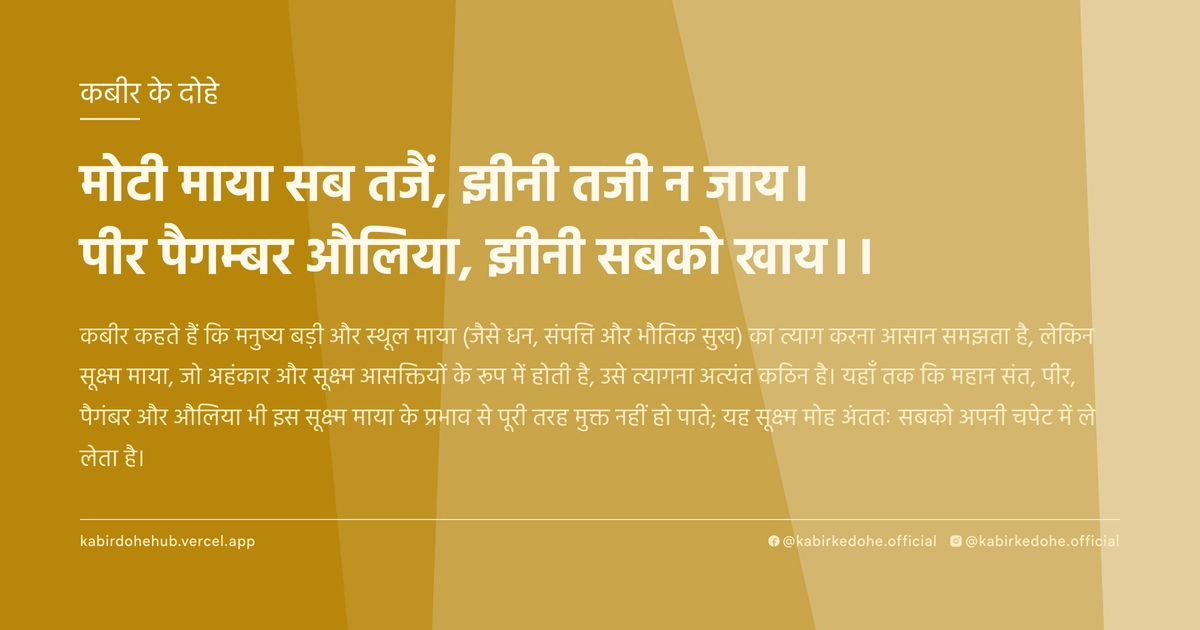
मोटी माया सब तजैं, झीनी तजी न जाय।
पीर पैगम्बर औलिया, झीनी सबको खाय।।
Moti maya sab tajein, jheeni taji na jaaye. Peer paigambar auliya, jheeni sabko khaye.
इस पृष्ठ पर इस कबीर दोहे का अर्थ (meaning), हिंदी व्याख्या और अंग्रेज़ी अनुवाद, दार्शनिक विश्लेषण और व्यावहारिक जीवन सीख दी गई है। यह दोहा माया (Maya) विषय से जुड़ा है — Kabir doha meaning and explanation in Hindi and English.
अर्थ (Meaning):
कबीर कहते हैं कि मनुष्य बड़ी और स्थूल माया (जैसे धन, संपत्ति और भौतिक सुख) का त्याग करना आसान समझता है, लेकिन सूक्ष्म माया, जो अहंकार और सूक्ष्म आसक्तियों के रूप में होती है, उसे त्यागना अत्यंत कठिन है। यहाँ तक कि महान संत, पीर, पैगंबर और औलिया भी इस सूक्ष्म माया के प्रभाव से पूरी तरह मुक्त नहीं हो पाते; यह सूक्ष्म मोह अंततः सबको अपनी चपेट में ले लेता है।
Kabir asserts that while humans find it relatively simple to renounce gross illusions—such as wealth, property, and material luxuries—the subtle maya, manifesting as ego and minute attachments, remains stubbornly entrenched. Even the most revered spiritual figures, including Peers, Prophets, and Saints, are not entirely immune to this subtle veil; it is this invisible attachment that eventually consumes all who are not fully awakened.
व्याख्या (Interpretation):
इस दोहे में 'मोटी माया' का अर्थ भौतिक संपदा से है, जिसे समाज में संन्यास लेकर आसानी से छोड़ा जा सकता है। 'झीनी माया' वह सूक्ष्म अहंकार है जो 'मैं एक संत हूँ' या 'मैं ज्ञानी हूँ' के रूप में प्रकट होता है। यह निरगुण भक्ति का सार है कि ईश्वर केवल बाहरी त्याग से नहीं, बल्कि आंतरिक शून्य से प्राप्त होता है। अद्वैत वेदांत के अनुसार, जब तक 'मैं' का सूक्ष्म बोध रहता है, तब तक आत्मा और ब्रह्म का मिलन संभव नहीं है। यह विरोधाभास है कि जो व्यक्ति दुनिया छोड़ता है, वह अक्सर अपनी इस उपलब्धि के अहंकार में फंस जाता है। माया केवल धन नहीं, बल्कि वह विचार है जो हमें पूर्णता से अलग करता है।
In this verse, 'Moti Maya' refers to gross material wealth, which is easily renounced through formal asceticism. 'Jheeni Maya' is the subtle ego, manifesting as the pride of being a 'saint' or 'learned.' This aligns with Nirgun Bhakti, suggesting that the Divine is reached not through external renunciation, but through internal void. According to Advaita Vedanta, as long as the subtle sense of 'I' persists, the non-duality of Atman and Brahman remains obscured. The central paradox lies in the fact that one who abandons the world often becomes trapped in the ego of their own renunciation. Maya is not merely money, but any thought-form that creates a perceived separation from the Absolute.
दार्शनिक विश्लेषण (Philosophical Analysis):
कबीर का यह प्रहार उस समय के धार्मिक पाखंड और औपचारिक संन्यास पर था। उन्होंने देखा कि लोग गेरुए वस्त्र पहनकर या माला जपकर खुद को मुक्त मान लेते हैं, जबकि उनका अहंकार और भी गहरा हो जाता है। यह विश्लेषण सूफी मत के 'नफ्स' (अहंकार) के विनाश से मेल खाता है, जहाँ साधक को अपनी इच्छाओं के साथ-साथ अपनी आध्यात्मिक श्रेष्ठता के भ्रम को भी मिटाना होता है।
ऐतिहासिक रूप से, कबीर ने जाति और धर्म की सीमाओं को तोड़कर एक ऐसे सत्य की खोज की जो किसी मंदिर या मस्जिद में नहीं, बल्कि मनुष्य के भीतर है। वे बताते हैं कि बाहरी कर्मकांड केवल 'मोटी माया' का खेल हैं। असली चुनौती उस सूक्ष्म पर्दे को हटाना है जो हमें यह विश्वास दिलाता है कि हम दूसरों से भिन्न या श्रेष्ठ हैं।
अद्वैत वेदांत के परिप्रेक्ष्य में, यह 'झीनी माया' ही अविद्या है। जब तक यह सूक्ष्म अविद्या रहती है, तब तक जीव स्वयं को कर्ता और भोक्ता मानता रहता है। कबीर यहाँ चेतावनी दे रहे हैं कि आध्यात्मिक पद (जैसे पीर या औलिया होना) स्वयं में एक जाल बन सकते हैं यदि उनमें विनम्रता और पूर्ण समर्पण का अभाव हो।
मनोवैज्ञानिक स्तर पर, यह 'कॉग्निटिव बायस' की तरह है जहाँ व्यक्ति अपनी धार्मिक पहचान को अपनी वास्तविक पहचान मान लेता है। यह पहचान उसे एक सुरक्षा कवच देती है, लेकिन वास्तव में वह उसे सत्य से दूर ले जाती है। अहंकार का यह सूक्ष्म रूप सबसे घातक है क्योंकि यह पवित्रता के मुखौटे में आता है।
अंततः, कबीर का संदेश यह है कि मुक्ति केवल बाहरी त्याग में नहीं, बल्कि आंतरिक विसर्जन में है। जब तक 'ज्ञानी' होने का गर्व है, तब तक ज्ञान केवल एक और बंधन है। वास्तविक मुक्ति तब होती है जब ज्ञाता, ज्ञान और ज्ञेय का भेद समाप्त हो जाता है और केवल शुद्ध चेतना शेष रहती है।
Kabir's critique targets the religious hypocrisy and formal asceticism of his era. He observed that people often assumed liberation simply by wearing saffron robes or chanting beads, while their internal ego grew more profound. This analysis resonates with the Sufi concept of 'Nafs' (the lower self), where the seeker must annihilate not only worldly desires but also the illusion of spiritual superiority.
Historically, Kabir transcended caste and creed to seek a truth residing within the human heart rather than in temples or mosques. He argues that external rituals are merely games of 'gross maya.' The real challenge is removing the subtle veil that convinces us we are distinct or superior to others.
From the perspective of Advaita Vedanta, this 'subtle maya' is Avidya (ignorance). As long as this persists, the individual continues to perceive themselves as the doer and the enjoyer. Kabir warns that spiritual titles—such as Peer or Auliya—can become traps if they lack genuine humility and total surrender.
Psychologically, this operates like a cognitive bias where an individual mistakes their religious identity for their true essence. This identity provides a false sense of security but actually distances them from the Absolute. This subtle form of ego is the most dangerous because it arrives masked as holiness.
Ultimately, Kabir teaches that liberation is not found in external renunciation, but in internal dissolution. As long as the pride of being 'learned' exists, knowledge is merely another chain. True liberation occurs when the distinction between the knower, the known, and the knowledge vanishes, leaving only pure consciousness.
मूल संदेश (Core Message):
- बाहरी त्याग आसान है, आंतरिक विसर्जन कठिन है।
- अहंकार केवल धन में नहीं, ज्ञान और पवित्रता में भी होता है।
- आध्यात्मिक पद अक्सर मुक्ति के मार्ग में सबसे बड़ी बाधा बनते हैं।
- सत्य वह है जो 'मैं' के अंतिम अवशेष को भी मिटा दे।
- विनम्रता ही वह एकमात्र कुंजी है जो सूक्ष्म माया का ताला खोलती है।
- External renunciation is easy; internal dissolution is the true challenge.
- Ego resides not only in wealth, but also in knowledge and perceived purity.
- Spiritual titles often become the greatest obstacles on the path to liberation.
- Truth is that which erases the final residue of the 'I'.
- Humility is the only key that unlocks the lock of subtle maya.
व्यावहारिक उदाहरण (Practical Example):
वाराणसी के एक पुराने घाट पर माधव नाम का एक वृद्ध बुनकर रहता था। माधव ने अपनी पूरी जिंदगी सादगी में बिताई और अंततः सब कुछ त्याग कर एक तपस्वी बन गया। उसने अपना घर, कपड़े और धन सब दान कर दिया। लोग उसे 'महात्मा' कहकर पुकारने लगे।
माधव को इस बात का गहरा संतोष था कि उसने 'मोटी माया' को जीत लिया है। वह घंटों ध्यान करता और लोग उसके पास आशीर्वाद लेने आते। धीरे-धीरे, माधव के मन में यह विचार घर करने लगा कि वह इस शहर के सबसे शुद्ध व्यक्ति हैं।
जब भी कोई अन्य साधु उसके पास आता, माधव अनजाने में उनकी साधना की कमियां ढूंढने लगता। वह सोचने लगा, "इनकी विधि गलत है, मेरी विधि ही सत्य है।"
एक दिन, एक साधारण सा भिखारी उसके पास आया और उससे पानी मांगा। माधव ने उसे पानी तो दिया, लेकिन उसके मन में विचार आया कि यह भिखारी कितना अशुद्ध है और मैं कितना पवित्र हूँ।
तभी उसे कबीर का वह दोहा याद आया कि सूक्ष्म माया सबको खा जाती है। उसे अहसास हुआ कि उसने धन तो छोड़ दिया, लेकिन 'पवित्रता के अहंकार' को नहीं छोड़ा।
उसने महसूस किया कि उसका यह 'महात्मा' होने का गर्व, उस सोने के गहनों से कहीं अधिक भारी बोझ था जिसे उसने वर्षों पहले त्याग दिया था।
माधव की आंखों में आंसू आ गए। उसने महसूस किया कि वह अब तक केवल एक भ्रम से दूसरे भ्रम की ओर गया था।
उसने अपनी आँखें बंद कीं और प्रार्थना की कि वह इस सूक्ष्म अहंकार से मुक्त हो सके। उसने अब खुद को 'महात्मा' मानना बंद कर दिया और स्वयं को केवल एक सेवक समझा।
उस दिन के बाद, माधव ने किसी को सुधारने की कोशिश नहीं की, बल्कि स्वयं के भीतर की अशुद्धियों को देखना शुरू किया।
यही वह 'कबीर ट्विस्ट' था जिसने उसे वास्तविक शांति दी—जब उसने अपनी आध्यात्मिक श्रेष्ठता के मुखौटे को उतार फेंका।
On an ancient ghat in Varanasi lived an elderly weaver named Madhav. Madhav spent his entire life in simplicity and eventually renounced everything to become an ascetic. He donated his home, clothes, and wealth to the needy.
Madhav felt a deep sense of satisfaction that he had conquered 'gross maya.' He spent hours in meditation, and people flocked to him for blessings, calling him a 'Mahatma.'
Gradually, a thought took root in Madhav's mind: that he was the purest soul in the entire city. He began to feel a quiet superiority over others.
Whenever another seeker approached him, Madhav unconsciously began searching for flaws in their practice, thinking, "Their method is wrong; only my path is the truth."
One day, a simple beggar approached him and asked for water. Madhav gave him the water, but a thought flashed through his mind: "How impure this beggar is, and how pure I am."
At that moment, Kabir's verse echoed in his mind—that subtle maya consumes everyone. He realized that while he had abandoned wealth, he had not abandoned the 'ego of purity.'
He understood that his pride in being a 'Mahatma' was a far heavier burden than the gold ornaments he had discarded years ago.
Tears welled in Madhav's eyes. He realized he had merely moved from one illusion to another, more sophisticated one.
He closed his eyes and prayed to be liberated from this subtle arrogance. He stopped identifying as a 'great soul' and began seeing himself as a mere servant of the Divine.
From that day on, Madhav stopped trying to correct others and instead focused on observing the impurities within his own heart.
This was the 'Kabir Twist' that brought him true peace—the moment he tore down the mask of spiritual superiority.
अभ्यास मार्गदर्शन (Practice Guidance):
- प्रतिदिन 20 मिनट मौन आत्म-निरीक्षण करें: यह देखें कि जब आप किसी की मदद करते हैं, तो क्या आपके भीतर 'दाता' होने का अहंकार जागता है?
- जर्नलिंग प्रॉम्प्ट: "आज मैंने किन सूक्ष्म तरीकों से अपनी श्रेष्ठता सिद्ध करने की कोशिश की?" इसे ईमानदारी से लिखें।
- व्यवहार परिवर्तन: जब भी आपको लगे कि आप किसी से अधिक 'जागरूक' या 'आध्यात्मिक' हैं, तो तुरंत उस विचार को पहचानें और उसे विसर्जित करें।
- डायग्नोस्टिक चेकलिस्ट: क्या मैं दूसरों की गलतियों पर तुरंत प्रतिक्रिया देता हूँ? क्या मुझे अपनी धार्मिक/नैतिक पहचान पर गर्व है? यदि हाँ, तो सूक्ष्म माया सक्रिय है।
- Daily 20-minute silent self-observation: Notice if the ego of being a 'giver' arises when you help someone.
- Journaling Prompt: "In what subtle ways did I attempt to prove my superiority today?" Write this with absolute honesty.
- Behavioral Shift: Whenever you feel more 'aware' or 'spiritual' than another, immediately identify that thought and let it dissolve.
- Diagnostic Checklist: Do I react instantly to others' mistakes? Do I feel pride in my religious or moral identity? If yes, subtle maya is active.
चिंतन प्रश्न (Reflection Questions):
- क्या मेरी आध्यात्मिक प्रगति वास्तव में अहंकार का विसर्जन है, या यह केवल एक नए, अधिक परिष्कृत अहंकार का निर्माण है?
- यदि मेरी सारी धार्मिक पहचान और उपलब्धियाँ छीन ली जाएँ, तो मेरे भीतर क्या बचेगा?
- मैं अपनी 'अच्छाई' का उपयोग दूसरों को नीचा दिखाने के लिए सूक्ष्म रूप से कैसे करता हूँ?
- क्या मैं वास्तव में सत्य की खोज कर रहा हूँ, या मैं केवल 'सत्य खोजने वाले' की छवि का आनंद ले रहा हूँ?
- मेरे जीवन का वह कौन सा सूक्ष्म मोह है जिसे मैं 'धर्म' या 'कर्तव्य' का नाम देकर बचा रहा हूँ?
- Is my spiritual progress truly the dissolution of ego, or is it merely the construction of a new, more sophisticated ego?
- If all my religious identities and achievements were stripped away, what would remain within me?
- How do I subtly use my 'goodness' to make others feel inferior?
- Am I truly seeking the Truth, or am I simply enjoying the image of being a 'truth-seeker'?
- What is that subtle attachment in my life that I am protecting by labeling it as 'religion' or 'duty'?