
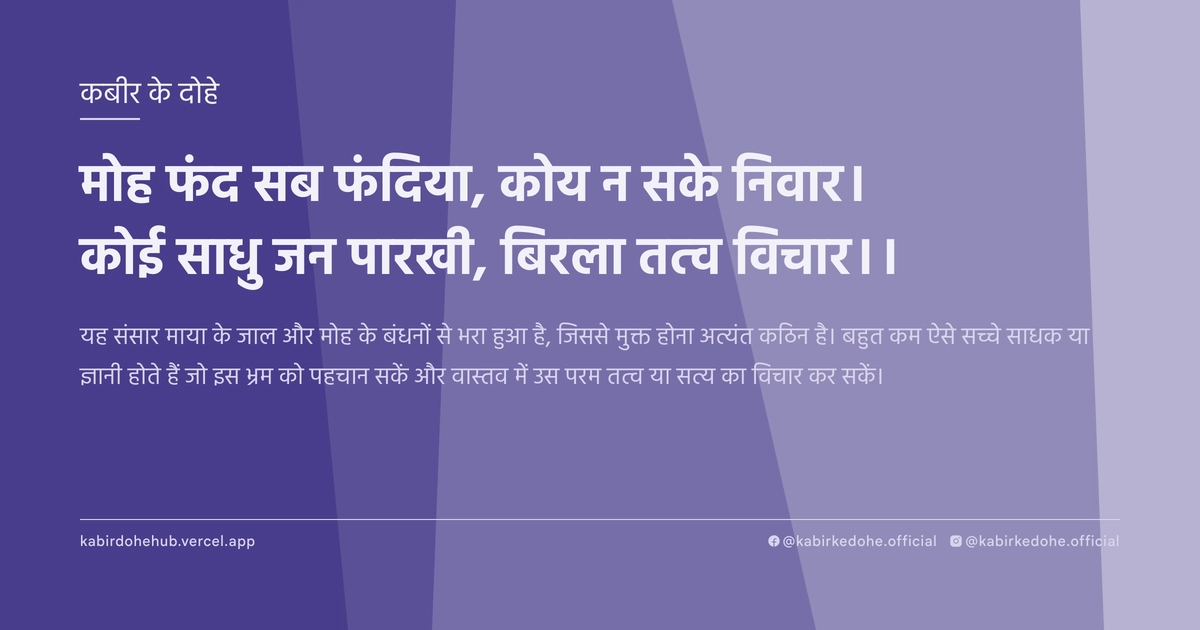
मोह फंद सब फंदिया, कोय न सके निवार।
कोई साधु जन पारखी, बिरला तत्व विचार।।
Moh phand sab phandiya, koy na sake nivar. Koi sadhu jan parkhi, birla tatv vichar.
इस पृष्ठ पर इस कबीर दोहे का अर्थ (meaning), हिंदी व्याख्या और अंग्रेज़ी अनुवाद, दार्शनिक विश्लेषण और व्यावहारिक जीवन सीख दी गई है। यह दोहा मुक्ति (Liberation) विषय से जुड़ा है — Kabir doha meaning and explanation in Hindi and English.
अर्थ (Meaning):
यह संसार माया के जाल और मोह के बंधनों से भरा हुआ है, जिससे मुक्त होना अत्यंत कठिन है। बहुत कम ऐसे सच्चे साधक या ज्ञानी होते हैं जो इस भ्रम को पहचान सकें और वास्तव में उस परम तत्व या सत्य का विचार कर सकें।
The entire world is a complex web of traps and attachments from which escape seems impossible. Only a rare few, the truly awakened seekers, possess the discernment to recognize these illusions and contemplate the actual essence of Truth.
व्याख्या (Interpretation):
कबीर यहाँ 'फंद' (जाल) शब्द का प्रयोग माया के लिए कर रहे हैं। शाब्दिक अर्थ में, यह सांसारिक मोह-माया का जाल है, लेकिन आध्यात्मिक स्तर पर यह अज्ञानता (Avidya) है जो आत्मा को शरीर और अहंकार से बांधती है। यह निर्गुण भक्ति का संकेत है जहाँ ईश्वर किसी मूर्ति में नहीं, बल्कि उस 'तत्व' में है जिसे केवल आंतरिक विश्लेषण से पाया जा सकता है। यह द्वैतवाद का खंडन है, क्योंकि जब तक हम स्वयं को इस जाल का हिस्सा मानते हैं, हम सत्य से दूर रहते हैं। केवल वह 'बिरला' (दुर्लभ) व्यक्ति ही पार उतरता है जो बाहरी कर्मकांडों को छोड़कर आत्म-साक्षात्कार की ओर बढ़ता है।
Kabir employs the metaphor of 'phand' (a snare or trap) to describe Maya. Literally, it refers to worldly attachments, but metaphysically, it signifies Avidya (ignorance) that binds the Atman to the ego and physical form. This aligns with Nirgun Bhakti, suggesting that the Divine is not found in idols but in the 'Tattva' (Essence) accessible only through internal scrutiny. It challenges dualism; as long as we perceive ourselves as separate from the whole, we remain trapped. Only the 'Birla' (the rare one) transcends this by shifting focus from external rituals to the non-dual reality of Brahman, recognizing that the trap is not external, but a projection of the mind.
दार्शनिक विश्लेषण (Philosophical Analysis):
कबीर का यह दोहा उस समय के सामाजिक और धार्मिक परिवेश पर प्रहार करता है जहाँ लोग तीर्थयात्राओं और बाहरी आडंबरों को मोक्ष का मार्ग मानते थे। वे स्पष्ट करते हैं कि मोक्ष किसी बाहरी क्रिया से नहीं, बल्कि 'तत्व विचार' यानी सत्य के विश्लेषण से आता है। यह अद्वैत वेदांत के उस सिद्धांत से मेल खाता है जहाँ जगत को मिथ्या और ब्रह्म को एकमात्र सत्य माना गया है।
सूफीवाद के नजरिए से, यह 'नफ्स' (अहंकार) के विनाश की बात है। जब तक इंसान अपनी इच्छाओं और सामाजिक पहचान के जाल में फंसा है, वह खुदा या सत्य को नहीं देख सकता। कबीर यहाँ यह समझा रहे हैं कि धर्म केवल नाम बदलने या माला जपने में नहीं है, बल्कि चेतना के स्तर को ऊपर उठाने में है।
वे जाति और वर्ण व्यवस्था को भी इसी 'फंद' का हिस्सा मानते थे। उनके अनुसार, ऊंच-नीच का भेद केवल अज्ञानता का परिणाम है। जब व्यक्ति तत्व को जान लेता है, तो वह देखता है कि सभी में एक ही नूर या चेतना प्रवाहित हो रही है।
मनोवैज्ञानिक रूप से, यह दोहा संज्ञानात्मक विसंगति (cognitive dissonance) की बात करता है। हम जिसे सुख समझते हैं, वह वास्तव में एक सूक्ष्म बंधन है। कबीर हमें उस मानसिक कंडीशनिंग को तोड़ने के लिए प्रेरित करते हैं जो हमें समाज द्वारा निर्धारित 'सफलता' और 'पहचान' के पीछे भागने पर मजबूर करती है।
अंततः, यह दोहा एक चेतावनी है कि सत्य की खोज कठिन है क्योंकि यह हमारी सहज प्रवृत्तियों के विरुद्ध है। यह हमें सहजता से स्वीकार किए गए सत्यों पर प्रश्न उठाने और स्वयं के भीतर के 'साधु' को जगाने का आह्वान करता है, ताकि हम माया के इस जटिल जाल को काटकर मुक्त हो सकें।
This Doha critiques the socio-religious climate of Kabir's era, where salvation was erroneously sought through pilgrimages and external rituals. Kabir asserts that liberation is not a product of ritualistic action but of 'Tattva Vichar'—the analytical contemplation of the Absolute Truth. This resonates deeply with Advaita Vedanta, which posits the world as Maya (illusion) and Brahman as the only ultimate reality.
From a Sufi perspective, this is an invitation to the annihilation of the 'Nafs' (the lower ego). As long as a human is entangled in the web of desires and social identities, the Divine remains hidden. Kabir emphasizes that spirituality is not about changing one's label or reciting beads, but about elevating the state of consciousness.
He views the caste system and social hierarchies as integral parts of this 'phand' (trap). According to Kabir, the distinction between high and low is a byproduct of ignorance. Once the 'Tattva' is realized, one perceives the same universal consciousness flowing through every living being, regardless of birth.
Psychologically, the verse addresses the nature of attachment. What we perceive as pleasure or security is often a subtle snare. Kabir urges the seeker to break the mental conditioning that compels them to chase societal definitions of success and identity, which only further tighten the knot of the ego.
Ultimately, the Doha serves as a warning: the path to Truth is arduous because it requires moving against the current of instinctive desires. It is a call to question accepted norms and awaken the internal 'Sadhu' (the wise one) to sever the intricate threads of illusion and attain spiritual autonomy.
मूल संदेश (Core Message):
- सांसारिक मोह एक अदृश्य जाल है जो आत्मा को सीमित करता है।
- बाहरी कर्मकांड केवल भ्रम को बढ़ाते हैं, सत्य को नहीं।
- सच्ची मुक्ति केवल आंतरिक तत्व के विश्लेषण से संभव है।
- अहंकार का विसर्जन ही माया के जाल को काटने का एकमात्र तरीका है।
- ईश्वर किसी स्थान पर नहीं, बल्कि चेतना की गहराई में स्थित है।
- Worldly attachment is an invisible snare that limits the soul.
- External rituals only amplify the illusion, not the Truth.
- True liberation is possible only through the analysis of the inner essence.
- The dissolution of ego is the only way to cut through the web of Maya.
- The Divine resides not in a place, but in the depths of consciousness.
व्यावहारिक उदाहरण (Practical Example):
एक समय की बात है, वाराणसी के घाटों पर माधव नाम का एक वृद्ध नाविक रहता था। माधव का पूरा जीवन नाव चलाने और यात्रियों को पार उतारने में बीता था। वह बहुत धार्मिक था और हर दिन घंटों मंदिर में प्रार्थना करता था, इस उम्मीद में कि उसकी भक्ति उसे मोक्ष दिलाएगी।
माधव का मानना था कि यदि वह अधिक दान देगा और अधिक पूजा करेगा, तो वह जीवन के दुखों से मुक्त हो जाएगा। लेकिन जैसे-जैसे समय बीता, वह और अधिक चिंतित रहने लगा। उसे डर था कि कहीं उसके किसी पाप के कारण उसकी मुक्ति न रुक जाए।
एक दिन उसकी नाव पर एक फकीर सवार हुआ, जिसकी आँखों में एक अजीब सी शांति थी। फकीर ने देखा कि माधव पूजा करते समय भी बहुत बेचैन था। उसने माधव से पूछा, 'तुम किसे पार उतारने की कोशिश कर रहे हो?'
माधव ने उत्तर दिया, 'मैं अपनी आत्मा को इस संसार के दुखों से पार उतारना चाहता हूँ, प्रभु।' फकीर मुस्कुराया और बोला, 'तुम जिस किनारे की तलाश कर रहे हो, वह तुम्हारी नाव के नीचे ही है, लेकिन तुम उसे दूर क्षितिज पर ढूंढ रहे हो।'
माधव को लगा कि फकीर पागल है। लेकिन फकीर ने उसे एक बात कही, 'तुम मंदिर जाते हो, दान देते हो, यह सब एक जाल है यदि तुम इसे अपनी श्रेष्ठता सिद्ध करने के लिए कर रहे हो। असली जाल वह है जो तुम्हें यह विश्वास दिलाता है कि तुम और ईश्वर अलग-अलग हो।'
यह बात माधव के दिल में गहरे तक उतर गई। उसने महसूस किया कि उसकी सारी धार्मिकता वास्तव में उसके अहंकार को पाल रही थी। वह 'भक्त' होने के गर्व में फंसा हुआ था।
अगले कुछ महीनों तक, माधव ने बाहरी दिखावे वाली पूजा कम कर दी। उसने नाव चलाते समय केवल इस बात पर ध्यान देना शुरू किया कि वह और उसकी नाव, पानी और हवा, सब एक ही ऊर्जा का हिस्सा हैं।
उसने देखा कि जब वह 'मैं' को छोड़कर केवल 'होने' के भाव में रहता है, तो उसका डर गायब हो जाता है। वह अब केवल यात्रियों को पार नहीं उतार रहा था, बल्कि स्वयं के भीतर के उस तत्व को पहचान रहा था जो कभी बंधा ही नहीं था।
माधव की बेचैनी समाप्त हो गई। वह अब भी वही नाव चलाता था, लेकिन अब वह जाल में नहीं था। उसने जान लिया था कि मोक्ष किसी स्थान पर जाना नहीं, बल्कि इस भ्रम से जागना है कि हम अलग हैं।
उसका जीवन अब एक उत्सव बन गया था, जहाँ हर लहर उसे उस निराकार तत्व की याद दिलाती थी जिसे वह वर्षों तक मंदिरों की दीवारों में ढूंढ रहा था।
Once, on the ghats of Varanasi, lived an elderly boatman named Madhav. Madhav had spent his entire life rowing passengers across the river. He was deeply religious, spending hours in prayer every day, hoping his devotion would grant him Moksha.
Madhav believed that by increasing his donations and intensifying his rituals, he would be liberated from worldly suffering. However, as years passed, he became more anxious, fearing that some hidden sin might obstruct his liberation.
One day, a wandering fakir with an aura of profound peace boarded his boat. The fakir noticed that even while praying, Madhav was restless. He asked, 'Who are you trying to ferry across?'
Madhav replied, 'I wish to ferry my soul across the river of worldly sorrows, holy one.' The fakir smiled and said, 'The shore you seek is right beneath your boat, yet you search for it on the distant horizon.'
Madhav thought the fakir was mad. But the fakir added, 'Your temples and donations are but a snare if you do this to prove your superiority. The real trap is the belief that you and the Divine are separate.'
These words pierced Madhav's heart. He realized that his outward religiosity was actually feeding his ego. He was trapped in the pride of being a 'devotee.'
Over the next few months, Madhav reduced his performative rituals. While rowing, he began to focus on the realization that he, the boat, the water, and the wind were all manifestations of the same energy.
He discovered that when he let go of the 'I' and simply existed in the state of 'Being,' his fear vanished. He was no longer just ferrying passengers; he was recognizing the element within himself that was never bound.
Madhav's restlessness ceased. He continued to row the same boat, but he was no longer in the snare. He understood that liberation is not about reaching a destination, but about waking up from the illusion of separation.
His life became a celebration, where every ripple in the water reminded him of the formless essence he had spent years searching for within the walls of temples.
अभ्यास मार्गदर्शन (Practice Guidance):
- प्रतिदिन 20 मिनट मौन रहकर यह विचार करें कि आपकी कौन सी सामाजिक पहचान (पद, रिश्ता, धर्म) आपको सबसे अधिक बांधती है।
- एक 'अहंकार डायरी' लिखें: दिन भर में जब भी आपको 'मैं' या 'मेरा' होने का गर्व महसूस हो, उसे लिखें और विश्लेषण करें कि वह कौन सा 'जाल' है।
- व्यवहार परिवर्तन: किसी ऐसे व्यक्ति की मदद करें जिससे आप घृणा करते हैं, यह महसूस करते हुए कि आप दोनों एक ही तत्व के अंश हैं।
- निदान चेकलिस्ट: क्या आप अभी भी अपनी खुशी को बाहरी उपलब्धियों से जोड़ रहे हैं? क्या आप दूसरों को अपनी मान्यताओं से आंक रहे हैं? यदि हाँ, तो आप अभी भी 'फंद' में हैं।
- Spend 20 minutes in daily silence, contemplating which social identity (title, relationship, religion) binds you most tightly.
- Maintain an 'Ego Journal': Record moments during the day when you felt pride in 'I' or 'Mine,' and analyze which specific 'snare' was operating.
- Behavioral Shift: Perform an act of selfless service for someone you dislike, consciously recognizing that you both share the same universal essence.
- Diagnostic Checklist: Are you still linking your happiness to external achievements? Do you judge others based on your own beliefs? If yes, you are still within the 'phand'.
चिंतन प्रश्न (Reflection Questions):
- मेरी वह कौन सी 'पवित्र' आदत है जो वास्तव में मेरे अहंकार को संतुष्ट कर रही है?
- यदि मेरी सारी सामाजिक पहचान छीन ली जाए, तो मेरे भीतर क्या बचेगा?
- मैं किन लोगों को 'अज्ञानी' मानता हूँ, और क्या यह धारणा स्वयं एक जाल है?
- क्या मेरी आध्यात्मिक खोज वास्तव में सत्य के लिए है, या केवल मानसिक शांति के लिए?
- मेरे जीवन का वह कौन सा 'फंद' है जिसे मैं सबसे अधिक प्यार करता हूँ?
- Which of my 'holy' habits is actually serving to satisfy my ego?
- If all my social identities were stripped away, what would remain within me?
- Whom do I label as 'ignorant,' and is that very judgment a snare in itself?
- Is my spiritual quest truly for the Truth, or merely for psychological comfort?
- Which 'trap' in my life do I love the most?