
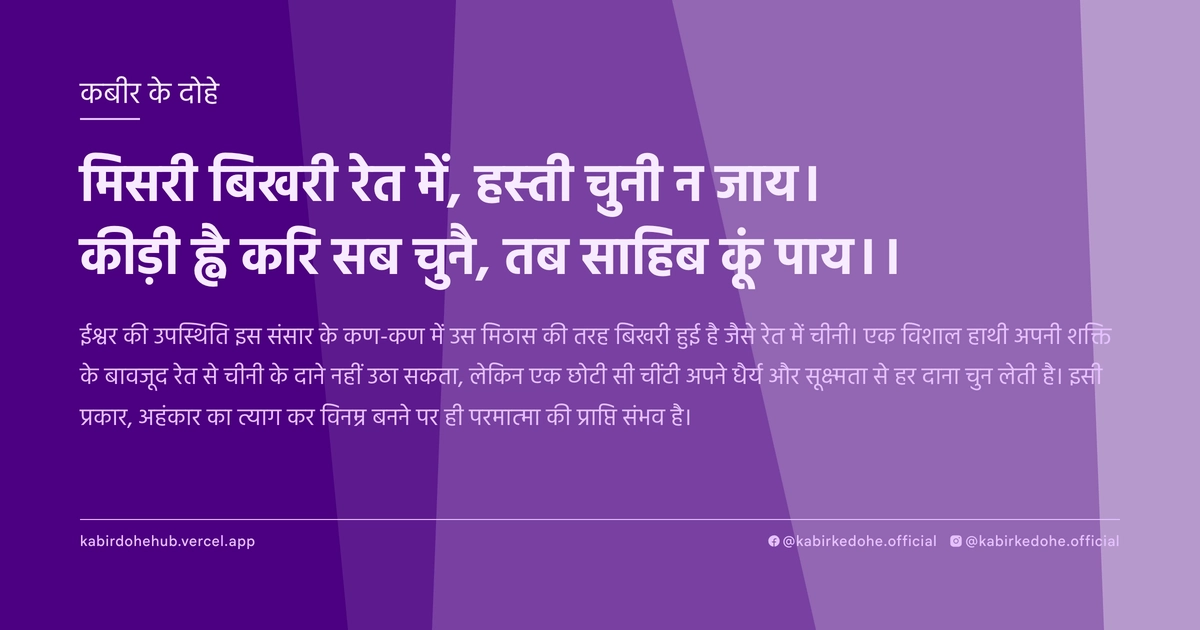
मिसरी बिखरी रेत में, हस्ती चुनी न जाय।
कीड़ी ह्वै करि सब चुनै, तब साहिब कूं पाय।।
Misri bikhari ret mein, hasti chuni na jaaye. Keedi hvai kari sab chunai, tab sahib koon paay.
इस पृष्ठ पर इस कबीर दोहे का अर्थ (meaning), हिंदी व्याख्या और अंग्रेज़ी अनुवाद, दार्शनिक विश्लेषण और व्यावहारिक जीवन सीख दी गई है। यह दोहा विनम्रता (Humility) विषय से जुड़ा है — Kabir doha meaning and explanation in Hindi and English.
अर्थ (Meaning):
ईश्वर की उपस्थिति इस संसार के कण-कण में उस मिठास की तरह बिखरी हुई है जैसे रेत में चीनी। एक विशाल हाथी अपनी शक्ति के बावजूद रेत से चीनी के दाने नहीं उठा सकता, लेकिन एक छोटी सी चींटी अपने धैर्य और सूक्ष्मता से हर दाना चुन लेती है। इसी प्रकार, अहंकार का त्याग कर विनम्र बनने पर ही परमात्मा की प्राप्ति संभव है।
The Divine presence is scattered throughout this existence like sugar crystals mixed into sand. A mighty elephant, despite its immense strength, cannot pick up the tiny grains of sugar from the sand; however, a small ant, through patience and humility, can collect every single grain. Similarly, only by shedding the ego and becoming humble can one realize the Divine.
व्याख्या (Interpretation):
यह दोहा विनम्रता और सूक्ष्मता के आध्यात्मिक महत्व को दर्शाता है। 'हाथी' यहाँ मानव अहंकार और बौद्धिक गर्व का प्रतीक है, जो अपनी शक्ति और स्थिति के कारण सत्य की सूक्ष्मता को अनदेखा कर देता है। 'रेत' माया और सांसारिक शोर का प्रतिनिधित्व करती है, जिसमें सत्य (मिसरी) घुला हुआ है। जब साधक 'चींटी' बनता है—अर्थात अपने अस्तित्व को शून्य करता है और पूर्ण समर्पण भाव अपनाता है—तब वह उस निराकार ब्रह्म को अनुभव कर पाता है। यह अद्वैत वेदांत के उस सिद्धांत की पुष्टि करता है जहाँ 'मैं' का विलोपन ही 'वह' की प्राप्ति है।
This couplet illustrates the spiritual significance of humility and subtlety. The 'elephant' symbolizes human ego and intellectual pride, which, due to its perceived power and status, overlooks the delicacy of Truth. The 'sand' represents Maya and the noise of the material world, within which the Truth (sugar) is dissolved. When the seeker becomes an 'ant'—meaning they nullify their ego and embrace total surrender—they are able to experience the Formless Brahman. This affirms the Advaita Vedanta principle where the dissolution of the 'I' is the only path to the realization of the 'That'.
दार्शनिक विश्लेषण (Philosophical Analysis):
कबीर का यह दर्शन निर्गुण भक्ति की पराकाष्ठा है, जहाँ ईश्वर किसी मंदिर या मस्जिद में नहीं, बल्कि अस्तित्व के सबसे सूक्ष्म स्तरों पर विद्यमान है। उन्होंने अपने समय के उन पंडितों और मुल्लाओं पर प्रहार किया जो केवल शास्त्रार्थ और बाहरी आडंबरों (हाथी जैसी शक्ति) के माध्यम से सत्य को खोजने का दावा करते थे। कबीर तर्क देते हैं कि सत्य 'बौद्धिक उपलब्धि' नहीं बल्कि 'भावनात्मक समर्पण' है।
सूफीवाद के 'फना' (अहंकार का विनाश) के सिद्धांत के समान, यहाँ चींटी बनना स्वयं को मिटाने की प्रक्रिया है। जब तक व्यक्ति स्वयं को बड़ा मानता है, वह उस सत्य को नहीं देख सकता जो अत्यंत सूक्ष्म और सरल है। यह विरोधाभास है कि जो सबसे छोटा होता है, वही सबसे विशाल (परमात्मा) को पा सकता है।
अद्वैत वेदांत के परिप्रेक्ष्य में, यह दोहा बताता है कि ब्रह्म सर्वव्यापी है, लेकिन हमारी 'अहंकार' की परतें उसे ढक लेती हैं। जैसे हाथी की सूंड रेत के दानों को अलग नहीं कर सकती, वैसे ही हमारा अहंकार सत्य और असत्य के बीच भेद नहीं कर पाता। केवल सूक्ष्म चेतना (Sūkshma Chaitanya) ही इस भेद को समझ सकती है।
कबीर जाति और वर्ग के भेदों को नकारते हुए यह संदेश देते हैं कि आध्यात्मिक पात्रता का आधार सामाजिक स्थिति नहीं, बल्कि आंतरिक विनम्रता है। एक साधारण व्यक्ति, यदि वह अहंकार शून्य है, तो वह उस सत्य को पा सकता है जिसे बड़े-बड़े विद्वान अपनी जटिलताओं के कारण खो देते हैं।
अंततः, यह मनोवैज्ञानिक रूपांतरण की बात है। अहंकार एक अवरोध है जो हमें वास्तविकता से अलग करता है। जब हम अपनी पहचान को एक 'चींटी' की तरह छोटा और समर्पित कर लेते हैं, तो हम ब्रह्मांडीय चेतना के साथ एकाकार हो जाते हैं, क्योंकि अब हमारे और सत्य के बीच कोई 'बड़ा' अवरोध नहीं बचता।
Kabir's philosophy here represents the pinnacle of Nirgun Bhakti, where the Divine is not confined to temples or mosques but exists at the most subtle levels of existence. He critiques the scholars and clerics of his era who claimed to find Truth through mere dialectics and external rituals (the strength of the elephant). Kabir argues that Truth is not an 'intellectual achievement' but an 'emotional surrender'.
Parallel to the Sufi concept of 'Fana' (annihilation of the self), becoming an ant is the process of erasing the ego. As long as a person perceives themselves as 'big' or superior, they cannot perceive the Truth, which is profoundly subtle and simple. It is a paradox that only the one who becomes the smallest can attain the Greatest (the Divine).
From the perspective of Advaita Vedanta, this doha suggests that Brahman is omnipresent, but the layers of our 'Ahamkara' (ego) veil this reality. Just as an elephant's trunk cannot separate individual grains of sugar from sand, our ego cannot distinguish Truth from illusion. Only a subtle consciousness (Sūkshma Chaitanya) can perceive this distinction.
By rejecting caste and class distinctions, Kabir conveys that spiritual eligibility is not based on social status but on internal humility. An ordinary person, if void of ego, can attain the Truth that great scholars lose due to their own complexities.
Ultimately, this is about psychological transformation. The ego is a barrier that separates us from reality. When we shrink our identity to that of an 'ant'—becoming small and devoted—we merge with the cosmic consciousness, for there is no longer a 'large' obstacle standing between us and the Truth.
मूल संदेश (Core Message):
- अहंकार सत्य के मार्ग में सबसे बड़ी बाधा है।
- ईश्वर की प्राप्ति शक्ति से नहीं, समर्पण से होती है।
- सत्य अत्यंत सूक्ष्म है, इसे केवल विनम्रता से पाया जा सकता है।
- बाहरी आडंबरों का त्याग कर आंतरिक सरलता अपनाएं।
- जब 'मैं' मिटता है, तभी 'वह' प्रकट होता है।
- विनम्रता ही वह कुंजी है जो ब्रह्मांड के रहस्य खोलती है।
- Ego is the greatest obstacle on the path to Truth.
- The Divine is attained through surrender, not through power.
- Truth is profoundly subtle; it can only be reached through humility.
- Abandon external rituals and embrace inner simplicity.
- Only when the 'I' vanishes does the 'He' appear.
- Humility is the key that unlocks the mysteries of the universe.
व्यावहारिक उदाहरण (Practical Example):
वाराणसी के घाटों पर रहने वाला एक वृद्ध विधवा, जिसे समाज ने हाशिए पर धकेल दिया था, प्रतिदिन मंदिर की सीढ़ियों पर गिरे हुए छोटे-छोटे चावल के दानों को इकट्ठा कर पक्षियों को खिलाती थी। उसी घाट पर एक प्रतापी पंडित जी आते थे, जो अपने ज्ञान और कुल के अहंकार में चूर थे। वे अक्सर उस महिला की सरलता का उपहास करते और उसे 'अज्ञानी' कहते।
पंडित जी घंटों शास्त्रों पर बहस करते, तर्क देते और यह सिद्ध करने की कोशिश करते कि ईश्वर केवल कठिन तपस्या और जटिल अनुष्ठानों से मिलता है। वे स्वयं को एक 'हाथी' की तरह शक्तिशाली और ज्ञानी मानते थे, लेकिन उनके मन में शांति नहीं थी, केवल मानसिक द्वंद्व था।
एक दिन, उस वृद्ध महिला ने बहुत ही सहजता से पंडित जी से कहा, 'महाराज, आप जिस ईश्वर को किताबों में ढूंढ रहे हैं, वह तो इन नन्हे दानों की भूख में और इन पक्षियों की चहचहाहट में छिपा है। बस उसे देखने के लिए खुद को छोटा करना पड़ता है।'
पंडित जी ने पहले तो इसे अनसुना किया, लेकिन उस रात उन्हें नींद नहीं आई। उन्होंने महसूस किया कि उनकी सारी विद्वत्ता उन्हें ईश्वर के करीब ले जाने के बजाय, उनके और सत्य के बीच एक दीवार बन गई है।
अगली सुबह, उन्होंने अपना अहंकार त्याग कर उस महिला के साथ बैठकर पक्षियों को दाना खिलाना शुरू किया। उन्होंने महसूस किया कि जब वे अपनी 'विद्वान' की छवि को छोड़कर एक साधारण सेवक बने, तो उन्हें वह शांति मिली जो हज़ारों ग्रंथों के अध्ययन से नहीं मिली थी।
उन्होंने देखा कि वह महिला, जिसे वे अज्ञानी समझते थे, वास्तव में एक उच्च आध्यात्मिक अवस्था में थी क्योंकि उसमें 'मैं' का कोई भाव नहीं था।
पंडित जी का व्यवहार पूरी तरह बदल गया। अब वे उपदेश देने के बजाय दूसरों की सेवा करने लगे। उन्होंने सीखा कि सत्य सूक्ष्म है और उसे केवल प्रेम और विनम्रता की 'चींटी' बनकर ही पाया जा सकता है।
इस प्रकार, एक छोटे से अनुभव ने उनके जीवन के सबसे बड़े भ्रम को तोड़ दिया और उन्हें वास्तविक भक्ति के मार्ग पर अग्रसर किया।
In the ghats of Varanasi lived an elderly widow, pushed to the margins of society, who spent her days collecting tiny grains of rice fallen on the temple steps to feed the birds. On the same ghat, a powerful priest would arrive, consumed by the pride of his knowledge and lineage. He often mocked the woman's simplicity, calling her 'ignorant'.
The priest spent hours debating scriptures, arguing and trying to prove that God is attained only through rigorous penance and complex rituals. He viewed himself as a mighty 'elephant' of wisdom, yet he lacked inner peace, plagued by constant mental conflict.
One day, the elderly woman simply said to him, 'Maharaj, the God you seek in books is hidden in the hunger of these tiny grains and the chirping of these birds. One only needs to become small to see Him.'
The priest initially ignored her, but that night, sleep eluded him. He realized that all his erudition, instead of bringing him closer to the Divine, had become a wall between him and the Truth.
The next morning, shedding his pride, he sat beside the woman and began feeding the birds. He discovered that when he let go of his image as a 'scholar' and became a simple servant, he found a peace that thousands of texts had never provided.
He saw that the woman, whom he deemed ignorant, was actually in a state of high spiritual realization because she possessed no sense of 'I'.
The priest's behavior transformed completely. Instead of preaching, he began serving others. He learned that Truth is subtle and can only be reached by becoming the 'ant' of love and humility.
Thus, a small, grounded experience shattered the greatest illusion of his life and set him on the path of true devotion.
अभ्यास मार्गदर्शन (Practice Guidance):
- दैनिक अभ्यास: प्रतिदिन 15 मिनट मौन बैठें और विचार करें कि आपके जीवन में कौन से 'हाथी' (अहंकार) सत्य को देखने से रोक रहे हैं।
- आत्म-निरीक्षण जर्नल: उन क्षणों को लिखें जब आपने अपनी श्रेष्ठता सिद्ध करने की कोशिश की और उस समय आपके भीतर की शांति कैसे कम हुई।
- व्यवहार परिवर्तन: दिन में कम से कम एक बार किसी ऐसे व्यक्ति की सेवा करें जिसे समाज 'छोटा' समझता है, और उसमें ईश्वर के दर्शन करने का प्रयास करें।
- निदान चेकलिस्ट: क्या मैं दूसरों को सुधारने की कोशिश कर रहा हूँ? (अहंकार), क्या मैं अपनी उपलब्धियों का श्रेय स्वयं ले रहा हूँ? (माया), क्या मैं सरल सत्य के बजाय जटिल तर्कों में उलझा हूँ? (अज्ञान)।
- Daily Practice: Sit in silence for 15 minutes daily and contemplate which 'elephants' (egos) in your life are preventing you from seeing the Truth.
- Self-Inquiry Journal: Record moments where you tried to prove your superiority and observe how your inner peace diminished during those instances.
- Behavioral Change: At least once a day, serve someone whom society deems 'small' and consciously attempt to perceive the Divine within them.
- Diagnostic Checklist: Am I trying to 'fix' others? (Ego), Am I taking all the credit for my achievements? (Maya), Am I entangled in complex arguments rather than simple truths? (Ignorance).
चिंतन प्रश्न (Reflection Questions):
- मेरी कौन सी बौद्धिक उपलब्धियां मेरे लिए 'हाथी' बन गई हैं, जो मुझे सरलता से दूर कर रही हैं?
- क्या मैं वास्तव में विनम्र हूँ, या मेरी विनम्रता केवल दूसरों से प्रशंसा पाने का एक मुखौटा है?
- मेरे जीवन की 'रेत' (शोर/माया) क्या है, और मैं उसमें छिपी 'मिसरी' (दिव्यता) को क्यों नहीं देख पा रहा?
- यदि मैं अपनी सभी उपाधियों और सामाजिक पहचान को खो दूँ, तो मेरे भीतर क्या बचेगा?
- मैं अपनी डिजिटल पहचान (सोशल मीडिया ईगो) को वास्तविक आध्यात्मिक खोज के साथ कैसे संतुलित करूँ?
- क्या मैं सत्य को खोजने के लिए अपनी 'बड़प्पन' की छवि को पूरी तरह त्यागने के लिए तैयार हूँ?
- Which of my intellectual achievements have become 'elephants' that distance me from simplicity?
- Am I truly humble, or is my humility merely a mask to gain admiration from others?
- What is the 'sand' (noise/Maya) in my life, and why am I unable to see the 'sugar' (Divinity) hidden within it?
- If I were to lose all my titles and social identities, what would remain within me?
- How do I balance my digital identity (social media ego) with a genuine spiritual quest?
- Am I truly prepared to completely relinquish my image of 'greatness' to find the Truth?