
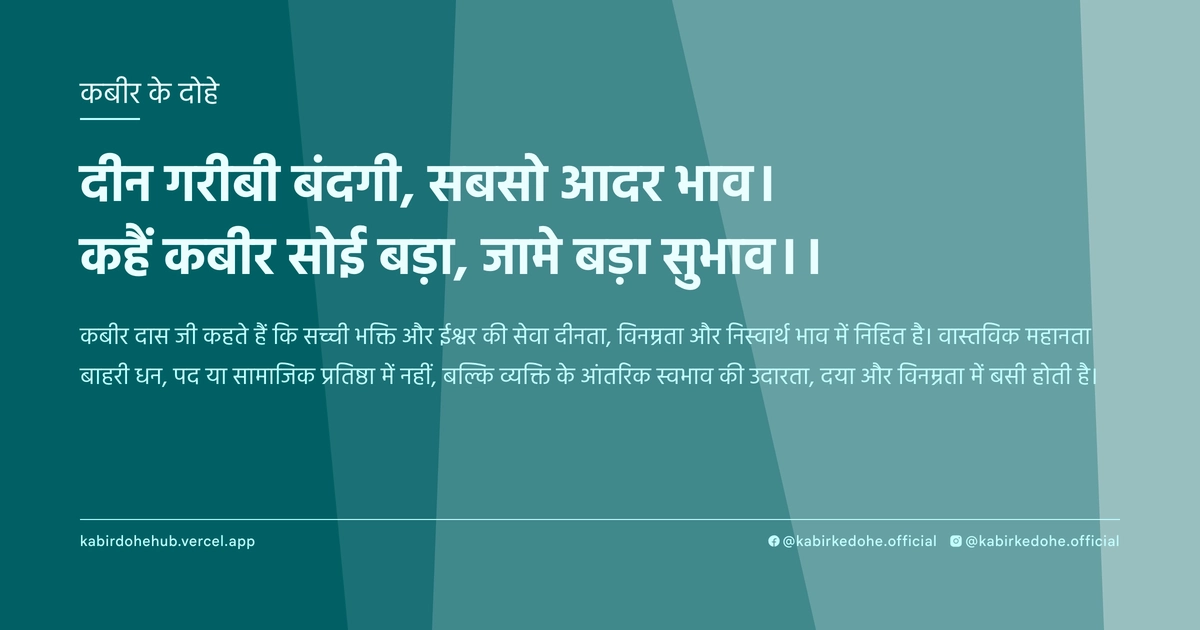
दीन गरीबी बंदगी, सबसो आदर भाव।
कहैं कबीर सोई बड़ा, जामे बड़ा सुभाव।।
Deen gareebi bandagi, sabso aadar bhaav. Kahain kabir soi bada, jaame bada subhaav.
इस पृष्ठ पर इस कबीर दोहे का अर्थ (meaning), हिंदी व्याख्या और अंग्रेज़ी अनुवाद, दार्शनिक विश्लेषण और व्यावहारिक जीवन सीख दी गई है। यह दोहा विनम्रता (Humility) विषय से जुड़ा है — Kabir doha meaning and explanation in Hindi and English.
अर्थ (Meaning):
कबीर दास जी कहते हैं कि सच्ची भक्ति और ईश्वर की सेवा दीनता, विनम्रता और निस्वार्थ भाव में निहित है। वास्तविक महानता बाहरी धन, पद या सामाजिक प्रतिष्ठा में नहीं, बल्कि व्यक्ति के आंतरिक स्वभाव की उदारता, दया और विनम्रता में बसी होती है।
Kabir asserts that true devotion and spiritual service reside in humility, simplicity, and a spirit of selfless surrender. Real greatness is not found in external wealth, social status, or titles, but is instead rooted in the nobility of one's inner nature, characterized by compassion and kindness.
व्याख्या (Interpretation):
इस दोहे का शाब्दिक अर्थ है कि जो व्यक्ति विनम्र है और सबके प्रति सम्मान रखता है, वही वास्तव में ईश्वर के करीब है। रूपक के स्तर पर, 'दीन गरीबी' का अर्थ भौतिक अभाव नहीं, बल्कि 'अहंकार का अभाव' है। जब मनुष्य अपने 'मैं' को मिटा देता है, तब वह उस शून्य में प्रवेश करता है जहाँ केवल परमात्मा का वास है। यह निर्गुण भक्ति का सार है, जहाँ ईश्वर किसी मंदिर या मस्जिद में नहीं, बल्कि एक शुद्ध और उदार हृदय में मिलता है। माया हमें यह विश्वास दिलाती है कि सत्ता और संपत्ति हमें बड़ा बनाती हैं, जबकि सत्य यह है कि अहंकार ही आत्मा और परमात्मा के बीच की सबसे बड़ी दीवार है। अद्वैत वेदांत के अनुसार, जब व्यक्ति स्वयं को दूसरों से अलग मानकर श्रेष्ठता का भाव रखता है, तो वह द्वैत में फँसा रहता है; लेकिन जब वह सबके भीतर एक ही चेतना को देखता है, तो वह वास्तविक 'बड़प्पन' या ब्रह्मत्व को प्राप्त करता है।
Literally, the verse suggests that one who is humble and respectful toward all is closest to the Divine. Metaphorically, 'deen gareebi' (poverty/humility) does not refer to material lack, but to the 'absence of ego.' When a human annihilates the 'I', they enter the void where only the Divine resides. This is the essence of Nirgun Bhakti, where God is found not in temples or mosques, but within a pure and generous heart. Maya deceives us into believing that power and wealth grant greatness, whereas the truth is that ego is the primary barrier between the Atman and Brahman. According to Advaita Vedanta, as long as one perceives themselves as superior or separate from others, they remain trapped in duality; however, by recognizing the same consciousness in all beings, they attain true 'greatness' or the state of Brahman.
दार्शनिक विश्लेषण (Philosophical Analysis):
कबीर का यह दोहा उस सामाजिक और धार्मिक परिवेश की प्रतिक्रिया है जहाँ जाति, वर्ण और बाहरी कर्मकांडों के आधार पर श्रेष्ठता तय की जाती थी। कबीर ने स्पष्ट रूप से उन पाखंडों को नकारा जिन्होंने धर्म को केवल बाहरी दिखावे और ऊँच-नीच के भेदभाव तक सीमित कर दिया था। उनके लिए 'बड़प्पन' का पैमाना सामाजिक पदानुक्रम नहीं, बल्कि नैतिक और आध्यात्मिक उत्थान था।
दार्शनिक रूप से, यह विचार सूफीवाद के 'फना' (अहंकार का विलीनीकरण) के सिद्धांत से मेल खाता है। जिस प्रकार एक बूंद समुद्र में मिलकर समुद्र बन जाती है, उसी प्रकार एक व्यक्ति जब अपने अहंकार को त्यागकर विनम्रता धारण करता है, वह व्यक्तिगत पहचान से ऊपर उठकर सार्वभौमिक चेतना का हिस्सा बन जाता है। यह प्रक्रिया मनोवैज्ञानिक रूपांतरण की है, जहाँ व्यक्ति अपनी पहचान बाहरी उपलब्धियों से हटाकर आंतरिक गुणों पर केंद्रित करता है।
अद्वैत वेदांत के परिप्रेक्ष्य में, यह दोहा 'सोऽहम्' (वह मैं हूँ) की अनुभूति की ओर ले जाता है। जब हम दूसरों का आदर करते हैं, तो हम वास्तव में अपने ही भीतर स्थित उस परमात्मा का आदर कर रहे होते हैं जो दूसरे व्यक्ति में भी विद्यमान है। यहाँ 'आदर भाव' केवल एक शिष्टाचार नहीं, बल्कि एक आध्यात्मिक अभ्यास है जो द्वैत को समाप्त करता है।
कबीर यहाँ यह चेतावनी देते हैं कि जो लोग केवल शास्त्र पढ़कर या तिलक लगाकर खुद को बड़ा समझते हैं, वे वास्तव में आध्यात्मिक रूप से दरिद्र हैं। वास्तविक समृद्धि वह है जो हृदय की करुणा और क्षमा से आती है। यह दृष्टिकोण भौतिकवाद के विरुद्ध एक सशक्त प्रहार है, जो यह सिखाता है कि आत्मा की शुद्धि ही एकमात्र वास्तविक उपलब्धि है।
अंततः, यह दोहा हमें यह समझने के लिए प्रेरित करता है कि विनम्रता कमजोरी नहीं, बल्कि सर्वोच्च शक्ति है। केवल वही व्यक्ति वास्तव में शक्तिशाली है जो अपने क्रोध, लोभ और अहंकार पर विजय पा चुका है। यही वह 'बड़ा सुभाव' है जिसकी चर्चा कबीर कर रहे हैं, जो मनुष्य को पशुता से ऊपर उठाकर देवत्व की ओर ले जाता है।
This couplet is a direct response to the socio-religious climate of Kabir's era, where superiority was determined by caste, varna, and external rituals. Kabir explicitly rejected the hypocrisy that reduced religion to outward displays and hierarchical discrimination. For him, the metric of 'greatness' was not social standing, but moral and spiritual evolution.
Philosophically, this aligns with the Sufi concept of 'Fana' (the annihilation of the ego). Just as a drop becomes the ocean by merging into it, an individual transcends their personal identity and becomes part of the universal consciousness by shedding ego and embracing humility. This is a process of psychological transformation, shifting the locus of identity from external achievements to internal virtues.
From the perspective of Advaita Vedanta, this verse leads toward the realization of 'So-ham' (I am That). When we show respect to others, we are essentially honoring the Divine within them, which is the same Divine within ourselves. Here, 'aadar bhaav' (respectful attitude) is not mere etiquette, but a spiritual practice that dissolves duality.
Kabir warns that those who consider themselves superior simply by reading scriptures or wearing religious marks are, in reality, spiritually impoverished. True abundance is that which springs from compassion and forgiveness. This perspective is a powerful critique of materialism, teaching that the purification of the soul is the only genuine achievement.
Ultimately, the verse inspires us to understand that humility is not weakness, but the highest form of strength. Only the person who has conquered their anger, greed, and ego is truly powerful. This is the 'noble nature' (bada subhaav) Kabir speaks of, which elevates a human from animalistic instincts toward divinity.
मूल संदेश (Core Message):
- अहंकार ही आत्मा की सबसे बड़ी दरिद्रता है।
- विनम्रता कमजोरी नहीं, बल्कि आंतरिक शक्ति का शिखर है।
- सच्ची भक्ति बाहरी दिखावे में नहीं, हृदय की सरलता में है।
- दूसरों का सम्मान करना स्वयं के भीतर के ईश्वर को पहचानना है।
- महानता का पैमाना पद नहीं, बल्कि करुणा और स्वभाव है।
- जब 'मैं' मिटता है, तभी 'परमात्मा' प्रकट होता है।
- Ego is the greatest poverty of the soul.
- Humility is not weakness, but the pinnacle of inner strength.
- True devotion lies in simplicity of heart, not in external displays.
- Respecting others is the act of recognizing the Divine within oneself.
- The metric of greatness is compassion and nature, not status.
- Only when the 'I' vanishes does the 'Divine' manifest.
व्यावहारिक उदाहरण (Practical Example):
वाराणसी के एक पुराने घाट पर रामदीन नाम का एक वृद्ध नाविक रहता था। वह शहर के सबसे गरीब लोगों में से एक था, लेकिन उसकी ख्याति उसकी विनम्रता के लिए थी।
उसी घाट पर एक धनी व्यापारी रहता था, जो अपनी संपत्ति और दान के कारण पूरे शहर में 'बड़ा' माना जाता था। वह अक्सर रामदीन का मज़ाक उड़ाता और उसे तुच्छ समझता था।
एक बार शहर में भीषण बाढ़ आई। व्यापारी का आलीशान घर पानी में डूब गया और उसकी सारी संपत्ति बह गई। वह असहाय होकर सड़क पर आ गया।
जब व्यापारी भूख और ठंड से कांप रहा था, तब रामदीन ने उसे देखा। रामदीन के पास खुद बहुत कम था, लेकिन उसने बिना किसी झिझक के अपना एकमात्र कंबल और अपनी आधी रोटी व्यापारी को दे दी।
व्यापारी ने शर्मिंदा होकर पूछा, "मेरे पास सब कुछ था, फिर भी मैं आज खाली हूँ। तुम्हारे पास कुछ नहीं है, फिर भी तुम मुझे देने की क्षमता रखते हो। ऐसा क्यों?"
रामदीन ने मुस्कुराकर कहा, "साहब, जब तक मेरा अहंकार था, मैं भी खुद को छोटा समझता था। जिस दिन मैंने यह जान लिया कि हम सब एक ही ईश्वर की संतान हैं, मेरा हृदय बड़ा हो गया। अब मुझे अपनी गरीबी नहीं, बल्कि आपकी तकलीफ दिखती है।"
व्यापारी को अचानक कबीर के शब्दों की याद आई कि महानता धन में नहीं, स्वभाव में होती है। उसे अहसास हुआ कि वह अब तक केवल 'अमीर' था, 'बड़ा' नहीं।
उस दिन व्यापारी का अहंकार पूरी तरह टूट गया। उसने रामदीन के चरणों में सिर झुकाया और जीवन भर के लिए विनम्रता का मार्ग अपनाया।
उसने अपनी बची हुई संपत्ति का उपयोग केवल अपने लिए नहीं, बल्कि दूसरों की सेवा के लिए करना शुरू किया।
रामदीन की उस छोटी सी उदारता ने एक अहंकारी व्यक्ति को एक संवेदनशील मनुष्य में बदल दिया, जो इस कहानी का असली 'कबीर ट्विस्ट' था।
On an old ghat in Varanasi lived an elderly boatman named Ramdeen. He was among the poorest in the city, yet he was renowned for his profound humility.
On the same ghat lived a wealthy merchant, regarded as 'great' by the entire city due to his riches and public donations. He often mocked Ramdeen, viewing him as insignificant.
One year, a devastating flood hit the city. The merchant's opulent mansion was submerged, and his wealth was swept away by the current. He found himself helpless on the streets.
As the merchant shivered from cold and hunger, Ramdeen spotted him. Despite having very little himself, Ramdeen without hesitation gave the merchant his only blanket and half of his meager meal.
The merchant, overcome with shame, asked, "I had everything, yet today I am empty. You have nothing, yet you have the capacity to give to me. Why is this?"
Ramdeen smiled and replied, "Sir, as long as I had ego, I too felt small. The day I realized we are all children of the same Divine, my heart grew large. Now, I do not see my poverty; I only see your suffering."
The merchant suddenly remembered Kabir's words that greatness lies not in wealth, but in nature. He realized that until then, he had only been 'rich,' not 'great.'
That day, the merchant's ego completely shattered. He bowed at Ramdeen's feet and committed himself to a life of humility.
He began using whatever resources he had left not for personal luxury, but for the selfless service of others.
Ramdeen's small act of generosity transformed an arrogant man into a compassionate human being, serving as the 'Kabir Twist' of this story.
अभ्यास मार्गदर्शन (Practice Guidance):
- प्रतिदिन 15 मिनट मौन ध्यान करें, जहाँ आप अपनी सभी उपलब्धियों और पहचानों (पद, नाम, संपत्ति) को मानसिक रूप से त्याग दें और स्वयं को केवल एक 'सेवा भाव' के रूप में देखें।
- स्व-पूछताछ जर्नल: प्रतिदिन एक ऐसी घटना लिखें जहाँ आपने अपनी श्रेष्ठता महसूस की हो, और फिर विश्लेषण करें कि उस समय आपके भीतर कौन सा अहंकार सक्रिय था।
- व्यवहार परिवर्तन: दिन भर में कम से कम एक व्यक्ति की मदद करें जिसे समाज 'निम्न' मानता है, और यह अनुभव करें कि सेवा करने वाला वास्तव में सेवा प्राप्त करने वाले से बड़ा नहीं, बल्कि उसके समान है।
- डायग्नोस्टिक चेकलिस्ट: क्या मैं दूसरों की आलोचना करते समय खुद को श्रेष्ठ महसूस करता हूँ? क्या मुझे अपनी मदद के बदले प्रशंसा की अपेक्षा होती है? यदि हाँ, तो स्वभाव अभी 'बड़ा' नहीं हुआ है।
- Practice 15 minutes of silent meditation daily, mentally shedding all achievements and identities (rank, name, wealth) and viewing yourself solely as an instrument of service.
- Self-Inquiry Journal: Record one instance each day where you felt superior to someone, and analyze which specific ego-trigger was active at that moment.
- Behavioral Shift: Help at least one person daily whom society deems 'lowly,' and consciously experience that the giver is not superior to the receiver, but equal.
- Diagnostic Checklist: Do I feel a sense of superiority while criticizing others? Do I expect praise after helping someone? If yes, the 'inner nature' has not yet attained true greatness.
चिंतन प्रश्न (Reflection Questions):
- यदि आज आपसे आपकी सारी सामाजिक प्रतिष्ठा और धन छीन लिया जाए, तो आपके व्यक्तित्व में क्या शेष बचेगा जिसे आप 'महान' कह सकें?
- आप किन लोगों को अनजाने में 'छोटा' समझते हैं, और यह धारणा आपके किस आंतरिक डर या असुरक्षा से उपजी है?
- क्या आपकी विनम्रता वास्तविक है, या यह दूसरों से प्रशंसा पाने के लिए ओढ़ा गया एक मुखौटा है?
- जब आप किसी की मदद करते हैं, तो क्या आप उस व्यक्ति को छोटा महसूस कराते हैं? यदि हाँ, तो क्या वह मदद है या अहंकार की तुष्टि?
- डिजिटल युग में, जहाँ हम अपनी 'श्रेष्ठता' को सोशल मीडिया पर प्रदर्शित करते हैं, क्या हम वास्तविक आंतरिक विनम्रता को खो रहे हैं?
- क्या आप उस व्यक्ति को क्षमा कर सकते हैं जिसने आपको सबसे अधिक चोट पहुँचाई, बिना यह सोचे कि आप उनसे नैतिक रूप से श्रेष्ठ हैं?
- If all your social prestige and wealth were stripped away today, what would remain of your personality that you could call 'great'?
- Whom do you unconsciously perceive as 'inferior,' and from which internal fear or insecurity does this perception arise?
- Is your humility genuine, or is it a mask worn to elicit praise from others?
- When you help someone, do you make them feel small? If so, is that truly help or merely the satisfaction of your ego?
- In the digital age, where we curate and display our 'superiority' on social media, are we losing the essence of true inner humility?
- Can you forgive the person who hurt you the most without feeling that you are morally superior to them?