
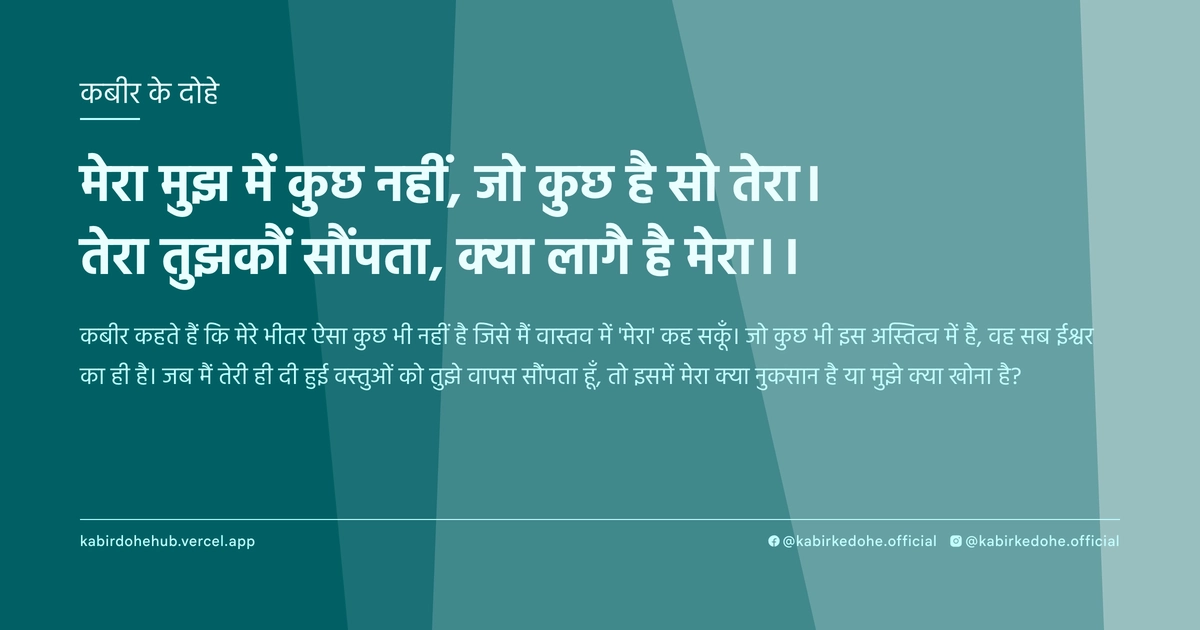
मेरा मुझ में कुछ नहीं, जो कुछ है सो तेरा।
तेरा तुझकौं सौंपता, क्या लागै है मेरा।।
Mera mujh mein kuchh nahi, jo kuchh hai so tera. Tera tujhkaun saunpta, kya laagai hai mera.
इस पृष्ठ पर इस कबीर दोहे का अर्थ (meaning), हिंदी व्याख्या और अंग्रेज़ी अनुवाद, दार्शनिक विश्लेषण और व्यावहारिक जीवन सीख दी गई है। यह दोहा प्रपत्ति (Surrender) विषय से जुड़ा है — Kabir doha meaning and explanation in Hindi and English.
अर्थ (Meaning):
कबीर कहते हैं कि मेरे भीतर ऐसा कुछ भी नहीं है जिसे मैं वास्तव में 'मेरा' कह सकूँ। जो कुछ भी इस अस्तित्व में है, वह सब ईश्वर का ही है। जब मैं तेरी ही दी हुई वस्तुओं को तुझे वापस सौंपता हूँ, तो इसमें मेरा क्या नुकसान है या मुझे क्या खोना है?
Kabir declares that there is nothing within him that can truly be claimed as 'mine'. Everything that exists in his being and surroundings belongs to the Divine. He asks rhetorically, if he is simply returning what already belongs to the Creator, what loss could he possibly incur or what attachment remains to be severed?
व्याख्या (Interpretation):
यह दोहा पूर्ण समर्पण की पराकाष्ठा है। शाब्दिक अर्थ में यह स्वामित्व के त्याग की बात करता है, परंतु आध्यात्मिक स्तर पर यह 'अहंकार' के विसर्जन का मार्ग है। कबीर यहाँ निर्गुण भक्ति के उस शिखर को छूते हैं जहाँ भक्त और भगवान के बीच का द्वैत समाप्त हो जाता है। 'मेरा' शब्द माया का प्रतीक है, जो हमें भ्रमित करता है कि हम कर्ता हैं। जब साधक यह अनुभव करता है कि वह स्वयं भी परमात्मा का एक अंश है, तो 'मैं' और 'मेरा' का भ्रम टूट जाता है। यह अद्वैत वेदांत की उस स्थिति के समान है जहाँ आत्मा और ब्रह्म की एकता स्थापित होती है। यहाँ समर्पण कोई बाहरी क्रिया नहीं, बल्कि एक आंतरिक बोध है कि पृथकता केवल एक मिथ्या है।
This couplet represents the pinnacle of absolute surrender. While literally discussing the relinquishing of ownership, on a spiritual plane, it is the path of dissolving the 'Ego'. Kabir touches the zenith of Nirgun Bhakti where the duality between the devotee and the Divine vanishes. The word 'mine' symbolizes Maya, the cosmic illusion that tricks us into believing we are the independent doers. When the seeker realizes that they themselves are a mere extension of the Divine, the illusion of 'I' and 'mine' shatters. This mirrors the state of Advaita Vedanta where the non-duality of Atman and Brahman is realized. Here, surrender is not an external act but an internal awakening to the truth that separation is merely a phantom.
दार्शनिक विश्लेषण (Philosophical Analysis):
कबीर का यह दर्शन उनके युग के कर्मकांडी और रूढ़िवादी समाज के विरुद्ध एक सशक्त प्रहार था। उस समय धर्म को बाहरी अनुष्ठानों, तीर्थों और जातिगत श्रेष्ठता से जोड़ा गया था। कबीर ने इन सबको नकारते हुए 'सहज' मार्ग पर जोर दिया। उनका यह विचार कि 'सब कुछ तेरा है', वास्तव में उस सामाजिक ढांचे को चुनौती देता है जो संचय और स्वामित्व पर आधारित था।
दार्शनिक रूप से, यह सूफी मत के 'फना' (Fana) के सिद्धांत से मेल खाता है, जहाँ साधक अपनी व्यक्तिगत पहचान को ईश्वर की इच्छा में विलीन कर देता है। जब 'मैं' मिट जाता है, तभी 'वह' प्रकट होता है। यह मनोवैज्ञानिक रूपांतरण की प्रक्रिया है जहाँ व्यक्ति अपनी पहचान को भौतिक उपलब्धियों या सामाजिक स्थिति से हटाकर अनंत चेतना से जोड़ता है।
अद्वैत वेदांत के परिप्रेक्ष्य में, यह दोहा 'नेति-नेति' (यह नहीं, वह नहीं) की प्रक्रिया का परिणाम है। जब हम हर उस चीज़ को नकार देते हैं जिसे हम 'अपना' कहते हैं, तो अंत में केवल वही बचता है जो शाश्वत है। कबीर यह समझाते हैं कि दुख का मूल कारण 'ममत्व' या मोह है।
यहाँ 'सौंपने' की क्रिया का अर्थ किसी वस्तु को भौतिक रूप से देना नहीं है, बल्कि मानसिक रूप से उस वस्तु के प्रति अपनी दावादारी को समाप्त करना है। यह एक मानसिक विमुक्ति है जो मनुष्य को भय और चिंता से मुक्त करती है, क्योंकि जो व्यक्ति कुछ नहीं मानता, उसे खोने का डर नहीं रहता।
अंततः, यह दोहा हमें सिखाता है कि वास्तविक स्वतंत्रता स्वामित्व में नहीं, बल्कि स्वामित्व के अभाव में है। यह उस शून्य की स्थिति है जहाँ से पूर्णता का जन्म होता है। कबीर का यह संदेश आज के उपभोक्तावादी युग में और भी प्रासंगिक है, जहाँ मनुष्य अपनी पहचान को वस्तुओं के संग्रह से परिभाषित करता है।
Kabir's philosophy serves as a potent critique of the ritualistic and orthodox society of his era. At a time when religion was tethered to external rites, pilgrimages, and caste superiority, Kabir championed the path of 'Sahaja' (spontaneous truth). His assertion that 'everything is Yours' fundamentally challenges a social structure built upon accumulation and ownership.
Philosophically, this aligns with the Sufi concept of 'Fana' (annihilation), where the seeker dissolves their individual identity into the Divine Will. Only when the 'I' is erased does the 'He' manifest. This is a process of psychological transformation where one shifts their identity from material achievements or social status to the infinite consciousness.
From the lens of Advaita Vedanta, this couplet is the fruition of the 'Neti-Neti' (not this, not that) process. When we negate everything we claim as 'mine', only that which is eternal remains. Kabir explains that the root of all suffering is 'Mamattva' or the clinging attachment to ownership.
The act of 'surrendering' here does not mean physically handing over an object, but mentally relinquishing the claim of ownership over it. It is a mental liberation that frees the human from fear and anxiety; for he who claims nothing has nothing to fear losing.
Ultimately, this couplet teaches that true freedom lies not in possession, but in the absence of possession. It is the state of 'Sunya' (void) from which totality is born. Kabir's message is profoundly relevant in today's consumerist age, where humans define their identity through the collection of things.
मूल संदेश (Core Message):
- अहंकार ही वह पर्दा है जो हमें सत्य से अलग करता है।
- स्वामित्व एक भ्रम है; केवल सेवा ही स्थायी सत्य है।
- जब 'मैं' मिटता है, तब अनंत का अनुभव होता है।
- समर्पण हार नहीं, बल्कि सर्वोच्च स्वतंत्रता है।
- सच्ची समृद्धि वस्तुओं के संचय में नहीं, उनके त्याग में है।
- The ego is the only veil separating us from the ultimate truth.
- Ownership is an illusion; selfless service is the only enduring reality.
- When the 'I' dissolves, the experience of the Infinite begins.
- Surrender is not defeat, but the highest form of liberation.
- True abundance lies not in accumulation, but in the art of letting go.
व्यावहारिक उदाहरण (Practical Example):
वाराणसी के एक पुराने घाट पर रामदीन नाम का एक वृद्ध बुनकर रहता था। उसने अपना पूरा जीवन बेहतरीन रेशमी साड़ियों को बुनने में बिताया था। उसकी कला इतनी प्रसिद्ध थी कि बड़े-बड़े व्यापारी उसके द्वार पर आते थे। रामदीन को अपनी कला पर बहुत गर्व था; वह मानता था कि उसकी उंगलियों का जादू ही उसकी असली संपत्ति है।
एक समय ऐसा आया जब शहर में एक नई मशीन आई जिसने हाथ की बुनाई को लगभग समाप्त कर दिया। धीरे-धीरे रामदीन के पास काम आना बंद हो गया। उसकी जमा पूँजी खत्म होने लगी और वह गहरे अवसाद में डूब गया। उसे लगा कि उसकी पहचान, उसका गौरव और उसका अस्तित्व सब छिन गया है।
एक शाम, वह गंगा किनारे बैठा अपनी किस्मत को कोस रहा था। तभी उसकी मुलाकात एक फकीर से हुई जिसने उसे कबीर का यह दोहा सुनाया। फकीर ने उससे पूछा, "रामदीन, क्या यह हुनर तुम्हारा था, या तुम्हें उपहार में मिला था? क्या यह शरीर तुम्हारा है, या इसे प्रकृति ने बनाया है?"
रामदीन पहले तो चुप रहा, फिर उसने सोचा कि वास्तव में उसने कभी अपनी उंगलियों को नहीं बनाया, न ही उस रेशम को। उसने महसूस किया कि वह केवल एक माध्यम था, एक यंत्र था जिसके जरिए ईश्वर अपनी कला प्रकट कर रहा था।
जैसे ही उसने यह स्वीकार किया कि उसकी कला 'उसकी' नहीं बल्कि 'उसकी' (ईश्वर की) थी, उसके मन का बोझ हल्का हो गया। उसने महसूस किया कि वह अब तक एक ऐसे बोझ को ढो रहा था जो उसका था ही नहीं।
उसने अपनी बची हुई छोटी सी दुकान को उन युवा बुनकरों के लिए एक प्रशिक्षण केंद्र बना दिया जो गरीबी के कारण नहीं सीख पा रहे थे। उसने अब पैसे कमाने के लिए नहीं, बल्कि उस कला को समर्पित करने के लिए बुनना शुरू किया।
उसका अहंकार कि "मैं महान बुनकर हूँ" समाप्त हो गया और उसकी जगह एक गहरी शांति ने ले ली। अब वह अपनी साड़ियों को 'बेचता' नहीं था, बल्कि उन्हें ईश्वर की भेंट मानकर दुनिया को सौंपता था।
रामदीन की स्थिति अब बदल चुकी थी। वह अब गरीब था, लेकिन वह पहले से कहीं अधिक समृद्ध महसूस कर रहा था क्योंकि उसने 'मेरे' के बोझ को उतार फेंका था।
उसकी आँखों में अब शिकायत नहीं, बल्कि एक दिव्य चमक थी। उसने जान लिया था कि जब हम सब कुछ ईश्वर को सौंप देते हैं, तो हम वास्तव में कुछ नहीं खोते, बल्कि वह सब पा लेते हैं जो वास्तव में हमारा है।
यह परिवर्तन उसकी बाहरी परिस्थिति में नहीं, बल्कि उसकी आंतरिक दृष्टि में था। वह अब एक बुनकर नहीं, बल्कि एक मुक्त आत्मा बन चुका था।
On an ancient ghat in Varanasi lived an elderly weaver named Ramdin. He had spent his entire life weaving exquisite silk sarees. His art was so renowned that wealthy merchants flocked to his door. Ramdin took immense pride in his skill; he believed the magic in his fingers was his true personal asset.
There came a time when a new machine arrived in the city, nearly eradicating hand-weaving. Gradually, work stopped coming to Ramdin. His savings dwindled, and he sank into a deep depression. He felt that his identity, his pride, and his very existence were being stripped away.
One evening, while sitting by the Ganges cursing his fate, he met a wandering dervish who recited this couplet of Kabir. The dervish asked him, "Ramdin, was this skill truly yours, or was it a gift? Is this body yours, or did Nature create it?"
Ramdin remained silent at first, then he pondered that he had never actually created his fingers, nor the silk. He realized he was merely a medium, an instrument through which the Divine was manifesting its art.
The moment he accepted that his skill was not 'his' but 'His' (the Divine's), the burden on his heart lifted. He realized he had been carrying a weight that never belonged to him in the first place.
He turned his small remaining shop into a training center for young weavers who couldn't afford to learn. He began weaving not to earn money, but to dedicate the art to the Divine.
His ego of being a "great weaver" vanished, replaced by a profound peace. He no longer 'sold' his sarees; he offered them to the world as gifts from the Divine.
Ramdin's condition had changed. He was now materially poor, but he felt richer than ever because he had cast off the burden of 'mine'.
There was no longer a complaint in his eyes, only a divine glow. He had learned that when we surrender everything to the Divine, we lose nothing, but rather gain everything that truly belongs to us.
This transformation was not in his external circumstances, but in his internal vision. He was no longer just a weaver, but a liberated soul.
He lived his remaining years in a state of flow, understanding that the joy of giving is the only true possession.
अभ्यास मार्गदर्शन (Practice Guidance):
- दैनिक अभ्यास: प्रतिदिन 15 मिनट मौन बैठें और अपने जीवन की उन वस्तुओं की सूची बनाएं जिन्हें आप 'मेरा' कहते हैं। फिर मानसिक रूप से कहें, "यह ईश्वर का है, मैं केवल इसका संरक्षक हूँ।"
- आत्म-पूछताछ जर्नल: लिखें कि जब आप किसी चीज़ को खोने का डर महसूस करते हैं, तो वास्तव में आप क्या खो रहे होते हैं? क्या वह वस्तु आपकी है, या आपका उसके प्रति मोह?
- व्यवहारिक परिवर्तन: दिन में कम से कम एक बार किसी की मदद बिना किसी श्रेय (credit) की इच्छा के करें। यह अभ्यास करें कि आप केवल एक माध्यम हैं, कर्ता नहीं।
- निदान चेकलिस्ट: यदि आप क्रोधित महसूस कर रहे हैं क्योंकि किसी ने आपकी चीज़ ली है, या आप अपनी उपलब्धियों पर अहंकार महसूस कर रहे हैं, तो समझें कि आप अभी भी 'मेरे' के भ्रम में हैं।
- Daily Practice: Sit in silence for 15 minutes daily and list the things in your life you call 'mine'. Then mentally affirm, "This belongs to the Divine; I am merely its custodian."
- Self-Inquiry Journal: Write about the moments you feel the fear of loss. Ask yourself: What am I actually losing? Is it the object itself, or my attachment to the idea of owning it?
- Behavioral Change: Once a day, help someone without any desire for credit. Practice the feeling that you are merely a channel for the Divine, not the doer of the action.
- Diagnostic Checklist: If you feel anger because someone took something of yours, or pride in your achievements, recognize that you are still trapped in the illusion of 'mine'.
चिंतन प्रश्न (Reflection Questions):
- यदि आज आपसे आपकी सभी भौतिक संपत्तियां और आपकी सामाजिक पहचान छीन ली जाए, तो आपके भीतर क्या बचेगा?
- आपकी कौन सी ऐसी 'उपलब्धियां' हैं जिन पर आप गर्व करते हैं, लेकिन वास्तव में वे आपकी मेहनत से अधिक भाग्य या दूसरों की सहायता का परिणाम थीं?
- डिजिटल युग में, आपका 'ऑनलाइन व्यक्तित्व' (Online Persona) किस हद तक आपके 'मैं' के अहंकार को पोषित कर रहा है?
- क्या आप वास्तव में प्रेम करते हैं, या आप केवल उस व्यक्ति पर अपना 'स्वामित्व' जमाना चाहते हैं जिसे आप प्रेम करते हैं?
- वह कौन सा डर है जो आपको सब कुछ ईश्वर को सौंपने से रोकता है? वह डर किस चीज़ की सुरक्षा कर रहा है?
- If all your material possessions and social identities were stripped away today, what would remain within you?
- Which of your 'achievements' do you take pride in, that were actually more a result of luck or others' help than your own effort?
- In the digital age, to what extent is your 'online persona' nourishing the ego of the 'I'?
- Do you truly love, or do you merely wish to establish 'ownership' over the person you claim to love?
- What is the specific fear that prevents you from surrendering everything to the Divine? What exactly is that fear protecting?