
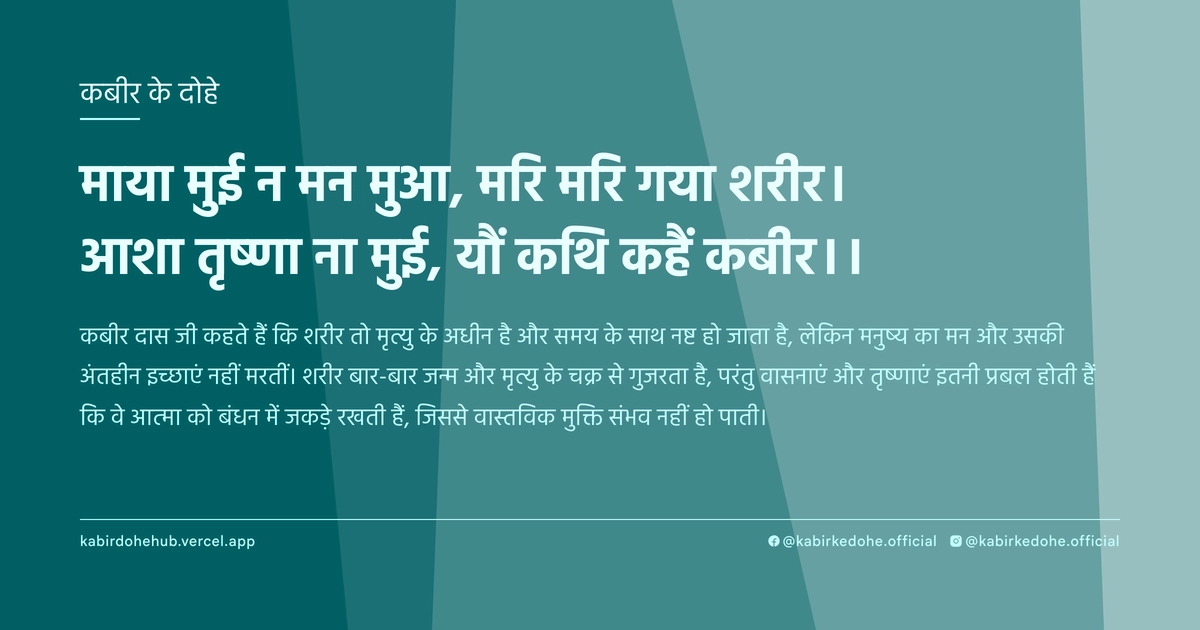
माया मुई न मन मुआ, मरि मरि गया शरीर।
आशा तृष्णा ना मुई, यौं कथि कहैं कबीर।।
Maya mui na man mua, mari mari gaya sharir. Asha trishna na mui, yaun kathi kahein kabir.
इस पृष्ठ पर इस कबीर दोहे का अर्थ (meaning), हिंदी व्याख्या और अंग्रेज़ी अनुवाद, दार्शनिक विश्लेषण और व्यावहारिक जीवन सीख दी गई है। यह दोहा मृतुक्यता (Mortality) विषय से जुड़ा है — Kabir doha meaning and explanation in Hindi and English.
अर्थ (Meaning):
कबीर दास जी कहते हैं कि शरीर तो मृत्यु के अधीन है और समय के साथ नष्ट हो जाता है, लेकिन मनुष्य का मन और उसकी अंतहीन इच्छाएं नहीं मरतीं। शरीर बार-बार जन्म और मृत्यु के चक्र से गुजरता है, परंतु वासनाएं और तृष्णाएं इतनी प्रबल होती हैं कि वे आत्मा को बंधन में जकड़े रखती हैं, जिससे वास्तविक मुक्ति संभव नहीं हो पाती।
Kabir observes a profound paradox: while the physical body is fragile and inevitably succumbs to death, the human mind and its insatiable cravings persist. The body undergoes a cycle of decay and rebirth, yet the deep-seated desires and attachments remain alive, tethering the soul to the cycle of suffering and preventing true spiritual liberation.
व्याख्या (Interpretation):
इस दोहे का शाब्दिक अर्थ है कि शरीर मर गया पर मन नहीं मरा। यहाँ 'मन' केवल मस्तिष्क नहीं, बल्कि 'अहंकार' और 'माया' का केंद्र है। कबीर निर्गुण भक्ति के माध्यम से समझाते हैं कि शरीर नश्वर है, लेकिन 'आशा' (अपेक्षा) और 'तृष्णा' (लालसा) सूक्ष्म बीज की तरह हैं जो पुनर्जन्म का कारण बनते हैं। यह अद्वैत वेदांत के उस सिद्धांत को दर्शाता है जहाँ अज्ञान (Avidya) के कारण जीव स्वयं को शरीर मानता है, जबकि वह शुद्ध चेतना है। जब तक तृष्णा जीवित है, तब तक आत्मा ब्रह्म में विलीन नहीं हो पाती। यह विरोधाभास है कि हम शरीर को बचाने की कोशिश करते हैं, जबकि वास्तव में हमें उस 'मन' को मारना है जो हमें भ्रम में रखता है।
Literally, the verse states that the body perished, but the mind did not. Here, 'mind' refers not to the biological brain, but to the seat of the ego and the veil of Maya. Through the lens of Nirgun Bhakti, Kabir explains that while the physical form is ephemeral, 'Asha' (expectation) and 'Trishna' (insatiable craving) act as subtle seeds that propel the soul back into the cycle of Samsara. This aligns with Advaita Vedanta, where ignorance (Avidya) leads the individual to misidentify with the body rather than the eternal Atman. The central paradox is that humans strive to preserve the decaying body while neglecting to extinguish the persistent desires that prevent union with the Brahman. Liberation requires the 'death' of the egoic mind.
दार्शनिक विश्लेषण (Philosophical Analysis):
कबीर का यह दोहा उस युग की उपज है जहाँ कर्मकांड और बाहरी आडंबर चरम पर थे। वे स्पष्ट करते हैं कि मोक्ष किसी तीर्थ या मंदिर से नहीं, बल्कि आंतरिक रूपांतरण से मिलता है। वे यहाँ 'मन की मृत्यु' की बात कर रहे हैं, जो वास्तव में अहंकार का विसर्जन है।
दार्शनिक स्तर पर, यह सूफी मत के 'फना' (Fana) के समान है, जहाँ साधक अपनी व्यक्तिगत पहचान को ईश्वर में मिटा देता है। यदि मन की इच्छाएं जीवित रहती हैं, तो व्यक्ति केवल एक 'जीवित मृत' है, क्योंकि वह सत्य से दूर है।
अद्वैत वेदांत के अनुसार, माया हमें यह विश्वास दिलाती है कि हम अलग-अलग इकाइयाँ हैं। तृष्णा इसी अलगाव की भावना से पैदा होती है। कबीर इस भ्रम को तोड़ने का आह्वान करते हैं।
वे जाति और धर्म के भेदभाव को नकारते हुए कहते हैं कि तृष्णा किसी विशेष वर्ग की नहीं, बल्कि संपूर्ण मानवता की समस्या है। यह एक मनोवैज्ञानिक युद्ध है जहाँ इच्छाएं मनुष्य को दास बनाती हैं।
अंततः, कबीर यह समझाते हैं कि वास्तविक मृत्यु शरीर की नहीं, बल्कि उस 'मैं' की होनी चाहिए जो कामनाओं से संचालित है। जब यह 'मैं' मिटता है, तभी शाश्वत आनंद की प्राप्ति होती है।
Kabir’s verse emerges from an era dominated by rigid ritualism and external piety. He asserts that liberation is not found in pilgrimages or temples, but through a radical internal transformation. The 'death of the mind' he references is not biological cessation, but the dissolution of the ego.
Philosophically, this mirrors the Sufi concept of 'Fana'—the annihilation of the self in the Divine. If desires persist, the individual remains a 'living corpse,' physically present but spiritually absent from the Ultimate Truth.
According to Advaita Vedanta, Maya creates the illusion of separation. Craving (Trishna) is a byproduct of this perceived duality. Kabir calls for the shattering of this illusion to realize the non-duality of Atman and Brahman.
He rejects caste and creed, arguing that the struggle against desire is a universal human condition. It is a psychological battle where the ego acts as a jailer, keeping the soul bound to transient pleasures.
Ultimately, Kabir teaches that the only death worth achieving is the death of the 'I'—the egoic center driven by longing. Only when the thirst for 'more' is quenched by the realization of 'All' does the soul find eternal peace.
मूल संदेश (Core Message):
- शरीर का अंत निश्चित है, पर मन की वासनाएं अंतहीन हैं।
- सच्ची मृत्यु शरीर की नहीं, बल्कि अहंकार और तृष्णा की होनी चाहिए।
- आशा और लालसा ही आत्मा को जन्म-मृत्यु के चक्र में बांधती हैं।
- बाहरी पूजा व्यर्थ है यदि आंतरिक इच्छाओं का दमन नहीं हुआ।
- मुक्ति का मार्ग 'पाने' में नहीं, बल्कि 'मिटाने' में है।
- जब 'मैं' मिटता है, तब केवल अनंत सत्य शेष रहता है।
- The body's end is certain, but the mind's cravings are seemingly endless.
- True death is not of the flesh, but of the ego and its insatiable desires.
- Expectations and longings are the chains that bind the soul to Samsara.
- External rituals are futile if internal attachments remain untouched.
- The path to liberation lies not in acquisition, but in annihilation.
- When the 'I' vanishes, only the Infinite Truth remains.
व्यावहारिक उदाहरण (Practical Example):
वाराणसी के घाटों पर रहने वाले एक वृद्ध विधवा, जानकी, का जीवन केवल एक ही इच्छा के इर्द-गिर्द घूम रहा था—अपने दिवंगत पुत्र की स्मृति को सहेजना और उसकी वापसी की एक असंभव आशा रखना।
वह प्रतिदिन गंगा आरती में जातीं, लेकिन उनका मन प्रार्थना में नहीं, बल्कि उस पुराने दर्द और अधूरी इच्छाओं में डूबा रहता था।
उनका शरीर जर्जर हो चुका था, स्वास्थ्य गिर रहा था, लेकिन मन की वह 'तृष्णा' कि काश समय पीछे लौट आए, उन्हें चैन से जीने नहीं देती थी।
एक दिन उनकी मुलाकात एक घुमंतू साधु से हुई, जिसने कबीर का यह दोहा सुनाया कि शरीर तो मिट जाता है, पर अधूरी इच्छाएं आत्मा को जकड़े रखती हैं।
जानकी को अहसास हुआ कि वह अपने पुत्र को नहीं, बल्कि अपनी 'ममता की आसक्ति' को पकड़कर बैठी हैं, जिसने उन्हें वर्तमान से काट दिया है।
उन्होंने महसूस किया कि उनकी यह आशा वास्तव में एक मानसिक बंधन था, जो उन्हें मुक्ति और शांति से दूर रख रहा था।
उन्होंने धीरे-धीरे अपनी यादों को 'मोह' के बजाय 'प्रेम' में बदलना शुरू किया, यह स्वीकार करते हुए कि सब कुछ परमात्मा का है और वहीं लौट जाता है।
उन्होंने अपनी शेष ऊर्जा अन्य अनाथ बच्चों की मदद करने में लगाई, जिससे उनकी व्यक्तिगत तृष्णा एक सार्वभौमिक करुणा में बदल गई।
इस 'कबीर ट्विस्ट' ने उन्हें मानसिक गुलामी से मुक्त किया; अब उनका शरीर भले ही कमजोर था, लेकिन मन शांत और मुक्त हो गया था।
अंततः, जानकी ने पाया कि जब उन्होंने 'पाने की इच्छा' को मार दिया, तभी उन्हें वह शांति मिली जिसकी तलाश वे वर्षों से कर रही थीं।
Janaki, an elderly widow living on the ghats of Varanasi, spent her days anchored to a single, agonizing desire—the hope that her deceased son might somehow return or that she could undo the past.
She attended the Ganga Aarti daily, but her mind was not in prayer; it was drowned in the longing and the 'what ifs' of her grief.
Her body had grown frail and worn by time, yet the 'Trishna' (craving) for her lost son remained as vibrant and painful as the day he died.
One afternoon, she encountered a wandering monk who recited Kabir’s words: the body decays, but the unfulfilled desires of the mind keep the soul in chains.
Janaki realized she wasn't clinging to her son, but to her own 'attachment'—a mental construct that prevented her from experiencing the present moment.
She understood that her hope was not a virtue, but a subtle form of egoic suffering, a refusal to accept the divine law of impermanence.
She began the conscious process of transforming her 'attachment' (Moha) into 'universal love' (Prem), accepting that all souls belong to the Infinite.
She redirected her emotional energy toward caring for orphaned children in the city, shifting her focus from 'my loss' to 'their need.'
This 'Kabir Twist' triggered a profound shift; while her physical health remained poor, her internal turmoil vanished, replaced by a serene detachment.
In the end, Janaki discovered that by 'killing' the desperate desire to possess the past, she finally attained the peace that had eluded her for decades.
अभ्यास मार्गदर्शन (Practice Guidance):
- दैनिक आत्म-निरीक्षण: प्रतिदिन 15 मिनट मौन बैठें और उन तीन इच्छाओं की पहचान करें जो आपको मानसिक तनाव दे रही हैं।
- साक्षी भाव का अभ्यास: जब भी कोई तीव्र लालसा (Craving) उठे, तो उसे दबाएं नहीं, बल्कि एक तीसरे व्यक्ति की तरह देखें और पूछें, 'यह इच्छा कौन कर रहा है?'
- त्याग का जर्नल: एक डायरी लिखें जिसमें उन चीजों की सूची हो जिन्हें आप 'अपना' मानते हैं, और फिर विश्लेषण करें कि उनमें से वास्तव में आपका क्या है।
- डायग्नोस्टिक चेकलिस्ट: क्या मैं वर्तमान क्षण में खुश हूँ? क्या मेरी शांति किसी बाहरी वस्तु या व्यक्ति की प्राप्ति पर निर्भर है? यदि हाँ, तो तृष्णा अभी जीवित है।
- Daily Self-Inquiry: Spend 15 minutes in silence identifying three specific desires that are currently causing you mental agitation or stress.
- Practice of the Witness: Whenever a strong craving arises, do not suppress it; instead, observe it as a third party and ask, 'Who is the one desiring this?'
- Detachment Journaling: List things you consider 'mine' and critically analyze whether any of these possessions truly belong to your eternal self.
- Diagnostic Checklist: Am I content in this exact moment? Is my peace contingent upon the acquisition of an object or person? If yes, the 'Trishna' is still active.
चिंतन प्रश्न (Reflection Questions):
- मेरी कौन सी ऐसी 'आशा' है जो मुझे वर्तमान में जीने से रोक रही है और एक काल्पनिक भविष्य से बांधे हुए है?
- यदि आज मेरा शरीर समाप्त हो जाए, तो मेरे मन की कौन सी अधूरी इच्छाएं मेरे साथ जाएंगी?
- क्या मेरा डिजिटल व्यक्तित्व (Social Media Ego) मेरी वास्तविक तृष्णाओं का एक आधुनिक विस्तार है?
- मैं जिसे 'प्रेम' कहता हूँ, क्या वह वास्तव में प्रेम है या केवल किसी को 'पाने' की सूक्ष्म तृष्णा?
- मेरे जीवन का वह कौन सा हिस्सा है जहाँ मैं केवल दिखावे के लिए जीवित हूँ, जबकि भीतर से मैं रिक्त हूँ?
- क्या मैं वास्तव में मुक्त होना चाहता हूँ, या मैं अपनी बेड़ियों से इतना प्यार करता हूँ कि उन्हें छोड़ने से डरता हूँ?
- Which specific 'hope' is preventing me from living in the present and tethering me to a fictional future?
- If my body were to perish today, which unfulfilled desires of my mind would still be clinging to me?
- Is my digital persona (Social Media Ego) merely a modern extension of my ancient, insatiable cravings?
- The thing I call 'love'—is it truly selfless love, or is it a subtle craving to possess another?
- In which area of my life am I merely performing a role for others, while remaining hollow inside?
- Do I truly desire liberation, or am I so attached to my chains that I fear the act of letting go?