
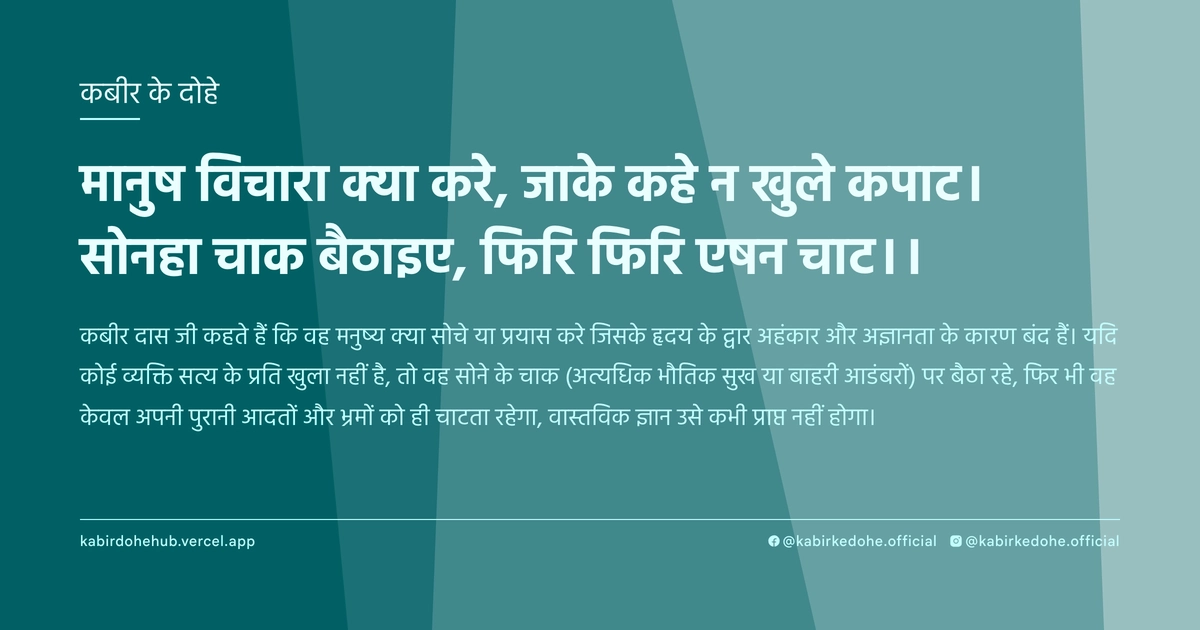
मानुष विचारा क्या करे, जाके कहे न खुले कपाट।
सोनहा चाक बैठाइए, फिरि फिरि एषन चाट।।
Manush vichara kya kare, jake kahe na khule kapat. Sonha chaak baithaiye, phiri phiri eshan chaat.
इस पृष्ठ पर इस कबीर दोहे का अर्थ (meaning), हिंदी व्याख्या और अंग्रेज़ी अनुवाद, दार्शनिक विश्लेषण और व्यावहारिक जीवन सीख दी गई है। यह दोहा माया (Maya) विषय से जुड़ा है — Kabir doha meaning and explanation in Hindi and English.
अर्थ (Meaning):
कबीर दास जी कहते हैं कि वह मनुष्य क्या सोचे या प्रयास करे जिसके हृदय के द्वार अहंकार और अज्ञानता के कारण बंद हैं। यदि कोई व्यक्ति सत्य के प्रति खुला नहीं है, तो वह सोने के चाक (अत्यधिक भौतिक सुख या बाहरी आडंबरों) पर बैठा रहे, फिर भी वह केवल अपनी पुरानी आदतों और भ्रमों को ही चाटता रहेगा, वास्तविक ज्ञान उसे कभी प्राप्त नहीं होगा।
Kabir questions the utility of intellectualizing or striving for a person whose inner doors of consciousness remain locked by ego and ignorance. Even if such a person is seated upon a golden wheel—symbolizing the highest material luxury or external religious rituals—they continue to obsess over their own illusions, never tasting the actual nectar of spiritual liberation.
व्याख्या (Interpretation):
यहाँ 'कपाट' या द्वार मनुष्य के हृदय और चेतना का प्रतीक है। जब तक अहंकार का पर्दा है, तब तक बाहरी उपदेश या ज्ञान व्यर्थ हैं। 'सोनहा चाक' भौतिक समृद्धि और बाहरी दिखावे का संकेत है। यह दोहा निरगुण भक्ति के उस सिद्धांत को रेखांकित करता है जहाँ ईश्वर बाहर नहीं, बल्कि भीतर है। यदि भीतर का द्वार बंद है, तो बाहरी स्वर्ण (माया) केवल एक भ्रम है जो व्यक्ति को और अधिक बंधन में डालता है। यह आत्मा और ब्रह्म की अद्वैत स्थिति को प्राप्त करने में आने वाली सबसे बड़ी बाधा—'अहं'—का चित्रण है।
The 'kapat' or doors symbolize the gateway to the heart and higher consciousness. When the veil of ego persists, external instructions or intellectual knowledge remain futile. The 'golden wheel' represents material opulence and the superficiality of ritualistic religion. This verse underscores the Nirgun Bhakti principle that the Divine resides within; if the inner door is locked, external gold (Maya) is merely a distraction that deepens bondage. It illustrates the central paradox: the seeker possesses the treasure, yet remains a beggar because the ego blocks the realization of Atman-Brahman non-duality.
दार्शनिक विश्लेषण (Philosophical Analysis):
कबीर का यह दोहा उनके युग के उस सामाजिक और धार्मिक पाखंड पर प्रहार है जहाँ लोग बाहरी कर्मकांडों को मोक्ष का साधन मानते थे। वे स्पष्ट करते हैं कि चाहे कोई कितना भी समृद्ध हो या धार्मिक अनुष्ठानों में लीन रहे, यदि आंतरिक रूपांतरण नहीं हुआ, तो सब व्यर्थ है। यह विचार अद्वैत वेदांत के करीब है, जहाँ अज्ञान (Avidya) को ही बंधन का कारण माना गया है।
सूफी मत के 'फना' (अहंकार का विनाश) के सिद्धांत की तरह, कबीर यहाँ यह समझा रहे हैं कि जब तक 'मैं' का अस्तित्व है, तब तक 'वह' (परमात्मा) का अनुभव असंभव है। वे जाति और वर्ण के भेदभाव को नकारते हुए यह बताते हैं कि आध्यात्मिक पात्रता किसी सामाजिक स्तर या धन से नहीं, बल्कि हृदय की सरलता और openness से आती है।
यहाँ 'चाक' का उपयोग एक रूपक के रूप में किया गया है, जो जीवन के चक्र और पुनरावृत्ति को दर्शाता है। मनुष्य अक्सर अपनी पुरानी मानसिक प्रवृत्तियों (Samskaras) के चक्र में घूमता रहता है, जिसे वह प्रगति समझता है, जबकि वह वास्तव में केवल अपने भ्रम को ही दोहरा रहा होता है।
मनोवैज्ञानिक स्तर पर, यह दोहा 'कन्फर्मेशन बायस' की बात करता है। व्यक्ति केवल वही देखता है जो वह देखना चाहता है। यदि उसका मन बंद है, तो वह सत्य के सामने खड़े होकर भी उसे नहीं पहचान पाएगा। यह मानसिक जड़ता का विश्लेषण है।
अंततः, कबीर यह संदेश देते हैं कि मुक्ति बाहरी साधनों से नहीं, बल्कि आंतरिक समर्पण से मिलती है। जब अहंकार का कपाट खुलता है, तब व्यक्ति को पता चलता है कि जिस सत्य को वह बाहर खोज रहा था, वह सदैव उसके भीतर ही विद्यमान था।
Kabir's verse is a scathing critique of the social and religious hypocrisy of his era, where external rituals were mistaken for the path to salvation. He asserts that regardless of one's wealth or adherence to religious rites, without internal transformation, all efforts are void. This aligns closely with Advaita Vedanta, which identifies ignorance (Avidya) as the primary cause of bondage.
Mirroring the Sufi concept of 'Fana' (the annihilation of the self), Kabir explains that as long as the 'I' exists, the experience of the 'Thou' (the Divine) is impossible. He rejects caste and class distinctions, arguing that spiritual eligibility is not derived from social status or wealth, but from the simplicity and openness of the heart.
The 'wheel' (chaak) serves as a metaphor for the cycle of existence and repetitive behavioral patterns. Humans often spin in the cycle of their own mental impressions (Samskaras), perceiving this circular motion as progress, while they are merely recycling their own delusions.
Psychologically, this verse addresses the phenomenon of cognitive dissonance and confirmation bias. A person perceives only what they are predisposed to see. If the mind is closed, the truth remains invisible even when it stands directly before the seeker. It is a profound analysis of mental rigidity.
Ultimately, Kabir teaches that liberation is not achieved through external instruments but through internal surrender. When the door of the ego swings open, the seeker realizes that the Truth they were searching for externally has always resided within them.
मूल संदेश (Core Message):
- बाहरी चमक आंतरिक अंधकार को नहीं मिटा सकती।
- अहंकार वह ताला है जो सत्य के द्वार को बंद रखता है।
- ज्ञान का अर्थ सूचना नहीं, बल्कि हृदय का खुलना है।
- माया के सोने के चक्र में घूमना केवल भ्रम की पुनरावृत्ति है।
- सच्ची भक्ति स्वयं के मिथ्या व्यक्तित्व का विसर्जन है।
- जब 'मैं' मिटता है, तभी 'परमात्मा' का अनुभव होता है।
- External brilliance cannot erase internal darkness.
- Ego is the lock that keeps the door of Truth closed.
- Knowledge is not the accumulation of information, but the opening of the heart.
- Spinning in the golden wheel of Maya is merely the repetition of illusion.
- True devotion is the dissolution of the false personality.
- Only when the 'I' vanishes does the experience of the Divine begin.
व्यावहारिक उदाहरण (Practical Example):
एक समय की बात है, वाराणसी के घाटों पर रहने वाला एक वृद्ध बुनकर था जिसका नाम माधव था। माधव अपने काम में निपुण था और शहर के सबसे अमीर व्यापारियों को रेशमी वस्त्र बेचता था। उसके पास धन की कमी नहीं थी, और वह स्वयं को बहुत धार्मिक मानता था क्योंकि वह हर दिन महंगे दान करता था और बड़े-बड़े पंडितों से सलाह लेता था।
माधव का अहंकार उसके धन और उसकी 'धार्मिकता' में छिपा था। वह मानता था कि वह दूसरों से श्रेष्ठ है क्योंकि वह शास्त्रों की चर्चा कर सकता है। एक दिन उसकी मुलाकात एक फकीर से हुई जो घाट की सीढ़ियों पर चुपचाप बैठा था। फकीर ने माधव के रेशमी वस्त्रों और उसके अहंकार को देखकर बस इतना कहा, "तुम्हारे पास सोने का चाक तो है, पर हृदय का द्वार बंद है।"
माधव को यह बात चुभी। उसने फकीर को चुनौती दी कि वह उसे बताए कि उसका द्वार बंद क्यों है। फकीर ने उसे एक साधारण प्रयोग दिया: "अगले सात दिनों तक, तुम किसी भी ऐसे व्यक्ति की मदद करो जिससे तुम नफरत करते हो या जिसे तुम तुच्छ समझते हो, और बदले में उनसे एक शब्द भी न लो।"
माधव ने अनिच्छा से इसे स्वीकार किया। उसने अपने उस प्रतिद्वंद्वी बुनकर की मदद की जिसने सालों पहले उसे धोखा दिया था। जब उसने चुपचाप उसकी मदद की, तो उसे महसूस हुआ कि उसकी नफरत वास्तव में उसके अपने अहंकार की रक्षा का एक तरीका थी।
जैसे-जैसे दिन बीते, माधव ने महसूस किया कि वह अब तक केवल अपनी श्रेष्ठता के भ्रम को 'चाट' रहा था। उसकी धार्मिकता केवल एक मुखौटा थी। जिस क्षण उसने दूसरे के प्रति करुणा महसूस की, उसके भीतर का वह भारीपन गायब हो गया।
वह समझ गया कि उसके सोने के वस्त्र और पंडितों की बातें केवल बाहरी चमक थीं। असली शांति उस समय मिली जब उसने अपने भीतर के 'मैं' को गिरा दिया।
उसने देखा कि वह अब तक जिस सत्य को किताबों में खोज रहा था, वह तो एक साधारण इंसान की सेवा और क्षमा में छिपा था।
माधव का जीवन बदल गया। उसने दान देना बंद नहीं किया, लेकिन अब वह दान अहंकार से नहीं, बल्कि प्रेम से करता था।
उसने जान लिया कि जब तक हृदय का कपाट नहीं खुलता, तब तक दुनिया की सारी दौलत केवल एक सोने का पिंजरा है।
अब वह केवल एक कुशल बुनकर नहीं था, बल्कि एक जागृत आत्मा बन चुका था जिसने माया के चक्र को तोड़ दिया था।
Once, in the ghats of Varanasi, lived an elderly weaver named Madhav. Madhav was masterly in his craft, selling exquisite silk garments to the city's wealthiest merchants. He lacked for nothing in terms of wealth and considered himself deeply religious, donating lavishly and consulting the most renowned scholars.
Madhav's ego was hidden within his wealth and his perceived 'piety.' He believed himself superior because he could debate scriptures. One day, he encountered a wandering dervish sitting silently on the stone steps of the ghat. Seeing Madhav's silk robes and arrogance, the dervish simply remarked, "You possess a golden wheel, yet the door of your heart remains locked."
Madhav felt insulted. He challenged the dervish to prove how his door was closed. The dervish gave him a simple task: "For the next seven days, help someone you despise or consider inferior, and in return, do not utter a single word to them."
Madhav reluctantly agreed. He began by helping a rival weaver who had betrayed him years ago. As he helped him in silence, he realized that his hatred was actually a mechanism to protect his own ego.
As the days passed, Madhav realized he had spent his entire life 'licking' the illusion of his own superiority. His religiosity had been nothing more than a mask.
The moment he felt genuine compassion for another, a heavy weight he hadn't known he was carrying vanished from his chest.
He understood that his golden clothes and the scholarly discourses were merely external glitters. True peace arrived only when he dismantled the 'I' within him.
He saw that the Truth he had been searching for in books was hidden in the simple act of serving and forgiving another human being.
Madhav's life transformed. He did not stop giving, but his charity shifted from a place of ego to a place of love.
He realized that until the door of the heart opens, all the wealth in the world is merely a golden cage.
He was no longer just a skilled weaver, but an awakened soul who had broken the cycle of Maya.
अभ्यास मार्गदर्शन (Practice Guidance):
- प्रतिदिन 20 मिनट मौन अभ्यास करें, जहाँ आप अपने विचारों को बिना किसी निर्णय के देखें और यह पहचानें कि कौन सा विचार 'अहंकार' से प्रेरित है।
- स्व-पूछताछ जर्नल: प्रतिदिन लिखें, "आज मैंने किस समय अपनी श्रेष्ठता सिद्ध करने की कोशिश की?" और विश्लेषण करें कि उस समय मन में कौन सा डर था।
- व्यवहारिक परिवर्तन: सप्ताह में एक बार किसी ऐसे व्यक्ति की निस्वार्थ सेवा करें जिसके प्रति आप पूर्वाग्रह रखते हों, बिना उन्हें यह बताए कि आप ऐसा कर रहे हैं।
- डायग्नोस्टिक चेकलिस्ट: क्या मैं दूसरों की सलाह सुनकर चिढ़ जाता हूँ? क्या मैं अपनी उपलब्धियों का श्रेय केवल स्वयं को देता हूँ? क्या मैं बाहरी अनुष्ठानों को आंतरिक शांति से अधिक महत्व देता हूँ? (यदि हाँ, तो कपाट अभी बंद हैं)।
- Practice 20 minutes of daily silence, observing your thoughts without judgment and identifying which thoughts are driven by the 'ego'.
- Self-Inquiry Journal: Write daily, "At what moment today did I try to prove my superiority?" and analyze the underlying fear present in that moment.
- Behavioral Shift: Once a week, perform a selfless act of service for someone you hold a prejudice against, without letting them know you are doing so.
- Diagnostic Checklist: Do I feel irritated when receiving advice? Do I take sole credit for my achievements? Do I value external rituals over internal peace? (If yes, the doors remain locked).
चिंतन प्रश्न (Reflection Questions):
- मेरे जीवन का वह 'सोने का चाक' क्या है—वह कौन सी उपलब्धि है जिसे मैं अपनी पहचान मान बैठा हूँ और जो मुझे सत्य से दूर रख रही है?
- यदि मेरी सारी सामाजिक प्रतिष्ठा और पद छीन लिए जाएँ, तो मेरे भीतर क्या बचेगा?
- मैं अपनी डिजिटल पहचान (सोशल मीडिया) के माध्यम से किस प्रकार के 'कपाट' बना रहा हूँ ताकि लोग मेरी वास्तविकता को न देख सकें?
- क्या मेरी धार्मिकता वास्तव में मुझे विनम्र बना रही है, या यह मुझे दूसरों को छोटा समझने का एक नया आधार दे रही है?
- वह कौन सा सत्य है जिसे मैं जानते हुए भी स्वीकार नहीं कर पा रहा हूँ क्योंकि वह मेरे अहंकार को चोट पहुँचाता है?
- क्या मैं वास्तव में सत्य की खोज कर रहा हूँ, या मैं केवल अपनी मान्यताओं की पुष्टि करने वाले प्रमाण खोज रहा हूँ?
- What is the 'golden wheel' in my life—which achievement have I mistaken for my identity, and how is it distancing me from the Truth?
- If all my social prestige and titles were stripped away, what would remain within me?
- Through my digital identity, what kind of 'doors' am I constructing to prevent people from seeing my authentic self?
- Is my religiosity actually making me humble, or is it providing a new foundation for me to look down upon others?
- What is the truth that I refuse to accept, even though I know it, because it wounds my ego?
- Am I truly seeking the Truth, or am I merely searching for evidence that confirms my existing beliefs?