
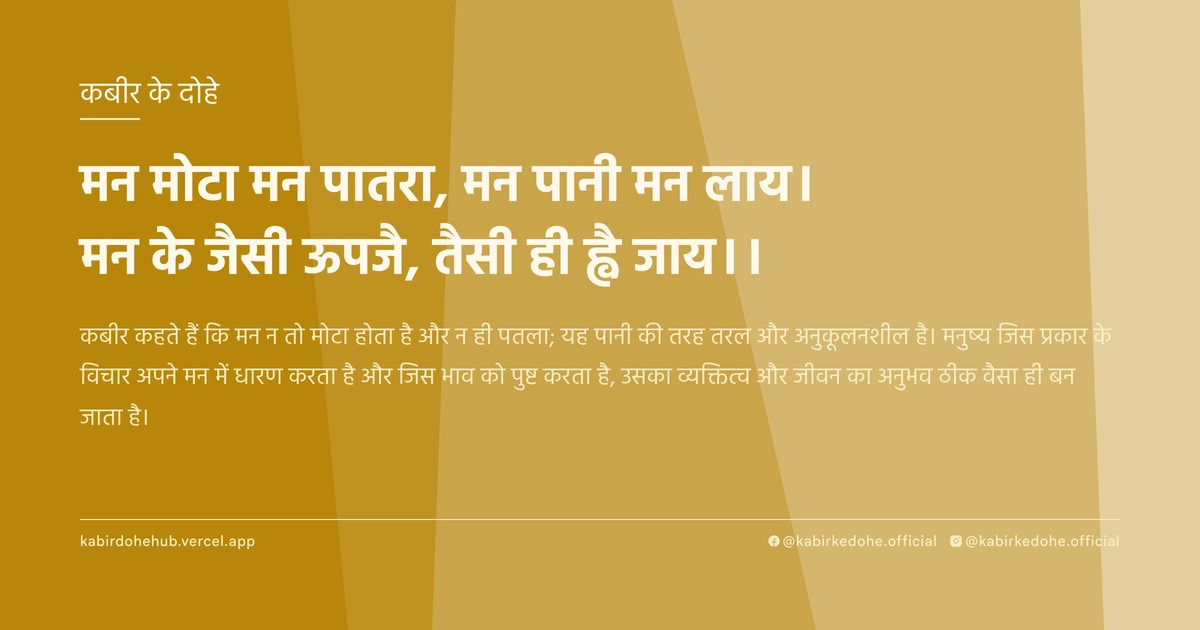
मन मोटा मन पातरा, मन पानी मन लाय।
मन के जैसी ऊपजै, तैसी ही ह्वै जाय।।
Man mota man patra, man paani man laay. Man ke jaisi upjai, taisi hi hvai jaaye.
इस पृष्ठ पर इस कबीर दोहे का अर्थ (meaning), हिंदी व्याख्या और अंग्रेज़ी अनुवाद, दार्शनिक विश्लेषण और व्यावहारिक जीवन सीख दी गई है। यह दोहा आत्मनिरीक्षण (Self-introspection) विषय से जुड़ा है — Kabir doha meaning and explanation in Hindi and English.
अर्थ (Meaning):
कबीर कहते हैं कि मन न तो मोटा होता है और न ही पतला; यह पानी की तरह तरल और अनुकूलनशील है। मनुष्य जिस प्रकार के विचार अपने मन में धारण करता है और जिस भाव को पुष्ट करता है, उसका व्यक्तित्व और जीवन का अनुभव ठीक वैसा ही बन जाता है।
Kabir asserts that the mind possesses no fixed thickness or thinness; rather, it is fluid like water. Whatever thoughts a person harbors and whatever intentions they cultivate within their consciousness, their entire existence and character eventually mold themselves into that very shape.
व्याख्या (Interpretation):
शाब्दिक रूप से, कबीर मन की तुलना जल से करते हैं जो किसी भी पात्र का आकार ले लेता है। आध्यात्मिक स्तर पर, यह 'मन' हमारी चेतना की वह अवस्था है जो संस्कारों और वासनाओं से प्रभावित होती है। निर्गुण भक्ति के संदर्भ में, यह दर्शाता है कि यदि मन माया के मोह में है, तो वह बंधन बन जाता है, और यदि वह ब्रह्म के शून्य में लीन है, तो वह मुक्ति बन जाता है। यह अद्वैत वेदांत के उस सिद्धांत को पुष्ट करता है जहाँ दृष्टा और दृश्य का भेद मिट जाता है। यहाँ विरोधाभास यह है कि जिसे हम 'स्थिर व्यक्तित्व' समझते हैं, वह वास्तव में केवल हमारे मानसिक प्रक्षेपणों का एक अस्थाई संचय है। अंततः, मन की तरलता ही वह द्वार है जिससे हम अहंकार को मिटाकर अनंत में विलीन हो सकते हैं।
Literally, Kabir compares the mind to water, which seamlessly adopts the shape of any vessel it inhabits. On a spiritual plane, this 'mind' represents the state of consciousness influenced by latent impressions (Samskaras) and desires. In the context of Nirgun Bhakti, it suggests that if the mind is tethered to the illusions of Maya, it becomes a prison; conversely, if it dissolves into the void of the Formless Brahman, it becomes liberation. This reinforces the Advaita Vedanta principle where the distinction between the observer and the observed vanishes. The central paradox lies in the fact that what we perceive as a 'stable personality' is merely a temporary accumulation of mental projections. Ultimately, the fluidity of the mind is the very gateway through which the ego is annihilated to merge with the Infinite.
दार्शनिक विश्लेषण (Philosophical Analysis):
कबीर का यह दोहा उस युग की उपज है जब धर्म बाहरी कर्मकांडों और कठोर जातिगत विभाजनों में जकड़ा हुआ था। कबीर ने इस बाहरी ढांचे को चुनौती देते हुए आंतरिक मनोविज्ञान पर जोर दिया। वे कहते हैं कि मोक्ष किसी मंदिर या मस्जिद में नहीं, बल्कि मन के रूपांतरण में है। यह दृष्टिकोण सूफीवाद के 'फना' (अहंकार का विनाश) और वेदांत के 'अहं ब्रह्मास्मि' के करीब है, जहाँ व्यक्ति अपनी सीमित पहचान को त्यागकर सार्वभौमिक सत्य को अपनाता है।
यहाँ 'मोटा' और 'पातरा' शब्द केवल भौतिक माप नहीं हैं, बल्कि मानसिक जड़ता और अति-संवेदनशीलता के प्रतीक हैं। कबीर तर्क देते हैं कि मन वास्तव में तटस्थ है। यह एक दर्पण की तरह है। यदि हम इसमें क्रोध देखते हैं, तो हम क्रोधमय हो जाते हैं; यदि हम इसमें करुणा देखते हैं, तो हम करुणा बन जाते हैं। यह मनोवैज्ञानिक सत्य है कि हमारे विचार हमारे तंत्रिका तंत्र और व्यवहार को पुनर्गठित करते हैं।
कबीर का विरोध उन पाखंडियों से था जो बाहरी रूप से पवित्र दिखने का दावा करते थे लेकिन भीतर से ईर्ष्या और घृणा से भरे थे। वे स्पष्ट करते हैं कि आध्यात्मिक प्रगति का पैमाना बाहरी वेशभूषा नहीं, बल्कि मन की शुद्धता है। जब मन 'पानी' की तरह पारदर्शी हो जाता है, तब उसमें ईश्वर का प्रतिबिंब स्पष्ट दिखाई देता है।
यह दर्शन हमें सिखाता है कि हम अपने भाग्य के निर्माता स्वयं हैं। यदि हम नकारात्मकता को सींचते हैं, तो हमारा जीवन कँटीला होगा। यदि हम प्रेम और शून्य को अपनाते हैं, तो हम स्वयं प्रेम बन जाते हैं। यह 'बीज' और 'फल' के सिद्धांत पर आधारित है—जैसा मानसिक बीज, वैसा ही जीवन का फल।
अंततः, यह दोहा अहंकार के विसर्जन की बात करता है। जब साधक यह समझ जाता है कि उसका 'मैं' केवल एक मानसिक लहर है, तो वह लहर शांत होकर समुद्र (परमात्मा) में मिल जाती है। यही वह बिंदु है जहाँ द्वैत समाप्त होता है और अद्वैत का अनुभव प्रारंभ होता है।
This couplet emerges from an era where religion was stifled by rigid rituals and oppressive caste hierarchies. Kabir challenged these external structures, shifting the focus toward internal psychology. He posits that salvation is found not in temples or mosques, but in the transmutation of the mind. This perspective aligns closely with the Sufi concept of 'Fana' (annihilation of the self) and the Vedantic realization of 'Aham Brahmasmi,' where the individual transcends limited identity to embrace universal truth.
The terms 'thick' (mota) and 'thin' (patara) are not mere physical measurements but symbols of mental rigidity and hypersensitivity. Kabir argues that the mind is essentially neutral—a mirror. If we project anger, we become angry; if we project compassion, we become compassion. This is a profound psychological truth: our recurring thoughts rewire our neural pathways and dictate our behavioral patterns.
Kabir’s critique was aimed at the hypocrites who maintained a facade of piety while harboring jealousy and hatred. He clarifies that the metric of spiritual progress is not outward attire or ritual purity, but the transparency of the mind. When the mind becomes as clear as water, the reflection of the Divine becomes visible without distortion.
This philosophy empowers the individual as the architect of their own destiny. If we nurture negativity, our life becomes thorny. If we cultivate love and emptiness, we embody love. It is based on the law of the seed and the fruit—the quality of the mental seed determines the nature of the life-harvest.
Ultimately, the verse speaks of the dissolution of the ego. When the seeker realizes that their 'I' is merely a ripple on the surface of consciousness, that ripple subsides, and the individual merges back into the ocean of the Absolute. This is the precise moment where duality ends and the experience of Non-duality (Advaita) begins.
मूल संदेश (Core Message):
- मन कोई ठोस वस्तु नहीं, बल्कि एक प्रवाह है।
- विचार ही हमारे व्यक्तित्व के वास्तुकार हैं।
- जैसे बीज बोओगे, वैसा ही मानसिक फल पाओगे।
- अहंकार की जड़ता को प्रेम की तरलता में बदलो।
- बाहरी दुनिया केवल आंतरिक मन का प्रतिबिंब है।
- शून्य हो जाओ, तभी अनंत को समा सकोगे।
- The mind is not a solid entity, but a continuous flow.
- Our thoughts are the sole architects of our personality.
- The mental seed you sow determines the fruit of your life.
- Transform the rigidity of ego into the fluidity of love.
- The external world is merely a reflection of the internal mind.
- Become empty to contain the Infinite.
व्यावहारिक उदाहरण (Practical Example):
वाराणसी के घाटों पर रहने वाली एक वृद्ध विधवा, जानकी, का जीवन कड़वाहट से भरा था। दशकों पहले उनके परिवार ने उन्हें त्याग दिया था, और उन्होंने दुनिया को एक क्रूर स्थान मान लिया था।
वह हर आने-जाने वाले को संदेह की दृष्टि से देखती थीं। उनके मन में यह गहरा विश्वास बैठ गया था कि हर व्यक्ति स्वार्थी होता है।
उनकी यह मानसिक स्थिति उनके व्यवहार में झलकती थी; वे छोटी-छोटी बातों पर चिल्लातीं और किसी की मदद लेने से इनकार कर देती थीं।
एक दिन, एक युवा साधु ने उन्हें देखा और बिना कुछ मांगे उनके पास बैठकर बस मुस्कुराने लगे।
जानकी ने उन्हें झिड़का, लेकिन साधु की शांति ने उन्हें विचलित कर दिया। उन्होंने सोचा, 'यह व्यक्ति मुझसे डर क्यों नहीं रहा?'
धीरे-धीरे, जानकी ने महसूस किया कि उनकी अपनी कड़वाहट ही उन्हें अकेला कर रही है, न कि दुनिया की क्रूरता।
उन्होंने एक प्रयोग किया: हर सुबह उठकर उन्होंने मन में यह दोहराया कि 'आज मैं किसी एक व्यक्ति में अच्छाई देखूँगी'।
शुरुआत में यह कठिन था, लेकिन जैसे-जैसे उन्होंने 'अच्छाई' के विचार को मन में पानी की तरह बहाया, उनका नजरिया बदलने लगा।
उन्होंने देखा कि वही लोग, जिन्हें वे स्वार्थी समझते थे, वास्तव में अपनी समस्याओं से जूझ रहे थे और दया के भूखे थे।
अंततः, जानकी का व्यक्तित्व बदल गया। वे अब घाट की सबसे प्रिय महिला थीं, जो सबको प्रेम देती थीं, क्योंकि उन्होंने अपने मन के 'पानी' का रंग बदल दिया था।
Janaki, an elderly widow living on the ghats of Varanasi, led a life saturated with bitterness. Decades ago, her family had abandoned her, and she had concluded that the world was an inherently cruel place.
She viewed every passerby with suspicion. A deep-seated conviction had taken root in her mind that every human being was fundamentally selfish.
This mental state manifested in her behavior; she would snap at the slightest provocation and refuse any offer of help, viewing it as a trap.
One day, a young monk noticed her and simply sat beside her, offering a serene smile without asking for anything in return.
Janaki scolded him, but the monk's unwavering peace unsettled her. She wondered, 'Why is this man not afraid of my anger?'
Gradually, Janaki realized that it was her own bitterness, not the world's cruelty, that was isolating her from humanity.
She decided to conduct a mental experiment: every morning, she would repeat to herself, 'Today, I will find one spark of goodness in another person.'
Initially, it felt forced and unnatural, but as she allowed the thought of 'goodness' to flow like water through her mind, her perception shifted.
She began to see that the people she had labeled as selfish were actually struggling with their own pains and were starving for kindness.
Eventually, Janaki's entire persona transformed. She became the most beloved figure on the ghats, radiating love, because she had changed the color of the 'water' in her mind.
अभ्यास मार्गदर्शन (Practice Guidance):
- दैनिक अवलोकन: दिन भर में जब भी क्रोध या ईर्ष्या आए, रुकें और सोचें—'मैं अभी अपने मन के पानी को किस रंग में रंग रहा हूँ?'
- मानसिक विसर्जन: प्रतिदिन 15 मिनट मौन बैठें और कल्पना करें कि आपके विचार पानी की तरह बह रहे हैं, आप केवल उन्हें देख रहे हैं, उनसे जुड़ नहीं रहे।
- लेखन अभ्यास: एक डायरी लिखें जिसमें उन धारणाओं को चुनौती दें जिन्हें आप 'सत्य' मानते हैं (जैसे: 'सब लोग बुरे हैं') और उनके विपरीत सकारात्मक संभावनाओं को लिखें।
- निदान चेकलिस्ट: क्या मैं दूसरों की प्रतिक्रियाओं से विचलित होता हूँ? क्या मेरी खुशी बाहरी परिस्थितियों पर निर्भर है? यदि हाँ, तो मेरा मन अभी 'जड़' है, 'तरल' नहीं।
- Daily Observation: Whenever anger or jealousy arises, pause and ask—'What color am I currently tinting the water of my mind?'
- Mental Dissolution: Sit in silence for 15 minutes daily, imagining your thoughts flowing like water; observe them as a witness without attaching to them.
- Writing Practice: Keep a journal to challenge the 'truths' you hold (e.g., 'Everyone is selfish') and consciously write opposite, positive possibilities.
- Diagnostic Checklist: Do I react impulsively to others? Is my happiness dependent on external conditions? If yes, my mind is currently 'rigid' rather than 'fluid'.
चिंतन प्रश्न (Reflection Questions):
- वह कौन सा 'स्थिर' विचार है जिसे मैंने अपनी पहचान बना लिया है, जबकि वह केवल एक मानसिक आदत है?
- यदि मेरा मन पानी की तरह है, तो मैं किन यादों के कचरे को पकड़कर बैठा हूँ जो मेरी पारदर्शिता को रोक रहे हैं?
- क्या मेरी डिजिटल पहचान (सोशल मीडिया) मेरे वास्तविक मन का प्रतिबिंब है या एक निर्मित मुखौटा?
- मैं दूसरों में जो बुराइयाँ देखता हूँ, क्या वे वास्तव में उनमें हैं या मेरे अपने मन के रंग हैं?
- क्या मैं वास्तव में स्वतंत्र हूँ, या मैं अपने ही पुराने संस्कारों के द्वारा संचालित एक कठपुतली हूँ?
- मेरे जीवन का सबसे बड़ा डर क्या है, और वह डर मेरे मन को किस आकार में ढाल रहा है?
- Which 'fixed' thought have I mistaken for my identity, when it is actually just a mental habit?
- If my mind is like water, what debris of old memories am I clinging to that obstructs my transparency?
- Is my digital persona a reflection of my true mind, or a carefully constructed mask?
- The flaws I perceive in others—do they truly exist, or are they merely the colors of my own mind?
- Am I truly free, or am I a puppet operated by my own ancient mental impressions (Samskaras)?
- What is the greatest fear in my life, and what shape is that fear molding my mind into?