
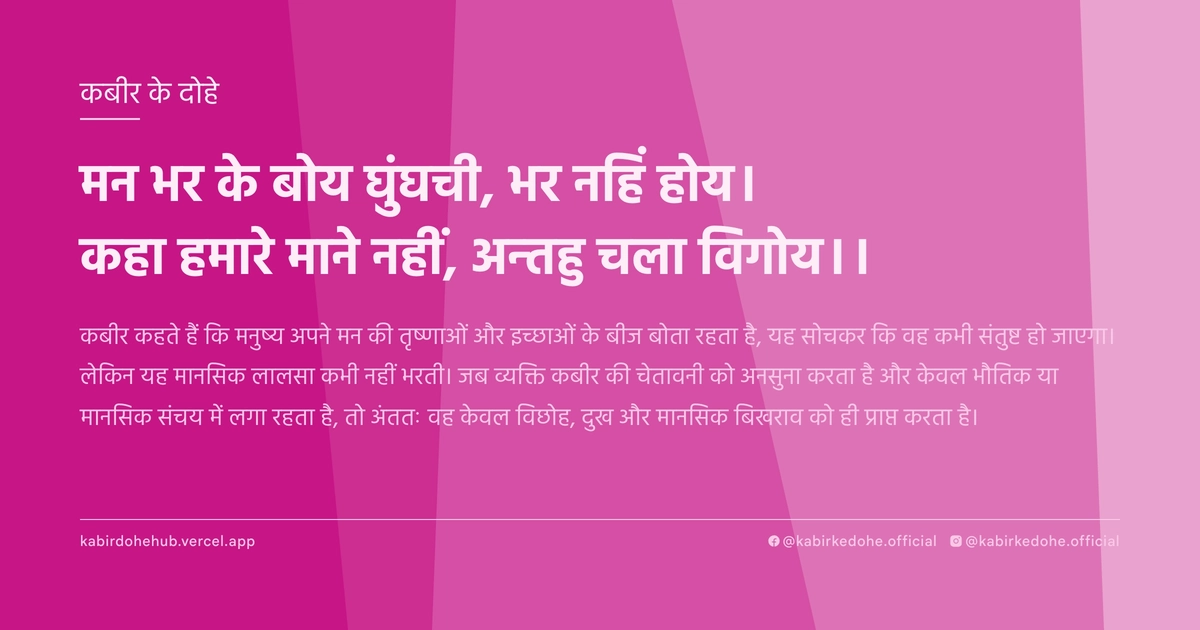
मन भर के बोय घुंघची, भर नहिं होय।
कहा हमारे माने नहीं, अन्तहु चला विगोय।।
Man bhar ke boy ghunghchi, bhar nahin hoye. Kaha hamare maane nahi, antahu chala vigoy.
इस पृष्ठ पर इस कबीर दोहे का अर्थ (meaning), हिंदी व्याख्या और अंग्रेज़ी अनुवाद, दार्शनिक विश्लेषण और व्यावहारिक जीवन सीख दी गई है। यह दोहा कर्म (Karma) विषय से जुड़ा है — Kabir doha meaning and explanation in Hindi and English.
अर्थ (Meaning):
कबीर कहते हैं कि मनुष्य अपने मन की तृष्णाओं और इच्छाओं के बीज बोता रहता है, यह सोचकर कि वह कभी संतुष्ट हो जाएगा। लेकिन यह मानसिक लालसा कभी नहीं भरती। जब व्यक्ति कबीर की चेतावनी को अनसुना करता है और केवल भौतिक या मानसिक संचय में लगा रहता है, तो अंततः वह केवल विछोह, दुख और मानसिक बिखराव को ही प्राप्त करता है।
Kabir observes that a human spends their entire life sowing the seeds of desire and craving, believing that one day they will reach a state of fullness. However, the void of the mind is an infinite abyss that cannot be filled by external acquisitions. By ignoring the spiritual truth and persisting in the pursuit of transient desires, the individual eventually finds themselves in a state of profound alienation and spiritual fragmentation.
व्याख्या (Interpretation):
यहाँ 'घुंघची' (बीज) मानवीय इच्छाओं और आसक्तियों का प्रतीक है। कबीर यह समझा रहे हैं कि मन एक ऐसी भूमि है जहाँ यदि वासना और अहंकार के बीज बोए जाएं, तो परिणाम केवल और अधिक प्यास के रूप में मिलता है। यह निरगुण भक्ति का सार है कि ईश्वर बाहर नहीं, बल्कि मन की शांति में है। जब तक हम माया के भ्रम में फंसे रहते हैं, हम अद्वैत के सत्य को नहीं देख पाते। अंततः 'विगोय' या विछोह का अर्थ है आत्मा का परमात्मा से अलग होना, जो केवल अहंकार के कारण होता है। यह विरोधाभास है कि हम पूर्णता की खोज में वही बीज बोते हैं जो हमें अधूरा बनाते हैं।
The 'ghunghchi' or seed serves as a potent metaphor for human cravings and attachments. Kabir posits that the mind is a fertile ground where sowing seeds of desire only yields a harvest of further longing. This aligns with Nirgun Bhakti, emphasizing that the Formless Divine is obscured by the clutter of the ego. The 'Maya' or cosmic illusion convinces the seeker that fulfillment lies in accumulation, whereas Advaita Vedanta teaches that the Atman is already complete. The 'vigoy' or separation represents the tragic irony of the human condition: we strive for union with the Infinite while strengthening the walls of the finite ego. The paradox is that the very effort to 'fill' the mind is what keeps it empty.
दार्शनिक विश्लेषण (Philosophical Analysis):
कबीर का यह दोहा उनके युग के उस सामाजिक और धार्मिक पाखंड पर प्रहार है जहाँ लोग बाहरी कर्मकांडों और संचय को मोक्ष का मार्ग मानते थे। वे स्पष्ट करते हैं कि चाहे वह धार्मिक अनुष्ठान हो या भौतिक संपत्ति, यदि मन में तृष्णा है, तो कोई भी बाहरी क्रिया उसे शांत नहीं कर सकती। यह विचार सूफीवाद के 'फना' (अहंकार का विनाश) के करीब है, जहाँ साधक को अपनी व्यक्तिगत इच्छाओं को मिटाना होता है ताकि वह ईश्वर में विलीन हो सके।
अद्वैत वेदांत के परिप्रेक्ष्य में, यह दोहा 'अविद्या' (अज्ञान) की चर्चा करता है। मनुष्य स्वयं को शरीर और मन मानता है, इसलिए वह उसे भरने की कोशिश करता है। कबीर कहते हैं कि जब तक 'मैं' (अहंकार) मौजूद है, तब तक 'भरने' की प्रक्रिया जारी रहेगी। वास्तविक पूर्णता तब आती है जब बोने वाला (कर्ता) ही समाप्त हो जाए।
कबीर का विरोध केवल बाहरी वस्तुओं से नहीं, बल्कि उस मानसिक प्रवृत्ति से है जो 'कमी' का अनुभव करती है। वे तर्क देते हैं कि इच्छाएं अग्नि की तरह हैं; उनमें घी डालने से वे बुझती नहीं, बल्कि और भड़कती हैं। यह मनोवैज्ञानिक विश्लेषण आज के उपभोक्तावादी समाज पर भी सटीक बैठता है जहाँ 'अधिक' की चाहत अंततः मानसिक अवसाद और अकेलेपन का कारण बनती है।
यहाँ 'विगोय' शब्द अत्यंत महत्वपूर्ण है। यह केवल भौतिक अलगाव नहीं, बल्कि चेतना का विखंडन है। जब मनुष्य अपनी प्रकृति के विरुद्ध जाता है और केवल बाहरी दुनिया में सुख खोजता है, तो वह अपनी आंतरिक शांति से विलग हो जाता है। यह आध्यात्मिक विस्थापन ही समस्त दुखों की जड़ है।
अंततः, कबीर हमें 'शून्य' होने का आमंत्रण देते हैं। उनका दर्शन यह है कि जब मन पूरी तरह खाली होगा, तभी वह उस अनंत ब्रह्म से भर पाएगा। संचय का मार्ग विछोह की ओर जाता है, जबकि त्याग और समर्पण का मार्ग मिलन की ओर ले जाता है।
This couplet is a scathing critique of the ritualistic and acquisitive tendencies of Kabir's era, where spiritual merit was often equated with external performance or material accumulation. Kabir dismantles the notion that the void within can be filled by external means, asserting that the hunger of the ego is an insatiable fire. This resonates deeply with the Sufi concept of 'Fana'—the annihilation of the self—where the seeker must dissolve their individual desires to realize the Absolute.
From the lens of Advaita Vedanta, the 'seeds' Kabir refers to are the 'Vasanas' or latent tendencies born of ignorance (Avidya). The tragedy lies in the misidentification of the Self; the individual believes they are the limited mind-body complex and thus attempts to 'fill' it. Kabir suggests that as long as the 'I' (the egoic agent) exists, the cycle of craving and dissatisfaction will persist. True wholeness is not an addition but a subtraction of the false self.
Kabir's insight extends to a psychological understanding of desire. He argues that craving is a self-perpetuating loop. In modern terms, this is the 'hedonic treadmill' where every achievement only sets a new, higher baseline for desire. By labeling this process as 'sowing seeds of longing,' he warns that the harvest of such a life is not satisfaction, but a fragmented psyche.
The term 'vigoy' (separation/alienation) is pivotal. It describes a state of ontological displacement. When a human aligns their existence with the transient (Maya) rather than the Eternal (Brahman), they experience a profound sense of homelessness and spiritual loneliness. This alienation is the direct result of ignoring the 'inner voice' or the Guru's warning.
Ultimately, Kabir advocates for the 'Via Negativa'—the path of negation. He suggests that only when the mind is completely emptied of the 'seeds' of ego can it be filled with the Formless Divine. The movement from 'filling' to 'emptying' is the fundamental shift from the path of the worldly to the path of the mystic.
मूल संदेश (Core Message):
- इच्छाओं का संचय कभी संतोष नहीं लाता।
- बाहरी पूर्णता एक भ्रम है, आंतरिक शून्य ही सत्य है।
- अहंकार की तृष्णा आत्मा को परमात्मा से अलग करती है।
- त्याग ही वास्तविक प्राप्ति का एकमात्र मार्ग है।
- मन को भरना नहीं, बल्कि उसे खाली करना सीखें।
- The accumulation of desires never leads to contentment.
- External fulfillment is an illusion; inner emptiness is the gateway to truth.
- The thirst of the ego alienates the soul from the Divine.
- Renunciation is the only authentic path to true attainment.
- Learn not to fill the mind, but to empty it completely.
व्यावहारिक उदाहरण (Practical Example):
एक समय की बात है, वाराणसी के घाटों पर माधव नाम का एक वृद्ध बुनकर रहता था। माधव अपनी कला में निपुण था, लेकिन उसका मन कभी शांत नहीं रहा। उसने सोचा कि यदि वह शहर का सबसे बड़ा व्यापारी बन जाए और उसके पास सोने के ढेर हों, तो वह अंततः शांति पा लेगा।
उसने दिन-रात मेहनत की, अपनी नींद और स्वास्थ्य की बलि दी। उसने धीरे-धीरे कई दुकानें खरीदीं और सैकड़ों मजदूरों को काम पर रखा। जैसे-जैसे उसका धन बढ़ा, उसकी चिंताएं भी बढ़ती गईं। अब उसे डर सताने लगा कि कहीं कोई उसका व्यापार छीन न ले या कोई उसे धोखा न दे दे।
वह अब रेशम के महंगे कपड़ों में लिपटा रहता था, लेकिन उसकी रातों की नींद उड़ चुकी थी। वह जितना अधिक कमाता, उसकी इच्छाएं उतनी ही बढ़ती जातीं। वह अब और बड़े शहरों में विस्तार करना चाहता था। वह एक ऐसी दौड़ में था जिसका कोई अंत नहीं था।
एक दिन, वह घाट पर बैठे एक फकीर के पास गया और अपनी व्यथा सुनाई। उसने कहा, "मैंने सब कुछ पा लिया, फिर भी मेरा मन खाली है। मैं इसे कैसे भरूँ?"
फकीर ने मुस्कुराते हुए माधव के हाथ में एक मुट्ठी बीज दिए और कहा, "इन्हें इस रेतीली जमीन पर बोओ और देखो क्या होता है।"
माधव ने वैसा ही किया। उसने बीज बोए, पानी दिया, लेकिन रेत ने सब कुछ सोख लिया और कुछ नहीं उगा। फकीर ने कहा, "तुम्हारा मन इस रेत की तरह है। तुम इसमें इच्छाओं के बीज बो रहे हो, यह सोचकर कि फसल उगेगी। लेकिन यह भूमि केवल सोखती है, देती कुछ नहीं।"
माधव को अचानक कबीर की बात याद आई कि मन की तृष्णा कभी नहीं भरती। उसे समझ आया कि वह अब तक केवल 'विछोह' के बीज बो रहा था—अपने परिवार से विछोह, अपनी शांति से विछोह और स्वयं से विछोह।
उस दिन माधव ने एक बड़ा निर्णय लिया। उसने अपनी संपत्ति का एक बड़ा हिस्सा गरीबों और अनाथों के लिए समर्पित कर दिया। उसने व्यापार को केवल जीविका का साधन बनाया, न कि अपनी पहचान का आधार।
जैसे ही उसने 'पाने' की जिद छोड़ी, उसे महसूस हुआ कि वह पहले से ही पूर्ण था। उसकी नींद वापस आ गई और उसके चेहरे पर वह संतोष दिखा जो करोड़ों रुपयों से नहीं खरीदा जा सकता था।
Once, on the ancient ghats of Varanasi, lived an elderly weaver named Madhav. Madhav was a master of his craft, yet his mind was a storm of restlessness. He convinced himself that if he could become the wealthiest merchant in the city, with mountains of gold, he would finally attain peace.
He labored tirelessly, sacrificing his sleep and health. Slowly, he acquired multiple shops and employed hundreds of workers. However, as his wealth grew, so did his anxieties. He became haunted by the fear of theft, betrayal, and the loss of his status.
He now draped himself in the finest silks, but his nights were sleepless. Every acquisition only fueled a deeper hunger; he began dreaming of expanding his empire to distant cities. He was trapped in a race with no finish line.
One afternoon, he approached a wandering mystic sitting by the river and confessed his misery. "I have acquired everything," Madhav lamented, "yet my heart feels like a void. How do I fill it?"
The mystic smiled and handed Madhav a handful of seeds. "Sow these in this sandy patch of earth," the mystic commanded, "and see what happens."
Madhav obeyed. He planted the seeds and watered them, but the dry sand swallowed everything, leaving the surface barren. The mystic then said, "Your mind is like this sand. You keep sowing seeds of desire, expecting a harvest of happiness. But this ground only consumes; it never satisfies."
In that moment, the truth of Kabir's words struck Madhav. He realized he had been sowing seeds of 'vigoy'—alienation from his family, his inner peace, and his true self.
Madhav made a radical change. He donated a vast portion of his wealth to the poor and the orphaned. He transformed his business from a quest for power into a simple means of livelihood.
As soon as he abandoned the obsession with 'filling' his life, he discovered a profound sense of wholeness. His sleep returned, and a serene glow settled on his face—a contentment that no amount of gold could ever purchase.
अभ्यास मार्गदर्शन (Practice Guidance):
- प्रतिदिन 20 मिनट 'साक्षी भाव' का अभ्यास करें: अपने मन में उठने वाली इच्छाओं को देखें, उन्हें रोकने की कोशिश न करें, बस यह देखें कि वे कैसे आती हैं और कैसे जाती हैं।
- स्व-पूछताछ जर्नल: हर रात लिखें कि आज आपने किन चीजों को 'पाने' की तीव्र इच्छा की और क्या वह इच्छा वास्तव में आपकी थी या समाज द्वारा थोपी गई थी?
- व्यवहारिक परिवर्तन: सप्ताह में एक बार ऐसी वस्तु का त्याग करें जिसे आप बहुत आवश्यक मानते हैं, ताकि आप यह अनुभव कर सकें कि आपकी पूर्णता बाहरी वस्तुओं पर निर्भर नहीं है।
- डायग्नोस्टिक चेकलिस्ट: क्या आप किसी नई उपलब्धि के बाद केवल कुछ दिनों तक खुश रहते हैं? क्या आप हमेशा 'अगली बड़ी चीज' के इंतजार में हैं? यदि हाँ, तो आप अभी भी 'घुंघची' बो रहे हैं।
- Practice 'Witness Consciousness' for 20 minutes daily: Observe the desires arising in your mind without judgment. Simply notice how they emerge and dissolve, recognizing them as transient waves.
- Self-Inquiry Journaling: Every night, document the intense cravings you felt during the day. Ask yourself: "Was this desire truly mine, or was it an echo of societal expectation?"
- Behavioral Shift: Once a week, intentionally give up a luxury or a possession you deem essential. Experience the realization that your wholeness is independent of external acquisitions.
- Diagnostic Checklist: Do you feel a surge of happiness after an achievement that fades within days? Are you perpetually waiting for the 'next big thing' to be happy? If yes, you are still sowing the seeds of longing.
चिंतन प्रश्न (Reflection Questions):
- आपकी वह कौन सी 'अतृप्त इच्छा' है जिसे आप अपनी पहचान का हिस्सा बना चुके हैं?
- यदि आपसे आपकी सभी सामाजिक उपलब्धियां छीन ली जाएं, तो क्या आपके भीतर कोई शांति शेष रहेगी?
- क्या आपका डिजिटल व्यक्तित्व (सोशल मीडिया) आपकी आंतरिक रिक्तता को भरने का एक आधुनिक प्रयास है?
- आप किन लोगों को अपनी सफलता से छोटा महसूस कराते हैं, और क्या यह आपकी अपनी असुरक्षा का प्रतिबिंब है?
- क्या आप वास्तव में शांति चाहते हैं, या आप केवल अपनी इच्छाओं के पूरा होने का सुख चाहते हैं?
- Which 'unfulfilled desire' have you integrated so deeply that it has become your primary identity?
- If all your social achievements were stripped away tomorrow, would there be any peace remaining within you?
- Is your digital persona a modern attempt to fill an ancient internal void?
- Whom do you make feel inferior through your success, and is this a reflection of your own hidden insecurity?
- Do you truly seek peace, or are you merely seeking the pleasure of having your desires gratified?