
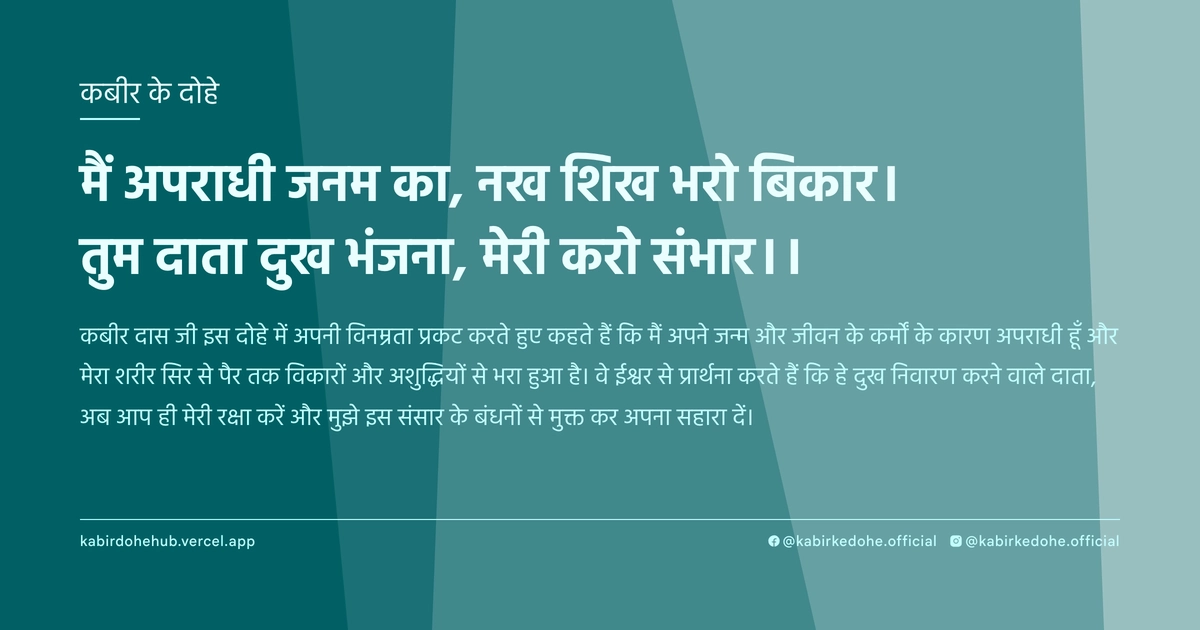
मैं अपराधी जनम का, नख शिख भरो बिकार।
तुम दाता दुख भंजना, मेरी करो संभार।।
Main apradhi janam ka, nakh shikh bharo bikar. Tum data dukh bhanjana, meri karo sambhar.
इस पृष्ठ पर इस कबीर दोहे का अर्थ (meaning), हिंदी व्याख्या और अंग्रेज़ी अनुवाद, दार्शनिक विश्लेषण और व्यावहारिक जीवन सीख दी गई है। यह दोहा प्रपत्ति (Surrender) विषय से जुड़ा है — Kabir doha meaning and explanation in Hindi and English.
अर्थ (Meaning):
कबीर दास जी इस दोहे में अपनी विनम्रता प्रकट करते हुए कहते हैं कि मैं अपने जन्म और जीवन के कर्मों के कारण अपराधी हूँ और मेरा शरीर सिर से पैर तक विकारों और अशुद्धियों से भरा हुआ है। वे ईश्वर से प्रार्थना करते हैं कि हे दुख निवारण करने वाले दाता, अब आप ही मेरी रक्षा करें और मुझे इस संसार के बंधनों से मुक्त कर अपना सहारा दें।
Kabir expresses profound humility, acknowledging himself as a transgressor of life's spiritual laws. He admits that from the tips of his nails to the crown of his head, he is permeated with impurities and egoistic distortions. He appeals to the Divine Giver and Destroyer of Sorrows to extend grace, provide refuge, and guide his fragmented soul toward liberation.
व्याख्या (Interpretation):
यह दोहा केवल शारीरिक अशुद्धि की बात नहीं करता, बल्कि यह 'अहंकार' के पूर्ण समर्पण का प्रतीक है। 'नख शिख' का अर्थ है संपूर्ण अस्तित्व—मानसिक, भावनात्मक और शारीरिक। यहाँ 'अपराधी' होने का अर्थ कानूनी अपराध नहीं, बल्कि सत्य से विमुख होना है। यह निर्गुण भक्ति का वह पड़ाव है जहाँ साधक यह महसूस करता है कि उसकी अपनी कोशिशें व्यर्थ हैं और केवल ईश्वरीय कृपा (Grace) ही उसे माया के जाल से निकाल सकती है। यह अद्वैत वेदांत के उस सत्य की ओर संकेत करता है जहाँ जब 'मैं' (अहंकार) मिटता है, तभी 'वह' (ब्रह्म) प्रकट होता है। विरोधाभास यह है कि स्वयं को सबसे निम्न मानना ही वास्तव में उच्चतम आध्यात्मिक अवस्था की पहली सीढ़ी है।
This couplet transcends literal filth, symbolizing the total surrender of the ego. 'Nakh Shikh' represents the entirety of human existence—mental, emotional, and physical. Being an 'offender' here refers not to legal crime, but to the spiritual transgression of forgetting one's divine nature. It illustrates a pivotal stage in Nirgun Bhakti where the seeker realizes that individual effort is insufficient; only Divine Grace can sever the chains of Maya. It aligns with Advaita Vedanta, suggesting that only when the 'I' (the false ego) is annihilated does the 'One' (Brahman) emerge. The central paradox is that acknowledging one's absolute insignificance is the prerequisite for attaining absolute spiritual wholeness.
दार्शनिक विश्लेषण (Philosophical Analysis):
कबीर का यह दोहा उस कालखंड की उपज है जब धर्म बाहरी कर्मकांडों और जातिगत श्रेष्ठता में जकड़ा हुआ था। कबीर ने 'अपराधी' शब्द का प्रयोग कर उस सामाजिक पदानुक्रम को चुनौती दी, जहाँ लोग स्वयं को पवित्र और दूसरों को अछूत मानते थे। यहाँ वे स्वयं को सबसे नीचे रखकर यह संदेश देते हैं कि ईश्वर के सामने कोई बड़ा या छोटा नहीं है, केवल समर्पण मायने रखता है।
दार्शनिक स्तर पर, यह सूफी मत के 'फना' (अस्तित्व का मिटना) के सिद्धांत से मिलता-जुलता है। जब तक मनुष्य अपनी योग्यताओं और गुणों का अभिमान करता है, वह ईश्वर से दूर रहता है। जैसे ही वह अपनी कमियों को स्वीकार करता है, वह ईश्वरीय प्रकाश के लिए पात्र बन जाता है। यह मनोवैज्ञानिक रूपांतरण है जहाँ आत्म-ग्लानि नहीं, बल्कि आत्म-बोध के माध्यम से अहंकार का विसर्जन होता है।
अद्वैत वेदांत के अनुसार, जीव और ब्रह्म एक ही हैं, लेकिन 'माया' के कारण जीव स्वयं को अलग और दूषित मानता है। कबीर यहाँ उस मायावी पर्दे को हटाने की बात कर रहे हैं। वे कहते हैं कि जब तक हम अपनी 'विकारों' को पहचानेंगे नहीं, तब तक हम उनसे मुक्त नहीं हो सकते। यह स्वीकारोक्ति ही शुद्धि की पहली प्रक्रिया है।
कबीर ritualism (कर्मकांड) का विरोध करते हुए यह स्पष्ट करते हैं कि गंगा स्नान या माला जपने से अधिक महत्वपूर्ण 'हृदय की दीनता' है। उनके लिए भक्ति कोई प्रदर्शन नहीं, बल्कि एक आंतरिक विलाप है जो आत्मा को परमात्मा से जोड़ता है। यह एक ऐसी स्थिति है जहाँ भक्त और भगवान के बीच का द्वैत समाप्त होने लगता है।
अंततः, यह दोहा हमें सिखाता है कि आध्यात्मिक प्रगति का मार्ग 'श्रेष्ठता' के दावे से नहीं, बल्कि 'शून्यता' के अनुभव से गुजरता है। जब हम स्वयं को शून्य मानते हैं, तभी अनंत हमारे भीतर प्रवेश कर सकता है। यह अहंकार के विनाश और आत्मा के पुनर्जन्म की प्रक्रिया है।
Kabir's verse emerges from an era where religion was stifled by rigid rituals and caste-based hierarchies. By labeling himself an 'offender,' Kabir challenges the social constructs of purity and pollution. He suggests that before the Divine, social status is irrelevant; only the depth of one's surrender determines their spiritual standing.
Philosophically, this mirrors the Sufi concept of 'Fana' (the annihilation of the self). As long as a human clings to their perceived virtues or merits, they remain separated from the Truth. The moment they embrace their flaws, they become a vessel for Divine Grace. This is not an act of self-loathing, but a psychological transformation where the ego is dissolved to make room for the Infinite.
In the context of Advaita Vedanta, the soul (Atman) and the Absolute (Brahman) are one, yet the illusion of 'Maya' creates a sense of separation and impurity. Kabir points toward the necessity of recognizing this 'pollution'—the ego—before it can be cleansed. Acknowledgment is the first step toward liberation from the cycle of birth and death.
Kabir vehemently rejects ritualism, asserting that external acts like bathing in holy rivers or repetitive chanting are meaningless without 'inner humility.' For him, devotion is not a performance but an internal longing, a cry from the soul that bridges the gap between the finite and the infinite.
Ultimately, the verse teaches that spiritual evolution does not occur through claims of superiority, but through the experience of 'emptiness.' Only when the seeker becomes a void can the Universe fill them. It is the process of dying to the false self to be reborn into the Eternal Truth.
मूल संदेश (Core Message):
- अहंकार की दीवार ही ईश्वर और आत्मा के बीच की सबसे बड़ी बाधा है।
- अपनी कमियों को स्वीकार करना ही आध्यात्मिक शुद्धि का एकमात्र द्वार है।
- सच्ची भक्ति श्रेष्ठता के दावे में नहीं, बल्कि पूर्ण समर्पण में निहित है।
- बाहरी कर्मकांड व्यर्थ हैं यदि हृदय में दीनता और करुणा का अभाव है।
- जब 'मैं' मिटता है, तभी उस 'परम तत्व' का अनुभव संभव होता है।
- The wall of ego is the primary obstacle between the soul and the Divine.
- Accepting one's flaws is the only gateway to genuine spiritual purification.
- True devotion lies not in claims of superiority, but in total surrender.
- External rituals are void if the heart lacks humility and compassion.
- Only when the 'I' vanishes does the experience of the 'Ultimate Truth' become possible.
व्यावहारिक उदाहरण (Practical Example):
एक समय की बात है, वाराणसी के घाटों पर माधव नाम का एक वृद्ध नाविक रहता था। माधव अपनी ईमानदारी के लिए जाना जाता था, लेकिन उसके मन में एक गहरा अहंकार था कि वह शहर के सबसे 'शुद्ध' और 'धार्मिक' व्यक्ति हैं क्योंकि वह कभी झूठ नहीं बोलता था। वह अक्सर अन्य नाविकों को उनकी कमियों के लिए ताना मारता था।
एक दिन उसकी नाव में एक फकीर सवार हुआ, जिसके कपड़े फटे हुए थे और शरीर से धूल की गंध आ रही थी। माधव ने घृणावश उसे नाव के एक कोने में बैठने को कहा, यह सोचकर कि यह फकीर उसकी पवित्र नाव को अपवित्र कर देगा।
नाव बीच धारा में थी जब अचानक एक तेज लहर आई और माधव का संतुलन बिगड़ गया। वह पानी में गिरने ही वाला था कि फकीर ने बिजली की तेजी से उसका हाथ पकड़ लिया और उसे खींचकर सुरक्षित कर लिया। माधव की जान बच गई, लेकिन वह स्तब्ध था।
फकीर ने मुस्कुराते हुए कहा, "माधव, तुम अपनी नाव की पवित्रता बचाने की कोशिश कर रहे थे, लेकिन क्या तुमने कभी अपने भीतर की गंदगी देखी है? तुम्हारा अहंकार उस कीचड़ से ज्यादा गहरा है जो मेरे पैरों पर लगा है।"
माधव को पहली बार महसूस हुआ कि उसकी 'शुद्धता' वास्तव में एक मुखौटा था। उसने महसूस किया कि वह जिसे धर्म समझ रहा था, वह केवल एक अहंकार था जो उसे दूसरों से अलग कर रहा था।
उस रात माधव सो नहीं सका। उसे कबीर का वह विचार याद आया कि मनुष्य सिर से पैर तक विकारों से भरा है। उसने महसूस किया कि वह वास्तव में एक 'अपराधी' था क्योंकि उसने मानवता से ऊपर अपनी झूठी छवि को रखा था।
अगले दिन से माधव का व्यवहार पूरी तरह बदल गया। उसने नाविकों के बीच अपनी श्रेष्ठता दिखाना छोड़ दिया। अब वह सबसे विनम्र होकर बात करता और हर किसी की मदद करता, बिना यह सोचे कि कौन पवित्र है और कौन अपवित्र।
उसने अपनी नाव का नाम 'समर्पण' रख दिया। अब वह केवल सवारी नहीं ढोता था, बल्कि लोगों के दुखों को सुनने और उन्हें सांत्वना देने लगा। उसकी आंतरिक शांति अब उसकी बाहरी ईमानदारी से कहीं अधिक गहरी थी।
माधव ने सीखा कि जब तक हम खुद को 'पापी' या 'अपूर्ण' स्वीकार नहीं करते, तब तक हम वास्तव में सुधर नहीं सकते। उसकी यह स्वीकारोक्ति ही उसकी वास्तविक मुक्ति बन गई।
उसकी कहानी वाराणसी के घाटों पर प्रसिद्ध हो गई, जहाँ लोग अब उसे एक 'पवित्र' व्यक्ति नहीं, बल्कि एक 'प्रेमपूर्ण' व्यक्ति के रूप में जानने लगे।
Once, on the ghats of Varanasi, lived an elderly boatman named Madhav. Madhav was known for his honesty, but deep within, he harbored a profound ego, believing himself to be the 'purest' and most 'religious' man in the city because he never lied. He often mocked other boatmen for their perceived moral failings.
One day, a wandering fakir boarded his boat. The man wore tattered clothes and smelled of road-dust. Overcome by a sense of superiority, Madhav asked him to sit in the farthest corner, fearing that the fakir's presence would pollute his 'pure' vessel.
While in the middle of the river, a sudden, violent surge of water knocked Madhav off balance. Just as he was about to be swept away by the current, the fakir acted with lightning speed, grabbing Madhav's arm and pulling him back to safety.
Madhav was shaken, not just by the near-death experience, but by the fakir's calm gaze. The fakir smiled and said, "Madhav, you were so concerned with the purity of your boat, but have you ever looked at the filth within? Your arrogance is deeper than the mud on my feet."
For the first time, Madhav realized that his 'purity' was merely a mask. He understood that what he called righteousness was actually an ego that separated him from the rest of humanity.
That night, Madhav could not sleep. He recalled the essence of Kabir's wisdom—that a human is permeated with distortions from head to toe. He felt like a true 'offender' for placing his false image above human compassion.
From the next day, Madhav's behavior transformed. He stopped asserting his superiority over other boatmen. He began speaking with genuine humility and helping everyone, regardless of their social or spiritual standing.
He renamed his boat 'Samarpan' (Surrender). He no longer just transported passengers; he became a listener to their sorrows and a source of solace for the weary.
Madhav learned that until one accepts their own imperfection and 'sinfulness,' true growth is impossible. This admission of his own flaws became his actual liberation.
His story spread across the ghats of Varanasi, where people no longer knew him as a 'pure' man, but as a 'loving' man, whose heart had finally opened to the world.
अभ्यास मार्गदर्शन (Practice Guidance):
- प्रतिदिन 15 मिनट मौन ध्यान करें, जिसमें आप अपने भीतर के क्रोध, ईर्ष्या और अहंकार को बिना किसी निर्णय के केवल देखें और स्वीकार करें।
- एक 'छाया पत्रिका' (Shadow Journal) बनाएँ। हर रात लिखें कि आज आपने कहाँ अपनी श्रेष्ठता महसूस की या कहाँ आपका अहंकार किसी को चोट पहुँचाया।
- व्यवहार परिवर्तन: दिन में कम से कम एक बार किसी ऐसे व्यक्ति की मदद करें जिसे समाज 'निम्न' मानता है, और यह महसूस करें कि आप उनसे कुछ सीख रहे हैं।
- निदान चेकलिस्ट: क्या आप दूसरों की गलती पर तुरंत प्रतिक्रिया देते हैं? क्या आप अपनी उपलब्धियों का श्रेय केवल स्वयं को देते हैं? यदि हाँ, तो आप अभी भी 'नख शिख' विकारों में हैं।
- Practice 15 minutes of silent meditation daily, observing your inner anger, jealousy, and ego without judgment, simply acknowledging their presence.
- Maintain a 'Shadow Journal.' Every night, record instances where you felt superior to others or where your ego caused friction in a relationship.
- Behavioral Shift: Once a day, consciously serve someone whom society deems 'inferior,' and actively seek a lesson in humility from their perspective.
- Diagnostic Checklist: Do you react instantly to others' mistakes? Do you take sole credit for your achievements? If yes, you are still operating under the veil of 'Nakh Shikh' distortions.
चिंतन प्रश्न (Reflection Questions):
- वह कौन सा 'पवित्र' मुखौटा है जिसे मैं दुनिया के सामने पहनता हूँ, जबकि भीतर मैं अपनी कमियों से डरता हूँ?
- क्या मेरी धार्मिकता मुझे दूसरों के प्रति अधिक दयालु बनाती है, या यह मुझे दूसरों को जज करने का अधिकार देती है?
- यदि आज मेरा सारा सामाजिक दर्जा और उपलब्धियाँ छीन ली जाएँ, तो क्या मेरे पास ईश्वर के सामने पेश करने के लिए कुछ बचेगा?
- मैं किन लोगों को 'अपराधी' या 'अशुद्ध' मानता हूँ, और क्या यह मेरी अपनी आंतरिक असुरक्षा का प्रतिबिंब है?
- क्या मैं वास्तव में मदद माँगने के लिए तैयार हूँ, या मैं केवल यह चाहता हूँ कि लोग मेरी 'विनम्रता' की प्रशंसा करें?
- What is the 'pure' mask I wear for the world, while internally fearing my own imperfections?
- Does my spirituality make me more compassionate, or does it merely grant me a license to judge others?
- If all my social status and achievements were stripped away today, would I have anything left to offer the Divine?
- Who do I label as 'offenders' or 'impure,' and is this a reflection of my own internal insecurities?
- Am I truly ready to seek help and surrender, or do I simply want people to praise my 'humility'?