
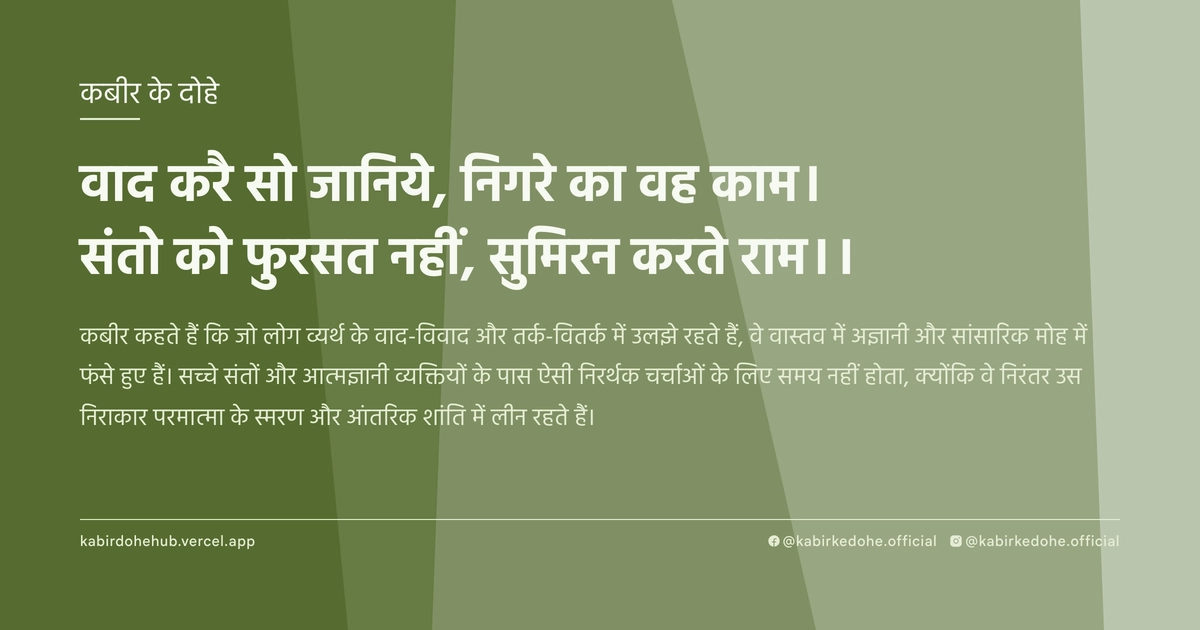
वाद करै सो जानिये, निगरे का वह काम।
संतो को फुरसत नहीं, सुमिरन करते राम।।
Vaad karai so jaaniye, nigre ka vah kaam. Santo ko fursat nahi, sumiran karte raam.
इस पृष्ठ पर इस कबीर दोहे का अर्थ (meaning), हिंदी व्याख्या और अंग्रेज़ी अनुवाद, दार्शनिक विश्लेषण और व्यावहारिक जीवन सीख दी गई है। यह दोहा सत्संग (Satsang) विषय से जुड़ा है — Kabir doha meaning and explanation in Hindi and English.
अर्थ (Meaning):
कबीर कहते हैं कि जो लोग व्यर्थ के वाद-विवाद और तर्क-वितर्क में उलझे रहते हैं, वे वास्तव में अज्ञानी और सांसारिक मोह में फंसे हुए हैं। सच्चे संतों और आत्मज्ञानी व्यक्तियों के पास ऐसी निरर्थक चर्चाओं के लिए समय नहीं होता, क्योंकि वे निरंतर उस निराकार परमात्मा के स्मरण और आंतरिक शांति में लीन रहते हैं।
Kabir asserts that those who engage in endless arguments and intellectual disputes are merely demonstrating their ignorance and attachment to the ego. True saints and enlightened souls have no leisure for such futile conflicts, as they are perpetually immersed in the remembrance of the Formless Divine and the stillness of the inner self.
व्याख्या (Interpretation):
इस दोहे का शाब्दिक अर्थ है कि बहस करना अज्ञानियों का लक्षण है। गहरे स्तर पर, 'वाद' या तर्क अहंकार की अभिव्यक्ति है, जहाँ व्यक्ति सत्य को खोजने के बजाय अपनी श्रेष्ठता सिद्ध करना चाहता है। यह माया के जाल का प्रतीक है जो आत्मा को वास्तविक शांति से दूर रखता है। निर्गुण भक्ति के संदर्भ में, राम यहाँ किसी व्यक्ति विशेष नहीं, बल्कि उस सर्वव्यापी चेतना (ब्रह्म) के प्रतीक हैं। जब साधक आत्म-साक्षात्कार की स्थिति में होता है, तो द्वैत (दो होने का भाव) समाप्त हो जाता है, और जहाँ द्वैत नहीं, वहाँ विवाद का कोई आधार नहीं बचता। यह अद्वैत वेदांत के उस सिद्धांत को दर्शाता है जहाँ आत्मा और परमात्मा एक हो जाते हैं, जिससे बाहरी शोर शांत हो जाता है।
Literally, the couplet suggests that arguing is a trait of the ignorant. Metaphorically, 'Vaad' or dispute is an expression of the ego, where the individual seeks to establish superiority rather than uncover Truth. This represents the veil of Maya, which keeps the soul tethered to superficiality. In the context of Nirgun Bhakti, 'Ram' does not refer to a mythological deity but to the formless, all-pervading consciousness (Brahman). When a seeker reaches the state of self-realization, duality vanishes; and where there is no duality, there is no ground for conflict. This aligns with Advaita Vedanta, where the realization of the non-duality of Atman and Brahman silences the external noise of the intellect.
दार्शनिक विश्लेषण (Philosophical Analysis):
कबीर का यह दोहा उनके समय के धार्मिक कट्टरवाद और शास्त्रार्थ की संस्कृति पर एक तीखा प्रहार है। मध्यकालीन भारत में, पंडित और मौलवी अक्सर सूक्ष्म तर्कों के माध्यम से अपनी श्रेष्ठता सिद्ध करते थे, जबकि वास्तविक आध्यात्मिक अनुभव की उपेक्षा की जाती थी। कबीर ने इस 'बौद्धिक अहंकार' को मोक्ष के मार्ग में सबसे बड़ी बाधा माना। वे तर्क को एक मानसिक व्यायाम मानते थे जो केवल अहंकार को पुष्ट करता है, जबकि भक्ति हृदय का विषय है।
दार्शनिक रूप से, यह सूफी मत के 'फना' (अहंकार का विनाश) और वेदांत के 'अहं ब्रह्मास्मि' के करीब है। जब तक 'मैं' जीवित है, तब तक विवाद रहेगा। जिस क्षण 'मैं' विलीन होता है, केवल 'वह' (परमात्मा) शेष रहता है। कबीर यहाँ यह स्पष्ट कर रहे हैं कि ज्ञान केवल सूचनाओं का संग्रह नहीं है, बल्कि वह मौन है जो शब्दों के पार होता है।
वे ritualism (कर्मकांड) और शास्त्र-आधारित श्रेष्ठता को नकारते हुए अनुभवजन्य ज्ञान (Anubhav) पर जोर देते हैं। उनके लिए, ईश्वर को तर्क से नहीं, बल्कि प्रेम और निरंतर स्मरण (Sumiran) से पाया जा सकता है। यह मनोवैज्ञानिक रूपांतरण की प्रक्रिया है जहाँ व्यक्ति बाहरी दुनिया के शोर से हटकर आंतरिक शून्यता की ओर बढ़ता है।
अक्सर लोग इस दोहे को केवल 'चुप रहने' की सलाह मानते हैं, लेकिन यह वास्तव में चेतना के स्तर को बदलने का आह्वान है। यह बौद्धिक विलासिता के विरुद्ध एक चेतावनी है। जब हम किसी को गलत साबित करने की कोशिश करते हैं, तो हम वास्तव में अपनी सीमित पहचान को बचाने की कोशिश कर रहे होते हैं।
अंततः, कबीर यह संदेश देते हैं कि आध्यात्मिक प्रगति का पैमाना यह नहीं है कि आप कितने तर्कों में जीतते हैं, बल्कि यह है कि आप कितने शांत और स्थिर हैं। वास्तविक शांति विवादों को जीतने में नहीं, बल्कि विवादों से ऊपर उठने में है।
This couplet is a sharp critique of the religious dogmatism and the culture of scholarly disputation prevalent during Kabir's era. In medieval India, pundits and clerics often used intricate logic to assert superiority, while the actual lived experience of spirituality was neglected. Kabir identified this 'intellectual ego' as the primary obstacle on the path to liberation, viewing logic as a mental exercise that only reinforces the ego, whereas devotion is a matter of the heart.
Philosophically, this resonates with the Sufi concept of 'Fana' (annihilation of the self) and the Vedantic realization of 'Aham Brahmasmi'. As long as the 'I' exists, conflict persists. The moment the 'I' dissolves, only the Divine remains. Kabir clarifies that true knowledge is not a collection of information but a silence that transcends words.
By rejecting ritualism and scripture-based superiority, he emphasizes experiential knowledge (Anubhav). For Kabir, the Divine is not reached through logic but through love and constant remembrance (Sumiran). This is a process of psychological transformation where the individual shifts from the noise of the external world toward an inner void.
Common literalist interpretations mistake this as mere advice to 'stay quiet,' but it is actually a call to elevate one's state of consciousness. It is a warning against intellectual luxury. When we strive to prove another wrong, we are essentially fighting to protect our limited identity.
Ultimately, Kabir suggests that the metric of spiritual progress is not how many arguments one wins, but how much stillness one embodies. True peace is found not in winning disputes, but in rising above the need for them entirely.
मूल संदेश (Core Message):
- तर्क अहंकार का पोषण करता है, जबकि मौन आत्मा का।
- सत्य को सिद्ध नहीं किया जाता, उसे अनुभव किया जाता है।
- विवाद बाहरी शोर है; सुमिरन आंतरिक संगीत है।
- अहंकार की जीत वास्तव में चेतना की हार है।
- परमात्मा शब्दों के पार, पूर्ण शांति में निवास करता है।
- Logic feeds the ego, while silence nourishes the soul.
- Truth is not to be proven; it is to be experienced.
- Dispute is external noise; remembrance is internal music.
- The victory of the ego is the defeat of consciousness.
- The Divine resides beyond words, in absolute stillness.
व्यावहारिक उदाहरण (Practical Example):
एक समय की बात है, वाराणसी के घाटों पर रहने वाला एक वृद्ध बुनकर था, जिसका नाम माधव था। माधव अपनी कला में निपुण था, लेकिन स्वभाव से अत्यंत क्रोधी और जिद्दी था। वह हर छोटी बात पर पड़ोसियों से झगड़ता और शास्त्रों के हवाले से खुद को सही साबित करने की कोशिश करता। उसका पूरा दिन इस बात में बीतता कि कौन गलत है और कौन सही।
एक दिन माधव की मुलाकात एक मौन साधु से हुई जो नदी के किनारे शांति से बैठे थे। माधव ने उनके पास जाकर अपनी श्रेष्ठता सिद्ध करने के लिए एक जटिल आध्यात्मिक प्रश्न पूछा और फिर घंटों तक तर्क देता रहा कि कैसे उसका विचार सही है। साधु ने एक शब्द भी नहीं कहा, बस मंद मुस्कान के साथ माधव की आँखों में देखते रहे।
माधव को लगा कि साधु हार मान चुके हैं या वे मूर्ख हैं। वह और अधिक उत्तेजित होकर चिल्लाने लगा। तभी उसने देखा कि साधु ने धीरे से एक मिट्टी का बर्तन उठाया और उसे जमीन पर पटक दिया। बर्तन चकनाचूर हो गया। साधु ने पहली बार बोले, "जैसे यह बर्तन टूट गया, वैसे ही तुम्हारा अहंकार भी टूट जाए, तभी तुम मुझे सुन पाओगे।"
माधव स्तब्ध रह गया। उसे एहसास हुआ कि वह पिछले कई वर्षों से केवल शब्दों की लड़ाई लड़ रहा था, जबकि उसके भीतर की शांति पूरी तरह नष्ट हो चुकी थी। उसने महसूस किया कि उसकी सारी बौद्धिक जीत वास्तव में उसकी आंतरिक हार थी।
उस दिन के बाद, माधव ने बहस करना छोड़ दिया। जब भी कोई उसे उकसाता, वह अपनी आँखें बंद करता और उस 'राम' या आंतरिक शांति का स्मरण करता। उसने पाया कि जब उसने दूसरों को सही साबित करना बंद किया, तो उसके काम में एक नई लय आ गई।
उसकी बुनाई अब केवल कपड़े बनाना नहीं, बल्कि एक ध्यान बन गई। लोग अब उसकी बुद्धिमानी के लिए नहीं, बल्कि उसकी शांति और सौम्यता के लिए उसके पास आने लगे।
माधव ने सीखा कि सत्य शब्दों में नहीं, बल्कि उस मौन में होता है जहाँ कोई दूसरा नहीं होता। उसने पाया कि विवादों से दूर रहकर वह वास्तव में खुद के करीब आ गया था।
अंत में, माधव एक ऐसा व्यक्ति बन गया जो बिना बोले ही दूसरों के दुखों को समझ लेता था। उसकी खामोशी अब उसकी कमजोरी नहीं, बल्कि उसकी सबसे बड़ी शक्ति बन चुकी थी।
Once, in the ghats of Varanasi, lived an elderly weaver named Madhav. Madhav was a master of his craft, but he was temperamental and stubborn. He spent his days arguing with neighbors, using scriptural references to prove his superiority. His entire existence revolved around who was right and who was wrong.
One day, Madhav encountered a silent monk sitting peacefully by the river. Seeking to assert his intellectual dominance, Madhav approached him with a complex spiritual question and spent hours arguing why his interpretation was the only correct one. The monk did not utter a word; he simply looked into Madhav's eyes with a gentle smile.
Madhav assumed the monk had conceded or was simply ignorant. He became more agitated, raising his voice. Suddenly, the monk picked up a clay pot and smashed it on the ground. As the pot shattered, the monk spoke for the first time: "Just as this pot has broken, let your ego break; only then will you be able to hear me."
Madhav was stunned. He realized that for years, he had been fighting battles of words while his inner peace had been completely decimated. He understood that all his intellectual victories were, in reality, internal defeats.
From that day forward, Madhav ceased all arguments. Whenever someone provoked him, he would close his eyes and remember the 'Ram'—the inner stillness. He discovered that once he stopped trying to prove others wrong, a new rhythm entered his work.
His weaving was no longer just a trade; it became a meditation. People began visiting him not for his knowledge, but for the peace and gentleness he radiated.
Madhav learned that Truth does not reside in words, but in the silence where the 'other' ceases to exist. He found that by distancing himself from disputes, he had finally come closer to himself.
Eventually, Madhav became a man who could understand the suffering of others without a single word. His silence was no longer a void, but his greatest strength.
अभ्यास मार्गदर्शन (Practice Guidance):
- प्रतिदिन 20 मिनट 'मौन अभ्यास' करें, जहाँ आप न केवल बोलना बंद करें, बल्कि मन में चलने वाले तर्कों को भी केवल एक साक्षी (observer) की तरह देखें।
- जब भी किसी विवाद में शामिल होने की इच्छा हो, खुद से पूछें: 'क्या मैं सत्य की खोज कर रहा हूँ या केवल अपनी पहचान की पुष्टि?'
- एक 'अहंकार डायरी' लिखें, जिसमें उन क्षणों को दर्ज करें जब आपने किसी को गलत साबित करने के लिए अपनी शांति का त्याग किया।
- निदान चेकलिस्ट: क्या आप दूसरों की राय बदलने की कोशिश करते हैं? क्या बहस के बाद आप मानसिक रूप से थका हुआ महसूस करते हैं? क्या आपकी शांति बाहरी परिस्थितियों पर निर्भर है? यदि हाँ, तो आप अभी भी 'वाद' के जाल में हैं।
- Practice 20 minutes of 'Sacred Silence' daily, where you not only stop speaking but observe the internal arguments of the mind as a detached witness.
- Whenever the urge to argue arises, ask yourself: 'Am I seeking the Truth, or am I merely seeking validation for my identity?'
- Maintain an 'Ego Journal,' recording instances where you sacrificed your inner peace just to prove someone else wrong.
- Diagnostic Checklist: Do you feel a compulsive need to change others' opinions? Do you feel mentally exhausted after a debate? Is your peace dependent on external agreement? If yes, you are still entangled in the web of 'Vaad'.
चिंतन प्रश्न (Reflection Questions):
- मेरे जीवन में ऐसा कौन सा विषय है जिस पर मैं कभी समझौता नहीं करता? क्या यह सत्य है या मेरा अहंकार?
- जब मैं किसी बहस में जीतता हूँ, तो मुझे जो संतुष्टि मिलती है, वह वास्तव में क्या है—शांति या केवल श्रेष्ठता का भ्रम?
- क्या मेरी डिजिटल पहचान (सोशल मीडिया) मेरे वास्तविक आत्म से अधिक महत्वपूर्ण हो गई है, जहाँ मैं केवल 'सही' दिखने की कोशिश करता हूँ?
- यदि मैं अपनी सभी बौद्धिक उपलब्धियों और मान्यताओं को छोड़ दूँ, तो मेरे भीतर क्या बचेगा?
- क्या मैं मौन में रहने से डरता हूँ क्योंकि वहाँ मुझे अपने स्वयं के अंधेरे का सामना करना पड़ता है?
- What is the one topic in my life I refuse to compromise on? Is it Truth, or is it my ego?
- When I win an argument, what is the nature of the satisfaction I feel—is it peace, or merely the illusion of superiority?
- Has my digital identity (social media) become more important than my actual self, where I strive only to appear 'correct'?
- If I were to strip away all my intellectual achievements and beliefs, what would remain within me?
- Do I fear silence because it forces me to confront my own internal shadows?