
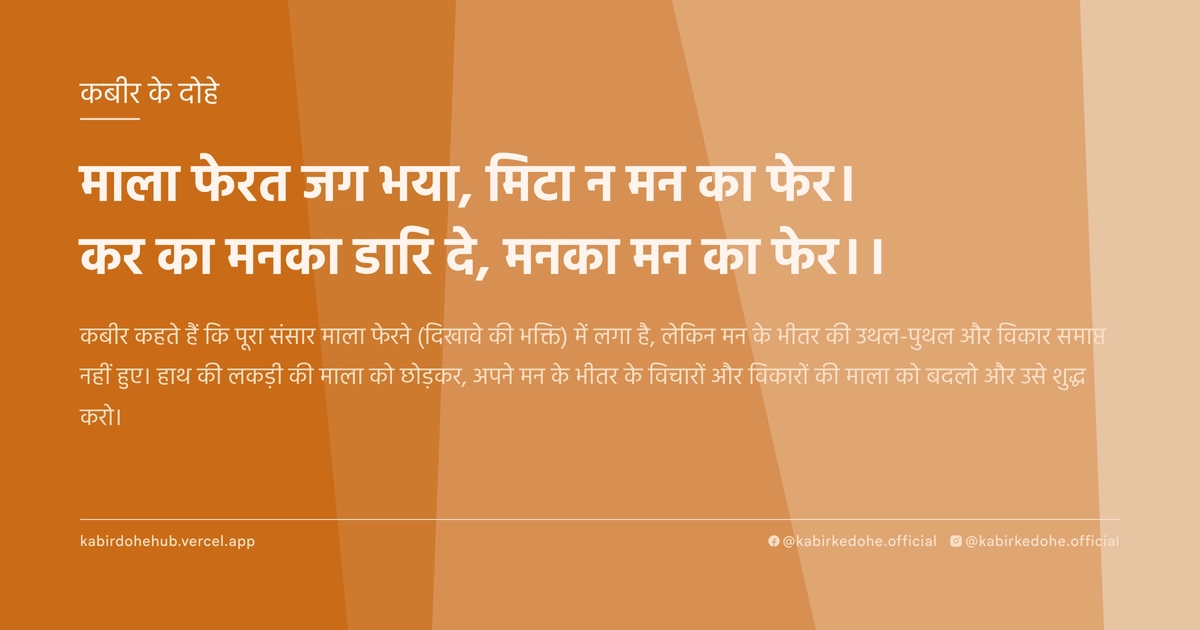
माला फेरत जग भया, मिटा न मन का फेर।
कर का मनका डारि दे, मनका मन का फेर।।
Maala pherat jag bhaya, mita na man ka pher. Kar ka manka daari de, manka man ka pher.
इस पृष्ठ पर इस कबीर दोहे का अर्थ (meaning), हिंदी व्याख्या और अंग्रेज़ी अनुवाद, दार्शनिक विश्लेषण और व्यावहारिक जीवन सीख दी गई है। यह दोहा मन नियंत्रण (Mind Control) विषय से जुड़ा है — Kabir doha meaning and explanation in Hindi and English.
अर्थ (Meaning):
कबीर कहते हैं कि पूरा संसार माला फेरने (दिखावे की भक्ति) में लगा है, लेकिन मन के भीतर की उथल-पुथल और विकार समाप्त नहीं हुए। हाथ की लकड़ी की माला को छोड़कर, अपने मन के भीतर के विचारों और विकारों की माला को बदलो और उसे शुद्ध करो।
Kabir observes that the world is preoccupied with the mechanical act of counting beads on a rosary, yet the inner turmoil and psychological distortions of the mind remain untouched. He urges the seeker to discard the external bead of the hand and instead focus on transforming the 'beads' of the mind—the repetitive patterns of ego and desire.
व्याख्या (Interpretation):
यह दोहा बाहरी कर्मकांड और आंतरिक रूपांतरण के बीच के विरोधाभास को दर्शाता है। 'माला फेरना' यहाँ केवल एक धार्मिक क्रिया नहीं, बल्कि एक मानसिक आदत है जहाँ व्यक्ति बाहरी अनुशासन के पीछे अपनी आंतरिक अराजकता को छिपाता है। कबीर 'मनका' शब्द के साथ एक सुंदर शब्द-क्रीड़ा करते हैं, जहाँ एक 'मनका' माला का दाना है और दूसरा 'मन का' अर्थात हृदय का। यह निरगुण भक्ति का सार है, जहाँ ईश्वर किसी वस्तु में नहीं, बल्कि चेतना की शुद्धता में बसता है। जब तक अहंकार (माया) बना रहता है, तब तक बाहरी पूजा केवल एक मानसिक व्यायाम है। वास्तविक मोक्ष तब आता है जब साधक बाहरी प्रतीकों का त्याग कर आत्म-साक्षात्कार की ओर बढ़ता है, जिससे आत्मा और ब्रह्म की अद्वैत स्थिति प्राप्त होती है।
This couplet highlights the paradox between external ritualism and internal transformation. 'Rotating the beads' is not merely a religious act but a psychological habit where the individual hides inner chaos behind a facade of external discipline. Kabir employs a sophisticated pun on 'Manka'—referring both to the physical bead of a rosary and the 'beads of the mind' (mental patterns). This is the essence of Nirgun Bhakti, asserting that the Divine resides not in objects, but in the purity of consciousness. As long as Maya (illusion) and the ego persist, external worship remains a mere mental exercise. True liberation occurs when the seeker transcends external symbols to achieve the non-dual state of Atman-Brahman, recognizing that the internal shift is the only authentic pilgrimage.
दार्शनिक विश्लेषण (Philosophical Analysis):
कबीर का यह दृष्टिकोण उनके समय के धार्मिक पाखंड और रूढ़िवादिता पर एक तीखा प्रहार है। 15वीं शताब्दी में, धर्म अक्सर बाहरी प्रतीकों—जैसे माला, तिलक और तीर्थयात्रा—तक सीमित हो गया था। कबीर ने इस यांत्रिक भक्ति को 'मिथ्या' घोषित किया क्योंकि यह व्यक्ति को उसके वास्तविक स्वरूप से दूर ले जाती है। उनका दर्शन अद्वैत वेदांत से मेल खाता है, जहाँ यह माना जाता है कि ब्रह्म हमारे भीतर ही है, और उसे खोजने के लिए किसी बाहरी उपकरण की आवश्यकता नहीं है।
सूफीवाद के प्रभाव में, कबीर 'इश्क-ए-हकीकी' (ईश्वरीय प्रेम) की बात करते हैं, जो केवल हृदय की गहराई में पाया जा सकता है। उनके लिए, माला फेरना एक 'अहंकारी क्रिया' बन जाती है जब साधक यह सोचने लगता है कि वह माला फेरकर पुण्य अर्जित कर रहा है। यह 'कर्ता भाव' ही मोक्ष के मार्ग में सबसे बड़ी बाधा है।
मनोवैज्ञानिक स्तर पर, कबीर 'संज्ञानात्मक विसंगति' (Cognitive Dissonance) की बात कर रहे हैं। हम बाहरी दुनिया में शांत दिखने का नाटक करते हैं, जबकि भीतर क्रोध, लोभ और ईर्ष्या का तांडव चलता रहता है। कबीर का सुझाव है कि हम अपनी ऊर्जा को बाहरी प्रदर्शन से हटाकर आंतरिक निरीक्षण (Self-Observation) में लगाएं।
जाति और वर्ण व्यवस्था के विरोध में, कबीर ने यह स्पष्ट किया कि ईश्वर तक पहुँचने का मार्ग किसी विशेष जाति या विधि के लिए आरक्षित नहीं है। यदि मन शुद्ध है, तो एक साधारण बुनकर भी उस ऊंचाई को छू सकता है जिसे एक पंडित माला फेरकर भी नहीं पा सका।
अंततः, यह दोहा 'साधना' की परिभाषा बदल देता है। साधना अब मंदिर या मस्जिद की यात्रा नहीं, बल्कि मन की परतों को छीलने की प्रक्रिया है। जब 'मन का फेर' (मानसिक भटकाव) समाप्त होता है, तब जो शेष बचता है, वही शुद्ध चेतना या शून्य है।
Kabir's perspective is a sharp critique of the religious hypocrisy and dogmatism prevalent during his era. In the 15th century, spirituality had largely devolved into external symbols—rosaries, tilaks, and pilgrimages. Kabir declared this mechanical devotion 'illusory' because it diverged the seeker from their true essence. His philosophy aligns with Advaita Vedanta, which posits that Brahman is immanent within the self, rendering external tools redundant for realization.
Influenced by Sufism, Kabir emphasizes 'Ishq-e-Haqiqi' (Divine Love), which can only be experienced in the depths of the heart. For him, the act of counting beads becomes an 'ego-driven action' when the practitioner believes they are accumulating merit through a ritual. This 'sense of doership' (Karta Bhav) is the primary obstacle to liberation.
Psychologically, Kabir addresses 'cognitive dissonance.' We perform a facade of serenity in the external world while a storm of anger, greed, and jealousy rages within. Kabir suggests redirecting this energy from external performance to rigorous internal observation (Self-Inquiry).
In his rejection of caste and hierarchy, Kabir clarifies that the path to the Divine is not reserved for any specific caste or method. If the mind is pure, a simple weaver can attain the spiritual heights that a scholar, despite a lifetime of chanting, might miss.
Ultimately, this couplet redefines 'Sadhana.' Practice is no longer a journey to a temple or mosque, but a process of peeling away the layers of the mind. When the 'mental rotation' (psychological agitation) ceases, what remains is pure consciousness or the Void (Shunya).
मूल संदेश (Core Message):
- बाहरी कर्मकांड केवल एक माध्यम हैं, लक्ष्य नहीं।
- अहंकार से प्रेरित भक्ति वास्तव में भक्ति नहीं, बल्कि एक मानसिक जाल है।
- वास्तविक प्रार्थना मन के विकारों का विसर्जन है।
- चेतना की शुद्धता किसी भी भौतिक वस्तु से अधिक मूल्यवान है।
- जब 'मैं' मिटता है, तभी 'वह' (परमात्मा) प्रकट होता है।
- External rituals are merely mediums, not the ultimate destination.
- Devotion driven by ego is not spirituality, but a psychological trap.
- True prayer is the dissolution of mental distortions.
- Purity of consciousness is far more valuable than any physical object.
- Only when the 'I' vanishes does the 'Divine' manifest.
व्यावहारिक उदाहरण (Practical Example):
वाराणसी के एक पुराने घाट पर रहने वाले माधव नाम के एक वृद्ध व्यक्ति थे, जो शहर के सबसे बड़े माला-साधक माने जाते थे। वे दिन भर अपनी रुद्राक्ष की माला फेरते और घंटों ईश्वर का नाम जपते। लोग उन्हें महान संत मानते थे, लेकिन माधव के भीतर एक गहरा असंतोष था। वे अपने बेटों के बीच संपत्ति के विवाद को लेकर अत्यंत क्रोधित रहते थे और अक्सर उन्हें अपशब्द कहते थे।
एक दिन, माधव की मुलाकात एक घुमंतू फकीर से हुई। फकीर ने देखा कि माधव एक हाथ से माला फेर रहे हैं और दूसरे हाथ से अपने बेटे को डांट रहे हैं। फकीर मुस्कुराया और बोला, 'बाबा, आपकी माला के दाने तो बहुत चमक रहे हैं, लेकिन आपके मन के दाने अभी भी काले हैं।'
माधव को पहले तो गुस्सा आया, लेकिन फकीर की आंखों में एक अजीब सी शांति थी। फकीर ने उनसे पूछा, 'जब आप माला फेरते हैं, तो क्या आप वास्तव में ईश्वर को याद करते हैं, या आप केवल इस बात की गिनती कर रहे होते हैं कि आपने कितने हजार नाम पूरे कर लिए?'
यह प्रश्न माधव के हृदय में बिजली की तरह कौंधा। उन्होंने महसूस किया कि उनकी भक्ति एक 'कार्य' बन गई थी, एक ऐसी चेकलिस्ट जिसे पूरा करके वे खुद को श्रेष्ठ महसूस करते थे। माला फेरना उनके लिए एक ढाल बन गया था जिसके पीछे वे अपने क्रोध और अहंकार को छिपाते थे।
अगले कुछ हफ्तों तक, माधव ने माला फेरना बंद कर दिया। उन्होंने तय किया कि वे अब 'मन की माला' फेरेंगे। जब भी उनके मन में बेटे के प्रति क्रोध आता, वे अपनी आँखें बंद करते और उस क्रोध के स्रोत को देखते। वे खुद से पूछते, 'यह क्रोध किसका है? क्या यह मेरा है, या मेरे अहंकार का?'
धीरे-धीरे, उन्होंने पाया कि जिस शांति की तलाश में वे हजारों मालाएं फेर चुके थे, वह शांति तो उस क्रोध को स्वीकार करने और उसे विसर्जित करने में थी। उन्होंने अपने बेटों को माफ किया और संपत्ति के मोह को त्याग दिया।
एक शाम, जब वे घाट पर बैठे थे, उनके पास कोई माला नहीं थी। फिर भी, उनके चेहरे पर एक ऐसी आभा थी जो पहले कभी नहीं देखी गई थी। उनके बेटे अब उनसे डरते नहीं थे, बल्कि उनके पास शांति पाने आते थे।
माधव ने समझ लिया था कि हाथ की माला केवल एक संकेत है, गंतव्य नहीं। असली प्रार्थना तो वह है जो व्यवहार में झलके, न कि केवल उंगलियों के पोरों पर।
In the ancient ghats of Varanasi lived an elderly man named Madhav, regarded as one of the city's most devout practitioners of Japa. He spent his entire day rotating a rudraksha rosary, chanting the names of the Divine for hours. The community revered him as a saint, yet inside, Madhav harbored a deep, simmering discontent. He was perpetually enraged by property disputes among his sons and frequently unleashed verbal abuse upon them.
One day, Madhav encountered a wandering fakir. The fakir observed Madhav rotating his beads with one hand while scolding his son with the other. The fakir smiled and remarked, 'Baba, the beads of your rosary are shining brightly, but the beads of your mind are still blackened.'
Initially, Madhav felt insulted, but there was an unsettling peace in the fakir's eyes. The fakir asked, 'When you rotate those beads, are you truly remembering the Divine, or are you merely counting how many thousands of names you have completed?'
This question struck Madhav like a bolt of lightning. He realized that his devotion had become a 'task'—a checklist he used to feel superior. The rosary had become a shield behind which he hid his anger and ego.
For the next few weeks, Madhav stopped using the rosary. He decided to 'rotate the beads of the mind.' Whenever anger toward his sons arose, he would close his eyes and observe the source of that anger. He would ask himself, 'Whose anger is this? Is it mine, or is it the ego's?'
Gradually, he discovered that the peace he had sought through thousands of rosaries was actually found in acknowledging and dissolving that anger. He forgave his sons and relinquished his attachment to the property.
One evening, as he sat on the ghat, he held no beads. Yet, his face radiated a luminosity never seen before. His sons no longer feared him; instead, they came to him for solace.
Madhav finally understood that the hand-rosary is merely a signpost, not the destination. True prayer is that which manifests in behavior, not merely on the fingertips.
अभ्यास मार्गदर्शन (Practice Guidance):
- प्रतिदिन 20 मिनट 'साक्षी भाव' का अभ्यास करें: अपने विचारों को बिना किसी निर्णय के देखें, जैसे आप किसी और की माला फेरते हुए देख रहे हों।
- आत्म-पूछताछ जर्नल: प्रतिदिन एक ऐसी घटना लिखें जहाँ आपने बाहरी रूप से शांत दिखने का प्रयास किया लेकिन भीतर अशांत थे। विश्लेषण करें कि वह 'दिखावा' क्या था।
- व्यवहारिक परिवर्तन: जब भी आप किसी धार्मिक क्रिया (पूजा, प्रार्थना) में बैठें, तो पहले 5 मिनट केवल अपनी सांसों और मन की वर्तमान स्थिति को महसूस करें, न कि मंत्रों की गिनती पर ध्यान दें।
- निदान चेकलिस्ट: (1) क्या मैं अपनी आध्यात्मिक उपलब्धियों पर गर्व महसूस करता हूँ? (2) क्या मेरी प्रार्थना के बाद भी मेरा व्यवहार दूसरों के प्रति कठोर रहता है? (3) क्या मैं बाहरी अनुष्ठानों को अपनी आंतरिक कमियों के विकल्प के रूप में उपयोग कर रहा हूँ? (यदि उत्तर 'हाँ' है, तो आप 'हाथ की माला' में फंसे हैं)।
- Practice 'Witness Consciousness' for 20 minutes daily: Observe your thoughts without judgment, as if you are watching someone else rotate a rosary.
- Self-Inquiry Journaling: Daily record one instance where you attempted to appear externally calm while remaining internally turbulent. Analyze the nature of that 'performance.'
- Behavioral Shift: Before engaging in any religious ritual (prayer, puja), spend the first 5 minutes simply feeling your breath and the current state of your mind, rather than focusing on the count of mantras.
- Diagnostic Checklist: (1) Do I feel pride in my spiritual achievements? (2) Does my behavior remain harsh toward others despite my prayers? (3) Am I using external rituals as a substitute for addressing internal flaws? (If 'Yes', you are trapped in the 'rosary of the hand').
चिंतन प्रश्न (Reflection Questions):
- मेरे जीवन में ऐसी कौन सी 'माला' (दिखावा) है जिसे मैं दुनिया को दिखाने के लिए फेर रहा हूँ?
- क्या मेरी धार्मिक पहचान मेरे वास्तविक व्यक्तित्व को छिपाने का एक तरीका है?
- यदि मुझसे मेरे सभी बाहरी धार्मिक प्रतीक छीन लिए जाएं, तो मेरी आध्यात्मिकता का क्या बचेगा?
- मैं अपनी मानसिक उथल-पुथल को शांत करने के लिए किन बाहरी आदतों का सहारा लेता हूँ?
- क्या मैं वास्तव में ईश्वर की खोज कर रहा हूँ, या केवल अपनी 'पवित्र' छवि की?
- मेरे भीतर का वह कौन सा 'मनका' (विचार) है जो सबसे अधिक बार दोहराया जाता है और मुझे बंधन में रखता है?
- What is the 'rosary' (facade) in my life that I rotate primarily for the world to see?
- Is my religious identity a mechanism to mask my true, flawed personality?
- If all my external religious symbols were stripped away, what would remain of my spirituality?
- Which external habits do I rely on to distract myself from my internal turmoil?
- Am I truly seeking the Divine, or am I merely seeking a 'holy' image of myself?
- Which specific 'bead' (recurring thought) in my mind is repeated most often and keeps me in bondage?