
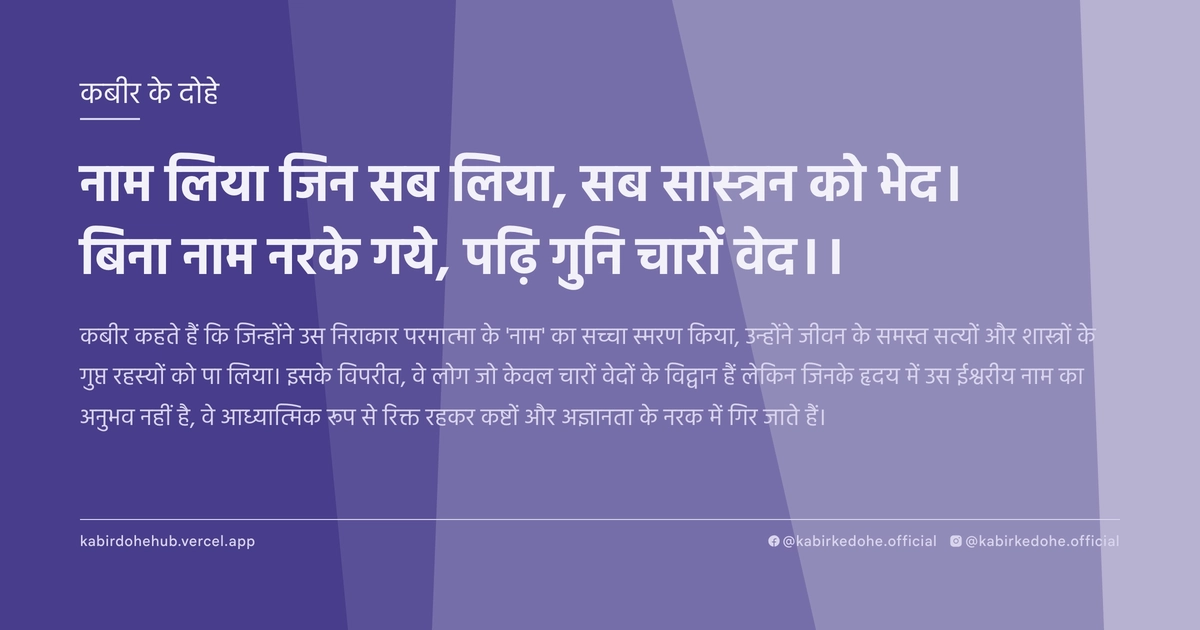
नाम लिया जिन सब लिया, सब सास्त्रन को भेद।
बिना नाम नरके गये, पढ़ि गुनि चारों वेद।।
Naam liya jin sab liya, sab sastran ko bhed. Bina naam narke gaye, padhi guni chaaron ved.
इस पृष्ठ पर इस कबीर दोहे का अर्थ (meaning), हिंदी व्याख्या और अंग्रेज़ी अनुवाद, दार्शनिक विश्लेषण और व्यावहारिक जीवन सीख दी गई है। यह दोहा भक्ति (Bhakti) विषय से जुड़ा है — Kabir doha meaning and explanation in Hindi and English.
अर्थ (Meaning):
कबीर कहते हैं कि जिन्होंने उस निराकार परमात्मा के 'नाम' का सच्चा स्मरण किया, उन्होंने जीवन के समस्त सत्यों और शास्त्रों के गुप्त रहस्यों को पा लिया। इसके विपरीत, वे लोग जो केवल चारों वेदों के विद्वान हैं लेकिन जिनके हृदय में उस ईश्वरीय नाम का अनुभव नहीं है, वे आध्यात्मिक रूप से रिक्त रहकर कष्टों और अज्ञानता के नरक में गिर जाते हैं।
Kabir asserts that those who have truly embraced the 'Naam' (the Divine Name/Vibration) have attained everything and unlocked the deepest secrets of all scriptures. Conversely, those who possess mere intellectual mastery over the four Vedas but lack the living experience of the Divine Name remain spiritually bankrupt, descending into the 'hell' of ignorance and egoic suffering.
व्याख्या (Interpretation):
यहाँ 'नाम' का अर्थ किसी शब्द की पुनरावृत्ति नहीं, बल्कि उस निराकार सत्ता (Nirgun Brahman) के साथ एक जीवंत संबंध है। कबीर एक गहरा विरोधाभास प्रस्तुत करते हैं: किताबी ज्ञान बनाम प्रत्यक्ष अनुभव। वेदों का अध्ययन बौद्धिक अहंकार को जन्म दे सकता है, जो माया के जाल को और मजबूत करता है। जब तक साधक 'नाम' के माध्यम से अपने अहंकार का विसर्जन नहीं करता, तब तक शास्त्र केवल शब्दों का बोझ हैं। यह व्याख्या अद्वैत वेदांत के उस सिद्धांत की ओर ले जाती है जहाँ ज्ञान (Jnana) केवल तब सार्थक है जब वह अनुभव (Anubhava) में बदल जाए। बिना प्रेम और समर्पण के, ज्ञान एक मानसिक कारागार बन जाता है, जिसे कबीर ने 'नरक' कहा है।
Here, 'Naam' does not refer to the mere repetition of a word, but to a living, resonant connection with the Formless Absolute (Nirgun Brahman). Kabir presents a profound paradox: intellectual scholarship versus direct experiential realization. The study of the Vedas, if devoid of devotion, can fuel the ego, strengthening the veil of Maya. Until the seeker dissolves the 'I' through the vibration of the Divine Name, scriptures remain mere burdens of ink and paper. This interpretation aligns with Advaita Vedanta, where knowledge (Jnana) is only valid when it transforms into experience (Anubhava). Without love and surrender, intellectualism becomes a mental prison, which Kabir metaphorically labels as 'hell'.
दार्शनिक विश्लेषण (Philosophical Analysis):
कबीर का यह दोहा उनके युग के धार्मिक पाखंड और शास्त्र-केंद्रित कट्टरता पर एक तीखा प्रहार है। मध्यकालीन भारत में, ब्राह्मणवादी व्यवस्था ने वेदों के ज्ञान को एक विशेषाधिकार बना दिया था, जहाँ केवल रटने और व्याख्या करने को ही मोक्ष का मार्ग माना जाता था। कबीर इस 'बौद्धिक अभिजात्य' को चुनौती देते हुए घोषणा करते हैं कि ईश्वर किसी भाषा, लिपि या जाति का मोहताज नहीं है। वे 'नाम' को एक लोकतांत्रिक उपकरण बनाते हैं, जिसे एक अनपढ़ बुनकर भी पा सकता है, जबकि एक पंडित उसे खो सकता है।
दार्शनिक स्तर पर, यह सूफीवाद के 'जिक्र' (Zikr) और भक्ति आंदोलन के 'नाम-स्मरण' का संगम है। सूफी मत में जैसे खुदा की याद दिल की सफाई करती है, वैसे ही कबीर का 'नाम' मन के मैल को धोता है। वे तर्क देते हैं कि शास्त्रों का उद्देश्य केवल दिशा दिखाना है, मंजिल नहीं। जब कोई व्यक्ति स्वयं को शास्त्रों का ज्ञाता मानकर दूसरों से श्रेष्ठ महसूस करता है, तो वह 'अहंकार' का सृजन करता है, जो आत्मा और परमात्मा के बीच की सबसे बड़ी दीवार है।
अद्वैत वेदांत के परिप्रेक्ष्य में, यह दोहा 'माया' के सूक्ष्म रूप—बौद्धिक अहंकार—पर प्रहार करता है। माया केवल बाहरी दुनिया नहीं है, बल्कि यह विश्वास भी है कि हम अपनी बुद्धि से सत्य को 'पकड़' सकते हैं। कबीर समझाते हैं कि सत्य 'पकड़ा' नहीं जाता, बल्कि उसमें 'घुल' जाना पड़ता है। वेदों का ज्ञान यदि केवल मस्तिष्क में है, तो वह बंधन है; यदि वह हृदय में 'नाम' बनकर उतरा है, तो वह मुक्ति है।
कबीर का 'नरक' कोई भौगोलिक स्थान नहीं, बल्कि एक मनोवैज्ञानिक अवस्था है। यह वह स्थिति है जहाँ मनुष्य सत्य के अत्यंत निकट होकर भी अपने अहंकार के कारण उससे दूर रहता है। यह एक ऐसी त्रासदी है जहाँ व्यक्ति के पास नक्शा (शास्त्र) तो है, लेकिन वह चलने की क्षमता (समर्पण) खो चुका है।
अंततः, यह विश्लेषण हमें यह सिखाता है कि आध्यात्मिक प्रगति का पैमाना यह नहीं है कि हमने कितना पढ़ा है, बल्कि यह है कि हम कितने सरल और प्रेमपूर्ण हो गए हैं। ज्ञान जब विनम्रता में नहीं बदलता, तो वह केवल एक मानसिक बोझ बन जाता है।
This couplet is a searing critique of the religious hypocrisy and scripture-centric orthodoxy of Kabir's era. In medieval India, the Brahmanical system had turned Vedic knowledge into an exclusive privilege, where rote memorization and scholarly commentary were mistaken for the path to liberation. Kabir challenges this 'intellectual elitism,' declaring that the Divine is not bound by language, script, or caste. He democratizes spirituality through the 'Naam,' making it accessible to an illiterate weaver while noting that a learned priest might still miss it.
Philosophically, this is a convergence of the Sufi practice of 'Zikr' (remembrance) and the Bhakti movement's 'Naam-Smaran.' Just as Zikr cleanses the heart in Sufism, Kabir's 'Naam' scrubs away the impurities of the mind. He argues that scriptures are merely signposts, not the destination. When a person identifies as a 'scholar' and feels superior to others, they construct an 'ego,' which is the primary barrier between the Atman and Brahman.
From the lens of Advaita Vedanta, this doha attacks a subtle form of Maya—intellectual pride. Maya is not just the external world, but the delusion that truth can be 'captured' through the intellect. Kabir explains that Truth is not captured; one must dissolve into it. Vedic knowledge residing only in the brain is a bondage; when it descends into the heart as 'Naam,' it becomes liberation.
Kabir's 'hell' is not a geographical location but a psychological state. It is the agony of being proximity to the Truth yet remaining separated by the wall of one's own ego. It is the tragedy of possessing the map (scriptures) but lacking the will to walk (surrender).
Ultimately, this analysis teaches us that the metric of spiritual progress is not the volume of our reading, but the depth of our humility and love. Knowledge that does not translate into humility is merely a mental burden.
मूल संदेश (Core Message):
- बौद्धिक ज्ञान बिना अनुभव के केवल एक मानसिक बोझ है।
- ईश्वर शब्दों में नहीं, बल्कि हृदय के समर्पण में बसता है।
- अहंकार का विसर्जन ही वास्तविक ज्ञान की पहली सीढ़ी है।
- शास्त्र मार्ग दिखाते हैं, लेकिन यात्रा 'नाम' के प्रेम से पूरी होती है।
- सत्य को रटा नहीं जा सकता, उसे केवल जिया जा सकता है।
- Intellectual knowledge without experience is merely a mental burden.
- The Divine resides not in words, but in the surrender of the heart.
- The dissolution of ego is the first step toward true realization.
- Scriptures show the way, but the journey is completed through the love of the Name.
- Truth cannot be memorized; it can only be lived.
व्यावहारिक उदाहरण (Practical Example):
वाराणसी के एक पुराने मोहल्ले में पंडित शिवदत्त रहते थे। शिवदत्त को चारों वेदों और उपनिषदों का गहरा ज्ञान था। उनकी वाणी में विद्वता थी, लेकिन उनके व्यवहार में अहंकार। वे अक्सर गली के लोगों को नीचा दिखाते थे कि वे शास्त्रों को नहीं जानते। उनके घर के बाहर एक छोटा सा चबूतरा था जहाँ एक बूढ़ा मोची, रामू, बैठता था। रामू अनपढ़ था, लेकिन वह दिन भर जूते सिलते हुए बस एक ही धुन में 'राम-राम' या 'अल्लाह-अल्लाह' गुनगुनाता रहता था।
शिवदत्त अक्सर रामू का मजाक उड़ाते, "अरे मूर्ख! तू क्या जाने ईश्वर को? तूने तो कभी कोई श्लोक नहीं पढ़ा। तू नरक की ओर जा रहा है।"
रामू बस मुस्कुराता और कहता, "महाराज, मैं तो बस उस नाम की डोर पकड़े हुए हूँ, आप तो पूरे समुद्र के नक्शे रट चुके हैं।"
एक बार शहर में एक महान संत आए। शिवदत्त उनके पास गए और अपनी विद्वता का प्रदर्शन करने लगे। उन्होंने कठिन संस्कृत श्लोकों की व्याख्या की। संत ने शांति से सुना और फिर पूछा, "शिवदत्त, इन शब्दों के पीछे जो मौन है, क्या तुमने उसे कभी सुना? क्या तुम्हारे भीतर वह नाम गूँजता है जिसने तुम्हें शून्य कर दिया हो?"
शिवदत्त निरुत्तर थे। उन्हें एहसास हुआ कि उनके पास ज्ञान का ढेर तो था, लेकिन उस ज्ञान को महसूस करने वाला हृदय नहीं था। वे केवल 'शब्दों' के प्रेमी थे, 'सत्य' के नहीं।
उसी शाम, शिवदत्त ने देखा कि रामू अपनी छोटी सी कमाई का एक हिस्सा एक भूखे कुत्ते को खिला रहा था और उसकी आँखों में एक ऐसी शांति थी जो शिवदत्त ने अपनी हज़ारों किताबों में नहीं पाई थी।
शिवदत्त के भीतर एक विस्फोट हुआ। उन्हें समझ आया कि रामू ने 'नाम' को जी लिया था, जबकि उन्होंने केवल 'नाम' के बारे में पढ़ा था।
पंडित जी का अहंकार टूट गया। उन्होंने अपनी पोथियों को एक तरफ रखा और रामू के पास बैठकर पूछा, "भाई, मुझे वह रास्ता बताओ जहाँ शब्द खत्म होते हैं और अनुभव शुरू होता है।"
उस दिन शिवदत्त ने पहली बार वेदों को नहीं, बल्कि एक इंसान के भीतर बसे ईश्वर को देखा। उन्होंने जाना कि वास्तविक ज्ञान वह है जो हमें दूसरों के सामने झुका दे, न कि वह जो हमें दूसरों के ऊपर खड़ा करे।
In an ancient alley of Varanasi lived Pandit Shivdutt. Shivdutt possessed profound knowledge of the four Vedas and Upanishads. His speech was scholarly, but his behavior was arrogant. He often belittled the locals, claiming they were ignorant of the scriptures. Outside his house was a small platform where an old cobbler, Ramu, sat. Ramu was illiterate, but while stitching shoes all day, he constantly hummed the 'Naam'—a rhythmic, devoted chant of the Divine.
Shivdutt would often mock him, "You fool! What do you know of God? You have never read a single shloka. You are heading straight for hell."
Ramu would simply smile and reply, "Maharaj, I am merely holding onto the thread of the Name, while you have memorized the entire map of the ocean."
One day, a great saint visited the city. Shivdutt approached him and began showcasing his erudition, interpreting complex Sanskrit verses. The saint listened calmly and then asked, "Shivdutt, have you ever heard the silence behind these words? Does that Name resonate within you, the one that has reduced you to nothingness?"
Shivdutt was speechless. He realized that while he had a mountain of knowledge, he lacked the heart to experience it. He was a lover of 'words,' not of 'Truth.'
That evening, Shivdutt observed Ramu feeding a portion of his meager earnings to a stray dog. There was a serenity in Ramu's eyes that Shivdutt had never found in his thousands of books.
An epiphany struck Shivdutt. He understood that Ramu was living the 'Naam,' while he had only been reading about it.
The Pandit's ego shattered. He set aside his manuscripts, sat beside Ramu, and asked, "Brother, show me the path where words end and experience begins."
For the first time, Shivdutt saw not the Vedas, but the Divine residing within a human being. He learned that true knowledge is that which makes us bow before others, not that which places us above them.
अभ्यास मार्गदर्शन (Practice Guidance):
- दैनिक अभ्यास: दिन में 20 मिनट मौन बैठें। किसी शब्द या मंत्र का जाप करें, लेकिन धीरे-धीरे शब्द को छोड़कर उस 'ध्वनि' या 'कंपन' पर ध्यान केंद्रित करें जो आपके भीतर गूँज रहा है।
- आत्म-पूछताछ जर्नल: हर रात लिखें कि आज कितनी बार मेरा 'बौद्धिक अहंकार' (यह सोचना कि मैं दूसरों से अधिक जानता हूँ) जागृत हुआ? उस क्षण में मैंने क्या महसूस किया?
- व्यवहारिक परिवर्तन: किसी ऐसे व्यक्ति की सेवा करें जिसे समाज 'अज्ञानी' या 'नीचा' मानता है। यह देखें कि क्या आप उनके प्रति अपनी श्रेष्ठता का भाव महसूस कर रहे हैं।
- निदान चेकलिस्ट: यदि आप किसी चर्चा में अपनी बात सही साबित करने के लिए व्याकुल हैं, तो आप 'शास्त्र' (अहंकार) में हैं। यदि आप सत्य को सुनने के लिए उत्सुक हैं, तो आप 'नाम' (अनुभव) में हैं।
- Daily Practice: Sit in silence for 20 minutes. Chant a name or mantra, but gradually shift your focus from the word to the 'vibration' or 'resonance' echoing within your being.
- Self-Inquiry Journal: Every night, record instances where your 'intellectual ego' (the feeling of knowing more than others) surfaced. What emotion drove that need for superiority?
- Behavioral Shift: Serve someone whom society deems 'ignorant' or 'lowly.' Observe whether you still feel a sense of superiority during the act of service.
- Diagnostic Checklist: If you feel a desperate need to prove yourself right in a debate, you are operating from 'Scripture' (Ego). If you are genuinely curious to hear the truth, you are operating from 'Naam' (Experience).
चिंतन प्रश्न (Reflection Questions):
- क्या मेरी शिक्षा और डिग्रियाँ मुझे वास्तव में विनम्र बना रही हैं, या वे मेरे अहंकार के लिए एक नया मुखौटा बन गई हैं?
- जब मैं किसी को 'अज्ञानी' कहता हूँ, तो क्या मैं वास्तव में उनकी कमी देख रहा हूँ या अपनी श्रेष्ठता की पुष्टि कर रहा हूँ?
- मेरे जीवन में 'ज्ञान' और 'करुणा' का अनुपात क्या है? क्या मेरा ज्ञान मुझे दूसरों से जोड़ता है या अलग करता है?
- यदि आज मुझसे मेरी सारी किताबी जानकारी छीन ली जाए, तो मेरे पास ईश्वर के साथ जुड़ने के लिए क्या बचेगा?
- क्या मैं सत्य की खोज कर रहा हूँ, या मैं केवल अपनी पहले से बनी धारणाओं की पुष्टि करने वाले प्रमाण खोज रहा हूँ?
- Do my education and degrees truly make me humble, or have they become a new mask for my ego?
- When I label someone as 'ignorant,' am I truly seeing their lack, or am I merely validating my own superiority?
- What is the ratio of 'knowledge' to 'compassion' in my life? Does my learning connect me to others or isolate me?
- If all my bookish knowledge were stripped away today, what would remain for me to connect with the Divine?
- Am I searching for the Truth, or am I merely searching for evidence that confirms my pre-existing beliefs?