
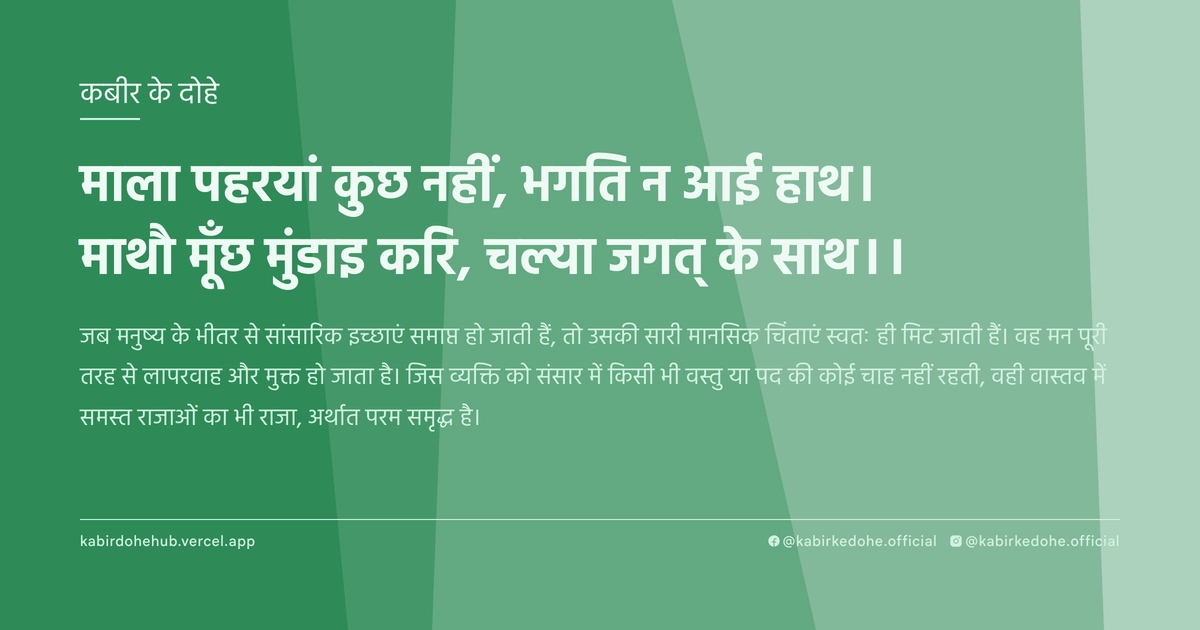
माला पहरयां कुछ नहीं, भगति न आई हाथ।
माथौ मूँछ मुंडाइ करि, चल्या जगत् के साथ।।
Maala pahrayan kuch nahi, bhagati na aayi haath. Maathau moonchh mundai kari, chalya jagat ke saath.
इस पृष्ठ पर इस कबीर दोहे का अर्थ (meaning), हिंदी व्याख्या और अंग्रेज़ी अनुवाद, दार्शनिक विश्लेषण और व्यावहारिक जीवन सीख दी गई है। यह दोहा संतोष (Contentment) विषय से जुड़ा है — Kabir doha meaning and explanation in Hindi and English.
अर्थ (Meaning):
जब मनुष्य के भीतर से सांसारिक इच्छाएं समाप्त हो जाती हैं, तो उसकी सारी मानसिक चिंताएं स्वतः ही मिट जाती हैं। वह मन पूरी तरह से लापरवाह और मुक्त हो जाता है। जिस व्यक्ति को संसार में किसी भी वस्तु या पद की कोई चाह नहीं रहती, वही वास्तव में समस्त राजाओं का भी राजा, अर्थात परम समृद्ध है।
When the fire of worldly desires is extinguished, the burden of anxiety vanishes instantly. The mind becomes carefree and liberated from the shackles of longing. He who seeks nothing from the external world is the true emperor of emperors, possessing a wealth that no earthly king can ever claim.
व्याख्या (Interpretation):
इस दोहे का शाब्दिक अर्थ है कि इच्छाओं का त्याग ही शांति का मार्ग है। गहराई में, कबीर 'चाह' को माया का मूल कारण मानते हैं। जब तक हम बाहरी वस्तुओं में सुख खोजते हैं, हम द्वंद्व और भय के चक्र में फंसे रहते हैं। यह 'बेपरवाही' आलस्य नहीं, बल्कि एक उच्च आध्यात्मिक अवस्था है जहाँ आत्मा अपनी पूर्णता को स्वयं के भीतर पहचान लेती है। यह अद्वैत वेदांत के उस सत्य को दर्शाता है जहाँ जीव और ब्रह्म एक हो जाते हैं, और तब बाहरी अभाव केवल एक भ्रम प्रतीत होता है। यहाँ 'शाहन के शाह' होना अहंकार का विस्तार नहीं, बल्कि अहंकार का पूर्ण विलीनीकरण है, जिससे एक अनंत आंतरिक साम्राज्य का उदय होता है।
Literally, the verse suggests that the cessation of desire is the path to peace. Metaphorically, Kabir identifies 'desire' (Chaah) as the root of Maya, the cosmic illusion. As long as we seek fulfillment in external objects, we remain trapped in the cycle of duality and fear. This 'carefreeness' (Beparvah) is not indolence, but a state of spiritual transcendence where the Atman recognizes its own inherent wholeness. It aligns with Advaita Vedanta, where the realization of non-duality between the self and the Absolute renders external lack an illusion. Being the 'King of Kings' here does not imply worldly power, but the absolute sovereignty over one's own mind, achieved through the annihilation of the ego.
दार्शनिक विश्लेषण (Philosophical Analysis):
कबीर का यह दर्शन उस कालखंड में आया जब समाज कर्मकांडों और बाहरी आडंबरों में उलझा था। उन्होंने स्पष्ट किया कि मोक्ष किसी मंदिर या मस्जिद में नहीं, बल्कि इच्छाओं के विसर्जन में है। यह विचार सूफी मत के 'फना' (अहंकार का विनाश) और बौद्ध धर्म के 'तृष्णा' के त्याग से गहराई से मेल खाता है। कबीर का तर्क है कि चिंता वास्तव में भविष्य की एक काल्पनिक इच्छा है; यदि इच्छा नहीं, तो चिंता का कोई आधार ही नहीं बचता।
वे यहाँ सामाजिक श्रेणीबद्धता पर प्रहार करते हैं। एक राजा वह नहीं है जिसके पास स्वर्ण है, बल्कि वह है जिसने अपनी इंद्रियों को जीत लिया है। यह दृष्टिकोण व्यक्ति को बाहरी संसाधनों पर निर्भरता से मुक्त कर आंतरिक आत्मनिर्भरता की ओर ले जाता है। यह मनोवैज्ञानिक रूपांतरण है जहाँ 'अभाव' की भावना 'पूर्णता' के बोध में बदल जाती है।
निर्गुण भक्ति के संदर्भ में, यह दोहा सिखाता है कि ईश्वर किसी वस्तु में नहीं, बल्कि उस शून्य में है जहाँ कोई मांग नहीं बचती। जब हम 'मांगने' की प्रवृत्ति को छोड़ देते हैं, तब हम उस अनंत स्रोत से जुड़ जाते हैं। यह एक क्रांतिकारी विचार था जिसने जाति और वर्ग की सीमाओं को तोड़कर एक सार्वभौमिक मानवीय सत्य को प्रस्तुत किया।
अक्सर लोग इसे भौतिकवाद के पूर्ण विरोध के रूप में देखते हैं, लेकिन वास्तव में यह 'आसक्ति' (Attachment) का विरोध है। कबीर यह नहीं कहते कि वस्तुएं न हों, बल्कि यह कहते हैं कि वस्तुएं हमें नियंत्रित न करें। जब वस्तु का स्वामित्व समाप्त होता है और केवल उपयोग बचता है, तब मनुष्य वास्तव में स्वतंत्र होता है।
अंततः, यह विश्लेषण हमें इस निष्कर्ष पर ले जाता है कि वास्तविक समृद्धि मानसिक शांति है। जिस क्षण हम यह स्वीकार कर लेते हैं कि हमारे पास जो है वह पर्याप्त है, हम उस मानसिक कारागार से मुक्त हो जाते हैं जिसे दुनिया 'महत्वाकांक्षा' कहती है। यही वह बिंदु है जहाँ साधक 'शाहन के शाह' बन जाता है।
Kabir's philosophy emerged during an era dominated by rigid rituals and external piety. He asserted that liberation is found not in temples or mosques, but in the dissolution of desire. This perspective resonates deeply with the Sufi concept of 'Fana' (annihilation of the self) and the Buddhist teaching on the cessation of 'Tanha' (craving). Kabir argues that anxiety is merely a projection of a future-oriented desire; without the seed of longing, the fruit of worry cannot grow.
He challenges the societal definition of power. A true king is not one who possesses gold, but one who has conquered their own senses. This shift moves the individual from external dependency to internal self-sufficiency. It is a psychological transmutation where the feeling of 'lack' is replaced by the realization of 'fullness'.
In the context of Nirgun Bhakti, this verse teaches that the Divine is not found in an object, but in the void created when all demands cease. When the habit of 'asking' ends, the connection to the Infinite begins. This was a revolutionary stance that bypassed caste and class to present a universal human truth.
Common literalist misconceptions view this as a total rejection of materialism. However, Kabir is opposing 'attachment,' not existence. He does not forbid the presence of objects, but the dominion of objects over the mind. When ownership is replaced by utility, the human being becomes truly free.
Ultimately, this analysis reveals that true wealth is mental equanimity. The moment we accept that what we have is enough, we break the bars of the mental prison that society labels as 'ambition.' At this precise intersection of surrender and satisfaction, the seeker becomes the 'King of Kings.'
मूल संदेश (Core Message):
- इच्छा ही समस्त मानसिक क्लेशों का मूल कारण है।
- सच्ची स्वतंत्रता बाहरी अभाव में नहीं, आंतरिक संतोष में है।
- जब माँग समाप्त होती है, तब पूर्णता का अनुभव शुरू होता है।
- अहंकार का त्याग ही वास्तविक साम्राज्य की प्राप्ति है।
- शांति वह नहीं जो दुनिया देती है, बल्कि वह है जो दुनिया के बिना भी बनी रहे।
- Desire is the root cause of all mental anguish.
- True freedom lies not in external lack, but in internal contentment.
- When the act of asking ends, the experience of wholeness begins.
- The surrender of ego is the attainment of the true empire.
- Peace is not what the world grants, but what remains when the world is gone.
व्यावहारिक उदाहरण (Practical Example):
एक समय की बात है, वाराणसी के घाटों पर माधव नाम का एक वृद्ध बुनकर रहता था। माधव का जीवन अत्यंत साधारण था, वह दिन भर सूत कातता और जो मिलता उसे संतोष के साथ स्वीकार करता। उसके पड़ोस में एक धनी व्यापारी रहता था, जिसका महल बड़ा था, लेकिन नींद गायब थी। व्यापारी हमेशा इस चिंता में रहता कि उसका व्यापार गिरेगा नहीं या कोई उसे धोखा नहीं देगा।
व्यापारी अक्सर माधव को देखता और सोचता कि यह व्यक्ति इतना शांत कैसे है, जबकि इसके पास पहनने को ढंग के कपड़े तक नहीं हैं। एक दिन व्यापारी ने माधव से पूछा, "तुम्हारे पास कुछ नहीं है, फिर भी तुम इतने खुश कैसे हो? क्या तुम्हें भविष्य की चिंता नहीं सताती?"
माधव ने मुस्कुराते हुए जवाब दिया, "सेठ जी, मेरी चिंता तब तक थी जब तक मुझे लगता था कि मुझे कुछ और चाहिए। जिस दिन मैंने यह मान लिया कि जो आज मेरे पास है, वही मेरी नियति है और मुझे उससे अधिक कुछ नहीं चाहिए, मेरी सारी चिंताएं गायब हो गईं।"
व्यापारी को यह बात अजीब लगी, लेकिन उसने गौर किया कि माधव की आँखों में एक ऐसी चमक थी जो उसके अपने सोने के सिक्कों में नहीं थी। माधव ने आगे कहा, "आप दुनिया के राजा बनना चाहते हैं, इसलिए आप डरते हैं। मैं अपनी इच्छाओं का राजा बन गया हूँ, इसलिए मैं मुक्त हूँ।"
व्यापारी ने महसूस किया कि उसकी सारी दौलत वास्तव में उसकी बेड़ियाँ थीं। वह जितना अधिक जोड़ता, उसका डर उतना ही बढ़ता जाता। वह माधव की 'बेपरवाही' से प्रभावित हुआ, जो आलस्य नहीं बल्कि एक गहरा संतोष था।
अगले कुछ महीनों तक, व्यापारी ने माधव के साथ समय बिताया। उसने सीखा कि कैसे अपनी जरूरतों को कम करके अपनी शांति को बढ़ाया जा सकता है। उसने धीरे-धीरे अपनी संपत्ति का एक बड़ा हिस्सा गरीबों में बांटना शुरू किया, न कि दान के अहंकार से, बल्कि बोझ कम करने के लिए।
जैसे-जैसे उसकी 'चाह' कम हुई, उसकी रातों की नींद वापस आने लगी। वह अब व्यापार के लाभ-हानि से विचलित नहीं होता था। उसने पाया कि जब उसने कुछ पाने की जिद छोड़ी, तो उसे वह मानसिक शांति मिली जिसे वह करोड़ों रुपये खर्च करके भी नहीं खरीद पाया था।
अंत में, वह व्यापारी अब बाहरी दुनिया की नजर में शायद उतना बड़ा 'शाह' नहीं रहा होगा, लेकिन अपने भीतर वह माधव की तरह 'शाहन का शाह' बन गया था। उसने जान लिया कि असली साम्राज्य वह है जहाँ मन किसी बाहरी वस्तु का गुलाम न हो।
Once, on the ghats of Varanasi, lived an elderly weaver named Madhav. Madhav's life was profoundly simple; he spent his days spinning yarn and accepted whatever he earned with deep contentment. His neighbor was a wealthy merchant who owned a sprawling mansion but suffered from chronic insomnia. The merchant lived in constant anxiety that his trade would decline or that someone would betray him.
The merchant often observed Madhav, wondering how a man with almost nothing—hardly even proper clothes to wear—could remain so serene. One day, the merchant asked, "You possess nothing, yet you are so happy. Does the uncertainty of the future not haunt you?"
Madhav smiled and replied, "Seth ji, my anxiety lasted only as long as I believed I needed something more. The day I accepted that what I have today is my destiny and that I require nothing beyond it, all my worries vanished."
The merchant found this strange, but he noticed a luminosity in Madhav's eyes that was absent in his own gold coins. Madhav added, "You wish to be a king of the world, and therefore you fear. I have become the king of my desires, and therefore I am free."
The merchant realized that his wealth was, in reality, his shackle. The more he accumulated, the greater his fear grew. He became fascinated by Madhav's 'carefreeness,' which was not laziness but a profound spiritual satisfaction.
Over the following months, the merchant spent time with Madhav. He learned how to increase his peace by decreasing his needs. He gradually began distributing a large portion of his wealth to the poor—not out of an egoistic sense of charity, but to lighten his own burden.
As his 'longing' diminished, his sleep returned. He was no longer disturbed by the fluctuations of profit and loss. He discovered that when he stopped insisting on gaining more, he attained a mental stillness that millions of rupees could not buy.
In the end, the merchant may have seemed less of a 'king' to the outside world, but within himself, he became the 'King of Kings' like Madhav. He understood that the only true empire is one where the mind is no longer a slave to external objects.
अभ्यास मार्गदर्शन (Practice Guidance):
- प्रतिदिन 20 मिनट मौन ध्यान करें, जहाँ आप अपनी हर उभरती हुई इच्छा को केवल एक साक्षी (Observer) की तरह देखें और उसे बिना निर्णय के जाने दें।
- एक 'इच्छा-डायरी' बनाएँ। लिखें कि आप क्या चाहते हैं और फिर ईमानदारी से पूछें: "यदि यह मुझे नहीं मिला, तो क्या मेरी आत्मा की शांति वास्तव में नष्ट हो जाएगी?"
- सप्ताह में एक दिन 'न्यूनतमवाद' (Minimalism) का अभ्यास करें। केवल बुनियादी जरूरतों का उपयोग करें और देखें कि अभाव में भी आप कितने पूर्ण महसूस करते हैं।
- डायग्नोस्टिक चेकलिस्ट: क्या आप किसी वस्तु के खोने के डर से घबराते हैं? क्या आपकी खुशी दूसरों की उपलब्धियों पर निर्भर है? यदि हाँ, तो आप अभी भी 'चाह' के बंधन में हैं।
- Practice 20 minutes of silent meditation daily, observing every arising desire as a witness and letting it pass without judgment.
- Maintain a 'Desire Journal.' List what you want and honestly ask: "If I do not obtain this, will the peace of my soul truly be destroyed?"
- Practice 'Minimalism' one day a week. Use only basic necessities and observe how complete you feel even in the absence of luxuries.
- Diagnostic Checklist: Do you panic at the thought of losing a possession? Is your happiness dependent on others' achievements? If yes, you are still bound by 'Chaah' (longing).
चिंतन प्रश्न (Reflection Questions):
- मेरी वे कौन सी 'जरूरतें' हैं जो वास्तव में समाज द्वारा थोपी गई इच्छाएं हैं?
- यदि आज मेरी सारी सामाजिक पहचान और संपत्ति छीन ली जाए, तो मेरे भीतर क्या बचेगा?
- मैं अपनी डिजिटल छवि (Social Media Ego) को बनाए रखने के लिए कितनी मानसिक शांति का बलिदान कर रहा हूँ?
- क्या मेरी उदारता वास्तव में निस्वार्थ है, या यह मेरी 'अच्छे इंसान' दिखने की एक सूक्ष्म इच्छा है?
- वह कौन सा डर है जो मुझे वर्तमान क्षण में पूरी तरह जीने से रोक रहा है?
- Which of my 'needs' are actually desires imposed upon me by society?
- If all my social identities and possessions were stripped away today, what would remain within me?
- How much mental peace am I sacrificing to maintain my digital image (Social Media Ego)?
- Is my generosity truly selfless, or is it a subtle desire to be seen as a 'good person'?
- What is the specific fear that prevents me from living fully in the present moment?