
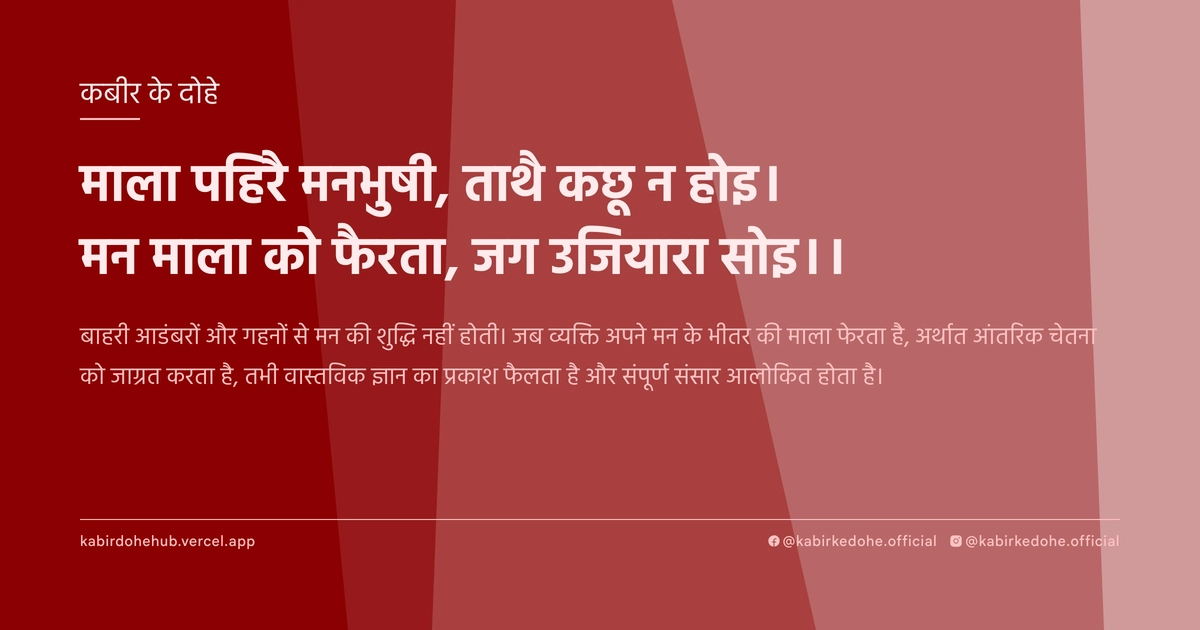
माला पहिरै मनभुषी, ताथै कछू न होइ।
मन माला को फैरता, जग उजियारा सोइ।।
Maala pahire manbhushi, taathai kachhu na hoi. Man maala ko phairta, jag ujiyara soi.
इस पृष्ठ पर इस कबीर दोहे का अर्थ (meaning), हिंदी व्याख्या और अंग्रेज़ी अनुवाद, दार्शनिक विश्लेषण और व्यावहारिक जीवन सीख दी गई है। यह दोहा मन नियंत्रण (Mind Control) विषय से जुड़ा है — Kabir doha meaning and explanation in Hindi and English.
अर्थ (Meaning):
बाहरी आडंबरों और गहनों से मन की शुद्धि नहीं होती। जब व्यक्ति अपने मन के भीतर की माला फेरता है, अर्थात आंतरिक चेतना को जाग्रत करता है, तभी वास्तविक ज्ञान का प्रकाश फैलता है और संपूर्ण संसार आलोकित होता है।
Adorning the body with external ornaments or rituals brings no spiritual progress. Only when one rotates the 'rosary of the mind'—cultivating internal awareness and mindfulness—does the true light of consciousness dawn, illuminating the entire existence.
व्याख्या (Interpretation):
कबीर यहाँ 'मनभुषी' (मन के आभूषण) और 'मन माला' के बीच एक सूक्ष्म अंतर स्पष्ट कर रहे हैं। बाहरी दिखावा, चाहे वह धार्मिक वस्त्र हों या सामाजिक प्रतिष्ठा, आत्मा की प्यास नहीं बुझा सकते। यहाँ 'माला फेरना' केवल मंत्र जाप नहीं, बल्कि आत्म-निरीक्षण की प्रक्रिया है। यह निर्गुण भक्ति का सार है जहाँ ईश्वर किसी मंदिर या मूर्ति में नहीं, बल्कि शुद्ध अंतःकरण में निवास करता है। जब अहंकार का पर्दा हटता है, तो आत्मा और ब्रह्म की एकता (अद्वैत) का अनुभव होता है, जिससे अज्ञान का अंधकार मिट जाता है।
Kabir distinguishes between 'manbhushi' (ornaments of the mind/ego) and the 'man mala' (the rosary of consciousness). External displays, whether religious attire or social status, cannot quench the soul's thirst. Here, 'rotating the rosary' is not a ritualistic act of counting beads, but a process of deep introspection. This is the essence of Nirgun Bhakti, where the Divine resides not in temples or idols, but within a purified heart. When the veil of ego is lifted, the non-duality of Atman and Brahman is realized, dissolving the darkness of ignorance.
दार्शनिक विश्लेषण (Philosophical Analysis):
कबीर का यह दोहा मध्यकालीन भारत के उस दौर की प्रतिक्रिया है जब धर्म केवल कर्मकांडों और बाहरी प्रतीकों में सिमट गया था। उन्होंने स्पष्ट किया कि मोक्ष किसी बाहरी क्रिया से नहीं, बल्कि आंतरिक रूपांतरण से मिलता है। यह विचार अद्वैत वेदांत के करीब है, जहाँ 'माया' को बाहरी दुनिया का भ्रम माना गया है।
सूफी मत के 'इश्क-ए-हकीकी' की तरह, कबीर भी हृदय की आंतरिक पवित्रता पर जोर देते हैं। उनके लिए, माला फेरने का अर्थ है अपनी सांसों और विचारों के प्रति सजग होना। यह एक मनोवैज्ञानिक प्रक्रिया है जिसमें साधक अपने 'अहं' को मिटाकर 'शून्य' में विलीन होता है।
कबीर जाति और धर्म के भेदों को नकारते हुए यह बताते हैं कि सत्य सार्वभौमिक है। जो व्यक्ति केवल बाहरी दिखावे में विश्वास करता है, वह वास्तव में अपनी आध्यात्मिक यात्रा में बाधा उत्पन्न कर रहा है।
यहाँ 'जग उजियारा' का अर्थ केवल व्यक्तिगत मोक्ष नहीं, बल्कि एक ऐसी चेतना है जो दूसरों के प्रति करुणा और प्रेम में बदल जाती है। जब व्यक्ति स्वयं को जान लेता है, तो वह संपूर्ण सृष्टि को अपने भीतर देखता है।
अतः, यह दोहा हमें चेतावनी देता है कि हम धार्मिकता के मुखौटों के पीछे न छिपें। वास्तविक भक्ति वह है जो हमें हमारे वास्तविक स्वरूप से मिलाए, न कि वह जो हमें समाज में 'पवित्र' दिखाए।
This couplet is a reaction to the medieval Indian era where religion had shrunk into mere rituals and external symbols. Kabir asserts that liberation is achieved not through external acts, but through internal transformation. This aligns with Advaita Vedanta, which views 'Maya' as the illusion of the external world.
Similar to the Sufi concept of 'Ishq-e-Haqiqi' (Divine Love), Kabir emphasizes the internal purity of the heart. For him, 'rotating the rosary' means becoming mindful of one's breath and thoughts. It is a psychological process where the seeker annihilates the 'ego' to merge into the 'Void' or Absolute.
By rejecting caste and sectarian divides, Kabir demonstrates that Truth is universal. One who relies solely on external appearances is effectively obstructing their own spiritual journey.
'Jag Ujiyara' (World Light) refers not just to individual salvation, but to a consciousness that manifests as compassion and love for all. When a person knows themselves, they perceive the entire universe within.
Thus, the verse warns against hiding behind masks of religiosity. True devotion is that which connects us to our authentic nature, rather than that which makes us appear 'holy' to society.
मूल संदेश (Core Message):
- बाहरी दिखावा आध्यात्मिक प्रगति का भ्रम पैदा करता है।
- सच्ची प्रार्थना शब्दों में नहीं, बल्कि जागरूकता में है।
- अहंकार का त्याग ही वास्तविक ज्ञान का द्वार है।
- आंतरिक शुद्धि के बिना कोई भी अनुष्ठान व्यर्थ है।
- प्रेम और करुणा ही ईश्वर के वास्तविक स्वरूप हैं।
- External displays create an illusion of spiritual progress.
- True prayer lies in awareness, not in words.
- Surrendering the ego is the only gateway to real knowledge.
- Any ritual without internal purity is utterly futile.
- Love and compassion are the true forms of the Divine.
व्यावहारिक उदाहरण (Practical Example):
वाराणसी के घाटों पर रहने वाले एक वृद्ध विधवा, जानकी, का जीवन केवल पूजा-पाठ और कठोर नियमों के इर्द-गिर्द घूमता था। वह सफेद वस्त्र पहनती और दिन भर माला जपती, यह विश्वास करते हुए कि यही उसकी मुक्ति का मार्ग है।
वह अक्सर अन्य महिलाओं को उनके नियमों की अनदेखी करने पर टोकती और खुद को अधिक 'पवित्र' मानती थी। उसकी भक्ति बाहरी थी, लेकिन मन में अभी भी दूसरों के प्रति निर्णय और सूक्ष्म अहंकार था।
एक दिन, उसने एक छोटे बच्चे को देखा जो भूख से तड़प रहा था और पास के मंदिर की सीढ़ियों पर रो रहा था। जानकी अपनी माला फेर रही थी और मंत्रोच्चार में लीन थी।
उसने बच्चे को देखा, लेकिन उसके मन में विचार आया कि 'मैं अभी अपनी प्रार्थना पूरी कर रही हूँ, यह मेरा समय है'। उसने अपनी धार्मिक मर्यादा को प्राथमिकता दी।
तभी उसे कबीर का एक विचार याद आया कि बाहरी माला से अधिक महत्वपूर्ण मन की करुणा है। उसे अचानक महसूस हुआ कि उसकी माला केवल लकड़ी के दानों का समूह है, जबकि असली प्रार्थना उस बच्चे की भूख मिटाना है।
उसने पहली बार अपनी माला छोड़ी और अपनी पोटली से वह आखिरी रोटी निकाली जो उसने अपने लिए रखी थी। उसने बच्चे को खिलाया और उसकी आँखों में जो संतोष देखा, वह उसे किसी मंत्र में नहीं मिला था।
उस क्षण जानकी को समझ आया कि 'मन माला' फेरने का अर्थ है अपने हृदय के कठोरता को पिघलाना और प्रेम को जागृत करना।
उसकी भक्ति अब प्रदर्शन नहीं, बल्कि सेवा बन गई। उसने पाया कि जब उसने अहंकार का आभूषण उतारा, तब उसके जीवन में वास्तविक प्रकाश (उजियारा) आया।
अब वह केवल मंत्र नहीं पढ़ती थी, बल्कि हर दुखी व्यक्ति में उस निराकार ईश्वर को देखने लगी।
उसका जीवन अब एक जीवित प्रार्थना बन गया था, जहाँ करुणा ही उसका सबसे बड़ा आभूषण था।
Janaki, an elderly widow living on the ghats of Varanasi, spent her life revolving around strict rituals and prayers. She wore white robes and spent her days chanting on a rosary, believing this was the only path to liberation.
She often corrected other women for ignoring rules, viewing herself as more 'pure.' Her devotion was external, but her mind still harbored judgment and a subtle ego.
One day, she saw a small child shivering with hunger, crying on the steps of a nearby temple. Janaki was in the middle of her chanting, deeply absorbed in her beads.
She noticed the child, but a thought crossed her mind: 'I am completing my prayers; this is my sacred time.' She prioritized her religious protocol over the child's suffering.
Suddenly, a thought of Kabir struck her—that the compassion of the heart is far more important than the external rosary. She realized her beads were merely pieces of wood, while the real prayer was to satiate the child's hunger.
For the first time, she dropped her rosary and took out the last piece of bread she had saved for herself. As she fed the child, the gratitude in the boy's eyes gave her a peace no mantra ever had.
In that moment, Janaki understood that 'rotating the mind's rosary' means melting the hardness of the heart and awakening love.
Her devotion ceased to be a performance and became a service. She discovered that when she shed the ornament of ego, true light (Ujiyara) entered her life.
She no longer just recited mantras; she began to see the Formless Divine in every suffering soul.
Her life became a living prayer, where compassion was her most precious ornament.
अभ्यास मार्गदर्शन (Practice Guidance):
- प्रतिदिन 15 मिनट मौन बैठें और केवल अपने विचारों के आने-जाने को देखें, बिना किसी निर्णय के। यह 'मन माला' फेरने की शुरुआत है।
- एक डायरी लिखें जिसमें आप उन क्षणों को दर्ज करें जब आपने केवल 'दिखावे' के लिए कोई धार्मिक या नैतिक कार्य किया। आत्म-विश्लेषण करें कि उस समय आपका उद्देश्य क्या था।
- व्यवहार परिवर्तन: दिन में कम से कम एक बार किसी ऐसे व्यक्ति की मदद करें जिससे आपको कोई लाभ न हो और इस बात को गुप्त रखें।
- निदान चेकलिस्ट: क्या मैं दूसरों की भक्ति को कमतर आंकता हूँ? क्या मुझे अपनी धार्मिक पहचान पर गर्व है? यदि हाँ, तो आप अभी भी 'मनभुषी' (बाहरी आभूषणों) में फंसे हैं।
- Sit in silence for 15 minutes daily, observing the flow of your thoughts without judgment. This is the beginning of 'rotating the mind's rosary.'
- Keep a journal to record moments when you performed a religious or moral act solely for 'appearance.' Analyze the underlying motive.
- Behavioral Shift: Once a day, help someone from whom you gain nothing and keep the act strictly secret to kill the ego.
- Diagnostic Checklist: Do I judge others' forms of devotion? Do I feel a sense of superiority due to my religious identity? If yes, you are still trapped in 'manbhushi' (external ornaments).
चिंतन प्रश्न (Reflection Questions):
- मेरे जीवन में ऐसे कौन से 'धार्मिक आभूषण' हैं जिन्हें मैं अपनी कमियों को छिपाने के लिए पहनता हूँ?
- यदि मेरी सारी सामाजिक और धार्मिक पहचान छीन ली जाए, तो मेरे भीतर क्या बचेगा?
- क्या मेरी प्रार्थनाएँ मुझे दूसरों के प्रति अधिक विनम्र बनाती हैं या अधिक श्रेष्ठ?
- मैं अपनी डिजिटल पहचान (सोशल मीडिया) पर अपनी 'आध्यात्मिकता' को कैसे प्रदर्शित करता हूँ और यह मेरी वास्तविकता से कितना अलग है?
- क्या मैं वास्तव में ईश्वर की खोज कर रहा हूँ, या केवल 'भक्त' कहलाने की इच्छा रखता हूँ?
- What 'religious ornaments' do I wear in my life to mask my internal flaws?
- If all my social and religious identities were stripped away, what would remain within me?
- Do my prayers make me more humble toward others, or more feeling of superiority?
- How do I project my 'spirituality' on my digital identity, and how far is it from my actual reality?
- Am I truly seeking the Divine, or do I merely desire to be called a 'devotee'?