
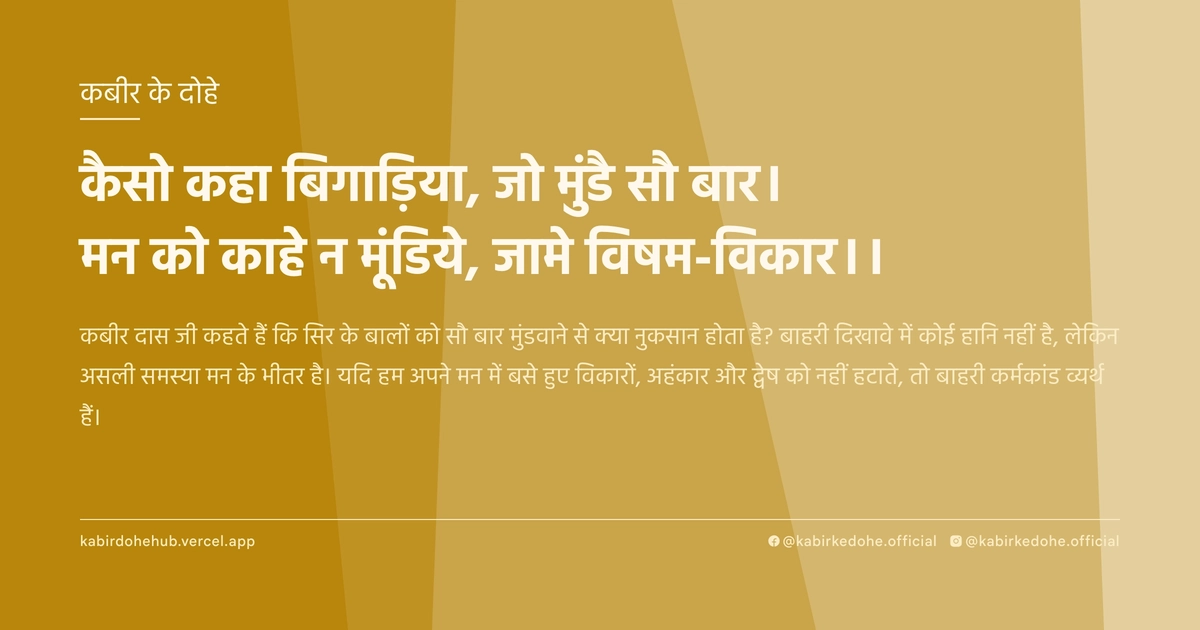
कैसो कहा बिगाड़िया, जो मुंडै सौ बार।
मन को काहे न मूंडिये, जामे विषम-विकार।।
Kaiso kaha bigadiya, jo mundai sau baar. Man ko kaahe na mundiye, jaame visham-vikaar.
इस पृष्ठ पर इस कबीर दोहे का अर्थ (meaning), हिंदी व्याख्या और अंग्रेज़ी अनुवाद, दार्शनिक विश्लेषण और व्यावहारिक जीवन सीख दी गई है। यह दोहा अहंकार (The Ego) विषय से जुड़ा है — Kabir doha meaning and explanation in Hindi and English.
अर्थ (Meaning):
कबीर दास जी कहते हैं कि सिर के बालों को सौ बार मुंडवाने से क्या नुकसान होता है? बाहरी दिखावे में कोई हानि नहीं है, लेकिन असली समस्या मन के भीतर है। यदि हम अपने मन में बसे हुए विकारों, अहंकार और द्वेष को नहीं हटाते, तो बाहरी कर्मकांड व्यर्थ हैं।
Kabir asks what harm is there in shaving the head a hundred times? External rituals of tonsure do not diminish the soul. However, the true challenge lies in 'shaving' the mind—removing the deep-seated impurities, poisons, and distortions of the ego that hinder spiritual growth.
व्याख्या (Interpretation):
यह दोहा बाहरी शुद्धि बनाम आंतरिक शुद्धि के विरोधाभास को दर्शाता है। 'मुंडना' यहाँ केवल बालों को हटाने का नहीं, बल्कि त्याग का प्रतीक है। कबीर तर्क देते हैं कि भौतिक शरीर पर किया गया कोई भी त्याग तब तक शून्य है जब तक वह मानसिक स्तर पर न हो। यह निर्गुण भक्ति का सार है, जहाँ ईश्वर मंदिर या बाहरी अनुष्ठानों में नहीं, बल्कि मन की निर्मलता में बसता है। माया हमें बाहरी प्रतीकों में उलझाए रखती है, जबकि आत्मा का वास्तविक मिलन केवल तब होता है जब 'विषम-विकार' यानी मानसिक विष समाप्त हो जाए। यह अद्वैत वेदांत के उस सिद्धांत की ओर इशारा करता है जहाँ ज्ञाता और ज्ञेय के बीच का पर्दा केवल अहंकार है। जब मन का अहंकार मुंड जाता है, तब केवल शुद्ध चैतन्य शेष रहता है।
This couplet highlights the paradox between external purification and internal transmutation. 'Shaving' here is not merely a physical act but a metaphor for renunciation. Kabir argues that any sacrifice performed on the physical body is void unless it is mirrored at the psychological level. This is the essence of Nirgun Bhakti, where the Divine resides not in temples or rituals, but in the purity of the heart. Maya keeps the seeker entangled in external symbols, whereas the union of Atman and Brahman occurs only when 'visham-vikar'—the poisonous distortions of the mind—are eradicated. It aligns with Advaita Vedanta, suggesting that the only veil between the individual and the Absolute is the ego. Once the ego is 'shaved' away, only pure consciousness remains.
दार्शनिक विश्लेषण (Philosophical Analysis):
कबीर का यह प्रहार तत्कालीन समाज में व्याप्त कर्मकांडवाद पर है। उस युग में लोग बाहरी प्रतीकों जैसे जटाएं रखना, तिलक लगाना या सिर मुंडवाना ही धर्म मानते थे। कबीर इस पाखंड को चुनौती देते हुए कहते हैं कि धर्म शरीर का नहीं, चेतना का विषय है। वे सूफी मत के 'फना' (अहंकार का विनाश) और वेदांत के 'अहं ब्रह्मास्मि' के बीच एक सेतु बनाते हैं।
उनका दर्शन यह है कि मनुष्य बाहरी दुनिया में अपनी पहचान बनाने के लिए संघर्ष करता है, जबकि वास्तविक यात्रा अंतर्मुखी होनी चाहिए। 'विषम-विकार' का अर्थ है काम, क्रोध, लोभ, मोह और अहंकार। ये विकार मन की परतों पर जमी धूल की तरह हैं। जब तक यह धूल नहीं हटती, सत्य का साक्षात्कार असंभव है।
कबीर जाति और वर्ग के भेदभाव को भी इसी मानसिक विकार का हिस्सा मानते थे। उनके लिए एक ब्राह्मण का मुंडित सिर और एक अछूत का सिर समान हैं, यदि दोनों के मन में अहंकार है। वे सामाजिक समानता को आध्यात्मिक शुद्धि का अनिवार्य हिस्सा मानते थे।
मनोवैज्ञानिक स्तर पर, यह दोहा संज्ञानात्मक पुनर्गठन की बात करता है। हम अक्सर अपनी आदतों को बदलने के बजाय अपने परिवेश को बदलते हैं। कबीर कहते हैं कि परिवेश बदलने से कुछ नहीं होगा; जब तक आंतरिक प्रोग्रामिंग (विकार) नहीं बदलेगी, दुख बना रहेगा।
अंततः, यह संदेश है कि सच्ची भक्ति वह है जो मनुष्य को विनम्र बनाए। यदि कोई व्यक्ति कठोर तपस्या करे लेकिन उसके मन में दूसरों के प्रति घृणा हो, तो वह तपस्या केवल एक और अहंकार का रूप है। वास्तविक मोक्ष मन के अहंकार के पूर्ण विसर्जन में है।
Kabir’s critique is aimed squarely at the ritualism prevalent in his era. During his time, spiritual legitimacy was often tied to external markers—matted hair, sacred threads, or the act of tonsure. Kabir challenges this hypocrisy, asserting that religion is a matter of consciousness, not cosmetics. He builds a bridge between the Sufi concept of 'Fana' (annihilation of the self) and the Vedantic realization of non-duality.
His philosophy posits that humans struggle to build an identity in the external world, while the true journey must be inward. 'Visham-vikar' refers to the internal poisons: lust, anger, greed, attachment, and ego. These distortions are like layers of dust on the mirror of the soul; until this dust is cleared, the reflection of the Divine remains obscured.
Kabir viewed caste and class distinctions as manifestations of these very mental distortions. To him, the shaven head of a priest and that of an outcast were identical if both harbored arrogance. He saw social equality as an indispensable byproduct of spiritual purification.
Psychologically, this Doha advocates for cognitive restructuring. Humans often attempt to change their environment to find peace, whereas Kabir insists that unless the internal programming—the 'vikars'—is altered, suffering persists regardless of the setting.
Ultimately, the message is that true devotion is that which cultivates humility. If a practitioner undergoes rigorous austerity but retains hatred for others, that austerity becomes another layer of ego. True liberation lies in the total dissolution of the perceived separate self into the universal whole.
मूल संदेश (Core Message):
- बाहरी दिखावा आध्यात्मिक प्रगति का प्रमाण नहीं है।
- अहंकार का त्याग ही वास्तविक वैराग्य है।
- मन के विकारों को हटाना ही सच्ची पूजा है।
- आंतरिक शुद्धि के बिना कर्मकांड व्यर्थ हैं।
- विनम्रता ही वह कुंजी है जो सत्य के द्वार खोलती है।
- External displays are not evidence of spiritual progress.
- The renunciation of ego is the only true detachment.
- Cleansing the mind's distortions is the highest form of worship.
- Rituals are void without internal purification.
- Humility is the key that unlocks the doors of Truth.
व्यावहारिक उदाहरण (Practical Example):
एक समय की बात है, वाराणसी के घाटों पर रहने वाला एक वृद्ध बुनकर था, जिसका नाम माधव था। माधव अपनी कला में निपुण था, लेकिन उसका स्वभाव अत्यंत क्रोधी और अहंकारी था। वह मानता था कि उसकी बुनाई पूरे शहर में सबसे श्रेष्ठ है और जो उसकी प्रशंसा नहीं करता, वह अज्ञानी है।
माधव हर साल एक विशेष तीर्थयात्रा पर जाता था और वहां अपनी श्रद्धा प्रकट करने के लिए अपना सिर मुंडवाता था। वह इसे अपनी महान भक्ति का प्रतीक मानता था। उसने कई बार यह क्रिया की, लेकिन उसके जीवन में शांति नहीं आई। उसका क्रोध बढ़ता गया और उसके परिवार के साथ संबंध बिगड़ते गए।
एक दिन उसकी मुलाकात एक फकीर से हुई, जिसने माधव को उसकी श्रेष्ठता के बारे में बात करते सुना। फकीर ने मुस्कुराते हुए पूछा, 'माधव, तुमने अपना सिर तो कई बार मुंडवाया, लेकिन क्या कभी अपने मन के अहंकार को मुंडवाया?'
माधव को पहले तो यह बात समझ नहीं आई। उसने कहा, 'सिर मुंडवाना तो परंपरा है, मन को कैसे मुंडवाते हैं?' फकीर ने जवाब दिया, 'जैसे बाल शरीर की बाहरी परत हैं, वैसे ही तुम्हारा अहंकार तुम्हारी आत्मा की बाहरी परत है। जब तक तुम इस 'मैं श्रेष्ठ हूँ' के विचार को नहीं काटोगे, तुम्हारी तीर्थयात्रा केवल एक सैर है।'
माधव गहरे सोच में डूब गया। उसने महसूस किया कि वह बाहरी क्रियाओं को ढाल बनाकर अपने आंतरिक अंधकार को छिपा रहा था। उसने तय किया कि अब वह अपनी कला का उपयोग अहंकार के लिए नहीं, बल्कि सेवा के लिए करेगा।
उसने अपने पास आने वाले गरीब बुनकरों को मुफ्त में सिखाना शुरू किया। जब उसने दूसरों की प्रगति में अपनी खुशी ढूंढी, तो उसका क्रोध धीरे-धीरे शांत होने लगा।
एक दिन, जब उसने एक नए शिष्य की बुनाई की प्रशंसा की, तो उसे एक ऐसी शांति महसूस हुई जो उसे किसी भी तीर्थयात्रा में नहीं मिली थी। उसने महसूस किया कि उसका 'मन मुंड' गया है।
अब माधव के लिए सिर मुंडवाना केवल एक शारीरिक क्रिया थी, लेकिन उसके मन की निर्मलता उसका वास्तविक धर्म बन गई। वह अब एक कुशल बुनकर ही नहीं, बल्कि एक शांत इंसान बन चुका था।
Once, in the ghats of Varanasi, lived an elderly weaver named Madhav. Madhav was a master of his craft, but his nature was volatile, marked by intense anger and a towering ego. He believed his weaving was the finest in the city and viewed anyone who didn't acknowledge his superiority as ignorant.
Every year, Madhav would embark on a specific pilgrimage where he would shave his head as a sign of devotion. He viewed this act as a symbol of his great piety. He performed this ritual many times, yet peace remained elusive. His anger grew, and his relationships with his family deteriorated.
One day, he encountered a wandering Sufi fakir who overheard Madhav boasting about his skills. The fakir smiled and asked, 'Madhav, you have shaven your head a hundred times, but have you ever shaven the ego within your mind?'
Madhav was initially confused. He replied, 'Shaving the head is a tradition, but how does one shave the mind?' The fakir replied, 'Just as hair is an external layer of the body, your ego is an external layer of your soul. Until you cut away the thought of "I am superior," your pilgrimage is merely a walk.'
Madhav fell into deep contemplation. He realized he had been using external rituals as a shield to hide his internal darkness. He decided that from then on, he would use his art not for vanity, but for service.
He began teaching poor weavers in his village for free. As he found joy in the progress of others, his anger began to dissolve. He stopped seeking validation and started seeking connection.
One day, while praising the work of a young apprentice, he felt a profound sense of peace that no pilgrimage had ever provided. He realized that his 'mind had been shaven.'
For Madhav, the physical act of tonsure became irrelevant, while the purity of his heart became his true religion. He was no longer just a master weaver, but a liberated human being.
अभ्यास मार्गदर्शन (Practice Guidance):
- दैनिक आत्म-निरीक्षण: प्रतिदिन 15 मिनट मौन में बैठें और उन विचारों को पहचानें जहाँ 'मैं' (अहंकार) प्रबल है।
- विकार-डायरी: जब भी क्रोध या ईर्ष्या महसूस हो, उसे लिखें और विश्लेषण करें कि यह किस मानसिक 'बाल' (अहंकार) के कारण उत्पन्न हुआ।
- सेवा का अभ्यास: सप्ताह में एक बार ऐसा कार्य करें जिसमें आपको कोई श्रेय न मिले और आपकी पहचान गुप्त रहे।
- निदान चेकलिस्ट: क्या मैं दूसरों की गलती पर तुरंत प्रतिक्रिया देता हूँ? क्या मैं अपनी उपलब्धियों का बार-बार जिक्र करता हूँ? यदि हाँ, तो मन को 'मुंडवाने' की आवश्यकता है।
- Daily Self-Inquiry: Spend 15 minutes in silence daily, identifying moments where the 'I' (ego) becomes dominant in your thoughts.
- Vikar-Journaling: Whenever you feel anger or jealousy, record it and analyze which specific mental 'hair' (ego-attachment) triggered the emotion.
- Anonymous Service: Once a week, perform an act of kindness where you receive no credit and your identity remains hidden.
- Diagnostic Checklist: Do I react instantly to others' mistakes? Do I frequently mention my own achievements? If yes, the mind requires 'shaving'.
चिंतन प्रश्न (Reflection Questions):
- मैं अपनी सार्वजनिक छवि को बनाए रखने के लिए अपने भीतर किन सचाइयों को दबा रहा हूँ?
- क्या मेरी धार्मिक या नैतिक मान्यताएं वास्तव में मुझे विनम्र बनाती हैं, या वे मेरे अहंकार को एक नया आधार दे रही हैं?
- यदि मेरी सभी उपलब्धियां और पद छीन लिए जाएं, तो मेरे पास 'मैं' के रूप में क्या बचेगा?
- मेरे जीवन का वह कौन सा 'विकार' है जिसे मैं सबसे अधिक सही ठहराता हूँ?
- क्या मैं दूसरों की मदद इसलिए करता हूँ क्योंकि मैं दयालु हूँ, या इसलिए ताकि मैं खुद को दयालु महसूस कर सकूँ?
- What internal truths am I suppressing to maintain my public persona?
- Do my religious or moral beliefs actually make me humble, or do they provide a new foundation for my ego?
- If all my achievements and titles were stripped away, what would remain of 'I'?
- Which mental distortion in my life do I most frequently justify as a 'strength'?
- Do I help others because I am compassionate, or because I want to feel the sensation of being compassionate?