
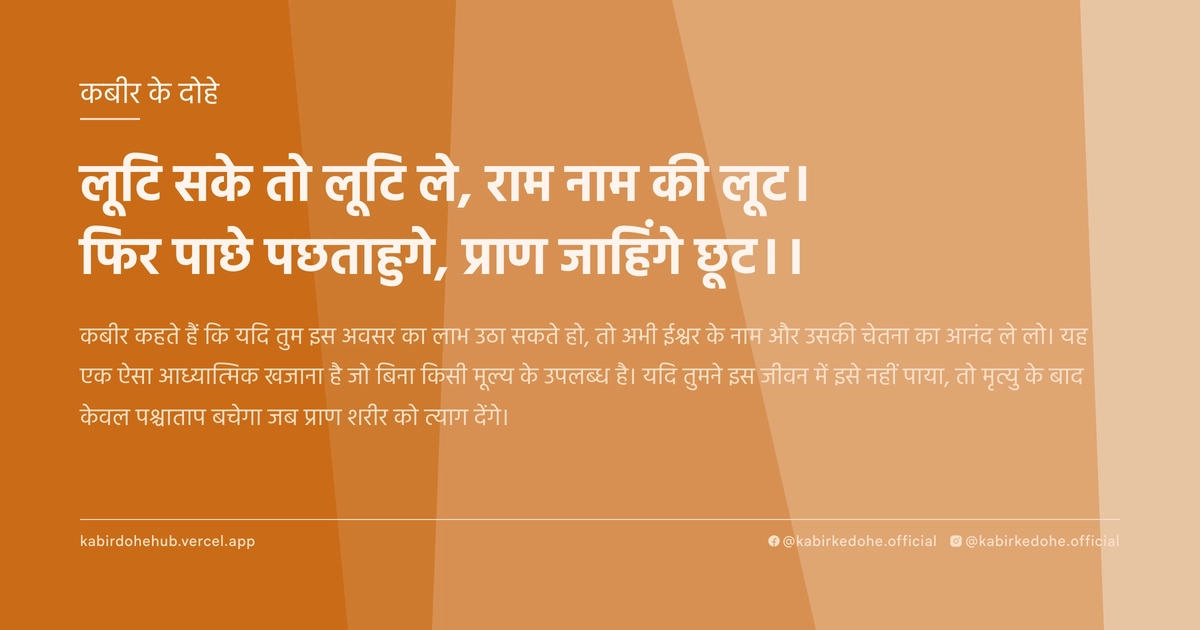
लूटि सके तो लूटि ले, राम नाम की लूट।
फिर पाछे पछताहुगे, प्राण जाहिंगे छूट।।
Looti sake to looti le, Ram naam ki loot. Phir paachhe pachhtahuge, praan jaahinge chhoot.
इस पृष्ठ पर इस कबीर दोहे का अर्थ (meaning), हिंदी व्याख्या और अंग्रेज़ी अनुवाद, दार्शनिक विश्लेषण और व्यावहारिक जीवन सीख दी गई है। यह दोहा जागृति (The Wake-up Call) विषय से जुड़ा है — Kabir doha meaning and explanation in Hindi and English.
अर्थ (Meaning):
कबीर कहते हैं कि यदि तुम इस अवसर का लाभ उठा सकते हो, तो अभी ईश्वर के नाम और उसकी चेतना का आनंद ले लो। यह एक ऐसा आध्यात्मिक खजाना है जो बिना किसी मूल्य के उपलब्ध है। यदि तुमने इस जीवन में इसे नहीं पाया, तो मृत्यु के बाद केवल पश्चाताप बचेगा जब प्राण शरीर को त्याग देंगे।
Kabir urges us to seize the divine opportunity of remembering the Formless One while we still possess the breath of life. He describes the remembrance of 'Ram' not as a ritual, but as a spiritual treasure available for the taking. To ignore this grace now is to invite an eternal regret once the soul departs from the physical vessel.
व्याख्या (Interpretation):
यहाँ 'लूट' शब्द का प्रयोग एक विरोधाभास के रूप में किया गया है; आमतौर पर लूट नकारात्मक होती है, लेकिन यहाँ यह ईश्वरीय कृपा की प्रचुरता को दर्शाता है। 'राम' यहाँ दशरथ पुत्र नहीं, बल्कि निर्गुण ब्रह्म हैं जो कण-कण में व्याप्त हैं। यह दोहा माया के प्रभाव को रेखांकित करता है, जहाँ मनुष्य सांसारिक वस्तुओं को इकट्ठा करने में समय व्यतीत करता है और उस वास्तविक सत्य को भूल जाता है जो उसके भीतर है। जब प्राण छूटते हैं, तब व्यक्ति को आभास होता है कि उसने केवल भ्रम का संचय किया था। यह अद्वैत वेदांत के उस सत्य की ओर संकेत है जहाँ आत्मा और परमात्मा का मिलन ही एकमात्र उद्देश्य है। अंततः, यह समय की नश्वरता और आध्यात्मिक तत्परता का आह्वान है।
The use of the word 'loot' (plunder) is a provocative paradox; while looting is typically criminal, here it signifies the abundance of divine grace available for the taking. 'Ram' does not refer to the mythological king, but to the Nirgun Brahman—the formless, omnipresent consciousness. The verse highlights the tragedy of Maya, where humans spend their existence accumulating transient material wealth while ignoring the eternal treasure within. As the breath departs, the illusion shatters, leaving behind the agony of missed opportunity. This aligns with Advaita Vedanta, emphasizing that the realization of non-duality is the only permanent gain. It is a visceral call to spiritual urgency, reminding us that the window for liberation is the present moment.
दार्शनिक विश्लेषण (Philosophical Analysis):
कबीर का यह दोहा उनके युग के धार्मिक पाखंड और कर्मकांडीय जटिलताओं पर एक गहरा प्रहार है। उस समय धर्म केवल बाहरी आडंबरों, तीर्थों और कठिन अनुष्ठानों तक सीमित था, जिससे आम आदमी दूर हो गया था। कबीर ने 'राम नाम' को एक सरल, सुलभ और आंतरिक प्रक्रिया के रूप में प्रस्तुत किया, जो जाति, वर्ण या सामाजिक स्थिति से परे है। यह दृष्टिकोण सूफीवाद के 'इश्क-ए-हकीकी' (परमात्मा से प्रेम) और भक्ति आंदोलन की सहजता का संगम है।
दार्शनिक स्तर पर, यह दोहा 'अहंकार' के विसर्जन की बात करता है। जब कबीर 'लूटने' की बात करते हैं, तो वे वास्तव में उस अहंकार को नष्ट करने की बात कर रहे हैं जो हमें यह विश्वास दिलाता है कि हम ईश्वर से अलग हैं। यह अद्वैत दर्शन का सार है—यह समझना कि जिसे हम बाहर खोज रहे हैं, वह वास्तव में हमारा अपना शुद्ध स्वरूप है।
कबीर यहाँ समय की अवधारणा को 'क्षणभंगुरता' के रूप में देखते हैं। वे चेतावनी देते हैं कि भौतिक जगत की मोह-माया एक ऐसा जाल है जो मनुष्य को वास्तविक लक्ष्य से भटकाता है। यह मनोवैज्ञानिक रूपांतरण की प्रक्रिया है, जहाँ व्यक्ति बाहरी दुनिया की 'लूट' (संग्रह) को छोड़कर आंतरिक शांति की 'लूट' (प्राप्ति) की ओर बढ़ता है।
यह शिक्षण हमें सिखाता है कि मोक्ष किसी भविष्य की घटना नहीं है, बल्कि वर्तमान में जागरूक होने की स्थिति है। जो व्यक्ति इस सत्य को पहचान लेता है, वह मृत्यु के भय से मुक्त हो जाता है क्योंकि वह जान जाता है कि वह शरीर नहीं, बल्कि अविनाशी चेतना है।
अंततः, कबीर का संदेश यह है कि आध्यात्मिक जागृति के लिए किसी मध्यस्थ या पुरोहित की आवश्यकता नहीं है। सत्य सीधा, सरल और सबके लिए खुला है। बस आवश्यकता है एक तीव्र अभिलाषा की, जो सांसारिक मोह से ऊपर उठकर सत्य की खोज करे।
This couplet is a profound critique of the ritualistic complexities and religious hypocrisy prevalent during Kabir's era. At a time when spirituality was gated by caste, elaborate pilgrimages, and rigid priesthood, Kabir democratized the divine. By framing the remembrance of 'Ram' as a 'loot' available to all, he stripped away the exclusivity of salvation, aligning his teachings with the egalitarian spirit of the Bhakti movement and the mystical longing of Sufism.
Philosophically, the verse addresses the annihilation of the ego. The 'plundering' Kabir refers to is not the acquisition of an object, but the dissolution of the false identity that separates the individual from the Universal Consciousness. This is the core of Advaita Vedanta: the realization that the Atman (soul) and Brahman (Ultimate Reality) are one and the same. The 'loot' is the sudden, intuitive leap into this non-dual awareness.
Kabir employs the concept of temporal urgency to trigger a psychological shift. He contrasts the 'false accumulation' of material wealth—which is subject to decay—with the 'true accumulation' of spiritual awareness. He warns that the human mind is often trapped in Maya (illusion), believing that the external world is the primary reality, while the internal divine spark is ignored.
This teaching suggests that liberation (Mukti) is not a post-mortem destination but a state of being achievable in the present. By urging the seeker to 'loot' the name of Ram now, he is calling for a radical shift in priority: from the quantitative (how much I own) to the qualitative (how aware I am).
Furthermore, Kabir rejects the need for intermediaries. He asserts that the path to the Divine is direct and unmediated. The only barrier is the seeker's own hesitation and attachment to the ego. The 'regret' mentioned is the existential horror of realizing, at the moment of death, that one lived an entire life in a dream, chasing shadows while the sun was shining within.
मूल संदेश (Core Message):
- सांसारिक संग्रह एक भ्रम है, आंतरिक बोध ही वास्तविक संपत्ति है।
- समय सीमित है; आध्यात्मिक जागृति के लिए प्रतीक्षा करना आत्मघाती है।
- ईश्वर कोई बाहरी व्यक्ति नहीं, बल्कि आपकी अपनी शुद्ध जागरूकता है।
- अहंकार का विसर्जन ही वह कुंजी है जो मोक्ष के द्वार खोलती है।
- वर्तमान क्षण ही एकमात्र स्थान है जहाँ परमात्मा का साक्षात्कार संभव है।
- Material accumulation is a mirage; internal awakening is the only true wealth.
- Time is finite; delaying spiritual realization is a fatal error of the ego.
- The Divine is not an external entity, but your own purest state of awareness.
- The dissolution of the ego is the only key that unlocks the gates of liberation.
- The present moment is the only portal through which the Infinite can be realized.
व्यावहारिक उदाहरण (Practical Example):
वाराणसी के एक पुराने घाट पर माधव नाम का एक वृद्ध मल्लाह रहता था। माधव का पूरा जीवन नाव चलाने और पर्यटकों को गंगा की लहरों पर घुमाने में बीता। उसने जीवन भर केवल धन संचय करने की कोशिश की, यह सोचकर कि अधिक पैसा उसे बुढ़ापे में शांति और सुरक्षा देगा। वह जितना कमाता, उतना ही और पाने की लालसा करता, जिससे उसका मन हमेशा अशांत रहता।
एक दिन, उसकी नाव के पास एक फकीर आया, जिसने माधव की बेचैनी को देखा और मुस्कुराते हुए कहा, 'माधव, तू इस नदी के पानी को बटोरने की कोशिश कर रहा है, जबकि पूरा सागर तेरे भीतर है। तूने दुनिया की लूट तो देखी, पर उस लूट को नहीं देखा जो मुफ्त में मिल रही है।'
माधव ने हैरान होकर पूछा, 'वह कौन सी लूट है बाबा?' फकीर ने जवाब दिया, 'वह शांति जो केवल स्वयं को जानने से मिलती है। तूने उम्र भर दूसरों को किनारे लगाया, पर खुद कभी किनारे नहीं लगा।'
उस रात माधव सो नहीं सका। उसे महसूस हुआ कि उसने अपनी पूरी ऊर्जा उन चीजों को पकड़ने में लगा दी जो रेत की तरह फिसल रही थीं। उसने महसूस किया कि उसकी 'सफलता' वास्तव में एक बड़ी रिक्तता थी।
अगले दिन से माधव ने एक बदलाव किया। उसने नाव चलाना नहीं छोड़ा, लेकिन अब वह नाव चलाते समय केवल पैसे के बारे में नहीं सोचता था। उसने हर सांस के साथ उस 'अनंत' का स्मरण करना शुरू किया, जिसे वह अब 'राम' कहने लगा था।
उसने देखा कि जब वह आंतरिक शांति में होता, तो उसकी नाव चलाने की कला और भी निखर गई। यात्री उसकी शांति से प्रभावित होने लगे। वह अब केवल एक मल्लाह नहीं था, बल्कि एक शांत साक्षी बन गया था।
एक समय ऐसा आया जब माधव के पास बहुत धन नहीं था, लेकिन उसके चेहरे पर एक ऐसी चमक थी जो करोड़पतियों के पास नहीं होती। उसने जान लिया था कि असली 'लूट' वह आंतरिक आनंद है जिसे कोई चुरा नहीं सकता।
जब माधव का अंतिम समय आया, तो वह डरा हुआ नहीं था। उसके चेहरे पर एक गहरी मुस्कान थी। उसने अपने शिष्यों से कहा, 'मैंने समय रहते वह खजाना लूट लिया, अब मुझे किसी चीज का पछतावा नहीं है।'
माधव की कहानी हमें सिखाती है कि भौतिक संचय केवल एक भ्रम है। वास्तविक उपलब्धि वह है जब हम अपनी सांसों के बीच उस दिव्य चेतना को खोज लेते हैं।
उसका रूपांतरण इस बात का प्रमाण है कि आध्यात्मिक जागृति किसी गुफा में जाने से नहीं, बल्कि अपने दैनिक कर्म को ईश्वर के स्मरण के साथ जोड़ने से आती है।
On the ancient ghats of Varanasi lived an elderly boatman named Madhav. Madhav had spent his entire life rowing tourists across the Ganges, driven by a singular obsession: accumulating wealth. He believed that the more gold he amassed, the more security and peace he would find in his twilight years. However, the more he earned, the more his greed grew, leaving his mind in a state of perpetual turbulence.
One afternoon, a wandering mystic boarded his boat. Observing Madhav's restless eyes, the mystic smiled and said, 'Madhav, you are trying to bottle the river's water while the entire ocean resides within you. You have witnessed the plunder of the world, but you have ignored the plunder that is offered for free.'
Confused, Madhav asked, 'What plunder is this, Baba?' The mystic replied, 'The peace that comes from knowing your true self. You have spent your life taking others to the shore, but you never once stepped onto the shore of your own soul.'
That night, Madhav could not sleep. He realized that he had spent his vital energy grasping at things that were slipping through his fingers like sand. He saw that his perceived 'success' was actually a profound emptiness.
From the next day, Madhav introduced a subtle change in his life. He did not stop rowing his boat, but he stopped rowing for the sake of greed. With every breath and every stroke of the oar, he began to remember the 'Infinite,' which he now called 'Ram.'
He discovered that when he operated from a place of inner stillness, his work became an art. Passengers were drawn not just to the river, but to the radiating peace on his face. He was no longer just a boatman; he had become a silent witness to the flow of life.
Eventually, Madhav did not possess great riches, but he carried a luminosity that the wealthiest merchants of the city lacked. He understood that the only 'loot' worth stealing was the internal bliss that no thief could ever take away.
When the time came for Madhav to leave his physical body, he was not afraid. A deep, serene smile graced his lips. He told his young apprentices, 'I have plundered the treasure in time; now, there is no room for regret.'
Madhav's story illustrates that material accumulation is a mirage. The only true achievement is the discovery of divine consciousness within the rhythm of one's own breath.
His transformation proves that spiritual awakening does not require retreating to a cave, but rather integrating the remembrance of the Divine into the very fabric of one's daily labor.
अभ्यास मार्गदर्शन (Practice Guidance):
- प्रतिदिन 20 मिनट 'साक्षी भाव' का अभ्यास करें, जहाँ आप अपने विचारों को बिना किसी निर्णय के केवल देखते हैं, जैसे वे बहते हुए बादल हों।
- स्व-पूछताछ जर्नल: प्रतिदिन लिखें—'आज मैंने किन सांसारिक मोहों के कारण अपनी आंतरिक शांति को खोया?' और 'क्या मैं वर्तमान क्षण में उपस्थित था?'
- व्यवहार परिवर्तन: दिन में तीन बार (सुबह, दोपहर, शाम) रुककर एक गहरी सांस लें और महसूस करें कि आप शरीर नहीं, बल्कि वह अनंत चेतना हैं जो इस शरीर के माध्यम से अनुभव कर रही है।
- निदान चेकलिस्ट: यदि आप छोटी बातों पर क्रोधित हो रहे हैं या भविष्य की चिंता में डूबे हैं, तो समझ लें कि आप 'माया' के प्रभाव में हैं और आपको पुनः 'राम नाम' (चेतना) की शरण में जाने की आवश्यकता है।
- Practice 'Witness Consciousness' for 20 minutes daily, observing your thoughts without judgment, as if they were passing clouds in a vast sky.
- Self-Inquiry Journaling: Daily record—'Which worldly attachments caused me to lose my inner peace today?' and 'Was I truly present in the current moment?'
- Behavioral Shift: Three times a day (morning, noon, evening), pause for one deep breath and consciously remind yourself: 'I am not this body or this role; I am the infinite consciousness experiencing this life.'
- Diagnostic Checklist: If you find yourself reacting with disproportionate anger to trivialities or feeling consumed by future anxieties, recognize it as the grip of 'Maya' and return to the practice of conscious remembrance.
चिंतन प्रश्न (Reflection Questions):
- यदि आज आपकी मृत्यु हो जाए, तो आपके पास ऐसी कौन सी 'संपत्ति' होगी जो आपके साथ जाएगी?
- आपकी सार्वजनिक पहचान (पद, प्रतिष्ठा) और आपके आंतरिक शून्य के बीच कितना बड़ा अंतर है?
- क्या आप वास्तव में ईश्वर को खोज रहे हैं, या केवल अपनी इच्छाओं की पूर्ति के लिए एक माध्यम ढूंढ रहे हैं?
- वह कौन सा डर है जो आपको पूरी तरह से वर्तमान में जीने और 'लूटने' से रोकता है?
- क्या आपकी भक्ति केवल शब्दों में है, या वह आपके व्यवहार में करुणा और निस्वार्थता के रूप में दिखती है?
- If your life ended today, what 'wealth' would you possess that transcends the physical realm?
- How vast is the chasm between your public persona (status, titles) and your internal void?
- Are you truly seeking the Divine, or are you merely looking for a cosmic vending machine to fulfill your desires?
- What is the specific fear that prevents you from fully inhabiting the present moment and claiming your spiritual inheritance?
- Is your devotion merely a linguistic habit, or does it manifest as tangible compassion and selflessness in your daily interactions?