
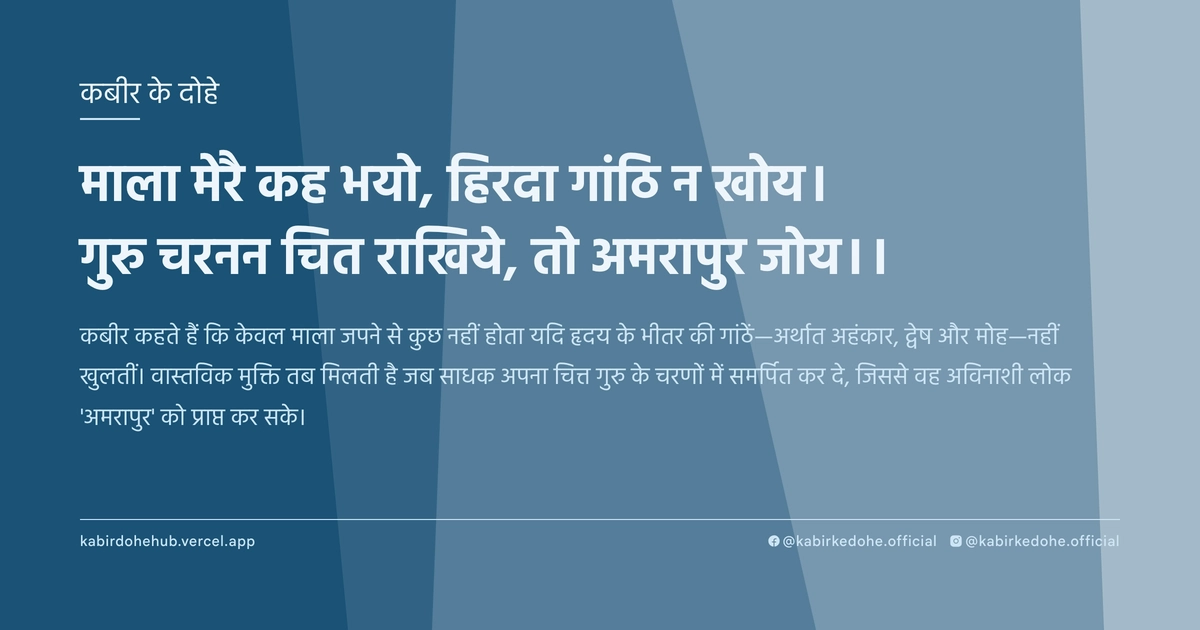
माला मेरै कह भयो, हिरदा गांठि न खोय।
गुरु चरनन चित राखिये, तो अमरापुर जोय।।
Maala merai kah bhayo, hirda gaanthi na khoy. Guru charnan chit rakhiye, to amrapur joy.
इस पृष्ठ पर इस कबीर दोहे का अर्थ (meaning), हिंदी व्याख्या और अंग्रेज़ी अनुवाद, दार्शनिक विश्लेषण और व्यावहारिक जीवन सीख दी गई है। यह दोहा गुरु महत्व (The Guru's Importance) विषय से जुड़ा है — Kabir doha meaning and explanation in Hindi and English.
अर्थ (Meaning):
कबीर कहते हैं कि केवल माला जपने से कुछ नहीं होता यदि हृदय के भीतर की गांठें—अर्थात अहंकार, द्वेष और मोह—नहीं खुलतीं। वास्तविक मुक्ति तब मिलती है जब साधक अपना चित्त गुरु के चरणों में समर्पित कर दे, जिससे वह अविनाशी लोक 'अमरापुर' को प्राप्त कर सके।
Kabir asserts that the mere mechanical act of chanting beads is futile if the knots within the heart—ego, hatred, and attachment—remain untied. True liberation is achieved only when the seeker anchors their consciousness at the feet of the Guru, thereby attaining the immortal realm of Amrapur.
व्याख्या (Interpretation):
इसका शाब्दिक अर्थ है कि बाहरी धार्मिक क्रियाएं व्यर्थ हैं यदि आंतरिक शुद्धि न हो। 'गांठ' यहाँ मानसिक अवरोधों और अहंकार का प्रतीक है जो आत्मा को परमात्मा से अलग करता है। यह निर्गुण भक्ति का सार है जहाँ ईश्वर किसी मूर्ति में नहीं, बल्कि शुद्ध चेतना में है। जब चित्त गुरु (ज्ञान के मार्गदर्शक) में लीन होता है, तो माया का पर्दा गिर जाता है। यह अद्वैत वेदांत के उस सिद्धांत को दर्शाता है जहाँ जीव और ब्रह्म की एकता स्थापित होती है। अंततः, अमरापुर कोई भौगोलिक स्थान नहीं, बल्कि वह अवस्था है जहाँ मृत्यु का भय समाप्त हो जाता है।
Literally, it suggests that external rituals are void without internal purification. The 'knot' symbolizes the psychological blockages and ego that sever the connection between the Atman and Brahman. This aligns with Nirgun Bhakti, where the Divine is not an idol but a formless consciousness. By anchoring the mind at the Guru's feet—representing the descent of grace and wisdom—the veil of Maya is lifted. It reflects the Advaita Vedanta principle of non-duality, where the perceived separation between the self and the Absolute vanishes. Ultimately, Amrapur is not a physical city but a state of being where the fear of death is extinguished.
दार्शनिक विश्लेषण (Philosophical Analysis):
कबीर का यह दोहा मध्यकालीन भारत के उस समय का है जब धर्म केवल कर्मकांडों और बाहरी दिखावे तक सीमित हो गया था। उन्होंने पुरोहितवाद और जातिगत श्रेष्ठता को चुनौती देते हुए यह स्पष्ट किया कि मोक्ष किसी विशेष माला या मंत्र से नहीं, बल्कि हृदय की पवित्रता से मिलता है। यह दृष्टिकोण सूफीवाद के 'फना' (अहंकार का विनाश) और वेदांत के 'ज्ञान मार्ग' का एक अनूठा संगम है।
यहाँ 'माला' केवल मोतियों की माला नहीं, बल्कि हर उस सामाजिक या धार्मिक पहचान का प्रतीक है जिसे मनुष्य अपनी श्रेष्ठता सिद्ध करने के लिए ओढ़ता है। कबीर तर्क देते हैं कि जब तक हृदय में 'गांठ' (अज्ञान और राग-द्वेष) है, तब तक कोई भी बाहरी साधना फलदायी नहीं होगी। यह मनोवैज्ञानिक रूपांतरण की मांग करता है, न कि केवल धार्मिक अनुपालन की।
गुरु का महत्व यहाँ व्यक्ति विशेष से अधिक 'गुरु-तत्व' या उस ज्ञान का है जो अंधकार को मिटाता है। यह अद्वैत दर्शन की वह स्थिति है जहाँ साधक यह अनुभव करता है कि वह स्वयं ही वह सत्य है जिसे वह खोज रहा था। गुरु केवल वह दर्पण है जो साधक को उसकी अपनी वास्तविक प्रकृति दिखाता है।
कबीर का प्रहार उन लोगों पर है जो धर्म को एक व्यापार या सामाजिक प्रतिष्ठा का साधन मानते हैं। वे कहते हैं कि वास्तविक भक्ति वह है जो मनुष्य को विनम्र बनाए और उसके भीतर के द्वैत को समाप्त करे। यह 'अहं' का विसर्जन है, जिसके बिना परमात्मा का अनुभव असंभव है।
अमरापुर, या अमर लोक, वह स्थिति है जहाँ समय और स्थान का बंधन समाप्त हो जाता है। यह मोक्ष की वह अवस्था है जिसे कबीर 'सहज' कहते हैं—जहाँ प्रयास समाप्त हो जाता है और केवल अस्तित्व बचता है। यह भौतिक स्वर्ग नहीं, बल्कि चेतना का उच्चतम स्तर है।
This couplet emerges from a medieval Indian era where religion had devolved into rigid ritualism and superficial displays of piety. Kabir challenged the priestly hegemony and caste hierarchies, asserting that liberation is not a product of specific beads or mantras, but of internal purity. His approach is a unique synthesis of the Sufi concept of 'Fana' (annihilation of the ego) and the Vedantic 'Jnana Marga' (path of knowledge).
In this context, the 'mala' (rosary) represents not just beads, but every social or religious identity that humans wear to claim spiritual superiority. Kabir argues that as long as the 'knot'—the psychological residue of ignorance and attachment—exists in the heart, no external practice can be fruitful. He demands a psychological transformation rather than mere religious compliance.
The significance of the Guru here transcends the individual person; it refers to the 'Guru-Tattva' or the illuminating principle that dispels darkness. This aligns with Advaita philosophy, where the seeker realizes that they are the very Truth they were searching for. The Guru acts as a mirror, reflecting the seeker's own inherent divinity.
Kabir targets those who treat religion as a trade or a tool for social prestige. He posits that genuine devotion is that which fosters humility and dissolves duality. It is the surrender of the 'I-consciousness' (Ahamkara), without which the experience of the Divine is impossible.
Amrapur, the immortal city, is a state where the constraints of time and space cease to exist. This is the state of liberation that Kabir calls 'Sahaja'—where striving ends and only pure existence remains. It is not a celestial geography, but the highest evolution of consciousness.
मूल संदेश (Core Message):
- बाहरी कर्मकांड बिना आंतरिक शुद्धि के व्यर्थ हैं।
- अहंकार की गांठें ही आत्मा और परमात्मा के बीच की दीवार हैं।
- सच्ची भक्ति विनम्रता और समर्पण में निहित है।
- गुरु का अर्थ है वह ज्ञान जो अज्ञान के अंधकार को मिटाए।
- मोक्ष कोई स्थान नहीं, बल्कि अहंकार से मुक्ति की अवस्था है।
- External rituals are futile without internal purification.
- The knots of ego are the only barriers between the soul and the Divine.
- True devotion resides in humility and absolute surrender.
- The Guru is the illuminating knowledge that dispels the darkness of ignorance.
- Liberation is not a destination, but the state of freedom from the ego.
व्यावहारिक उदाहरण (Practical Example):
वाराणसी के घाटों पर रहने वाली एक वृद्ध विधवा, जानकी, का जीवन केवल पूजा-पाठ और माला जपने में बीतता था। वह शहर की सबसे 'धार्मिक' महिला मानी जाती थी, लेकिन उसका हृदय कड़वाहट से भरा था। वह अपने पड़ोस की अन्य महिलाओं को उनकी कमियों के लिए निरंतर ताने देती और खुद को श्रेष्ठ मानती थी। उसके लिए माला जपना एक आदत थी, लेकिन उसके मन की गांठें—घमंड और ईर्ष्या—अटूट थीं।
एक दिन, एक साधारण सा फकीर घाट पर आया। उसने जानकी को माला जपते देखा और मुस्कुराते हुए पूछा, 'माँ, यह माला आपके हाथों में तो है, पर क्या यह आपके हृदय के भीतर के अंधेरे को भी गिन रही है?' जानकी को यह बात चुभी, लेकिन फकीर ने शांति से कहा, 'हाथों की माला केवल मोती गिनती है, हृदय की माला प्रेम गिनती है।'
जानकी ने क्रोध में जवाब दिया कि वह वर्षों से तपस्या कर रही है। फकीर ने उत्तर दिया, 'तपस्या वह नहीं जो आपको दूसरों से ऊपर उठाए, बल्कि वह है जो आपको दूसरों के दुख में विलीन कर दे। आपकी माला तो चमक रही है, पर आपकी आत्मा की गांठें अभी भी कसी हुई हैं।'
यह बात जानकी के भीतर गहरे तक उतर गई। उसने महसूस किया कि उसकी धार्मिकता वास्तव में उसके अहंकार का एक कवच थी। वह खुद को पवित्र मानकर दूसरों को तुच्छ समझने लगी थी। वह 'अमरापुर' की खोज तो कर रही थी, लेकिन उसके भीतर नफरत का वास था।
अगले कुछ महीनों तक, जानकी ने माला जपना नहीं छोड़ा, लेकिन उसने अपना ध्यान बदल दिया। अब वह माला जपते समय उन लोगों के लिए प्रार्थना करने लगी जिनसे वह घृणा करती थी। उसने अपनी श्रेष्ठता के भ्रम को त्याग दिया और चुपचाप दूसरों की सेवा करने लगी।
एक दिन, जब उसने एक बीमार अछूत महिला की सेवा की, जिसे उसने वर्षों तक अनदेखा किया था, उसे एक अपूर्व शांति का अनुभव हुआ। उसे लगा जैसे उसके हृदय की एक बहुत पुरानी और सख्त गांठ अचानक खुल गई हो।
उसने महसूस किया कि अब उसे किसी बाहरी स्वर्ग या अमरापुर की तलाश नहीं है। वह शांति, वह अमरता, उसके अपने भीतर ही थी, जो केवल तब प्रकट हुई जब उसका अहंकार मिटा।
जानकी अब भी माला जपती थी, लेकिन अब वह माला उसके अहंकार को बढ़ाने का साधन नहीं, बल्कि उसके समर्पण का प्रतीक थी। वह वास्तव में 'गुरु' (उस फकीर के ज्ञान) के चरणों में अपना चित्त समर्पित कर चुकी थी।
उसका जीवन अब एक उदाहरण बन गया था कि कैसे बाहरी कर्मकांड जब आंतरिक करुणा में बदलते हैं, तब वास्तविक आध्यात्मिक यात्रा शुरू होती है।
Janaki, an elderly widow living on the ghats of Varanasi, spent her entire existence in ritualistic prayer and the constant chanting of beads. She was regarded as the most 'pious' woman in her colony, yet her heart was saturated with bitterness. She constantly belittled other women for their perceived flaws, using her piety as a pedestal of superiority. For her, the rosary was a mechanical habit, while the knots of her heart—pride and envy—remained tightly wound.
One day, a simple wandering ascetic arrived at the ghat. Observing Janaki, he smiled and asked, 'Mother, the beads are in your hands, but are they also counting the darkness within your heart?' Janaki felt stung, but the ascetic calmly added, 'The rosary of the hand counts only beads; the rosary of the heart counts only love.'
Janaki responded with anger, citing her years of austerity. The ascetic replied, 'True austerity is not that which elevates you above others, but that which dissolves you into the suffering of others. Your beads shine, but the knots of your soul are still tight.'
These words penetrated Janaki's consciousness. She realized that her religiosity was merely a shield for her ego. By labeling herself as 'pure,' she had justified her contempt for others. She was searching for 'Amrapur' (the immortal realm) while harboring hatred within.
Over the next few months, Janaki did not stop chanting, but she shifted her focus. While moving the beads, she began to pray specifically for those she had previously despised. She consciously dismantled her illusion of superiority and began quietly serving others.
One day, while nursing a sick woman from an 'untouchable' caste—someone she had ignored for decades—Janaki experienced an unprecedented sense of peace. It felt as if a rigid, ancient knot in her heart had suddenly snapped open.
She realized that she no longer needed to search for an external heaven or Amrapur. That peace, that immortality, resided within her, manifesting only when her ego vanished.
Janaki continued to use her rosary, but it was no longer a tool for ego-inflation; it became a symbol of surrender. She had truly anchored her consciousness at the feet of the 'Guru' (the wisdom of the ascetic).
Her life became a testament to the fact that when external rituals are transformed into internal compassion, the true spiritual journey begins.
अभ्यास मार्गदर्शन (Practice Guidance):
- दैनिक चिंतन: प्रतिदिन 15 मिनट मौन बैठें और विचार करें कि आपके जीवन में कौन सी 'गांठें' (क्रोध, ईर्ष्या, या निर्णय) अभी भी बंधी हुई हैं।
- आत्म-पूछताछ जर्नल: लिखें कि क्या आपकी धार्मिक या नैतिक पहचान आपको दूसरों से बेहतर महसूस कराती है? इस अहंकार को पहचानें और उसे स्वीकार करें।
- व्यवहार परिवर्तन: दिन में कम से कम एक बार ऐसे व्यक्ति की मदद करें या उससे विनम्रता से बात करें जिसे आप मानसिक रूप से 'नीचा' या 'अप्रिय' समझते हैं।
- डायग्नोस्टिक चेकलिस्ट: यदि आप किसी की गलती पर तुरंत प्रतिक्रिया देते हैं या अपनी श्रेष्ठता सिद्ध करने की कोशिश करते हैं, तो समझें कि 'गांठ' अभी भी मौजूद है। यदि आप दूसरों की त्रुटियों में अपनी ही छवि देखते हैं, तो आप सही मार्ग पर हैं।
- Daily Contemplation: Sit in silence for 15 minutes daily and observe which 'knots' (anger, jealousy, or judgment) are still tightly bound within your psyche.
- Self-Inquiry Journaling: Write down whether your religious or moral identity makes you feel superior to others. Identify this ego and acknowledge its presence.
- Behavioral Shift: At least once a day, help or speak with genuine humility to someone whom you subconsciously perceive as 'inferior' or 'unpleasant'.
- Diagnostic Checklist: If you react instantly to someone's mistake or feel a compulsive need to prove your righteousness, the 'knot' persists. If you see your own flaws reflected in others' errors, you are aligning with the wisdom.
चिंतन प्रश्न (Reflection Questions):
- क्या मेरी 'आध्यात्मिकता' वास्तव में मुझे विनम्र बना रही है, या यह मेरे अहंकार को एक नया, सूक्ष्म रूप दे रही है?
- मेरे जीवन की वह कौन सी 'गांठ' है जिसे मैं सबसे अधिक छिपाने की कोशिश करता हूँ?
- यदि मेरी सभी सामाजिक और धार्मिक पहचानें छीन ली जाएं, तो मेरे भीतर क्या बचेगा?
- क्या मैं वास्तव में सत्य की खोज कर रहा हूँ, या मैं केवल अपनी मान्यताओं की पुष्टि चाहता हूँ?
- मेरे भीतर का 'अमरापुर' तब प्रकट होगा जब मैं किस चीज़ का त्याग करूँगा?
- Is my 'spirituality' truly making me humble, or is it merely giving my ego a new, more subtle form?
- What is the specific 'knot' in my heart that I struggle most to hide from the world?
- If all my social and religious identities were stripped away, what would remain of me?
- Am I genuinely seeking the Truth, or am I merely seeking confirmation of my existing beliefs?
- What must I sacrifice within myself for the 'Amrapur' inside me to manifest?