
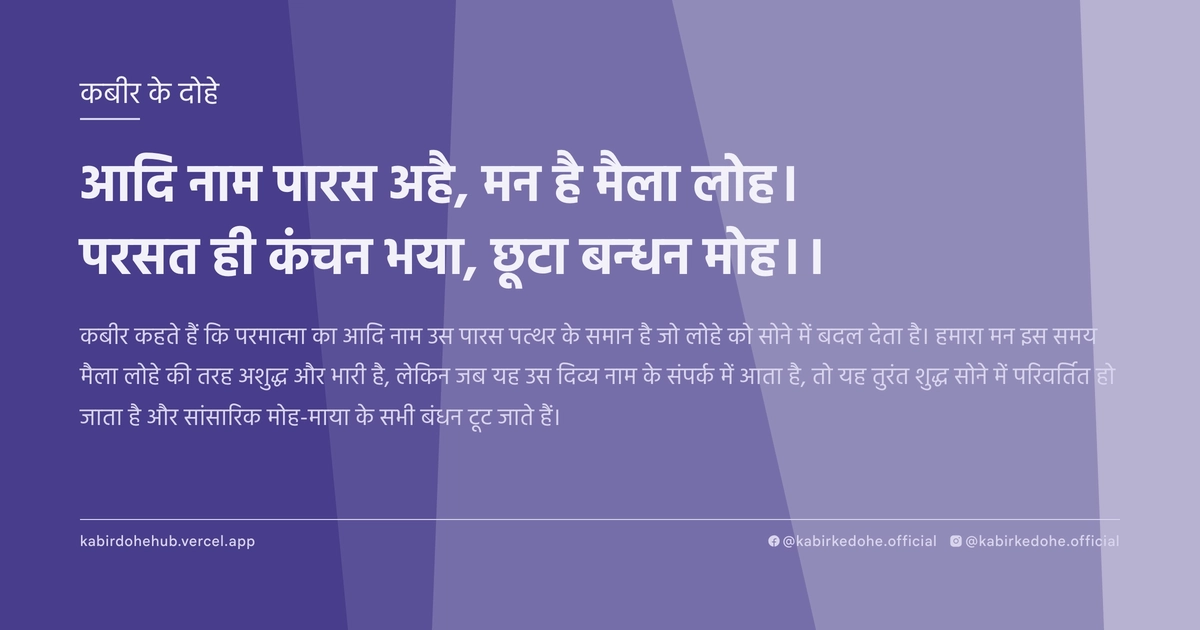
आदि नाम पारस अहै, मन है मैला लोह।
परसत ही कंचन भया, छूटा बन्धन मोह।।
Aadi naam paaras ahai, man hai maila loh. Parasat hi kanchan bhaya, chhoota bandhan moh.
इस पृष्ठ पर इस कबीर दोहे का अर्थ (meaning), हिंदी व्याख्या और अंग्रेज़ी अनुवाद, दार्शनिक विश्लेषण और व्यावहारिक जीवन सीख दी गई है। यह दोहा निर्गुण ब्रह्म (Nirguna Brahman) विषय से जुड़ा है — Kabir doha meaning and explanation in Hindi and English.
अर्थ (Meaning):
कबीर कहते हैं कि परमात्मा का आदि नाम उस पारस पत्थर के समान है जो लोहे को सोने में बदल देता है। हमारा मन इस समय मैला लोहे की तरह अशुद्ध और भारी है, लेकिन जब यह उस दिव्य नाम के संपर्क में आता है, तो यह तुरंत शुद्ध सोने में परिवर्तित हो जाता है और सांसारिक मोह-माया के सभी बंधन टूट जाते हैं।
Kabir asserts that the Primordial Name (Aadi Naam) acts as the mythical philosopher's stone (Paras), capable of transforming base metal into gold. The human mind is currently like rusted, soiled iron—heavy and impure. However, upon touching the divine vibration of the Name, the mind is transmuted into pure gold, liberating the soul from the shackles of worldly attachment and delusion.
व्याख्या (Interpretation):
यहाँ 'पारस' एक रूपक है जो आध्यात्मिक रूपांतरण की शक्ति को दर्शाता है। 'मैला लोह' मनुष्य के अहंकार, वासनाओं और अज्ञानता का प्रतीक है जो आत्मा की वास्तविक चमक को ढँक लेता है। जब साधक 'आदि नाम' यानी उस निराकार ध्वनि या शून्य का अनुभव करता है, तो द्वैत समाप्त हो जाता है। यह प्रक्रिया केवल बाहरी जाप नहीं, बल्कि आंतरिक चेतना का विलीनीकरण है। Nirgun Bhakti के अनुसार, ईश्वर किसी मूर्ति में नहीं बल्कि इस सार्वभौमिक ध्वनि में है। जैसे ही यह बोध जागता है, माया का पर्दा हट जाता है और जीव स्वयं को ब्रह्म के रूप में अनुभव करता है। इस प्रकार, बंधन का टूटना वास्तव में यह अहसास है कि जिसे हम बंधन समझ रहे थे, वह केवल एक भ्रम था।
The 'Paras' serves as a potent metaphor for the catalyst of spiritual transmutation. 'Soiled iron' represents the human ego, clouded by desires and ignorance, which obscures the soul's innate luminosity. When the seeker connects with the 'Aadi Naam'—the primordial sound or the Void—the duality between the observer and the observed dissolves. This is not mere rote recitation but a profound merging of consciousness. In the tradition of Nirgun Bhakti, the Divine is not a sculpted idol but a universal vibration. As this realization dawns, the veil of Maya is lifted, and the Atman recognizes its non-duality with Brahman. Consequently, the 'breaking of bonds' is actually the realization that the shackles were an illusion created by the ego's perceived separation from the Whole.
दार्शनिक विश्लेषण (Philosophical Analysis):
कबीर का यह दोहा मध्यकालीन भारत के उस सामाजिक-धार्मिक संघर्ष का प्रतिबिंब है जहाँ कर्मकांड और बाहरी आडंबरों का बोलबाला था। कबीर ने स्पष्ट रूप से मंदिर, मस्जिद और जातिगत श्रेष्ठता को नकारते हुए 'नाम' की आंतरिक शक्ति पर बल दिया। यह दृष्टिकोण अद्वैत वेदांत के करीब है, जहाँ यह माना जाता है कि आत्मा और परमात्मा मूलतः एक हैं, बस अज्ञानता (Avidya) के कारण हम स्वयं को अलग मानते हैं।
सूफी मत के 'जिक्र' (स्मरण) के समान, कबीर का 'नाम' वह सेतु है जो इंसान को उसकी मूल स्थिति में वापस ले जाता है। यहाँ 'लोहे का सोना बनना' कोई भौतिक परिवर्तन नहीं, बल्कि मनोवैज्ञानिक और आध्यात्मिक उत्थान है। यह अहंकार के विसर्जन (Fana) की प्रक्रिया है, जहाँ 'मैं' समाप्त होता है और केवल 'वह' शेष रहता है।
कबीर यह समझाते हैं कि धर्म ग्रंथों का रट्टा मारना या कठिन तपस्या करना व्यर्थ है यदि मन की शुद्धि नहीं हुई। पारस पत्थर की तरह, नाम का प्रभाव तात्कालिक और पूर्ण होता है, बशर्ते मन समर्पण के लिए तैयार हो। यह एक क्रांतिकारी विचार था जिसने भक्ति को पंडितों और मौलवियों के नियंत्रण से निकालकर आम आदमी के हृदय तक पहुँचाया।
दार्शनिक स्तर पर, यह दोहा 'माया' की प्रकृति पर प्रहार करता है। माया वह शक्ति है जो लोहे को लोहा दिखाती है, जबकि वह वास्तव में सोने में बदलने की क्षमता रखती है। जब नाम का स्पर्श होता है, तो दृष्टि बदल जाती है। अब संसार बंधन नहीं, बल्कि परमात्मा की लीला बन जाता है।
अंततः, यह विश्लेषण हमें बताता है कि मुक्ति कहीं बाहर से नहीं आती। मुक्ति वह स्थिति है जब हम अपनी अशुद्धियों को स्वीकार करते हैं और उन्हें उस अनंत चेतना में विलीन कर देते हैं। यह एक आंतरिक कीमिया (Alchemy) है जहाँ दुख, सुख में और अज्ञान, ज्ञान में बदल जाता है।
This couplet reflects the socio-religious friction of medieval India, where ritualism and external piety dominated. Kabir explicitly rejects the hegemony of temples, mosques, and caste hierarchies, emphasizing the internal potency of the 'Naam' (The Name). This aligns closely with Advaita Vedanta, which posits that the Atman and Brahman are fundamentally one, separated only by the veil of Avidya (ignorance).
Similar to the Sufi practice of 'Zikr' (remembrance), Kabir's 'Naam' is the bridge returning the human to their primordial state. The transformation of 'iron into gold' is not a physical miracle but a psychological and spiritual alchemy. It is the process of 'Fana'—the annihilation of the ego—where the 'I' dissolves, leaving only the Absolute.
Kabir argues that rote memorization of scriptures or grueling asceticism is futile if the heart remains impure. Like the philosopher's stone, the effect of the Name is instantaneous and total, provided the mind is surrendered. This was a revolutionary shift, democratizing spirituality by removing it from the control of the priestly class and placing it within the heart of the commoner.
On a deeper philosophical level, the verse attacks the nature of Maya. Maya is the cosmic illusion that makes the iron perceive itself as iron, hiding its potential for gold. Upon the touch of the Divine Name, the perception shifts. The world is no longer seen as a prison of bonds, but as the playful manifestation (Lila) of the Divine.
Ultimately, this analysis reveals that liberation is not an external acquisition. Liberation is the state achieved when one acknowledges their impurities and merges them into the infinite consciousness. It is an internal alchemy where suffering is transmuted into bliss and ignorance into enlightenment.
मूल संदेश (Core Message):
- अहंकार वह जंग है जो आत्मा की चमक को ढक लेता है।
- दिव्य चेतना का एक क्षणिक अनुभव जीवनभर के संघर्ष को समाप्त कर सकता है।
- बाहरी अनुष्ठानों से अधिक महत्वपूर्ण आंतरिक रूपांतरण है।
- सच्ची मुक्ति मोह के त्याग में नहीं, बल्कि मोह के पार देखने में है।
- हम सब मूलतः सोने हैं, बस अज्ञानता की परतें हमें लोहा बनाती हैं।
- Ego is the rust that obscures the innate brilliance of the soul.
- A single moment of divine consciousness can dissolve a lifetime of struggle.
- Internal transmutation is far superior to external ritualistic piety.
- True liberation is not in fleeing attachment, but in seeing through it.
- We are all fundamentally gold; only layers of ignorance make us perceive ourselves as iron.
व्यावहारिक उदाहरण (Practical Example):
एक समय की बात है, वाराणसी के घाटों पर माधव नाम का एक वृद्ध बुनकर रहता था। माधव अपनी कला में निपुण था, लेकिन उसका मन हमेशा क्रोध और कड़वाहट से भरा रहता था। वह अपने पड़ोसियों से ईर्ष्या करता और अपनी गरीबी के लिए ईश्वर को कोसता था। उसका मन वास्तव में उस 'मैले लोहे' की तरह था, जो जंग खाया हुआ और भारी था।
एक दिन उसकी मुलाकात एक घुमंतू फकीर से हुई, जिसने उसे केवल एक बात कही—'अपने भीतर की शोर को सुनो, वहीं वह नाम है जो तुम्हें बदल देगा।' माधव ने पहले तो इसे बकवास समझा, लेकिन धीरे-धीरे उसने हर सांस के साथ उस शून्य की ध्वनि को सुनने का प्रयास किया।
शुरुआत में, उसे केवल अपने पुराने घाव और शिकायतें सुनाई दीं। वह चिल्लाया, 'मैं इतना मैला हूँ कि कोई पारस मुझे नहीं बदल सकता!' लेकिन फकीर मुस्कुराया और कहा, 'लोहा जितना मैला होगा, पारस की जरूरत उतनी ही ज्यादा होगी।'
माधव ने हार नहीं मानी। उसने प्रतिदिन सुबह उठकर शांत बैठकर केवल अपनी सांसों के आने-जाने पर ध्यान केंद्रित करना शुरू किया। वह शब्दों को नहीं, बल्कि उस मौन को खोजने लगा जो शब्दों के पीछे छिपा था।
महीनों बाद, एक दिन जब वह करघे पर काम कर रहा था, उसे अचानक महसूस हुआ कि वह और उसका करघा, धागे और यह पूरा शहर एक ही लय में नाच रहे हैं। उसके भीतर का क्रोध अचानक एक गहरी करुणा में बदल गया।
उसने देखा कि जिस पड़ोसी से वह नफरत करता था, वह भी उसी तरह संघर्ष कर रहा था जैसे वह खुद। उसने पहली बार महसूस किया कि उसकी गरीबी उसके कपड़ों में नहीं, बल्कि उसकी संकीर्ण सोच में थी।
उसका मन अब भारी नहीं था; वह हल्का और चमकने लगा था। उसने अपने जीवन की सारी जमापूंजी उन लोगों की मदद में लगानी शुरू कर दी जो उससे भी अधिक बदहाल थे।
गाँव के लोग हैरान थे कि वह गुस्सैल माधव अब शांति का पर्याय बन गया है। जब उससे पूछा गया कि यह चमत्कार कैसे हुआ, तो उसने बस इतना कहा, 'मैंने लोहे को सोने में बदलने वाला पत्थर पा लिया है, जो कहीं बाहर नहीं, मेरे भीतर की शांति में था।'
माधव का जीवन अब एक बंधन नहीं, बल्कि एक उत्सव था। उसने जान लिया था कि जब अहंकार मिटता है, तो केवल प्रेम शेष रहता है।
यह 'कबीर ट्विस्ट' था—जहाँ एक व्यक्ति ने अपनी बाहरी परिस्थितियों को बदलने के बजाय अपनी आंतरिक चेतना को बदला, जिससे उसका पूरा संसार ही बदल गया।
Once, in the ghats of Varanasi, lived an elderly weaver named Madhav. Madhav was a master of his craft, but his heart was perpetually filled with anger and bitterness. He envied his neighbors and cursed God for his poverty. His mind was truly like 'soiled iron'—rusted, heavy, and dull.
One day, he encountered a wandering fakir who told him a single thing: 'Listen to the noise within you; there lies the Name that will transform you.' Initially, Madhav dismissed this as nonsense, but gradually, he began attempting to listen to the primordial vibration with every breath.
At first, he heard only his old wounds and grievances. He cried out, 'I am too soiled for any philosopher's stone to change me!' But the fakir smiled and replied, 'The more rusted the iron, the more it needs the Paras.'
Madhav persisted. Every morning, he sat in silence, focusing solely on the ebb and flow of his breath. He stopped searching for words and began seeking the silence that exists behind the words.
Months later, while working at his loom, he suddenly felt that he, the loom, the threads, and the entire city were dancing to a single, unified rhythm. His internal rage spontaneously transmuted into a profound sense of compassion.
He realized that the neighbor he had hated was struggling in the same way he had. He understood for the first time that his poverty did not reside in his clothes, but in the narrowness of his perception.
His mind was no longer heavy; it had become light and luminous. He began spending his meager savings to help those even more destitute than himself.
The villagers were astonished that the once-irascible Madhav had become a synonym for peace. When asked how this miracle happened, he simply said, 'I found the stone that turns iron to gold, and it was not outside, but in the silence within me.'
Madhav's life was no longer a series of bonds, but a celebration. He had learned that when the ego vanishes, only love remains.
This was the 'Kabir Twist'—where a man, instead of trying to change his external circumstances, changed his internal consciousness, thereby transforming his entire world.
अभ्यास मार्गदर्शन (Practice Guidance):
- दैनिक अभ्यास: प्रतिदिन 20 मिनट 'अजपा जाप' का अभ्यास करें, जहाँ आप शब्दों के बजाय सांसों की स्वाभाविक लय पर ध्यान दें।
- आत्म-पूछताछ जर्नल: प्रतिदिन लिखें कि आज किस विचार ने आपको 'लोहे' की तरह भारी महसूस कराया और उसे 'नाम' (चेतना) के प्रकाश में कैसे देखा जा सकता है।
- व्यवहार परिवर्तन: जब भी क्रोध या ईर्ष्या आए, रुकें और स्वयं से पूछें, 'यह कौन है जो क्रोध कर रहा है? क्या यह मेरी आत्मा है या मेरा अहंकार?'
- डायग्नोस्टिक चेकलिस्ट: यदि आप अभी भी दूसरों की आलोचना कर रहे हैं या अपनी पहचान को केवल पद/पैसे से जोड़ रहे हैं, तो समझें कि 'लोहा' अभी भी मैला है। यदि आप विपरीत परिस्थितियों में भी आंतरिक स्थिरता महसूस करते हैं, तो रूपांतरण शुरू हो चुका है।
- Daily Practice: Engage in 20 minutes of 'Ajapa Jap' (unuttered prayer), focusing on the natural rhythm of the breath rather than specific words.
- Self-Inquiry Journal: Record daily instances where a thought made you feel 'heavy like iron' and analyze how that thought can be transmuted through the light of pure consciousness.
- Behavioral Shift: Whenever anger or envy arises, pause and ask, 'Who is the one experiencing this anger? Is it my eternal soul or my transient ego?'
- Diagnostic Checklist: If you still find yourself criticizing others or tying your identity solely to status/wealth, recognize that the 'iron' is still soiled. If you feel an internal stillness despite external chaos, the transmutation has begun.
चिंतन प्रश्न (Reflection Questions):
- मेरे जीवन का वह 'मैला लोहा' क्या है—वह कौन सी आदत या विचार है जिसे मैं स्वीकार करने से डरता हूँ?
- मैं अपनी सार्वजनिक छवि (Digital/Social Ego) को बनाए रखने के लिए कितनी ऊर्जा व्यर्थ करता हूँ?
- क्या मैं वास्तव में शांति चाहता हूँ, या मैं केवल अपनी इच्छाओं की पूर्ति के बाद मिलने वाले सुख को शांति समझ रहा हूँ?
- यदि आज मेरा सारा सामाजिक दर्जा और संपत्ति छीन ली जाए, तो मेरे भीतर क्या बचेगा?
- मेरे भीतर का वह कौन सा हिस्सा है जो अभी भी दूसरों को 'छोटा' या 'नीचा' महसूस कराता है?
- क्या मैं 'नाम' का उपयोग एक हथियार की तरह कर रहा हूँ या एक दर्पण की तरह?
- What is the 'soiled iron' in my life—which habit or thought am I most afraid to acknowledge?
- How much energy do I waste maintaining my public persona (Digital/Social Ego)?
- Do I truly seek peace, or am I mistaking the satisfaction of fulfilled desires for peace?
- If all my social status and wealth were stripped away today, what would remain within me?
- Which part of me still feels the need to perceive others as 'lesser' or 'inferior'?
- Am I using the 'Name' (spirituality) as a weapon of superiority or as a mirror for self-correction?