
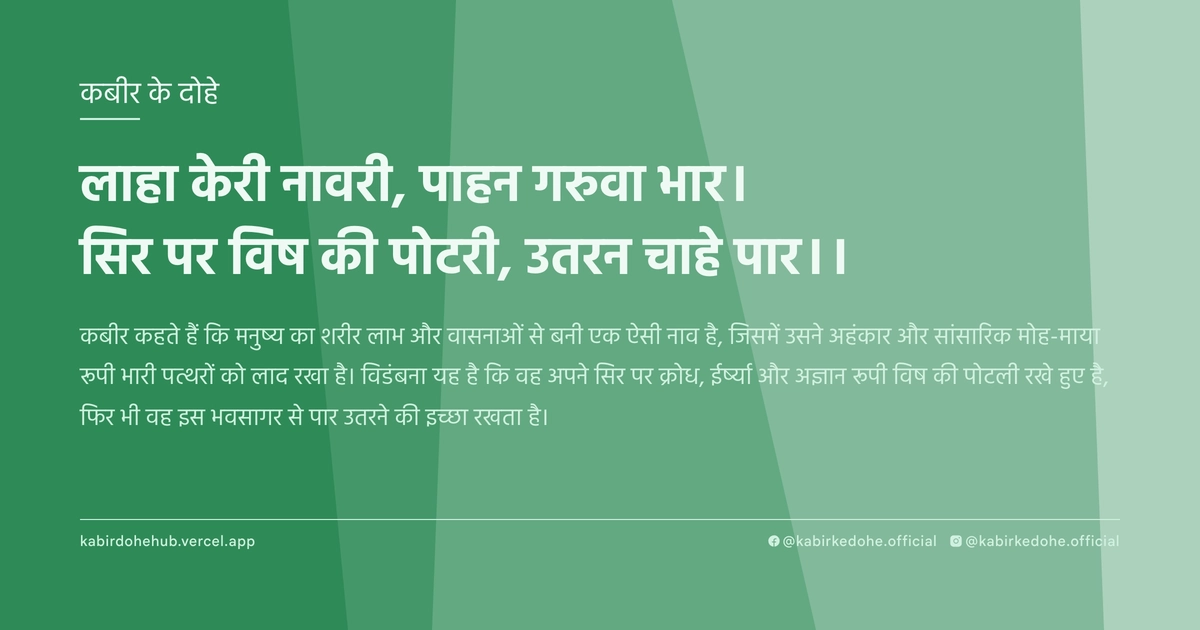
लाहा केरी नावरी, पाहन गरुवा भार।
सिर पर विष की पोटरी, उतरन चाहे पार।।
Laha keri navri, pahan garuva bhar. Sir par vish ki potri, utran chahe paar.
इस पृष्ठ पर इस कबीर दोहे का अर्थ (meaning), हिंदी व्याख्या और अंग्रेज़ी अनुवाद, दार्शनिक विश्लेषण और व्यावहारिक जीवन सीख दी गई है। यह दोहा मोह (Attachment) विषय से जुड़ा है — Kabir doha meaning and explanation in Hindi and English.
अर्थ (Meaning):
कबीर कहते हैं कि मनुष्य का शरीर लाभ और वासनाओं से बनी एक ऐसी नाव है, जिसमें उसने अहंकार और सांसारिक मोह-माया रूपी भारी पत्थरों को लाद रखा है। विडंबना यह है कि वह अपने सिर पर क्रोध, ईर्ष्या और अज्ञान रूपी विष की पोटली रखे हुए है, फिर भी वह इस भवसागर से पार उतरने की इच्छा रखता है।
Kabir describes the human existence as a fragile boat crafted from desires and worldly gains, yet heavily laden with the crushing weight of ego and material attachments. Paradoxically, the seeker carries a bundle of poison—representing anger, greed, and ignorance—upon their head, while desperately longing to cross the turbulent ocean of worldly existence to reach the shore of liberation.
व्याख्या (Interpretation):
यहाँ 'लाहा' का अर्थ सांसारिक लाभ और 'नावरी' का अर्थ नाव है। कबीर एक गहरे विरोधाभास को दर्शाते हैं: हम मोक्ष चाहते हैं, लेकिन उन चीजों को पकड़े हुए हैं जो हमें डुबो रही हैं। पाहन (पत्थर) हमारे संचित कर्म और अहंकार हैं जो आत्मा की हल्कापन को समाप्त कर देते हैं। 'विष की पोटरी' हमारे मानसिक विकारों का प्रतीक है। यह निरगुण भक्ति का संदेश है कि जब तक आंतरिक शुद्धि नहीं होती और 'मैं' का विसर्जन नहीं होता, तब तक परमात्मा का मिलन असंभव है। यह अद्वैत वेदांत के उस सत्य को उजागर करता है जहाँ माया हमें यह विश्वास दिलाती है कि हम अलग हैं, जबकि हम वास्तव में ब्रह्म का हिस्सा हैं।
The 'boat' symbolizes the physical and psychic vehicle of the human ego, constructed from the pursuit of transient gains. The 'heavy stones' represent the accumulated karmas and the rigid identity of the 'I', which prevents the soul from floating toward divinity. The 'bundle of poison' is a potent metaphor for the latent psychological toxins—hatred, pride, and delusion—that the seeker unconsciously carries. In the context of Nirgun Bhakti, this illustrates the central paradox: the desire for liberation (Mukti) is contradicted by the refusal to let go of the ego. It aligns with Advaita Vedanta by showing how Maya creates a false sense of burden, masking the inherent lightness of the Atman.
दार्शनिक विश्लेषण (Philosophical Analysis):
कबीर का यह दोहा 15वीं शताब्दी के सामाजिक और धार्मिक पाखंड पर एक तीखा प्रहार है। उस समय लोग बाहरी कर्मकांडों, तीर्थयात्राओं और कठिन व्रतों के माध्यम से मोक्ष पाने की कोशिश कर रहे थे, जबकि उनके भीतर जातिगत श्रेष्ठता और घृणा का विष भरा था। कबीर तर्क देते हैं कि बाहरी अनुष्ठान उस नाव में और पत्थर जोड़ने जैसा है, जो अंततः उसे डुबो देगा।
दार्शनिक स्तर पर, यह सूफी मत के 'नफ्स' (अहंकार) के विनाश और अद्वैत के 'माया' विलोपन से जुड़ा है। जब तक साधक यह नहीं समझता कि वह स्वयं ही वह बोझ है जिसे वह ढो रहा है, तब तक पार उतरना असंभव है। यह मनोवैज्ञानिक रूपांतरण की मांग करता है जहाँ व्यक्ति अपनी पहचान को बाहरी उपलब्धियों से हटाकर आंतरिक शून्य में विलीन करे।
कबीर यहाँ 'विष' को केवल क्रोध नहीं, बल्कि उस अज्ञान को मानते हैं जो हमें यह सोचने पर मजबूर करता है कि हम शरीर हैं। यह शरीर-चेतना ही वह सबसे भारी पत्थर है। जब यह बोध होता है कि आत्मा अजर-अमर और निराकार है, तब यह बोझ स्वतः गिर जाता है।
यह दोहा ritualism (कर्मकांड) की निरर्थकता को सिद्ध करता है। यदि हृदय में करुणा नहीं है और बुद्धि में स्पष्टता नहीं है, तो मंदिर या मस्जिद जाना केवल एक मानसिक भ्रम है। वास्तविक तीर्थ अंतर्मन की यात्रा है।
अंततः, यह संदेश देता है कि मोक्ष कोई बाहरी गंतव्य नहीं है जहाँ पहुँचा जाता है, बल्कि यह उन बोझों का त्याग है जिन्हें हमने अनावश्यक रूप से ओढ़ा हुआ है। मुक्ति 'पाने' की वस्तु नहीं, बल्कि 'छोड़ने' की प्रक्रिया है।
Kabir's couplet serves as a scathing critique of the 15th-century socio-religious landscape, where spiritual liberation was sought through external rituals, pilgrimages, and rigid caste hierarchies. He posits that these superficial acts are merely adding more 'stones' to an already sinking boat, failing to address the internal toxicity of the practitioner.
Philosophically, this resonates with the Sufi concept of 'Fana' (annihilation of the self) and the Advaita Vedantic dissolution of Maya. The 'poison' is the egoic identity—the false belief that the individual is separate from the Universal Consciousness. Kabir argues that psychological transformation must precede spiritual attainment; one cannot reach the shore of Truth while clinging to the anchors of delusion.
He challenges the literalist interpretation of salvation as a destination. Instead, he presents it as a process of subtraction. The 'burden' is not just sin in a moral sense, but the cognitive error of identifying with the transient body and its desires. This is the ultimate 'poison' that blinds the seeker to their own inherent divinity.
By rejecting the efficacy of ritualism, Kabir aligns himself with the radical edge of the Bhakti movement, emphasizing 'Sahaja' or the natural state of being. He suggests that the struggle to 'cross over' is itself a product of the ego, which creates a duality between the seeker and the sought.
Ultimately, the analysis reveals that the 'boat' and the 'stones' are one and the same—the construct of the human mind. The realization that there is no separate 'crosser' and no separate 'shore' is the only way to truly transcend the cycle of birth and death.
मूल संदेश (Core Message):
- बाहरी दिखावा आध्यात्मिक प्रगति का प्रमाण नहीं है।
- अहंकार वह सबसे भारी बोझ है जो आत्मा को डुबो देता है।
- क्रोध और ईर्ष्या आंतरिक विष हैं जो मोक्ष के मार्ग को अवरुद्ध करते हैं।
- सच्ची भक्ति कर्मकांडों में नहीं, बल्कि हृदय की शुद्धि में है।
- मुक्ति कुछ पाने का नाम नहीं, बल्कि अनावश्यक को छोड़ने का नाम है।
- External piety is not a metric for spiritual evolution.
- The ego is the heaviest anchor that sinks the soul.
- Anger and envy are internal toxins blocking the path to liberation.
- True devotion lies in the purification of the heart, not in rituals.
- Liberation is not about acquisition, but about the art of letting go.
व्यावहारिक उदाहरण (Practical Example):
वाराणसी के एक पुराने घाट पर माधव नाम का एक वृद्ध नाविक रहता था। माधव का जीवन केवल नाव चलाने और यात्रियों को पार उतारने में बीता था। वह खुद को बहुत धार्मिक मानता था क्योंकि वह हर सुबह गंगा में डुबकी लगाता और घंटों मंदिर में बैठता। लेकिन उसका स्वभाव अत्यंत क्रोधी था। वह अपने परिवार से नफरत करता था और अपने साथी नाविकों को नीचा दिखाने का कोई मौका नहीं छोड़ता था।
एक दिन एक फकीर उसकी नाव पर सवार हुआ। माधव ने गर्व से अपनी धार्मिकता और अपनी नाव की मजबूती के बारे में बताया। फकीर ने मुस्कुराते हुए कहा, "माधव, तुम्हारी नाव तो मजबूत है, लेकिन तुमने अपने मन की नाव में इतना जहर भर रखा है कि वह कभी किनारे नहीं लग पाएगी।"
माधव को यह बात चुभी। उसने पूछा, "जहर कैसा? मैं तो रोज पूजा करता हूँ!"
फकीर ने जवाब दिया, "तुम्हारी पूजा बाहरी है। तुम्हारे भीतर की ईर्ष्या और क्रोध वह विष है जिसे तुम अपने सिर पर ढो रहे हो। तुम गंगा में शरीर धोते हो, लेकिन आत्मा पर जमी गंदगी को नहीं देखते। तुम दूसरों को पार उतारते हो, लेकिन खुद बोझ तले दबे हो।"
माधव को पहली बार महसूस हुआ कि उसकी धार्मिकता केवल एक मुखौटा थी। उसने देखा कि कैसे उसका क्रोध उसके रिश्तों को जला चुका था और उसकी शांति को छीन लिया था। वह समझ गया कि मंदिर जाना आसान है, लेकिन अपने भीतर के अहंकार को मारना कठिन है।
अगले कुछ महीनों तक माधव ने एक नया प्रयोग किया। जब भी उसे किसी पर गुस्सा आता, वह चुपचाप अपनी नाव के एक पत्थर को पानी में फेंकने की कल्पना करता। उसने धीरे-धीरे लोगों को क्षमा करना शुरू किया और अपनी श्रेष्ठता के भाव को त्याग दिया।
उसने पाया कि जैसे-जैसे उसके मन का 'विष' कम हुआ, उसकी नाव चलाने की गति और उसका मानसिक सुकून बढ़ गया। अब वह केवल यात्रियों को शारीरिक रूप से पार नहीं उतारता था, बल्कि अपनी बातों से उन्हें मानसिक शांति भी देता था।
माधव की कहानी यह सिखाती है कि वास्तविक मोक्ष बाहरी यात्राओं में नहीं, बल्कि आंतरिक बोझों को उतारने में है। जब उसने अपने अहंकार का पत्थर फेंका, तब वह वास्तव में 'पार' हुआ।
On the ancient ghats of Varanasi lived an elderly boatman named Madhav. Madhav spent his entire life ferrying pilgrims across the river. He considered himself deeply pious, spending hours in temples and performing ritual ablutions in the Ganges every dawn. However, his inner world was a storm of bitterness; he harbored deep resentment toward his kin and took every opportunity to belittle his fellow boatmen.
One afternoon, a wandering mystic boarded his boat. Madhav, with a hint of arrogance, boasted about his spiritual discipline and the sturdiness of his vessel. The mystic smiled and remarked, "Madhav, your wooden boat is strong, but the boat of your soul is laden with such poison that it will never reach the shore."
Stung by the comment, Madhav retorted, "What poison? I am a devotee! I follow every rite!"
The mystic replied, "Your devotion is a garment you wear. The poison is the jealousy and rage you carry in your heart. You wash your skin in the river, but you ignore the filth on your soul. You help others cross the water, yet you are drowning under the weight of your own ego."
For the first time, Madhav realized that his religiosity was merely a facade. He saw how his anger had incinerated his relationships and robbed him of true peace. He understood that visiting a temple is easy, but slaying the ego within is the true struggle.
Over the following months, Madhav began a conscious practice. Whenever a surge of anger rose, he would visualize himself casting a heavy stone from his mental boat into the depths of the river. He started practicing forgiveness and ceased his attempts to prove his superiority.
He discovered that as the 'poison' of his mind dissipated, his physical work became lighter and his mind grew serene. He no longer just ferried passengers across the river; he became a source of solace for those in distress.
Madhav's transformation illustrates that true liberation is not found in external journeys, but in the shedding of internal burdens. Only when he cast away the stone of ego did he truly 'cross over'.
अभ्यास मार्गदर्शन (Practice Guidance):
- प्रतिदिन 20 मिनट मौन ध्यान करें और विचार करें कि आपके कौन से विचार 'पत्थर' (बोझ) की तरह हैं जो आपको मानसिक रूप से थका रहे हैं।
- एक 'भावनात्मक डायरी' लिखें: दिन भर में जब भी क्रोध या ईर्ष्या महसूस हो, उसे लिखें और विश्लेषण करें कि यह किस अहंकार से उपजा है।
- व्यवहार परिवर्तन: किसी ऐसे व्यक्ति की मदद करें जिसे आप नापसंद करते हैं, बिना यह उम्मीद किए कि वे आपको धन्यवाद देंगे।
- निदान चेकलिस्ट: क्या मैं दूसरों की गलती पर तुरंत प्रतिक्रिया देता हूँ? क्या मेरी खुशी दूसरों की विफलता पर टिकी है? क्या मैं अपनी धार्मिकता का उपयोग दूसरों को छोटा दिखाने के लिए करता हूँ? (यदि हाँ, तो आप अभी भी विष की पोटली ढो रहे हैं।)
- Engage in 20 minutes of silent meditation daily, observing which thoughts act as 'stones' (burdens) that drain your mental energy.
- Maintain an 'Emotional Inventory' journal: Record every instance of anger or envy and analyze the specific ego-attachment that triggered it.
- Behavioral Shift: Perform a selfless act of service for someone you personally dislike, without expecting any recognition or gratitude.
- Diagnostic Checklist: Do I react impulsively to others' mistakes? Is my sense of superiority tied to my rituals or knowledge? Do I feel a hidden need to be 'right' in every conflict? (If yes, the bundle of poison is still present.)
चिंतन प्रश्न (Reflection Questions):
- मेरी वह कौन सी 'धार्मिक' या 'नैतिक' पहचान है जिसका उपयोग मैं दूसरों को छोटा महसूस कराने के लिए करता हूँ?
- यदि आज मेरी सारी सामाजिक प्रतिष्ठा और उपलब्धियाँ छीन ली जाएँ, तो मेरे भीतर क्या बचेगा?
- मैं किन यादों और शिकायतों को 'विष की पोटली' की तरह ढो रहा हूँ, यह जानते हुए भी कि वे मुझे नुकसान पहुँचा रही हैं?
- क्या मेरी आध्यात्मिक खोज वास्तव में सत्य को जानने के लिए है, या यह केवल मेरे अहंकार को संतुष्ट करने का एक नया तरीका है?
- मेरे जीवन का वह कौन सा 'पत्थर' है जिसे मैं सबसे ज्यादा पकड़े हुए हूँ, और उसे छोड़ने का डर क्या है?
- Which 'religious' or 'moral' identity do I use as a weapon to make others feel inferior?
- If all my social status and achievements were stripped away today, what would remain of my core self?
- What grievances and memories am I carrying as a 'bundle of poison', despite knowing they only harm me?
- Is my spiritual quest a genuine search for Truth, or just a sophisticated way to feed my ego?
- What is the heaviest 'stone' I am clinging to in my life, and what is the specific fear preventing me from letting it go?