
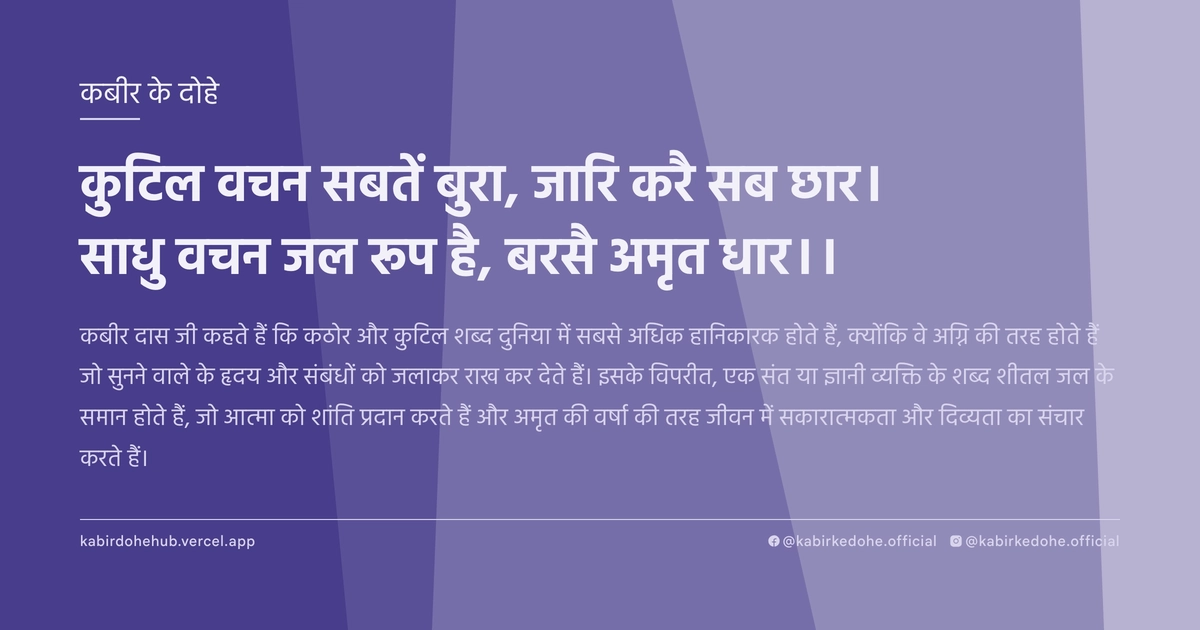
कुटिल वचन सबतें बुरा, जारि करै सब छार।
साधु वचन जल रूप है, बरसै अमृत धार।।
Kutil vachan sabten bura, jaari karai sab chhaar. Sadhu vachan jal roop hai, barsai amrit dhaar.
इस पृष्ठ पर इस कबीर दोहे का अर्थ (meaning), हिंदी व्याख्या और अंग्रेज़ी अनुवाद, दार्शनिक विश्लेषण और व्यावहारिक जीवन सीख दी गई है। यह दोहा विनम्रता (Humility) विषय से जुड़ा है — Kabir doha meaning and explanation in Hindi and English.
अर्थ (Meaning):
कबीर दास जी कहते हैं कि कठोर और कुटिल शब्द दुनिया में सबसे अधिक हानिकारक होते हैं, क्योंकि वे अग्नि की तरह होते हैं जो सुनने वाले के हृदय और संबंधों को जलाकर राख कर देते हैं। इसके विपरीत, एक संत या ज्ञानी व्यक्ति के शब्द शीतल जल के समान होते हैं, जो आत्मा को शांति प्रदान करते हैं और अमृत की वर्षा की तरह जीवन में सकारात्मकता और दिव्यता का संचार करते हैं।
Kabir explains that harsh and crooked words are the most destructive force in existence, acting like a fire that incinerates the heart and reduces relationships to ashes. Conversely, the words of a realized soul or a saint are like cooling water, providing solace to the tormented spirit and raining down a nectar of immortality and peace that rejuvenates the inner being.
व्याख्या (Interpretation):
इस दोहे का शाब्दिक अर्थ वाणी के प्रभाव पर केंद्रित है, लेकिन इसका आध्यात्मिक निहितार्थ गहरा है। 'कुटिल वचन' केवल शब्दों की कठोरता नहीं, बल्कि अहंकार (Ahamkara) का प्रकटीकरण हैं, जो माया के प्रभाव में व्यक्ति को दूसरों से अलग करता है। जब हम क्रोध या ईर्ष्या में बोलते हैं, तो हम वास्तव में अपनी ही चेतना को जला रहे होते हैं। 'साधु वचन' यहाँ केवल किसी बाहरी संत के शब्द नहीं, बल्कि उस 'साक्षी भाव' (Witness Consciousness) की अभिव्यक्ति हैं जो द्वैत से परे है। यह निर्गुण भक्ति का मार्ग है जहाँ शब्द केवल सूचना नहीं, बल्कि एक आध्यात्मिक उपकरण बन जाते हैं। यहाँ जल और अमृत का प्रतीक उस अद्वैत सत्य को दर्शाता है जहाँ आत्मा और परमात्मा एक हो जाते हैं, और वाणी केवल उस एकता का प्रतिबिंब बनती है। यह विरोधाभास है कि शब्द, जो अक्सर विभाजन पैदा करते हैं, वही मुक्ति का मार्ग भी प्रशस्त कर सकते हैं यदि वे अहंकार शून्य हों।
While the literal meaning focuses on the impact of speech, the spiritual implication is profound. 'Kutil vachan' (crooked words) are not merely harsh sounds but manifestations of the Ego (Ahamkara), driven by Maya, which creates a sense of separation. When we speak in anger or jealousy, we are effectively incinerating our own consciousness. 'Sadhu vachan' (words of the saint) refers not just to an external teacher, but to the expression of the 'Witness Consciousness' (Sakshi) that transcends duality. This aligns with Nirgun Bhakti, where words cease to be mere information and become spiritual instruments. The symbols of water and nectar represent the Advaita truth where the Atman and Brahman merge, and speech becomes a reflection of that unity. It presents the paradox that language, which often divides, can become the vehicle for liberation if it is stripped of the ego.
दार्शनिक विश्लेषण (Philosophical Analysis):
कबीर का यह दोहा उस सामाजिक और धार्मिक परिवेश में लिखा गया था जहाँ कर्मकांड और बाहरी आडंबरों का बोलबाला था। कबीर ने देखा कि लोग मंदिर-मस्जिद में तो विनम्रता का ढोंग करते हैं, लेकिन उनके व्यवहार और वाणी में घृणा और जातिगत श्रेष्ठता का जहर भरा होता है। उन्होंने इस पाखंड को चुनौती दी और बताया कि वास्तविक धर्म बाहरी अनुष्ठानों में नहीं, बल्कि वाणी की पवित्रता और हृदय की करुणा में है।
दार्शनिक रूप से, यह दोहा अद्वैत वेदांत के इस सिद्धांत से जुड़ा है कि हम सब एक ही चेतना के अंश हैं। यदि मैं किसी को कुटिल शब्द कहता हूँ, तो मैं वास्तव में स्वयं को ही चोट पहुँचा रहा हूँ क्योंकि दूसरा व्यक्ति मुझसे अलग नहीं है। यह सूफीवाद के 'इश्क-ए-हकीकी' (ईश्वरीय प्रेम) के समान है, जहाँ प्रेम ही एकमात्र सत्य है और कठोरता उस सत्य का अभाव है।
यहाँ 'जारि करै सब छार' (राख करना) मनोवैज्ञानिक विनाश का संकेत है। क्रोधित वाणी केवल सुनने वाले को ही नहीं, बल्कि बोलने वाले के मानसिक संतुलन और आध्यात्मिक प्रगति को भी नष्ट कर देती है। यह अहंकार का वह स्तर है जहाँ व्यक्ति स्वयं को कर्ता मानता है और दूसरों को वस्तु, जिससे उसकी आध्यात्मिक यात्रा अवरुद्ध हो जाती है।
कबीर यहाँ वाणी को एक 'तपस्या' के रूप में प्रस्तुत करते हैं। उनके लिए मौन और मीठी वाणी का अभ्यास केवल शिष्टाचार नहीं, बल्कि एक साधना है। जब वाणी से अहंकार हट जाता है, तब वह 'अमृत' बन जाती है, जिसका अर्थ है कि वह अब सत्य (Satya) का वाहक है।
अंततः, यह विश्लेषण हमें यह समझने पर मजबूर करता है कि शब्दों की शक्ति भौतिक हथियारों से अधिक है। यह दोहा हमें यह सिखाता है कि आध्यात्मिक जागृति का पहला लक्षण हमारी भाषा में परिवर्तन है। यदि हम ईश्वर को खोज रहे हैं, तो हमें पहले अपनी वाणी को उस ईश्वर की करुणा के अनुरूप ढालना होगा।
This couplet was composed in a socio-religious climate dominated by rigid rituals and outward displays of piety. Kabir observed a stark contradiction: people performed rituals of humility in temples and mosques, yet their speech was laced with hatred and caste-based superiority. He challenged this hypocrisy, asserting that true religion resides not in external rites, but in the purity of speech and the compassion of the heart.
Philosophically, this aligns with the Advaita Vedanta principle that we are all fragments of a single universal consciousness. If I utter crooked words to another, I am effectively harming myself, for the 'other' is an illusion of duality. This mirrors the Sufi concept of 'Ishq-e-Haqiqi' (Divine Love), where love is the only ultimate reality and harshness is a symptom of spiritual ignorance.
The phrase 'jaari karai sab chhaar' (reducing to ashes) signifies psychological and spiritual annihilation. Harsh speech does not only wound the listener but erodes the speaker's mental equilibrium and spiritual ascent. It represents the peak of the ego, where the individual perceives themselves as the 'doer' and others as 'objects,' thereby blocking their own path to liberation.
Kabir presents the mastery of speech as a form of 'Tapasya' (austerity). For him, practicing silence and kindness is not mere etiquette but a rigorous spiritual discipline. When the ego is purged from speech, it becomes 'Amrit' (nectar), meaning it now carries the vibration of Truth (Satya).
Ultimately, this analysis reveals that the power of words exceeds that of physical weapons. The couplet teaches us that the first sign of spiritual awakening is a transformation in our language. If we seek the Divine, we must first mold our speech to reflect the compassion of that Divine presence.
मूल संदेश (Core Message):
- अहंकार की वाणी विनाशकारी अग्नि है।
- करुणा से भरे शब्द आत्मा का उपचार हैं।
- वाणी की पवित्रता ही वास्तविक धर्म है।
- शब्दों का चयन हमारे आंतरिक स्तर को दर्शाता है।
- अमृत समान वाणी अद्वैत सत्य का प्रतिबिंब है।
- Speech driven by ego is a destructive fire.
- Words infused with compassion heal the soul.
- Purity of speech is the only true religion.
- Our choice of words reflects our spiritual level.
- Nectar-like speech reflects the truth of non-duality.
व्यावहारिक उदाहरण (Practical Example):
एक समय की बात है, राजस्थान के एक छोटे से गाँव में रामू नाम का एक किसान रहता था। रामू बहुत मेहनती था, लेकिन उसका स्वभाव अत्यंत क्रोधी था। उसकी वाणी इतनी कठोर थी कि गाँव का कोई भी व्यक्ति उससे बात करने से कतराता था। वह अक्सर अपने बच्चों और पत्नी पर चिल्लाता और मामूली बात पर पड़ोसियों को अपशब्द कहता। उसके घर में तनाव का माहौल रहता था और वह अकेलापन महसूस करता था, फिर भी उसका क्रोध कम नहीं होता था।
एक दिन गाँव में एक वृद्ध फकीर आए। रामू उनके पास गया और अपनी मानसिक अशांति का कारण पूछा। फकीर ने रामू को एक प्रयोग करने को कहा। उन्होंने रामू को एक छोटा सा मिट्टी का घड़ा दिया और कहा, 'जब भी तुम्हें गुस्सा आए, इस घड़े में एक मुट्ठी सूखी राख डाल देना और यह सोचना कि यह राख तुम्हारे उन शब्दों की है जिन्होंने दूसरों को जलाया है।'
शुरुआत में रामू को यह अजीब लगा, लेकिन उसने ऐसा ही किया। जैसे-जैसे घड़ा राख से भरने लगा, रामू को अहसास हुआ कि उसने अपने जीवन में कितने लोगों के दिलों को अपनी कड़वाहट से जलाया है। वह घड़ा अब उसके अपने भीतर की कड़वाहट का भौतिक प्रमाण बन गया था। उसे महसूस हुआ कि जिस आग से वह दूसरों को जला रहा था, उसने वास्तव में उसके अपने जीवन की शांति को राख कर दिया था।
एक शाम, जब वह अपने बेटे को डांटने ही वाला था, उसकी नज़र उस राख भरे घड़े पर पड़ी। उसे अचानक कबीर का वह विचार याद आया कि कुटिल वचन सब कुछ जला देते हैं। उसने महसूस किया कि उसका क्रोध वास्तव में उसकी अपनी असुरक्षा और अहंकार का मुखौटा था। उसने पहली बार अपने बेटे के कंधे पर हाथ रखा और उसे डांटने के बजाय प्यार से समझाया।
उस रात रामू को एक अजीब सी शांति महसूस हुई। उसने देखा कि जब उसने अपनी वाणी बदली, तो उसके परिवार के सदस्यों का व्यवहार भी बदलने लगा। उसकी पत्नी, जो अब तक उससे डरकर बात करती थी, अब उसके साथ खुलकर हंसने लगी। गाँव के लोग, जो उससे दूर भागते थे, अब उसके पास सलाह लेने आने लगे।
रामू ने समझा कि 'अमृत धार' कोई जादुई शक्ति नहीं है, बल्कि यह केवल प्रेम और करुणा से भरे शब्द हैं। उसने अपने जीवन का शेष समय दूसरों की मदद करने और मधुर वाणी बोलने में बिताया।
उसका परिवर्तन केवल व्यवहारिक नहीं था, बल्कि आध्यात्मिक था। उसने जाना कि जब हम दूसरों के प्रति दयालु होते हैं, तो हम वास्तव में अपनी आत्मा को शांत कर रहे होते हैं।
रामू की कहानी यह सिखाती है कि वाणी का परिवर्तन हृदय का परिवर्तन है। जब हम शब्दों के जहर को अमृत में बदलते हैं, तो हमारा पूरा संसार बदल जाता है।
Once, in a small village in Rajasthan, lived a farmer named Ramu. Ramu was hardworking, but he possessed an incredibly volatile temper. His speech was so harsh that the villagers avoided him. He frequently shouted at his children and wife, and used caustic language with his neighbors over the smallest disputes. His home was a place of tension, and though he felt profoundly lonely, his anger only intensified.
One day, an elderly wandering dervish arrived in the village. Ramu approached him, seeking a cure for his inner turmoil. The dervish gave Ramu a small clay pot and instructed him: 'Whenever you feel anger rising, put a handful of dry ash into this pot, and realize that this ash represents the words you have used to burn others.'
At first, Ramu found this strange, but he complied. As the pot filled with ash, Ramu began to realize how many hearts he had incinerated with his bitterness. The pot became a physical manifestation of the toxicity within him. He realized that the fire he used to scorch others had, in reality, turned his own peace into ash.
One evening, just as he was about to scream at his son, his eyes fell upon the ash-filled pot. He suddenly recalled the wisdom that crooked words destroy everything. He realized that his anger was merely a mask for his own insecurities and ego.
For the first time, instead of shouting, he placed a gentle hand on his son's shoulder and spoke with kindness. That night, Ramu experienced a strange, cooling peace. He noticed that as he changed his speech, the behavior of those around him shifted. His wife, who had lived in fear, began to laugh with him again. The villagers, who once shunned him, now sought his counsel.
Ramu understood that the 'stream of nectar' is not a magical power, but simply words infused with love and compassion. He spent the rest of his days helping others and speaking with sweetness.
His transformation was not merely behavioral, but spiritual. He learned that by being kind to others, he was actually soothing his own soul.
Ramu's story teaches us that the transformation of speech is the transformation of the heart. When we turn the poison of words into nectar, our entire world transforms.
अभ्यास मार्गदर्शन (Practice Guidance):
- दैनिक अभ्यास: दिन भर में बोले गए अपने शब्दों का 'सचेत अवलोकन' करें। यदि कोई शब्द कठोर निकला हो, तो उसे मानसिक रूप से वापस लें और क्षमा मांगें।
- आत्म-पूछताछ जर्नल: हर रात लिखें कि आज किस परिस्थिति में आपका अहंकार आपकी वाणी के माध्यम से बाहर आया और उस समय आपके भीतर कौन सा डर या असुरक्षा काम कर रही थी।
- व्यवहार परिवर्तन: 'तीन-सेकंड नियम' अपनाएं। किसी भी प्रतिक्रियात्मक उत्तर को देने से पहले तीन सेकंड रुकें और सोचें: 'क्या यह शब्द अमृत है या अग्नि?'
- नैदानिक चेकलिस्ट (Diagnostic Checklist): यदि आप निम्नलिखित अनुभव कर रहे हैं, तो आप इस ज्ञान को लागू करने में विफल हो रहे हैं: 1. दूसरों की गलती पर तुरंत प्रतिक्रिया देना। 2. बातचीत के बाद अपराधबोध महसूस करना। 3. यह सोचना कि 'मैं तो सच बोल रहा हूँ' जबकि आपका उद्देश्य केवल दूसरे को नीचा दिखाना है।
- Daily Practice: Perform 'Conscious Observation' of your speech throughout the day. If a word escapes that is harsh, mentally retract it and seek forgiveness from the inner self.
- Self-Inquiry Journal: Every night, record instances where your ego manifested through your speech. Analyze the underlying fear or insecurity that triggered the reaction.
- Behavioral Shift: Adopt the 'Three-Second Rule.' Before giving any reactive response, pause for three seconds and ask: 'Is this word nectar or fire?'
- Diagnostic Checklist: You are failing to live this wisdom if: 1. You react instantly to others' mistakes. 2. You feel a lingering sense of guilt after conversations. 3. You justify harshness by claiming 'I am just telling the truth' while your intent is to belittle.
चिंतन प्रश्न (Reflection Questions):
- क्या मेरी 'सच्चाई' वास्तव में सत्य है, या यह केवल मेरे अहंकार को संतुष्ट करने का एक तरीका है?
- जब मैं दूसरों की आलोचना करता हूँ, तो मैं वास्तव में उनके किस गुण को देख रहा हूँ जो मेरे अपने भीतर दबा हुआ है?
- मेरी डिजिटल पहचान (सोशल मीडिया) पर मेरी वाणी कितनी 'अमृत' है और कितनी 'कुटिल'?
- क्या मैं उन लोगों के प्रति भी मधुर हूँ जिनसे मुझे कोई लाभ नहीं मिलने वाला?
- मेरे शब्दों ने आज कितने लोगों के भीतर की शांति को नष्ट किया या उसे पुनर्जीवित किया?
- Is my 'honesty' truly about the truth, or is it just a tool to satisfy my ego?
- When I criticize others, which hidden trait within myself am I actually reacting to?
- How 'nectar-like' or 'crooked' is my speech within my digital identity and social media presence?
- Am I kind to those from whom I have absolutely nothing to gain?
- How many people's inner peace did my words destroy or revive today?