
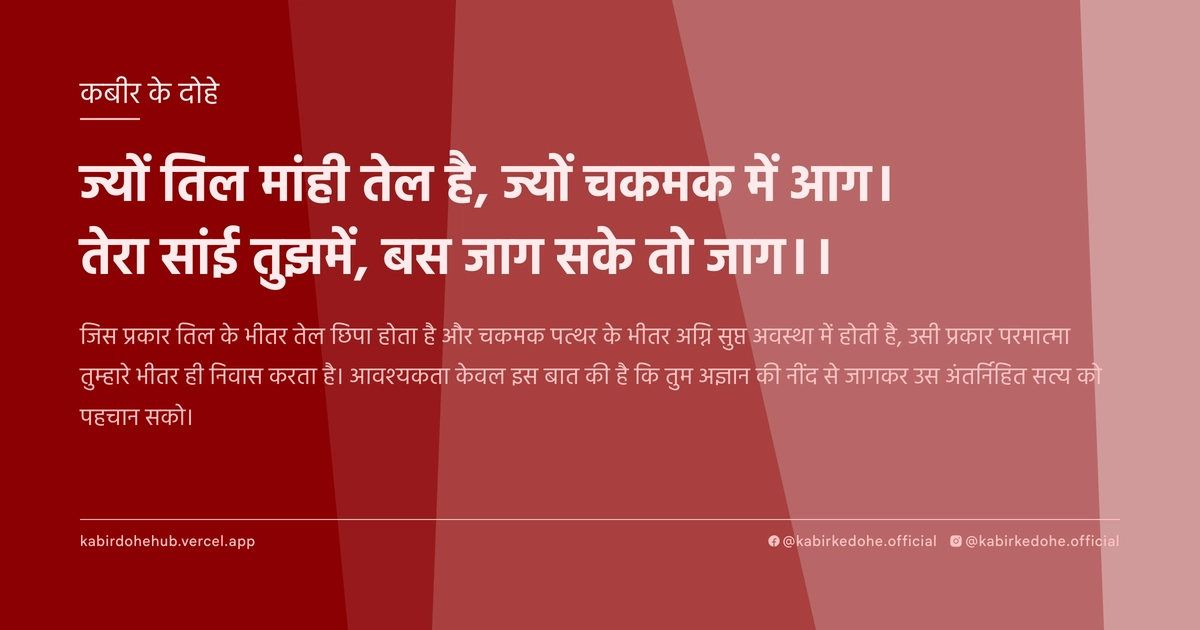
ज्यों तिल मांही तेल है, ज्यों चकमक में आग।
तेरा सांई तुझमें, बस जाग सके तो जाग।।
Jyon til maahi tel hai, jyon chakmak mein aag. Tera saai tujhme, bas jaag sake to jaag.
इस पृष्ठ पर इस कबीर दोहे का अर्थ (meaning), हिंदी व्याख्या और अंग्रेज़ी अनुवाद, दार्शनिक विश्लेषण और व्यावहारिक जीवन सीख दी गई है। यह दोहा अंतर ज्योति (The Inner Light) विषय से जुड़ा है — Kabir doha meaning and explanation in Hindi and English.
अर्थ (Meaning):
जिस प्रकार तिल के भीतर तेल छिपा होता है और चकमक पत्थर के भीतर अग्नि सुप्त अवस्था में होती है, उसी प्रकार परमात्मा तुम्हारे भीतर ही निवास करता है। आवश्यकता केवल इस बात की है कि तुम अज्ञान की नींद से जागकर उस अंतर्निहित सत्य को पहचान सको।
Just as oil is inherently present within the sesame seed and fire resides dormant within the flint stone, the Divine resides within your own being. The only requirement is for you to awaken from the slumber of ignorance and realize this immanent truth.
व्याख्या (Interpretation):
यह दोहा आत्मा और परमात्मा की अद्वैतता को दर्शाता है। तिल और तेल का उदाहरण यह स्पष्ट करता है कि ईश्वर कोई बाहरी सत्ता नहीं है जिसे खोजा जाए, बल्कि वह एक अंतर्निहित गुण है। चकमक पत्थर का उदाहरण यह बताता है कि सत्य प्रकट होने के लिए एक 'आघात' या तीव्र साधना की आवश्यकता होती है। यहाँ 'जागने' का अर्थ शारीरिक जागरण नहीं, बल्कि चेतना का विस्तार है। यह निर्गुण भक्ति का सार है जहाँ साधक बाहरी कर्मकांडों को त्यागकर अंतर्मुखी होता है। माया वह पर्दा है जो हमें यह विश्वास दिलाता है कि हम अलग हैं, जबकि वास्तविकता में हम ब्रह्म का ही अंश हैं। यह विरोधाभास है कि जिसे हम पूरी दुनिया में खोजते हैं, वह हमारे अपने हृदय की गहराई में चुपचाप बैठा है।
This couplet illustrates the non-duality of the Atman and Brahman. The analogy of the sesame seed and oil clarifies that the Divine is not an external entity to be sought, but an inherent quality of existence. The flint stone metaphor suggests that truth requires a 'strike' or intense spiritual discipline to be manifested. 'Awakening' here does not refer to physical waking, but to the expansion of consciousness. This is the essence of Nirgun Bhakti, where the seeker renounces external rituals to turn inward. Maya is the veil that convinces us of our separation, while in reality, we are essence of the Absolute. It is the central paradox of the human condition: that which we search for across the world resides silently within our own heart.
दार्शनिक विश्लेषण (Philosophical Analysis):
कबीर का यह दर्शन अद्वैत वेदांत और सूफी मत के 'वहदत-अल-वजूद' (अस्तित्व की एकता) का एक सुंदर संगम है। कबीर के समय में धर्म बाहरी आडंबरों, जातिगत श्रेष्ठता और कठिन अनुष्ठानों में उलझा हुआ था। उन्होंने इस व्यवस्था को चुनौती देते हुए यह प्रतिपादित किया कि ईश्वर किसी मंदिर, मस्जिद या तीर्थ में नहीं, बल्कि मनुष्य की अपनी चेतना में है। यह विचार उस समय के सामाजिक ढांचे के लिए क्रांतिकारी था क्योंकि यह हर व्यक्ति को, चाहे उसकी जाति कुछ भी हो, सीधे ईश्वर से जोड़ता था।
दार्शनिक स्तर पर, कबीर यहाँ 'शक्ति' और 'सामर्थ्य' के बीच के अंतर को समझा रहे हैं। तिल में तेल है, लेकिन वह तेल तब तक उपयोगी नहीं होता जब तक उसे निकाला न जाए। इसी तरह, हर मनुष्य में दिव्यता है, लेकिन वह अहंकार और अज्ञान के कारण सुप्त है। यह मनोवैज्ञानिक रूपांतरण की प्रक्रिया है जहाँ 'मैं' (अहंकार) का विलोपन होता है और 'वह' (परमात्मा) का उदय होता है।
सूफीवाद के प्रभाव में, कबीर यहाँ 'इश्क-ए-हकीकी' की बात करते हैं, जहाँ प्रेमी और प्रियतम एक हो जाते हैं। जब साधक यह जान लेता है कि वह स्वयं वह सत्य है जिसे वह खोज रहा था, तो खोज समाप्त हो जाती है और केवल अनुभव शेष रहता है। यह स्थिति 'सहज' अवस्था कहलाती है।
कबीर ritualism (कर्मकांड) का विरोध इसलिए करते हैं क्योंकि बाहरी क्रियाएं अक्सर अहंकार को बढ़ाती हैं। जब कोई व्यक्ति कहता है कि 'मैं पूजा कर रहा हूँ', तो वह 'मैं' को पुष्ट करता है। लेकिन जब वह अपने भीतर के सांई को पहचानता है, तो वह 'मैं' मिट जाता है।
अंततः, यह दोहा हमें सिखाता है कि आध्यात्मिक यात्रा बाहर से भीतर की ओर एक वापसी है। यह किसी नई वस्तु को प्राप्त करने की प्रक्रिया नहीं है, बल्कि जो पहले से मौजूद है, उसे पहचानने की कला है। अज्ञान ही वह एकमात्र बाधा है जो हमें हमारे वास्तविक स्वरूप से अलग करती है।
Kabir's philosophy here is a sublime synthesis of Advaita Vedanta and the Sufi concept of 'Wahdat-al-Wujud' (the Unity of Existence). During Kabir's era, religion was entangled in external ostentations, caste superiority, and rigid rituals. He challenged this system by asserting that the Divine resides not in temples, mosques, or pilgrimages, but within human consciousness. This idea was revolutionary for the social structure of the time, as it connected every individual, regardless of caste, directly to the Divine.
On a philosophical level, Kabir distinguishes between 'potential' and 'manifestation'. Oil exists within the sesame seed, but it is not useful until it is extracted. Similarly, divinity exists within every human, but remains dormant due to ego and ignorance. This is a process of psychological transformation where the 'I' (ego) is annihilated, and the 'He' (Divine) emerges.
Influenced by Sufism, Kabir speaks of 'Ishq-e-Haqiqi' (Divine Love), where the lover and the Beloved become one. When the seeker realizes that they are the very truth they were searching for, the search ends and only the experience remains. This state is termed as 'Sahaja' or the natural state.
Kabir opposes ritualism because external acts often inflate the ego. When a person says, 'I am performing a prayer,' they reinforce the 'I'. However, when they recognize the 'Saai' within, the 'I' vanishes. This shift from duality to non-duality is the core of his teaching.
Ultimately, this couplet teaches us that the spiritual journey is a return from the outside to the inside. It is not a process of acquiring something new, but the art of recognizing what has always been present. Ignorance is the only barrier separating us from our true nature.
मूल संदेश (Core Message):
- बाहरी खोज एक भ्रम है; सत्य सदैव आंतरिक होता है।
- अहंकार वह पर्दा है जो दिव्यता को ओझल करता है।
- जागरूकता ही वह आघात है जिससे सत्य प्रकट होता है।
- आप ईश्वर के अंश नहीं, बल्कि स्वयं ईश्वर हैं।
- मौन और अंतर्मुखता ही वास्तविक प्रार्थना है।
- External searching is an illusion; Truth is always internal.
- The ego is the veil that obscures the Divine.
- Awareness is the strike that manifests the Truth.
- You are not a part of God; you are the Divine itself.
- Silence and introversion are the only true prayers.
व्यावहारिक उदाहरण (Practical Example):
वाराणसी के एक पुराने घाट पर माधव नाम का एक वृद्ध नाई रहता था। वह जीवन भर लोगों के बाल काटता और उनकी गपशप सुनता रहा। माधव का मानना था कि मोक्ष केवल बड़े पंडितों और कठिन तपस्या करने वालों को मिलता है। वह खुद को बहुत छोटा और पापी समझता था और हर दिन गंगा किनारे घंटों बैठकर क्षमा याचना करता था।
एक दिन उसकी मुलाकात एक घुमक्कड़ फकीर से हुई। फकीर ने माधव की व्याकुलता देखी और उससे पूछा, 'तुम किसे खोज रहे हो?' माधव ने रोते हुए कहा, 'मैं उस ईश्वर को खोज रहा हूँ जो मुझे इस जन्म-मरण के चक्र से छुड़ा सके, पर मैं तो एक मामूली नाई हूँ, मुझमें क्या पवित्रता होगी?'
फकीर ने मुस्कुराते हुए पास पड़े एक पत्थर को उठाया और उसे दूसरे पत्थर पर जोर से मारा। चिंगारी निकली। फकीर ने कहा, 'माधव, क्या इस पत्थर में आग थी?' माधव ने कहा, 'नहीं, आग तो टकराने पर निकली।' फकीर ने फिर एक तिल का दाना दिखाया और पूछा, 'क्या इसमें तेल है?' माधव ने कहा, 'हाँ, पर वह अंदर छिपा है।'
फकीर ने माधव की आँखों में देखते हुए कहा, 'यही हाल तुम्हारा है। तुम बाहर गंगा में और पंडितों की बातों में ईश्वर खोज रहे हो, जबकि वह तुम्हारे भीतर उसी तरह छिपा है जैसे तिल में तेल। बस तुम अज्ञान की नींद में सोए हो। जिस दिन तुम यह जान लोगे कि तुम और तुम्हारा ईश्वर अलग नहीं हो, तुम्हारी खोज समाप्त हो जाएगी।'
यह बात माधव के हृदय में बिजली की तरह कौंधी। उसने महसूस किया कि वह अब तक खुद को एक 'छोटा इंसान' मानकर अपनी दिव्यता का अपमान कर रहा था। उसने बाहरी प्रार्थनाएं छोड़कर मौन का अभ्यास शुरू किया।
धीरे-धीरे माधव के व्यवहार में बदलाव आया। वह अब केवल बाल नहीं काटता था, बल्कि हर ग्राहक में उसी 'सांई' को देखने लगा। उसका अहंकार कि वह 'पापी' है, मिट गया और उसकी जगह एक गहरी शांति ने ले ली।
वह अब घाट पर बैठकर दूसरों को उपदेश नहीं देता था, बल्कि उसकी मुस्कुराहट और करुणा ही उसका उपदेश बन गई। लोग उसकी ओर खिंचे चले आते क्योंकि उनमें उसे एक ऐसी चमक दिखती थी जो पहले नहीं थी।
माधव ने जान लिया था कि मोक्ष किसी बाहरी स्थान की यात्रा नहीं, बल्कि अपने भीतर की गहराई में उतरने का नाम है। वह अब जाग चुका था।
On an old ghat in Varanasi lived an elderly barber named Madhav. All his life, he cut people's hair and listened to their gossip. Madhav believed that liberation was reserved only for great pundits and those who performed rigorous penance. He considered himself small and sinful, spending hours by the Ganges every day begging for forgiveness.
One day, he met a wandering fakir. Seeing Madhav's distress, the fakir asked, 'Whom are you searching for?' Madhav replied tearfully, 'I am searching for the God who can release me from this cycle of birth and death, but I am just a humble barber; what purity could I possibly possess?'
The fakir smiled, picked up a stone, and struck it hard against another. A spark flew. The fakir asked, 'Madhav, was there fire in this stone?' Madhav replied, 'No, the fire emerged only upon the strike.' The fakir then showed him a sesame seed and asked, 'Is there oil in this?' Madhav answered, 'Yes, but it is hidden inside.'
Looking into Madhav's eyes, the fakir said, 'This is your condition. You search for God in the Ganges and in the words of pundits, while He is hidden within you just as oil is in the seed. You are simply asleep in the slumber of ignorance. The day you realize that you and your God are not separate, your search will end.'
These words struck Madhav like a bolt of lightning. He realized that by viewing himself as a 'small human,' he had been insulting his own divinity. He stopped the external prayers and began the practice of silence.
Gradually, Madhav's behavior changed. He no longer just cut hair; he began to see that same 'Saai' in every customer. His ego—the identity of being a 'sinner'—vanished, replaced by a profound peace.
He no longer gave sermons to people on the ghats; instead, his smile and compassion became his sermon. People were drawn to him because they saw a radiance in him that wasn't there before.
Madhav had learned that liberation is not a journey to an external place, but the act of diving into the depths of one's own being. He had finally awakened.
अभ्यास मार्गदर्शन (Practice Guidance):
- प्रतिदिन 20 मिनट के लिए 'साक्षी भाव' का अभ्यास करें: अपने विचारों को ऐसे देखें जैसे वे किसी और के हों, यह महसूस करते हुए कि आप वह दृष्टा हैं जो अविनाशी है।
- स्व-पूछताछ जर्नल: प्रतिदिन एक प्रश्न लिखें—'आज मैंने किस परिस्थिति में अपने अहंकार को ईश्वर से ऊपर रखा?' और उसका विश्लेषण करें।
- मौन साधना: सप्ताह में एक दिन या दिन में कुछ घंटे पूर्ण मौन रहें, ताकि बाहरी शोर कम हो और भीतर की अंतर्ध्वनि सुनाई दे सके।
- निदान चेकलिस्ट: क्या मैं अभी भी बाहरी संकेतों/चमत्कारों पर निर्भर हूँ? क्या मैं दूसरों में दोष देख रहा हूँ? यदि हाँ, तो इसका अर्थ है कि मैं अभी भी 'सोया' हुआ हूँ और केवल बाहरी सतह पर हूँ।
- Practice 'Witness Consciousness' for 20 minutes daily: Observe your thoughts as if they belong to someone else, realizing that you are the unchanging observer.
- Self-Inquiry Journaling: Write one question daily—'In which situation today did I place my ego above the Divine?' and analyze the response.
- Silence Practice: Maintain complete silence for one day a week or a few hours a day to reduce external noise and hear the inner resonance.
- Diagnostic Checklist: Am I still dependent on external signs or miracles? Do I still see faults in others? If yes, it indicates I am still 'asleep' and operating only on the surface.
चिंतन प्रश्न (Reflection Questions):
- यदि मैं अपनी सामाजिक पहचान, पद और नाम को हटा दूँ, तो वास्तव में 'मैं' कौन हूँ?
- मैं किन बाहरी अनुष्ठानों का सहारा लेकर अपनी आंतरिक शून्यता को भरने की कोशिश कर रहा हूँ?
- क्या मेरा 'धार्मिक' होना वास्तव में मेरी आध्यात्मिक प्रगति है, या यह केवल मेरे अहंकार को संतुष्ट करने का एक तरीका है?
- मेरे भीतर का वह कौन सा डर है जो मुझे यह मानने से रोकता है कि मैं पूर्ण और दिव्य हूँ?
- जब मैं दूसरों की आलोचना करता हूँ, तो क्या मैं वास्तव में उनके भीतर छिपे उसी 'सांई' को नकार रहा होता हूँ?
- If I strip away my social identity, title, and name, who am I really?
- Which external rituals am I using to mask my internal emptiness?
- Is my 'religiosity' actually spiritual progress, or just a way to satisfy my ego?
- What is the fear within me that prevents me from believing that I am complete and divine?
- When I criticize others, am I actually denying the same 'Saai' hidden within them?