
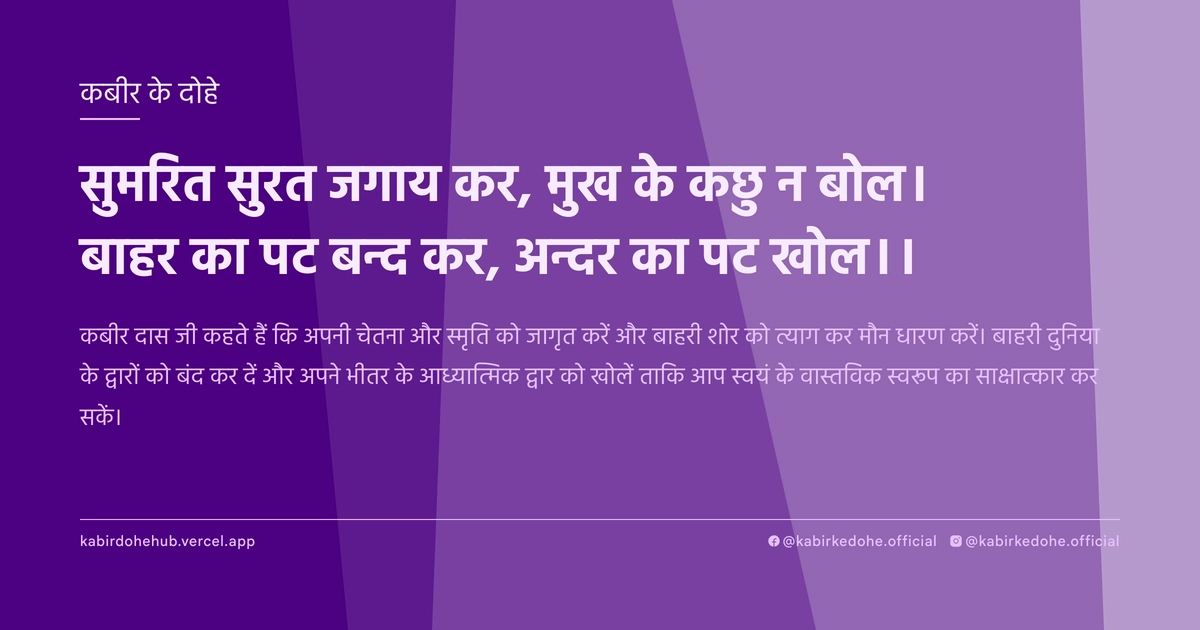
सुमरित सुरत जगाय कर, मुख के कछु न बोल।
बाहर का पट बन्द कर, अन्दर का पट खोल।।
Sumrit surat jagay kar, mukh ke kachu na bol. Bahar ka pat band kar, andar ka pat khol.
इस पृष्ठ पर इस कबीर दोहे का अर्थ (meaning), हिंदी व्याख्या और अंग्रेज़ी अनुवाद, दार्शनिक विश्लेषण और व्यावहारिक जीवन सीख दी गई है। यह दोहा अंतर ज्योति (The Inner Light) विषय से जुड़ा है — Kabir doha meaning and explanation in Hindi and English.
अर्थ (Meaning):
कबीर दास जी कहते हैं कि अपनी चेतना और स्मृति को जागृत करें और बाहरी शोर को त्याग कर मौन धारण करें। बाहरी दुनिया के द्वारों को बंद कर दें और अपने भीतर के आध्यात्मिक द्वार को खोलें ताकि आप स्वयं के वास्तविक स्वरूप का साक्षात्कार कर सकें।
Kabir urges the seeker to awaken their conscious awareness and spiritual memory while maintaining absolute silence. He advises closing the gates of the external sensory world to unlock the inner portal of the soul, allowing one to experience the divine presence within.
व्याख्या (Interpretation):
यह दोहा इंद्रिय निग्रह और अंतर्मुखी होने की प्रक्रिया का वर्णन करता है। 'बाहर का पट' हमारी पांच इंद्रियों और बाहरी मायाजाल का प्रतीक है जो हमें भ्रमित करता है। 'अंदर का पट' वह सूक्ष्म द्वार है जो आत्मा को परमात्मा (निर्गुण ब्रह्म) से जोड़ता है। जब साधक बाहरी दुनिया के प्रति अपनी आसक्ति को समाप्त करता है, तब वह अद्वैत वेदांत के उस सत्य को अनुभव करता है जहाँ ज्ञाता और ज्ञेय का भेद मिट जाता है। यह मौन केवल शब्दों का अभाव नहीं, बल्कि मानसिक शोर का शमन है। इस अवस्था में व्यक्ति माया के आवरण को हटाकर अपनी वास्तविक पहचान को पहचानता है।
This couplet describes the process of sensory withdrawal and internalization. The 'outer gate' symbolizes the five senses and the illusory web of Maya that distracts the soul. The 'inner gate' represents the subtle portal connecting the Atman to the formless Brahman (Nirgun Bhakti). When a seeker ceases their attachment to the external world, they experience the non-duality of Advaita Vedanta, where the distinction between the knower and the known dissolves. This silence is not merely the absence of speech, but the cessation of mental noise. In this state, the individual pierces the veil of illusion to realize their true, eternal identity.
दार्शनिक विश्लेषण (Philosophical Analysis):
कबीर का यह दर्शन मध्यकालीन भारत के उस दौर का है जब धर्म केवल बाहरी कर्मकांडों, तीर्थयात्राओं और शास्त्रार्थ तक सीमित था। कबीर ने इस दिखावे का पुरजोर विरोध किया और 'सहज मार्ग' पर जोर दिया। उनका मानना था कि ईश्वर किसी मंदिर या मस्जिद में नहीं, बल्कि मनुष्य के अपने हृदय के भीतर निवास करता है। यह विचार सूफी मत के 'इन्सान-ए-कामिल' और वेदांत के 'सोऽहम्' से मेल खाता है।
यहाँ 'सुरत' का अर्थ है वह चेतना जो निरंतर भटकती रहती है। कबीर इसे जगाने की बात करते हैं, जिसका अर्थ है कि हम अपनी जागरूकता को बाहरी वस्तुओं से हटाकर केंद्र की ओर ले जाएँ। यह मनोवैज्ञानिक रूपांतरण की प्रक्रिया है जहाँ अहंकार (Ego) का विसर्जन होता है। जब हम बाहरी दुनिया के प्रति अपनी प्रतिक्रिया बंद करते हैं, तो हम अपनी ऊर्जा को संचित करते हैं, जो अंततः आत्म-साक्षात्कार में बदल जाती है।
यह दोहा ritualism (कर्मकांड) के विरुद्ध एक सशक्त प्रहार है। कबीर कहते हैं कि माला जपना या तिलक लगाना तब तक व्यर्थ है जब तक कि आंतरिक रूपांतरण न हो। वे एक ऐसे शून्य की बात करते हैं जहाँ शब्द समाप्त हो जाते हैं और केवल अनुभव शेष रहता है। यह 'अनहद नाद' की स्थिति है जहाँ आत्मा ब्रह्मांडीय ध्वनि के साथ एकाकार हो जाती है।
दार्शनिक रूप से, यह 'प्रत्याहार' की योगिक प्रक्रिया है। इंद्रियों को बाहरी विषयों से हटाकर अंतर्मुखी करना ही मोक्ष का मार्ग है। कबीर यहाँ यह स्पष्ट करते हैं कि सत्य शब्दों में नहीं, बल्कि मौन के गहरे सागर में छिपा है। जो व्यक्ति शब्दों के जाल में उलझा रहता है, वह केवल दूसरों के अनुभवों को दोहराता है, स्वयं सत्य को नहीं जीता।
अंततः, यह संदेश हमें सिखाता है कि वास्तविक शांति और ज्ञान बाहरी खोज का परिणाम नहीं, बल्कि आंतरिक समर्पण का फल है। जब 'मैं' का भाव समाप्त होता है और केवल 'वह' (परमात्मा) शेष रहता है, तब आंतरिक द्वार स्वतः खुल जाते हैं। यह अद्वैत की वह स्थिति है जहाँ आत्मा और परमात्मा के बीच का पर्दा गिर जाता है।
Kabir's philosophy emerged during a medieval Indian era where religion was largely confined to external rituals, pilgrimages, and scholastic debates. Kabir vehemently opposed this superficiality, emphasizing the 'Sahaj Marg' (the natural path). He asserted that the Divine resides not in temples or mosques, but within the human heart, aligning his views with the Sufi concept of 'Insan-e-Kamil' and the Vedantic 'So-ham'.
'Surat' refers to the consciousness that constantly wanders. Kabir speaks of awakening this awareness, meaning the redirection of attention from external objects toward the center. This is a process of psychological transformation where the ego is dissolved. By ceasing reactions to the external world, the seeker conserves spiritual energy, which eventually culminates in self-realization.
This couplet is a powerful critique of ritualism. Kabir suggests that chanting beads or wearing religious marks is futile without internal transformation. He speaks of a 'void' or 'shunya' where words end and only pure experience remains. This is the state of 'Anhad Nad' (the unstruck sound), where the soul merges with the cosmic vibration.
Philosophically, this mirrors the yogic practice of 'Pratyahara'—the withdrawal of senses from external stimuli. Kabir clarifies that truth is not found in words but is hidden in the deep ocean of silence. One who remains entangled in verbal discourse merely echoes the experiences of others rather than living the truth personally.
Ultimately, this teaching conveys that true peace and enlightenment are not results of an external search but fruits of internal surrender. When the sense of 'I' vanishes and only 'That' (the Divine) remains, the inner gates open automatically. This is the state of non-duality where the veil between the Atman and Brahman is lifted.
मूल संदेश (Core Message):
- बाहरी शोर केवल भ्रम है, वास्तविक सत्य मौन में निहित है।
- इंद्रियों का संयम ही आंतरिक प्रकाश की कुंजी है।
- शब्द केवल संकेत हैं, अनुभव ही अंतिम गंतव्य है।
- अहंकार का त्याग करें ताकि आत्मा का द्वार खुल सके।
- स्वयं के भीतर उतरना ही सबसे बड़ी यात्रा है।
- External noise is a mere illusion; ultimate truth resides in silence.
- Sensory restraint is the key to unlocking inner illumination.
- Words are mere pointers; direct experience is the final destination.
- Dissolve the ego to allow the portal of the soul to open.
- Descending into one's own self is the greatest journey.
व्यावहारिक उदाहरण (Practical Example):
एक समय की बात है, वाराणसी के घाटों पर रहने वाला एक वृद्ध बुनकर था जिसका नाम माधव था। माधव दिन भर कपड़े बुनता था, लेकिन उसका मन हमेशा इस बात में उलझा रहता था कि लोग उसके बारे में क्या सोचते हैं। वह समाज में अपनी प्रतिष्ठा बढ़ाने के लिए धार्मिक चर्चाओं में भाग लेता और खुद को बहुत ज्ञानी दिखाता था।
माधव हमेशा दूसरों को उपदेश देता था कि ईश्वर को कैसे पाना चाहिए, लेकिन उसके अपने जीवन में शांति नहीं थी। वह जितना अधिक बाहरी ज्ञान बटोरता, उसका आंतरिक खालीपन उतना ही बढ़ता जाता। वह रात भर सो नहीं पाता था क्योंकि उसके दिमाग में कल की चिंताओं और पुराने विवादों का शोर चलता रहता था।
एक दिन उसकी मुलाकात एक मौन साधु से हुई। साधु ने माधव की बेचैनी को देखा और केवल एक इशारा किया—अपनी आँखें बंद करने और अपनी सांसों को सुनने का। माधव ने पहले तो इसे साधारण बात माना, लेकिन जब उसने गहराई से प्रयास किया, तो उसे महसूस हुआ कि वह अब तक केवल शब्दों के बाजार में घूम रहा था।
उसने महसूस किया कि उसकी सारी ऊर्जा दूसरों को प्रभावित करने में खर्च हो रही थी। उसने तय किया कि वह अब बाहरी दुनिया की प्रशंसा और आलोचना के द्वारों को बंद कर देगा। उसने अपने घर के एक छोटे से कोने को मौन के लिए समर्पित कर दिया।
शुरुआत में, उसका मन विद्रोह करने लगा। उसे लगा कि वह दुनिया से कट रहा है। लेकिन धीरे-धीरे, जब उसने बाहरी शोर को अनसुना करना शुरू किया, तो उसे अपने भीतर एक ऐसी शांति महसूस हुई जिसे उसने कभी किसी शास्त्र में नहीं पढ़ा था।
उसने पाया कि जब वह चुप रहता था, तो उसके काम की गुणवत्ता बढ़ गई। वह अब कपड़े केवल पैसे के लिए नहीं, बल्कि एक ध्यान की तरह बुनने लगा। उसकी उंगलियों की लय उसके हृदय की धड़कन से मिल गई।
गाँव के लोग हैरान थे कि माधव अब पहले की तरह बहस नहीं करता था, फिर भी उसके चेहरे पर एक अलौकिक तेज था। उसकी चुप्पी अब दूसरों के लिए एक मार्गदर्शक बन गई थी।
एक दिन एक युवक उसके पास आया और पूछा, 'बाबा, आपने कौन सा नया मंत्र सीखा है?' माधव ने केवल मुस्कुराकर अपनी उंगली अपने हृदय की ओर की और चुप रहा।
उस युवक ने महसूस किया कि माधव ने शब्दों को नहीं, बल्कि स्वयं को जीत लिया था। माधव ने बाहरी द्वार बंद कर आंतरिक द्वार खोल लिया था, और अब वह पूर्णतः संतुष्ट था।
यह 'कबीर ट्विस्ट' था—जहाँ ज्ञान का प्रदर्शन समाप्त हुआ और वास्तविक अनुभव का जन्म हुआ। माधव अब केवल एक बुनकर नहीं था, वह एक जीवित ध्यान बन चुका था।
Once, in the ghats of Varanasi, lived an elderly weaver named Madhav. Madhav spent his days weaving cloth, but his mind was always entangled in how others perceived him. To enhance his social prestige, he participated in religious debates and presented himself as a great scholar.
Madhav constantly lectured others on how to find God, yet he lacked peace in his own life. The more external knowledge he accumulated, the deeper his internal void became. He suffered from insomnia, his mind racing with tomorrow's anxieties and old disputes.
One day, he encountered a silent monk. The monk observed Madhav's restlessness and simply gestured for him to close his eyes and listen to his own breath. Madhav initially dismissed this as trivial, but upon deeper effort, he realized he had been wandering in a marketplace of words.
He recognized that all his energy was being spent on impressing others. He decided to close the gates of external praise and criticism. He dedicated a small corner of his home to absolute silence.
Initially, his mind rebelled. He felt he was becoming disconnected from the world. However, as he began to ignore the external noise, he felt a peace within that he had never read about in any scripture.
He discovered that in silence, the quality of his work improved. He stopped weaving cloth merely for money and began weaving as a form of meditation. The rhythm of his fingers synchronized with the beat of his heart.
Villagers were surprised that Madhav no longer engaged in arguments, yet his face radiated a divine glow. His silence became a guide for others.
One day, a young man approached him and asked, 'Baba, what new mantra have you learned?' Madhav simply smiled, pointed a finger toward his heart, and remained silent.
The youth realized that Madhav had not conquered words, but had conquered himself. Madhav had closed the outer gate and opened the inner one, and was now completely content.
This was the 'Kabir Twist'—where the display of knowledge ended and the birth of actual experience began. Madhav was no longer just a weaver; he had become a living meditation.
His transformation proved that the path to the Divine is not through the tongue, but through the stillness of the soul.
अभ्यास मार्गदर्शन (Practice Guidance):
- प्रतिदिन 20 मिनट का 'पूर्ण मौन' अभ्यास करें, जहाँ न केवल बोलना बंद हो, बल्कि मानसिक संवाद को भी रोकने का प्रयास किया जाए।
- एक डायरी रखें जिसमें आप उन 'बाहरी द्वारों' (जैसे सोशल मीडिया, दूसरों की राय, भौतिक इच्छाएं) की सूची बनाएं जो आपकी आंतरिक शांति को बाधित कर रहे हैं।
- सांसों के प्रति जागरूकता विकसित करें; जब भी मन बाहरी शोर की ओर भागे, धीरे से अपना ध्यान अपनी नाभि या हृदय केंद्र पर ले आएं।
- डायग्नोस्टिक चेकलिस्ट: क्या मैं अपनी खुशी के लिए दूसरों की स्वीकृति पर निर्भर हूँ? क्या मैं मौन रहने से डरता हूँ? क्या मेरा ध्यान वर्तमान क्षण के बजाय अतीत या भविष्य में अधिक रहता है? यदि हाँ, तो आंतरिक द्वार अभी बंद हैं।
- Practice 20 minutes of 'Absolute Silence' daily, aiming to stop not only speech but also the internal mental dialogue.
- Maintain a journal listing the 'outer gates' (e.g., social media, others' opinions, material desires) that disrupt your inner peace.
- Develop breath awareness; whenever the mind drifts toward external noise, gently redirect your focus to the navel or heart center.
- Diagnostic Checklist: Am I dependent on external validation for my happiness? Do I fear silence? Does my attention dwell more on the past or future than the present? If yes, the inner gate remains closed.
चिंतन प्रश्न (Reflection Questions):
- मेरी सार्वजनिक पहचान (Public Image) को बनाए रखने के लिए मैं अपने भीतर के कितने सच को दबा रहा हूँ?
- यदि आज मेरे पास बोलने के लिए कोई शब्द न हों, तो मेरी पहचान क्या रह जाएगी?
- मेरे जीवन में 'बाहरी पट' के रूप में कौन सी आदतें हैं जो मुझे मेरे वास्तविक स्वरूप से दूर रख रही हैं?
- क्या मेरा आध्यात्मिक अभ्यास वास्तव में आंतरिक है, या यह केवल एक नया 'धार्मिक अहंकार' बन गया है?
- मौन के उस क्षण में मुझे सबसे ज्यादा डर किस बात का लगता है?
- How much of my inner truth am I suppressing to maintain my public image?
- If I had no words to describe myself today, what would remain of my identity?
- Which habits in my life act as 'outer gates' that keep me distanced from my true nature?
- Is my spiritual practice truly internal, or has it simply become a new form of 'religious ego'?
- What is the primary fear that arises when I encounter absolute silence?