
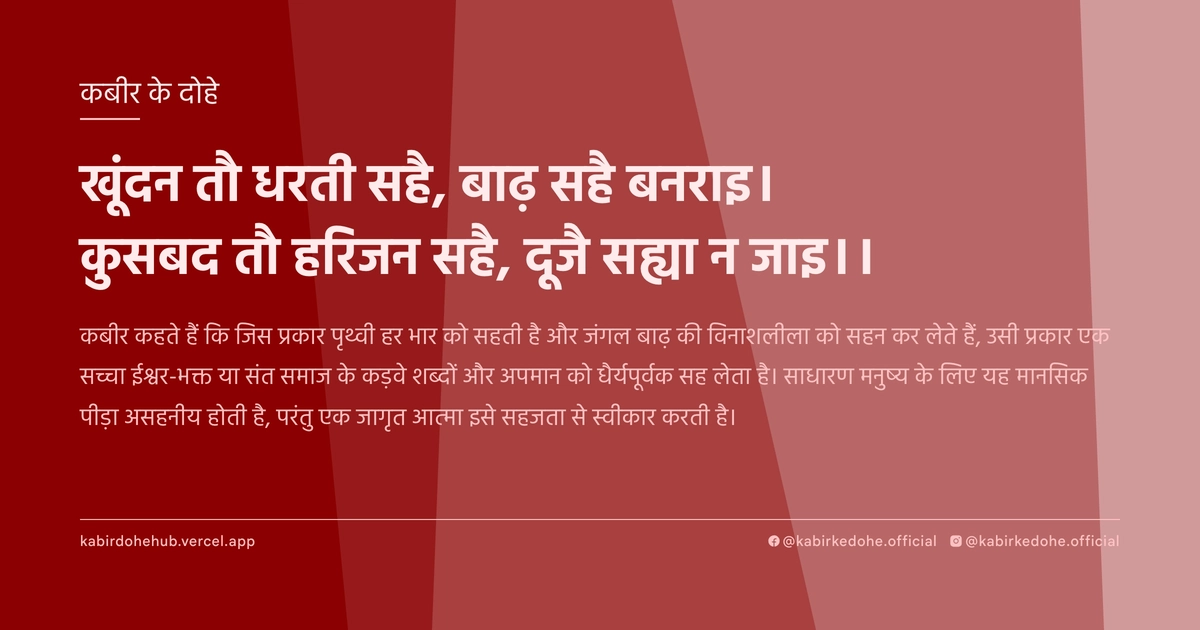
खूंदन तौ धरती सहै, बाढ़ सहै बनराइ।
कुसबद तौ हरिजन सहै, दूजै सह्या न जाइ।।
Khoondan tau dharti sahai, baadh sahai banrai. Kusabad tau harijan sahai, doojai sahya na jaaye.
इस पृष्ठ पर इस कबीर दोहे का अर्थ (meaning), हिंदी व्याख्या और अंग्रेज़ी अनुवाद, दार्शनिक विश्लेषण और व्यावहारिक जीवन सीख दी गई है। यह दोहा करुणा (Compassion) विषय से जुड़ा है — Kabir doha meaning and explanation in Hindi and English.
अर्थ (Meaning):
कबीर कहते हैं कि जिस प्रकार पृथ्वी हर भार को सहती है और जंगल बाढ़ की विनाशलीला को सहन कर लेते हैं, उसी प्रकार एक सच्चा ईश्वर-भक्त या संत समाज के कड़वे शब्दों और अपमान को धैर्यपूर्वक सह लेता है। साधारण मनुष्य के लिए यह मानसिक पीड़ा असहनीय होती है, परंतु एक जागृत आत्मा इसे सहजता से स्वीकार करती है।
Kabir observes that just as the earth bears every weight and the forests endure the devastating floods, a true devotee or a saint bears the brunt of harsh words and insults with unwavering patience. While an ordinary person finds such emotional agony unbearable, an awakened soul accepts it with profound equanimity and grace.
व्याख्या (Interpretation):
इस दोहे का शाब्दिक अर्थ प्रकृति की सहनशीलता की तुलना संत के धैर्य से करना है। गहरे स्तर पर, यह 'निर्गुण भक्ति' के उस मार्ग को दर्शाता है जहाँ साधक अपनी 'अहंकार' (Ego) को पूरी तरह मिटा देता है। जब व्यक्ति स्वयं को ब्रह्म या परमात्मा का अंश मानता है, तो बाहरी आलोचनाएँ केवल लहरों की तरह होती हैं जो समुद्र की गहराई को प्रभावित नहीं करतीं। यहाँ 'कुसबद' केवल शब्दों का अपमान नहीं, बल्कि माया के द्वारा उत्पन्न वह द्वंद्व है जो साधक की परीक्षा लेता है। यह अद्वैत वेदांत के उस सिद्धांत की पुष्टि करता है जहाँ ज्ञाता और ज्ञेय का भेद समाप्त हो जाता है, जिससे अपमान करने वाला और अपमान सहने वाला एक ही चेतना के दो छोर बन जाते हैं।
Literally, the couplet compares the resilience of nature to the patience of a saint. On a deeper level, it illustrates the path of 'Nirgun Bhakti' where the seeker completely annihilates the 'Ahamkara' (Ego). When an individual perceives themselves as an extension of the Formless Divine, external criticisms become mere ripples that cannot disturb the depths of the ocean of consciousness. Here, 'Kusabad' (harsh words) represents not just verbal abuse, but the duality created by 'Maya' to test the seeker's stability. This aligns with Advaita Vedanta, where the distinction between the subject and the object dissolves, rendering the insulter and the insulted as two ends of the same singular consciousness.
दार्शनिक विश्लेषण (Philosophical Analysis):
कबीर का यह विचार उनके युग के सामाजिक संघर्षों और धार्मिक कट्टरता की प्रतिक्रिया है। उन्होंने देखा कि कैसे धर्म और जाति के नाम पर लोगों को नीचा दिखाया जाता था। उनकी सहनशीलता का दर्शन कायरता नहीं, बल्कि एक उच्च मनोवैज्ञानिक अवस्था है जिसे 'स्थितप्रज्ञ' कहा जाता है।
यह दृष्टिकोण सूफीवाद के 'फना' (Fana) के सिद्धांत से मिलता-जुलता है, जहाँ साधक अपनी व्यक्तिगत पहचान को ईश्वर की इच्छा में विलीन कर देता है। जब 'मैं' मर जाता है, तो अपमान किसे होगा? कबीर ritualism (कर्मकांड) का विरोध करते हुए यह समझाते हैं कि असली पूजा मंदिर में नहीं, बल्कि अपने भीतर के क्रोध और अहंकार को जीतने में है।
अद्वैत वेदांत के अनुसार, संसार एक मिथ्या है। यदि संसार मिथ्या है, तो उसमें उत्पन्न होने वाले सुख-दुख और मान-अपमान भी क्षणभंगुर हैं। कबीर इस सत्य को व्यावहारिक जीवन में उतारने की प्रेरणा देते हैं।
मनोवैज्ञानिक स्तर पर, यह दोहा 'रिएक्टिविटी' (प्रतिक्रियाशीलता) को समाप्त करने की बात करता है। अधिकांश लोग बाहरी उत्तेजनाओं के गुलाम होते हैं, लेकिन एक संत अपनी आंतरिक शांति का केंद्र स्वयं होता है।
अंततः, कबीर यह संदेश देते हैं कि सहनशीलता ही वह अग्नि है जो अहंकार के कड़े खोल को पिघलाती है और आत्मा को शुद्ध करती है। यह केवल चुप रहना नहीं है, बल्कि प्रेम और करुणा के साथ विष को अमृत में बदलने की कला है।
Kabir's perspective is a direct response to the social conflicts and religious bigotry of his era. He witnessed how individuals were belittled in the name of religion and caste. His philosophy of endurance is not cowardice, but a high psychological state known as 'Sthitaprajna' (equanimity).
This approach mirrors the Sufi concept of 'Fana' (annihilation), where the seeker dissolves their personal identity into the Divine Will. When the 'I' ceases to exist, who is there to be insulted? Rejecting ritualism, Kabir explains that true worship lies not in temples, but in conquering one's own anger and ego.
According to Advaita Vedanta, the world is 'Maya' (illusion). If the world is illusory, then the resulting joys, sorrows, honor, and dishonor are equally ephemeral. Kabir inspires the practitioner to embody this truth in daily existence.
Psychologically, this couplet addresses the cessation of 'reactivity.' Most people are slaves to external stimuli, but a saint remains the centered source of their own inner peace.
Ultimately, Kabir suggests that endurance is the fire that melts the hard shell of the ego and purifies the soul. It is not mere silence, but the alchemy of transforming poison into nectar through love and compassion.
मूल संदेश (Core Message):
- बाहरी शोर केवल तभी सुनाई देता है जब आंतरिक शांति अनुपस्थित हो।
- सहनशीलता कायरता नहीं, बल्कि आत्मा की सर्वोच्च शक्ति है।
- अहंकार का विसर्जन ही अपमान के विष को अमृत बनाता है।
- प्रकृति की तरह उदार बनें; जो सब कुछ सहता है, वही पूजनीय होता है।
- सच्ची मुक्ति दूसरों को बदलने में नहीं, बल्कि स्वयं के प्रति तटस्थ होने में है।
- External noise is only audible when inner silence is absent.
- Endurance is not cowardice, but the supreme power of the soul.
- The dissolution of ego transforms the poison of insult into nectar.
- Be generous like nature; that which endures all is truly revered.
- True liberation lies not in changing others, but in becoming neutral toward oneself.
व्यावहारिक उदाहरण (Practical Example):
वाराणसी के एक पुराने घाट पर रामदीन नाम का एक वृद्ध नाविक रहता था। वह अपनी सादगी और शांत स्वभाव के लिए जाना जाता था, लेकिन शहर के कुछ प्रभावशाली लोग उसे 'अशिक्षित' और 'तुच्छ' कहकर उसका मजाक उड़ाते थे।
एक दिन, एक अहंकारी व्यापारी ने रामदीन की नाव में सवार होकर उसे सबके सामने बहुत भला-बुरा कहा और उसकी गरीबी का उपहास किया।
रामदीन ने न तो पलटकर जवाब दिया और न ही उसके चेहरे पर क्रोध के भाव आए। वह बस मंद-मंद मुस्कुराता रहा और अपनी चप्पू चलाता रहा।
व्यापारी को लगा कि रामदीन डर गया है, इसलिए वह और अधिक उग्र हो गया और उसे उसकी जाति और औकात याद दिलाने लगा।
जब नाव किनारे पहुँची, तो व्यापारी ने गुस्से में रामदीन को पैसे फेंक कर दिए और कहा, 'तेरी यही औकात है, चुपचाप सहना।'
रामदीन ने शांति से पैसे उठाए और कहा, 'साहब, आपकी बातें कड़वी थीं, लेकिन उन्होंने मुझे यह याद दिलाया कि मेरे भीतर अभी भी थोड़ा अहंकार बचा था जो शायद बुरा मान जाता। आपकी वजह से मैं और शांत हो गया।'
व्यापारी यह सुनकर स्तब्ध रह गया। उसे पहली बार महसूस हुआ कि उसकी शक्ति केवल शब्दों में थी, जबकि रामदीन की शक्ति उसकी चुप्पी और आंतरिक स्थिरता में थी।
उस दिन व्यापारी का अहंकार टूट गया। उसने महसूस किया कि जिस व्यक्ति को वह तुच्छ समझ रहा था, वह मानसिक रूप से उससे कहीं अधिक समृद्ध और स्वतंत्र था।
रामदीन का यह व्यवहार उस व्यापारी के लिए एक दर्पण बन गया, जिसने उसे अपनी आंतरिक कुरूपता देखने पर मजबूर कर दिया।
अंततः, वह व्यापारी रामदीन का शिष्य बन गया और उसने सीखा कि असली जीत बहस जीतने में नहीं, बल्कि स्वयं को जीतने में है।
On an ancient ghat in Varanasi lived an elderly boatman named Ramdeen. He was known for his simplicity and calm nature, but some influential people in the city mocked him, calling him 'uneducated' and 'insignificant.'
One day, an arrogant merchant boarded Ramdeen's boat and insulted him harshly in front of everyone, ridiculing his poverty.
Ramdeen neither retorted nor showed any sign of anger. He simply kept a gentle smile on his face and continued rowing his boat.
The merchant assumed Ramdeen was afraid, so he became even more aggressive, reminding him of his caste and social standing.
When the boat reached the shore, the merchant angrily threw money at Ramdeen and said, 'This is your place—to suffer in silence.'
Ramdeen calmly picked up the money and said, 'Sir, your words were bitter, but they reminded me that there was still a shred of ego within me that might have felt hurt. Because of you, I have become even more peaceful.'
The merchant was stunned. For the first time, he realized that his power lay only in words, while Ramdeen's power lay in his silence and inner stability.
That day, the merchant's ego shattered. He realized that the man he considered insignificant was mentally far wealthier and freer than he was.
Ramdeen's behavior became a mirror for the merchant, forcing him to see his own internal ugliness.
Ultimately, the merchant became Ramdeen's disciple, learning that true victory is not in winning an argument, but in conquering oneself.
अभ्यास मार्गदर्शन (Practice Guidance):
- प्रतिदिन 20 मिनट 'साक्षी भाव' का अभ्यास करें: अपने विचारों और भावनाओं को बिना किसी निर्णय के केवल देखें, जैसे आप किसी और को देख रहे हों।
- जब कोई आपकी आलोचना करे, तो तुरंत प्रतिक्रिया देने के बजाय 10 सेकंड का मौन रखें और स्वयं से पूछें, 'यह शब्द मुझे चोट पहुँचा रहे हैं या मेरे अहंकार को?'
- एक 'अपमान डायरी' बनाएँ: उन घटनाओं को लिखें जहाँ आपको बुरा लगा, और विश्लेषण करें कि उस समय आपके भीतर कौन सा विचार (जैसे- 'मैं श्रेष्ठ हूँ') चोटिल हुआ।
- निदान चेकलिस्ट: क्या आप दूसरों की राय से विचलित होते हैं? क्या आप बदला लेने की इच्छा रखते हैं? क्या आप चुप रहकर भी भीतर ही भीतर क्रोध पालते हैं? यदि हाँ, तो आप अभी भी अहंकार के प्रभाव में हैं।
- Practice 'Witness Consciousness' for 20 minutes daily: Observe your thoughts and emotions without judgment, as if you are watching a stranger.
- When criticized, instead of reacting immediately, maintain 10 seconds of silence and ask yourself, 'Are these words hurting me, or are they hurting my ego?'
- Maintain an 'Insult Journal': Record incidents where you felt offended and analyze which internal belief (e.g., 'I am superior') was wounded.
- Diagnostic Checklist: Do you get unsettled by others' opinions? Do you harbor a desire for revenge? Do you remain silent but nurture anger internally? If yes, you are still under the influence of the ego.
चिंतन प्रश्न (Reflection Questions):
- जब कोई आपकी छवि को गलत तरीके से प्रस्तुत करता है, तो आप वास्तव में किस बात से डरते हैं—सत्य के खोने से या अपनी सामाजिक प्रतिष्ठा से?
- क्या आपकी 'शांति' वास्तव में शांति है, या यह केवल क्रोध को दबाने का एक मुखौटा है?
- यदि आपका नाम, पद और उपलब्धियाँ छीन ली जाएँ, तो आपके पास ऐसा क्या बचेगा जो अपमानित नहीं किया जा सकता?
- आपकी डिजिटल पहचान (Social Media Ego) किस हद तक आपकी वास्तविक शांति को नियंत्रित कर रही है?
- क्या आप उन लोगों को क्षमा कर सकते हैं जिन्होंने आपको कभी समझा ही नहीं, या क्या आप उनकी समझ की कमी पर भी क्रोधित हैं?
- When someone misrepresents your image, what are you actually afraid of—the loss of truth or the loss of social prestige?
- Is your 'peace' truly peace, or is it merely a mask for suppressed anger?
- If your name, title, and achievements were stripped away, what would remain within you that cannot be insulted?
- To what extent does your digital identity (Social Media Ego) control your actual inner peace?
- Can you forgive those who never understood you, or are you still angry at their lack of understanding?