
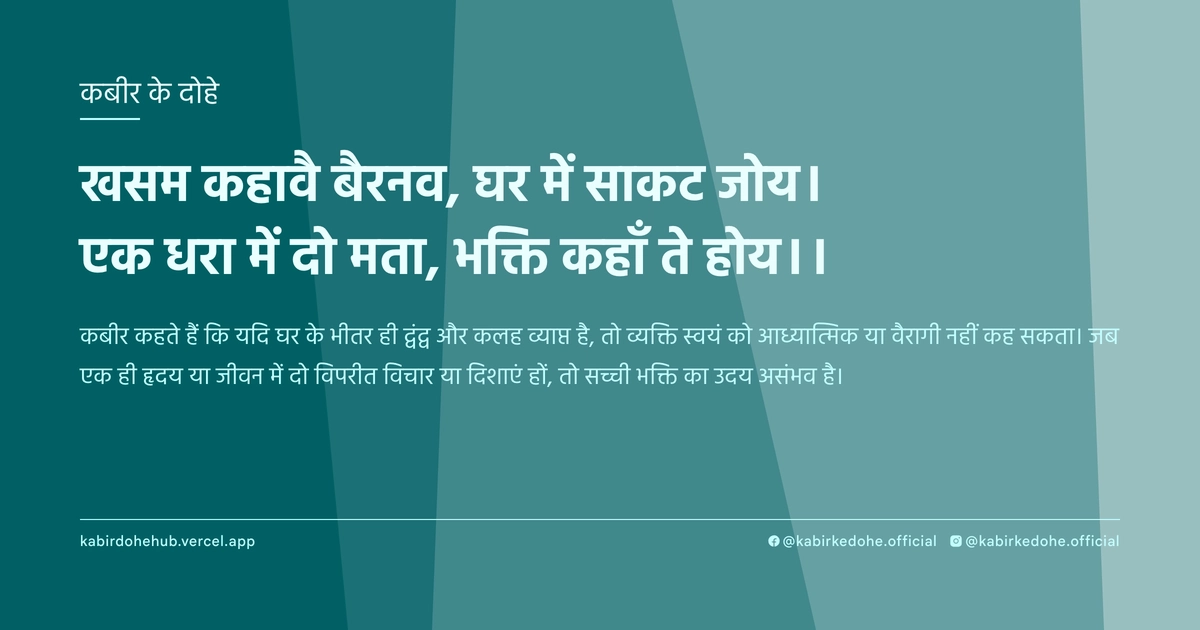
खसम कहावै बैरनव, घर में साकट जोय।
एक धरा में दो मता, भक्ति कहाँ ते होय।।
Khasam kahavai bairnav, ghar me saakat joye. Ek dhara me do mata, bhakti kahan te hoye.
इस पृष्ठ पर इस कबीर दोहे का अर्थ (meaning), हिंदी व्याख्या और अंग्रेज़ी अनुवाद, दार्शनिक विश्लेषण और व्यावहारिक जीवन सीख दी गई है। यह दोहा मन नियंत्रण (Mind Control) विषय से जुड़ा है — Kabir doha meaning and explanation in Hindi and English.
अर्थ (Meaning):
कबीर कहते हैं कि यदि घर के भीतर ही द्वंद्व और कलह व्याप्त है, तो व्यक्ति स्वयं को आध्यात्मिक या वैरागी नहीं कह सकता। जब एक ही हृदय या जीवन में दो विपरीत विचार या दिशाएं हों, तो सच्ची भक्ति का उदय असंभव है।
Kabir asserts that if conflict and discord reside within one's own home or heart, claiming to be a renunciant or a seeker is futile. When a single existence is split between two opposing inclinations or contradictory beliefs, true devotion cannot possibly blossom.
व्याख्या (Interpretation):
इस दोहे का शाब्दिक अर्थ है कि घर में झगड़ा होने पर वैराग्य का ढोंग व्यर्थ है। आध्यात्मिक स्तर पर, 'घर' मानव शरीर और मन का प्रतीक है। 'दो मता' का अर्थ है मानसिक द्वंद्व—जहाँ एक हिस्सा परमात्मा की ओर खिंचता है और दूसरा सांसारिक मोह और अहंकार में फंसा रहता है। यह स्थिति 'माया' के प्रभाव को दर्शाती है, जो आत्मा को भ्रमित कर उसे खंडित कर देती है। जब तक साधक के भीतर यह आंतरिक युद्ध समाप्त नहीं होता और वह अद्वैत (non-duality) की स्थिति में नहीं आता, तब तक वह उस निराकार ब्रह्म (Nirgun Brahman) का अनुभव नहीं कर सकता। भक्ति केवल बाहरी क्रिया नहीं, बल्कि आंतरिक एकरूपता है।
Literally, the verse warns that claiming renunciation while harboring domestic strife is a facade. Metaphorically, the 'home' represents the human psyche and physical body. 'Two opinions' or 'two minds' signify the psychological duality where one part of the self yearns for the Divine while the other remains shackled to worldly attachments and ego. This fragmentation is the hallmark of Maya, the cosmic illusion that veils the unity of Atman and Brahman. The central paradox is that one seeks peace externally while maintaining a battlefield internally. Until this internal schism is resolved and the seeker achieves a state of non-duality, the experience of the Formless (Nirgun) remains elusive. Devotion is not a ritual but the achievement of internal singularity.
दार्शनिक विश्लेषण (Philosophical Analysis):
कबीर का यह प्रहार उस पाखंड पर है जहाँ लोग बाहरी धार्मिक प्रतीकों (जैसे माला, तिलक या गेरुए वस्त्र) को अपनाकर आंतरिक अशांति को छिपाते हैं। उनके समय में, धर्म केवल कर्मकांडों और सामाजिक श्रेणियों में सिमट गया था। कबीर ने इस 'दोहरेपन' को भक्ति का सबसे बड़ा शत्रु माना।
अद्वैत वेदांत के परिप्रेक्ष्य में, यह दोहा 'द्वैत' (duality) के विनाश की बात करता है। जब तक हम स्वयं को शरीर और आत्मा के रूप में अलग-अलग देखते हैं, या ईश्वर को अपने से बाहर खोजते हैं, हम वास्तव में दो मतों में विभाजित हैं। यह विभाजन ही दुख का मूल कारण है।
सूफी मत के 'फना' (annihilation) के सिद्धांत से इसकी गहरी समानता है। सूफीवाद में जब तक 'मैं' (अहंकार) जीवित रहता है, तब तक 'वह' (परमात्मा) प्रकट नहीं होता। कबीर यहाँ उसी अहंकार के विसर्जन की मांग कर रहे हैं जो व्यक्ति को स्वयं से ही अलग कर देता है।
कबीर का विरोध केवल पारिवारिक कलह से नहीं, बल्कि उस मानसिक विखंडन से है जो मनुष्य को अधूरा बनाता है। वे तर्क देते हैं कि यदि आप अपने निकटतम संबंधों में प्रेम और शांति स्थापित नहीं कर सकते, तो ब्रह्मांडीय प्रेम (Universal Love) का दावा करना केवल एक बौद्धिक विलास है।
अंततः, यह विश्लेषण हमें इस निष्कर्ष पर ले जाता है कि वास्तविक आध्यात्मिक प्रगति बाहरी त्याग में नहीं, बल्कि आंतरिक एकीकरण में है। जब विचार, वाणी और कर्म एक ही दिशा में प्रवाहित होते हैं, तभी वह स्थिति 'भक्ति' कहलाती है।
Kabir’s critique targets the hypocrisy of those who adopt external religious symbols—beads, tilaks, or saffron robes—to mask an inner state of turmoil. In his era, spirituality had largely devolved into rigid rituals and social hierarchies. Kabir identifies this 'duality' as the primary obstacle to genuine liberation.
From the lens of Advaita Vedanta, this verse addresses the eradication of 'Dvaita' or duality. As long as the seeker perceives a separation between the self and the Divine, or between the physical and the spiritual, they are living in a state of fragmentation. This perceived separation is the root of all human suffering and spiritual stagnation.
There is a profound resonance here with the Sufi concept of 'Fana' (annihilation of the self). In Sufism, the 'I' (ego) must perish for the 'He' (Divine) to manifest. Kabir demands the dissolution of the ego-driven duality that splits the human consciousness, preventing the realization of the One.
Kabir is not merely discussing domestic disputes; he is analyzing the psychological fragmentation that renders a human incomplete. He argues that if one cannot cultivate peace and love within their immediate environment, claiming a connection to Universal Love is a mere intellectual vanity.
Ultimately, this analysis reveals that true spiritual evolution is not found in external renunciation but in internal integration. When thought, word, and action align in a single direction of truth, that state of coherence is what Kabir defines as 'Bhakti'.
मूल संदेश (Core Message):
- बाहरी दिखावा आंतरिक रिक्तता को नहीं भर सकता।
- सच्ची भक्ति मन के विखंडन को समाप्त करने में है।
- घर की शांति ही आध्यात्मिक प्रगति की पहली कसौटी है।
- द्वंद्व का त्याग ही अद्वैत की ओर पहला कदम है।
- प्रेम और करुणा के बिना कोई भी साधना व्यर्थ है।
- आत्मा की एकता ही परमात्मा का वास्तविक स्वरूप है।
- External piety cannot fill an internal void.
- True devotion lies in ending the fragmentation of the mind.
- Domestic peace is the primary litmus test for spiritual growth.
- Renouncing internal conflict is the first step toward non-duality.
- Any spiritual practice devoid of love and compassion is futile.
- The unity of the soul is the true reflection of the Divine.
व्यावहारिक उदाहरण (Practical Example):
एक समय की बात है, वाराणसी के घाटों पर रहने वाला एक वृद्ध बुनकर था, जिसका नाम माधव था। माधव अपनी कला में निपुण था, लेकिन उसका स्वभाव अत्यंत क्रोधी था। वह दिन भर मंदिर में घंटों प्रार्थना करता और स्वयं को एक महान भक्त मानता था, परंतु घर लौटते ही वह अपनी पत्नी और बच्चों पर छोटी-छोटी बातों के लिए चिल्लाता था।
उसके घर में हमेशा तनाव रहता था। माधव का मानना था कि उसकी भक्ति और उसका पारिवारिक जीवन दो अलग चीजें हैं। वह सोचता था कि मंदिर की शांति उसके घर के शोर को संतुलित कर देगी।
एक दिन, वह एक संत के पास गया और अपनी आध्यात्मिक प्रगति के बारे में चर्चा करने लगा। संत ने माधव की आँखों में देखा और मुस्कुराते हुए पूछा, 'तुम्हारे घर की शांति का क्या हाल है?'
माधव ने झेंपते हुए कहा, 'महाराज, घर में तो कलह रहती है, पर मैं तो ईश्वर का भक्त हूँ।'
संत ने शांति से उत्तर दिया, 'माधव, तुम एक ही समय में दो नावों पर सवार हो। एक नाव तुम्हें स्वर्ग ले जाना चाहती है और दूसरी तुम्हें नर्क की आग में जला रही है। जब तक तुम्हारा घर तुम्हारा मंदिर नहीं बनता, तुम्हारा मंदिर केवल एक पत्थर की इमारत है।'
यह बात माधव के हृदय में गहरे तक उतर गई। उसे समझ आया कि उसकी 'भक्ति' केवल एक मुखौटा थी, जबकि उसका वास्तविक धर्म उसके व्यवहार में छिपा था।
अगले दिन से माधव ने प्रार्थना के घंटों को कम किया और उस समय का उपयोग अपने परिवार की शिकायतों को सुनने और उन्हें प्रेम से सुलझाने में किया। उसने महसूस किया कि जब वह अपनी पत्नी के प्रति दयालु हुआ, तो उसकी प्रार्थनाओं में एक नई गहराई आ गई।
धीरे-धीरे उसके घर का वातावरण बदल गया। अब उसे मंदिर जाने की उतनी आवश्यकता नहीं महसूस होती थी, क्योंकि उसने अपने घर के भीतर ही उस शांति को पा लिया था जिसकी वह तलाश कर रहा था।
माधव ने सीखा कि ईश्वर मंदिर की मूर्तियों में नहीं, बल्कि उस प्रेम में है जो हम दूसरों के प्रति रखते हैं। उसकी आंतरिक द्वंद्व समाप्त हो गई और वह वास्तव में एक 'भक्त' बन गया।
यह परिवर्तन माधव के जीवन का 'कबीर ट्विस्ट' था—जहाँ उसने बाहरी दिखावे को त्यागकर आंतरिक सत्य को अपनाया।
Once, in the ghats of Varanasi, lived an elderly weaver named Madhav. Madhav was a master of his craft, but his temperament was volatile and prone to anger. He spent hours in the temple every day, considering himself a profound devotee, yet upon returning home, he would scream at his wife and children over the smallest trivialities.
His household was a theater of constant tension. Madhav believed that his spiritual practice and his domestic life were two separate spheres. He assumed that the peace he found in the temple would somehow offset the chaos he created at home.
One day, he visited a wandering saint and began boasting about his spiritual advancements. The saint looked into Madhav's eyes and asked with a gentle smile, 'And what is the state of peace within your own home?'
Embarrassed, Madhav replied, 'Maharaj, there is much conflict at home, but I am a devoted servant of the Lord.'
The saint replied calmly, 'Madhav, you are trying to sail in two opposite directions at once. One boat seeks heaven, while the other burns in the fires of hell. Until your home becomes your temple, your temple is merely a building of stone.'
These words pierced Madhav's heart. He realized that his 'devotion' was a mask, while his true religion lay hidden in his behavior toward those he loved most.
From the next day, Madhav reduced his hours of ritual prayer and instead used that time to listen to his family's grievances and resolve them with kindness. He discovered that as he became compassionate toward his wife, his prayers acquired a depth they never had before.
Gradually, the atmosphere of his home transformed. He no longer felt the desperate need to flee to the temple, for he had found the very peace he was seeking within his own walls.
Madhav learned that the Divine does not reside in idols, but in the love we extend to others. His internal conflict vanished, and he finally became a true 'bhakta'.
This was the 'Kabir Twist' in Madhav's life—the moment he abandoned external performance for internal authenticity.
अभ्यास मार्गदर्शन (Practice Guidance):
- दैनिक आत्म-निरीक्षण: प्रतिदिन 15 मिनट मौन बैठें और विश्लेषण करें कि क्या आपके विचार और कार्य एक दिशा में हैं या आप आंतरिक द्वंद्व से जूझ रहे हैं।
- सत्य-लेखन (Journaling): उन क्षेत्रों को लिखें जहाँ आप दुनिया को कुछ और दिखाते हैं और भीतर कुछ और महसूस करते हैं। इस 'दोहरेपन' को स्वीकार करना ही परिवर्तन की पहली सीढ़ी है।
- व्यवहारिक परिवर्तन: किसी ऐसे व्यक्ति के साथ शांतिपूर्ण संवाद स्थापित करें जिससे आपका वैचारिक मतभेद है। इसे एक आध्यात्मिक अभ्यास के रूप में लें।
- निदान चेकलिस्ट: क्या मैं दूसरों को उपदेश देते समय स्वयं उन पर अमल करता हूँ? क्या मेरी शांति केवल एकांत में है या भीड़ और कलह के बीच भी? यदि उत्तर 'नहीं' है, तो आप अभी भी 'दो मतों' में विभाजित हैं।
- Daily Self-Observation: Spend 15 minutes in silence analyzing whether your thoughts and actions are aligned or if you are battling an internal schism.
- Authenticity Journaling: Document the areas of your life where your public persona contradicts your private reality. Acknowledging this 'duality' is the first step toward integration.
- Behavioral Shift: Initiate a peaceful, non-judgmental conversation with someone with whom you have a deep conflict. Treat this as a spiritual exercise in non-duality.
- Diagnostic Checklist: Do I practice the virtues I preach to others? Is my peace dependent on solitude, or does it persist amidst conflict? If the answer is 'no', you are still divided by 'two minds'.
चिंतन प्रश्न (Reflection Questions):
- मेरा वह कौन सा 'दूसरा मत' है जो मुझे मेरी आध्यात्मिक यात्रा में बाधित कर रहा है?
- क्या मैं अपनी धार्मिक पहचान का उपयोग अपने वास्तविक दोषों को छिपाने के लिए एक ढाल के रूप में करता हूँ?
- यदि मेरा पूरा जीवन एक खुली किताब होता, तो क्या मेरी 'भक्ति' अभी भी उतनी ही वास्तविक लगती?
- मैं किन लोगों के प्रति कठोर हूँ, और क्या यह कठोरता मेरे भीतर के किसी अनसुलझे द्वंद्व का परिणाम है?
- क्या मेरी शांति केवल तब तक है जब तक दुनिया मेरी इच्छा के अनुसार चलती है?
- मेरे भीतर का 'वैरागी' और 'सांसारिक' व्यक्ति आपस में कैसे लड़ रहे हैं?
- What is the 'second opinion' or conflicting desire within me that obstructs my spiritual path?
- Do I use my religious or spiritual identity as a shield to hide my actual flaws?
- If my entire life were an open book, would my 'devotion' still seem authentic to an observer?
- Toward whom am I most harsh, and is this harshness a projection of an unresolved internal conflict?
- Is my peace conditional upon the world behaving exactly as I wish it to?
- How are the 'renunciant' and the 'worldly' versions of myself fighting for dominance?