
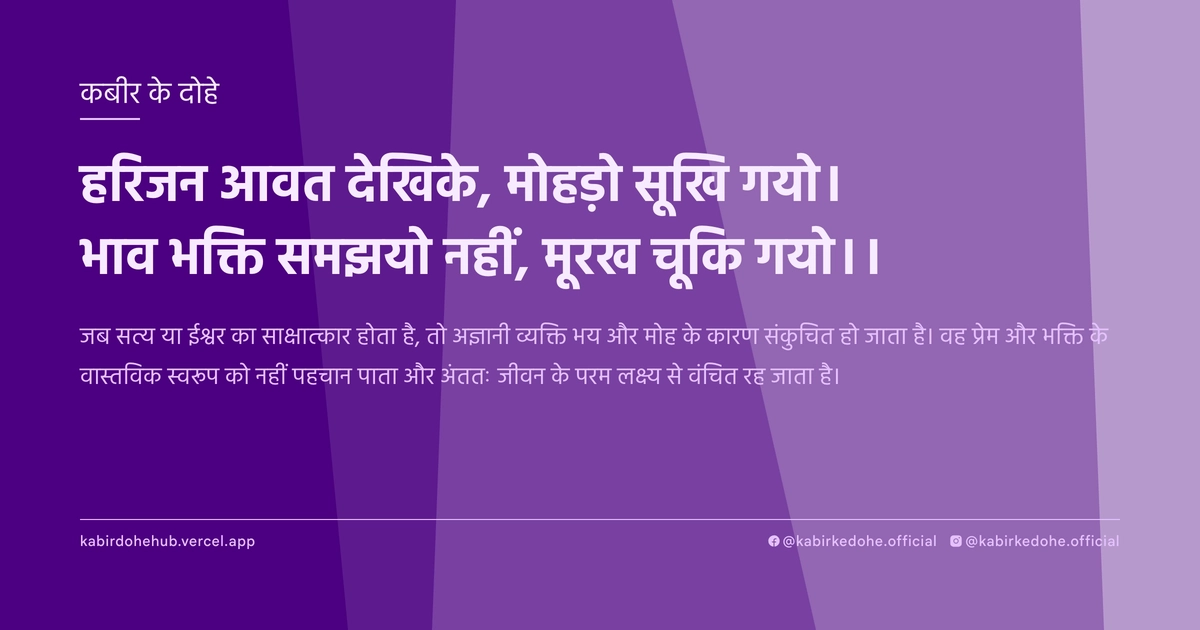
हरिजन आवत देखिके, मोहड़ो सूखि गयो।
भाव भक्ति समझयो नहीं, मूरख चूकि गयो।।
Harijan aavat dekhike, mohado sukhi gayo. Bhav bhakti samajhyo nahi, murakh chuki gayo.
इस पृष्ठ पर इस कबीर दोहे का अर्थ (meaning), हिंदी व्याख्या और अंग्रेज़ी अनुवाद, दार्शनिक विश्लेषण और व्यावहारिक जीवन सीख दी गई है। यह दोहा भक्ति (Bhakti) विषय से जुड़ा है — Kabir doha meaning and explanation in Hindi and English.
अर्थ (Meaning):
जब सत्य या ईश्वर का साक्षात्कार होता है, तो अज्ञानी व्यक्ति भय और मोह के कारण संकुचित हो जाता है। वह प्रेम और भक्ति के वास्तविक स्वरूप को नहीं पहचान पाता और अंततः जीवन के परम लक्ष्य से वंचित रह जाता है।
When the Truth or the Divine manifests, the ignorant soul shrinks in fear and attachment. Failing to comprehend the essence of selfless love and devotion, the fool misses the singular opportunity for liberation.
व्याख्या (Interpretation):
यहाँ 'मोहड़ो सूखि गयो' का अर्थ केवल शारीरिक भय नहीं, बल्कि अहंकार का संकुचन है। जब निराकार ब्रह्म (Nirgun Brahman) अपनी उपस्थिति दर्ज कराता है, तो वह माया के पर्दे को हटा देता है। जो व्यक्ति केवल बाहरी कर्मकांडों और सामाजिक पहचान में उलझा है, वह इस आंतरिक पुकार को नहीं पहचान पाता। यह दोहा आत्मा और परमात्मा के बीच के उस सूक्ष्म अंतराल को दर्शाता है जिसे केवल 'भाव' (शुद्ध भावना) से भरा जा सकता है। अज्ञानता यहाँ केवल जानकारी का अभाव नहीं, बल्कि हृदय की कठोरता है जो सत्य को स्वीकार करने से डरती है।
The phrase 'mohado sukhi gayo' signifies not mere physical trembling, but the contraction of the ego when confronted by the Absolute. As the Nirgun Brahman (Formless Divine) manifests, it strips away the veils of Maya. Those tethered to external rituals and social identities fail to recognize this internal resonance. The doha highlights the subtle void between the Atman and Brahman, which can only be bridged by 'Bhav' (pure emotional devotion). Ignorance here is not a lack of intellectual data, but a rigidity of heart that fears the dissolution of the separate self into the Infinite.
दार्शनिक विश्लेषण (Philosophical Analysis):
कबीर का यह दोहा मध्यकालीन भारत के उस सामाजिक परिवेश में लिखा गया जहाँ धर्म केवल बाहरी आडंबरों और जातिगत श्रेष्ठता का साधन बन गया था। कबीर यहाँ 'भाव भक्ति' पर जोर देते हैं, जो किसी मंदिर या मस्जिद की मोहताज नहीं है। यह दृष्टिकोण अद्वैत वेदांत के करीब है, जहाँ माना जाता है कि ईश्वर बाहर नहीं, बल्कि भीतर है, लेकिन अहंकार की परतें उसे देखने नहीं देतीं।
सूफी मत के 'फना' (अहंकार का विनाश) के सिद्धांत की तरह, कबीर संकेत करते हैं कि जब तक 'मैं' जीवित है, तब तक सत्य का अनुभव असंभव है। 'मूरख' वह नहीं है जो पढ़ा-लिखा नहीं है, बल्कि वह है जो सत्य के सामने आने पर भी अपने संकीर्ण मोह को नहीं छोड़ पाता। यह मनोवैज्ञानिक रूपांतरण की मांग करता है जहाँ साधक अपनी पहचान को पूरी तरह मिटा दे।
ritualism (कर्मकांड) का विरोध करते हुए कबीर समझाते हैं कि ईश्वर को पाने के लिए किसी विशेष विधि की आवश्यकता नहीं, बल्कि केवल एक शुद्ध हृदय की आवश्यकता है। जो लोग विधि-विधानों में उलझे रहते हैं, वे सत्य के द्वार पर खड़े होकर भी अंदर नहीं जा पाते क्योंकि वे 'भाव' को नहीं समझते।
यह दोहा मनुष्य की उस त्रासदी को दर्शाता है जहाँ वह सत्य की खोज तो करता है, लेकिन जब सत्य सामने आता है, तो वह उसे पहचानने की क्षमता खो चुका होता है। यह एक चेतावनी है कि आध्यात्मिक तैयारी केवल ग्रंथों को पढ़ने से नहीं, बल्कि हृदय को कोमल बनाने से आती है।
अंततः, यह संदेश देता है कि मुक्ति केवल ज्ञान से नहीं, बल्कि उस ज्ञान के प्रति समर्पण और प्रेम से मिलती है। जब तक भक्ति में 'भाव' नहीं है, तब तक वह केवल एक यांत्रिक क्रिया है, जो आत्मा को मुक्त करने के बजाय उसे और अधिक बंधन में डालती है।
Kabir composed this couplet during a medieval Indian era where religion had devolved into external ostentation and caste-based superiority. He emphasizes 'Bhav Bhakti' (devotional sentiment), which transcends the confines of temples or mosques. This perspective aligns closely with Advaita Vedanta, asserting that the Divine resides within, though obscured by layers of egoic identification.
Parallel to the Sufi concept of 'Fana' (annihilation of the self), Kabir suggests that as long as the 'I' persists, the experience of Truth remains impossible. The 'fool' is not the unlettered, but the one who, even in the presence of Truth, clings to narrow attachments. This necessitates a psychological metamorphosis where the seeker completely dissolves their perceived separate identity.
By rejecting ritualism, Kabir explains that reaching the Divine requires no specific liturgy, only a pure heart. Those entangled in rigid methodologies stand at the threshold of Truth but cannot enter because they lack the essential 'Bhav' or emotional resonance.
The doha portrays the human tragedy of seeking Truth yet being unable to recognize it upon its arrival. It serves as a warning that spiritual readiness is not achieved through scholarly study, but through the softening of the heart and the removal of spiritual callousness.
Ultimately, the message is that liberation comes not from intellectual knowledge alone, but from surrender and love toward that knowledge. Without 'Bhav', devotion is merely a mechanical act that binds the soul further rather than liberating it from the cycle of Samsara.
मूल संदेश (Core Message):
- बाहरी आडंबर सत्य के मार्ग में सबसे बड़ी बाधा हैं।
- ईश्वर को पाने का एकमात्र रास्ता शुद्ध हृदय का भाव है।
- अहंकार सत्य के साक्षात्कार के समय भय बनकर उभरता है।
- ज्ञान जब तक प्रेम में नहीं बदलता, वह केवल बोझ है।
- सत्य सबके भीतर है, बस उसे पहचानने वाली दृष्टि चाहिए।
- External ostentation is the greatest obstacle on the path to Truth.
- The only gateway to the Divine is the purity of emotional devotion.
- Ego manifests as fear when confronted by the Absolute Truth.
- Knowledge that does not transform into love is merely a burden.
- Truth resides within all; one only needs the vision to recognize it.
व्यावहारिक उदाहरण (Practical Example):
वाराणसी के घाटों पर रहने वाले एक वृद्ध विधवा, जानकी, का जीवन अत्यंत कठिन था। वह दूसरों के घरों में सफाई कर अपना गुजारा करती थी और समाज की नजरों में वह 'अशुद्ध' और 'तुच्छ' थी।
जानकी हर दिन गंगा किनारे बैठती, लेकिन वह मंत्रों का जाप नहीं करती थी, बल्कि बस मौन रहकर बहते पानी को देखती थी।
एक दिन शहर के एक बहुत बड़े विद्वान पंडित, जो शास्त्रों के ज्ञाता थे, उसके पास आए। उन्होंने जानकी को उपदेश देना शुरू किया कि कैसे उसे मोक्ष के लिए कठिन तपस्या और विशेष अनुष्ठान करने चाहिए।
पंडित जी ने उसे बताया कि बिना विधि-विधान के ईश्वर कभी नहीं मिलते। जानकी चुपचाप सुनती रही, उसकी आँखों में एक अजीब सी शांति थी।
तभी एक छोटा बच्चा, जो बहुत बीमार था, वहां आया और उसने जानकी का हाथ पकड़ लिया। जानकी ने उस बच्चे को अपनी गोद में लिया और उसे बिना किसी संकोच के प्रेम से सहलाने लगी।
उस क्षण, पंडित जी ने देखा कि जानकी के चेहरे पर जो तेज था, वह उनके हज़ारों ग्रंथों के अध्ययन से भी अधिक दिव्य था।
पंडित जी को अचानक महसूस हुआ कि वे सत्य की खोज में इतने उलझ गए थे कि उन्होंने उस 'भाव' को ही भुला दिया जो उनके सामने साक्षात मौजूद था।
वे अपनी विद्वत्ता के अहंकार में इतने अंधे थे कि उन्होंने जानकी की निस्वार्थ करुणा को नहीं पहचाना, जो वास्तव में ईश्वर का ही रूप था।
पंडित जी का चेहरा शर्म से झुक गया; वे समझ गए कि वे वही 'मूरख' थे जो सत्य को सामने देखकर भी उसे पहचान नहीं पाए।
उस दिन पंडित जी ने अपनी किताबों को किनारे रखा और जानकी के चरणों में बैठकर प्रेम और करुणा का वास्तविक पाठ सीखा।
Janaki, an elderly widow living on the ghats of Varanasi, led a life of extreme hardship. She survived by cleaning others' homes, viewed by society as 'impure' and 'insignificant'.
Every day, Janaki would sit by the Ganges, not chanting complex mantras, but simply observing the flowing water in profound silence.
One day, a renowned scholar-priest, a master of the scriptures, approached her. He began lecturing Janaki on the necessity of rigorous penance and specific rituals to achieve salvation.
The priest insisted that without strict adherence to methodology, the Divine could never be attained. Janaki listened quietly, a strange, luminous peace reflecting in her eyes.
Suddenly, a small, sickly child approached and grasped Janaki's hand. Without a moment's hesitation, Janaki pulled the child into her lap, cradling him with immense tenderness.
In that instant, the priest noticed a radiance on Janaki's face that was more divine than anything he had encountered in his thousands of texts.
The priest suddenly realized that in his pursuit of Truth, he had become so entangled in the 'how' that he had forgotten the 'Bhav' (essence) standing right before him.
Blinded by the ego of his erudition, he had failed to recognize Janaki's selfless compassion, which was the living embodiment of the Divine.
His face fell in shame; he realized he was the 'fool' who, despite the Truth manifesting before him, failed to perceive it.
That day, the priest set aside his books and sat at Janaki's feet to learn the true lesson of love and compassion.
अभ्यास मार्गदर्शन (Practice Guidance):
- प्रतिदिन 20 मिनट 'मौन साक्षी' अभ्यास करें, जहाँ आप अपने विचारों को बिना किसी निर्णय के केवल देखें।
- एक 'अहंकार डायरी' लिखें: दिन भर में उन क्षणों को नोट करें जब आपने अपनी श्रेष्ठता सिद्ध करने की कोशिश की और यह विश्लेषण करें कि वह डर कहाँ से आया।
- व्यवहार परिवर्तन: किसी ऐसे व्यक्ति की निस्वार्थ सेवा करें जिसे समाज 'तुच्छ' मानता है, बिना यह सोचे कि आप कुछ 'दान' कर रहे हैं।
- डायग्नोस्टिक चेकलिस्ट: क्या मैं सत्य को केवल किताबों में ढूंढ रहा हूँ? क्या मैं दूसरों की भक्ति को उनके बाहरी पहनावे से आंकता हूँ? क्या मैं प्रेम के बजाय नियमों को प्राथमिकता देता हूँ?
- Practice 20 minutes of 'Silent Witnessing' daily, observing your thoughts without judgment or intervention.
- Maintain an 'Ego Journal': Note moments throughout the day when you tried to prove your superiority and analyze the underlying fear driving that need.
- Behavioral Shift: Perform selfless service for someone marginalized by society, ensuring you do not view it as 'charity' but as serving the Divine within them.
- Diagnostic Checklist: Am I seeking Truth only in texts? Do I judge others' spirituality by their outward appearance? Do I prioritize rules over love?
चिंतन प्रश्न (Reflection Questions):
- जब आप किसी ऐसे व्यक्ति से मिलते हैं जिसकी मान्यताएं आपसे बिल्कुल अलग हैं, तो क्या आपका 'मोहड़ो' (अहंकार) संकुचित होता है या खुलता है?
- क्या आपकी आध्यात्मिक पहचान आपके वास्तविक स्वरूप को छिपाने का एक मुखौटा बन गई है?
- आप सत्य को पहचानने में विफल क्यों होते हैं, जबकि वह आपके दैनिक जीवन की छोटी-छोटी घटनाओं में मौजूद है?
- क्या आप प्रेम करने से डरते हैं क्योंकि प्रेम में 'मैं' का विसर्जन करना पड़ता है?
- यदि आपकी सारी डिग्रियां और सामाजिक प्रतिष्ठा छीन ली जाए, तो क्या आपके पास ईश्वर से जुड़ने का कोई 'भाव' बचेगा?
- When you encounter someone with beliefs diametrically opposed to yours, does your 'mohado' (ego) contract in fear or expand in openness?
- Has your spiritual identity become a mask to hide your authentic, flawed self?
- Why do you fail to recognize Truth when it manifests in the mundane events of your daily life?
- Do you fear loving unconditionally because love demands the dissolution of the 'I'?
- If all your degrees and social accolades were stripped away, would any 'Bhav' remain to connect you with the Divine?