
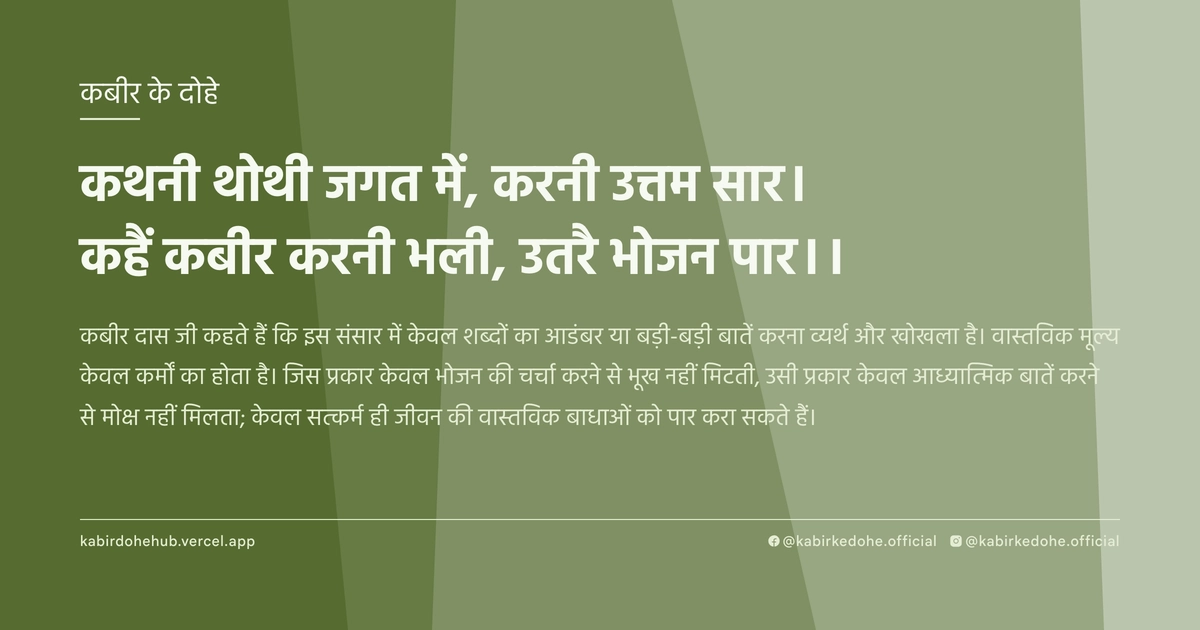
कथनी थोथी जगत में, करनी उत्तम सार।
कहैं कबीर करनी भली, उतरै भोजन पार।।
Kathani thothi jagat mein, karani uttam saar. Kahain kabir karani bhali, utrai bhojan paar.
इस पृष्ठ पर इस कबीर दोहे का अर्थ (meaning), हिंदी व्याख्या और अंग्रेज़ी अनुवाद, दार्शनिक विश्लेषण और व्यावहारिक जीवन सीख दी गई है। यह दोहा निष्ठा (Integrity) विषय से जुड़ा है — Kabir doha meaning and explanation in Hindi and English.
अर्थ (Meaning):
कबीर दास जी कहते हैं कि इस संसार में केवल शब्दों का आडंबर या बड़ी-बड़ी बातें करना व्यर्थ और खोखला है। वास्तविक मूल्य केवल कर्मों का होता है। जिस प्रकार केवल भोजन की चर्चा करने से भूख नहीं मिटती, उसी प्रकार केवल आध्यात्मिक बातें करने से मोक्ष नहीं मिलता; केवल सत्कर्म ही जीवन की वास्तविक बाधाओं को पार करा सकते हैं।
Kabir asserts that in this world, mere words and grand proclamations are hollow and devoid of substance. The true essence of a human being lies in their actions. Just as discussing the quality of food cannot satisfy a starving stomach, talking about spirituality without practicing it cannot lead to liberation; only righteous action allows one to cross the ocean of existence.
व्याख्या (Interpretation):
इस दोहे का शाब्दिक अर्थ है कि कथनी (बोलना) और करनी (करना) के बीच का अंतर ही मनुष्य के आध्यात्मिक स्तर को निर्धारित करता है। कबीर यहाँ 'थोथी' शब्द का प्रयोग कर रहे हैं, जो उस खोखलेपन को दर्शाता है जो तब उत्पन्न होता है जब अहंकार शब्दों के माध्यम से स्वयं को श्रेष्ठ सिद्ध करने का प्रयास करता है। यह निरगुण भक्ति का मूल सिद्धांत है, जहाँ ईश्वर किसी मंदिर या शास्त्र में नहीं, बल्कि शुद्ध आचरण में बसता है। माया हमें शब्दों के जाल में उलझाए रखती है, जहाँ हम 'ज्ञानी' दिखने की कोशिश करते हैं, जबकि वास्तव में हम अज्ञान में डूबे होते हैं। यहाँ 'भोजन पार उतरना' एक रूपक है, जो यह बताता है कि जिस प्रकार भोजन शरीर का पोषण कर उसे जीवित रखता है, उसी प्रकार सत्यपूर्ण कर्म आत्मा का पोषण कर उसे संसार रूपी सागर से पार लगाते हैं। यह अद्वैत वेदांत के उस सत्य की ओर संकेत है जहाँ ज्ञान और कर्म का एक होना ही वास्तविक बोध है।
The literal meaning focuses on the discrepancy between speech and action as the primary determinant of spiritual standing. Kabir uses the word 'thothi' (hollow) to describe the void created when the ego attempts to project superiority through rhetoric. This aligns with the core of Nirgun Bhakti, where the Divine is found not in scriptures or temples, but in the purity of conduct. Maya traps the seeker in a web of words, encouraging the illusion of being a 'scholar' while remaining spiritually dormant. The metaphor of 'crossing over via food' suggests that just as physical sustenance is essential for survival, righteous action is the only fuel that can propel the soul across the turbulent ocean of worldly existence. It points toward the Advaita Vedanta truth that the collapse of the duality between knowing and doing is the only path to true realization.
दार्शनिक विश्लेषण (Philosophical Analysis):
कबीर का यह दोहा उस सामाजिक और धार्मिक परिवेश की प्रतिक्रिया है जहाँ मध्यकालीन भारत में कर्मकांड और पाखंड चरम पर थे। उस समय के पंडित और मुल्ला केवल शास्त्रों की व्याख्या करते थे, लेकिन उनके जीवन में करुणा और सत्य का अभाव था। कबीर ने इस 'बौद्धिक अहंकार' पर प्रहार किया है। उनका दर्शन यह है कि यदि धर्म केवल शब्दों में है, तो वह बोझ है; यदि वह कर्म में है, तो वह मुक्ति है।
दार्शनिक स्तर पर, यह सूफी मत के 'इश्क-ए-हकीकी' (ईश्वर के प्रति प्रेम) से मेल खाता है, जहाँ प्रेम केवल शब्दों में नहीं, बल्कि समर्पण और सेवा में व्यक्त होता है। कबीर का मानना था कि जाति और धर्म की दीवारें शब्दों से नहीं, बल्कि मानवीय व्यवहार से टूटती हैं। जब एक व्यक्ति अपने अहंकार को मिटाकर दूसरों की सेवा करता है, तब वह वास्तव में 'अद्वैत' (non-duality) का अनुभव करता है।
यहाँ 'कथनी' को माया का एक रूप माना गया है। शब्द अक्सर सत्य को ढक लेते हैं। जब हम कहते हैं कि 'मैं सत्यवादी हूँ', तो वह 'मैं' (अहंकार) सत्य को ओझल कर देता है। लेकिन जब हम चुपचाप सत्य का पालन करते हैं, तो अहंकार विलीन हो जाता है। यह मनोवैज्ञानिक रूपांतरण की प्रक्रिया है—बाहरी प्रदर्शन से आंतरिक अनुभव की ओर संक्रमण।
अद्वैत वेदांत के अनुसार, आत्मा और ब्रह्म एक हैं। यह एकता तब प्रकट होती है जब व्यक्ति अपनी पहचान को 'कर्ता' (doer) के रूप में नहीं, बल्कि 'साक्षी' (witness) के रूप में देखता है, और उसके कर्म निस्वार्थ हो जाते हैं। कबीर यहाँ कर्म को ही पूजा मानते हैं। उनके लिए, एक बुनकर का ईमानदारी से कपड़ा बुनना किसी कठिन तपस्या से कम नहीं है, यदि वह कर्म पूर्ण जागरूकता और निस्वार्थ भाव से किया जाए।
अंततः, यह दोहा हमें चेतावनी देता है कि आध्यात्मिक विमर्श (spiritual discourse) एक जाल हो सकता है। लोग अक्सर आध्यात्मिक चर्चाओं का उपयोग अपनी आंतरिक कमियों को छिपाने के लिए करते हैं। कबीर इस ढोंग को नष्ट कर हमें 'करनी' यानी वास्तविक अनुभव की ओर धकेलते हैं, क्योंकि केवल अनुभव ही वह सेतु है जो जीव को शिव से जोड़ता है।
This couplet is a visceral reaction to the socio-religious climate of medieval India, where ritualism and hypocrisy were rampant. The scholars and clerics of the era focused on scriptural exegesis while lacking compassion and integrity in their personal lives. Kabir attacks this 'intellectual arrogance,' arguing that if religion exists only in words, it is a burden; if it exists in action, it is liberation.
Philosophically, this resonates with the Sufi concept of 'Ishq-e-Haqiqi' (Divine Love), where love is not a proclamation but a lived experience of surrender and service. Kabir believed that the barriers of caste and creed are not dismantled by theological debates but by the quality of human interaction. When an individual transcends the ego to serve others, they experience the essence of Advaita (non-duality).
In this context, 'speech' is viewed as a manifestation of Maya. Words often veil the truth. The moment one claims, 'I am a truth-seeker,' the 'I' (the ego) obscures the very truth being sought. However, when one silently embodies truth, the ego dissolves. This is a psychological shift—a transition from external performance to internal realization.
According to Advaita Vedanta, the Atman and Brahman are one. This unity manifests when the individual ceases to identify as the 'doer' and instead acts as a 'witness,' performing deeds without attachment. For Kabir, work is worship. The act of a weaver honestly weaving cloth is as sacred as any rigorous penance, provided it is done with total awareness and selflessness.
Ultimately, the verse warns that spiritual discourse can become a trap. People often use metaphysical discussions to mask their internal voids. Kabir shatters this facade, urging a return to 'Karni' (action), for only lived experience serves as the bridge connecting the finite human to the infinite Divine.
मूल संदेश (Core Message):
- शब्द केवल संकेत हैं, कर्म ही वास्तविक गंतव्य है।
- अहंकार शब्दों में छिपता है, सेवा में वह विलीन होता है।
- ज्ञान का प्रमाण शास्त्र नहीं, बल्कि आचरण की शुद्धता है।
- भोजन शरीर को पालता है, सत्कर्म आत्मा को मुक्त करता है।
- सत्य वह नहीं जो सुना जाए, सत्य वह है जो जिया जाए।
- Words are mere signposts; action is the actual destination.
- The ego hides in rhetoric; it dissolves in selfless service.
- The proof of knowledge is not in scriptures, but in purity of conduct.
- Food sustains the body; righteous action liberates the soul.
- Truth is not something to be heard, but something to be lived.
व्यावहारिक उदाहरण (Practical Example):
वाराणसी के एक पुराने मोहल्ले में रामदीन नाम का एक वृद्ध व्यक्ति रहता था, जो स्वयं को शहर का सबसे बड़ा धर्मशास्त्री मानता था। वह दिन भर गलियों में घूमकर लोगों को नैतिकता, दान और परोपकार पर लंबे-लंबे व्याख्यान देता था। उसकी बातें इतनी प्रभावशाली थीं कि लोग उसे 'महात्मा' मानने लगे थे। वह अक्सर कहता था कि 'परोपकार ही सबसे बड़ा धर्म है' और 'गरीबों की सेवा ही ईश्वर की सेवा है'।
उसी मोहल्ले में एक छोटा सा घर था जहाँ एक विधवा महिला, जानकी, रहती थी। जानकी अनपढ़ थी और उसने कभी किसी शास्त्र को नहीं छुआ था। वह दिन भर दूसरों के घरों में बर्तन मांजती और जो कुछ थोड़ा बहुत कमाती, उसका एक हिस्सा चुपचाप उन भूखे बच्चों को खिला देती जो सड़क पर सोते थे। वह कभी किसी को नहीं बताती थी कि उसने क्या किया, न ही वह कभी धर्म की बातें करती थी।
एक बार शहर में भीषण अकाल पड़ा। रामदीन ने एक बड़ी सभा बुलाई और लोगों को उपदेश दिया कि कैसे संकट के समय धैर्य रखना चाहिए और कैसे ईश्वर से प्रार्थना करके इस आपदा से बचा जा सकता है। उसकी बातें सुनकर लोग मंत्रमुग्ध थे, लेकिन उनकी भूख नहीं मिट रही थी। रामदीन के पास अनाज का भंडार था, लेकिन वह उसे 'संग्रह' मानकर बचा रहा था, यह सोचकर कि भविष्य में वह इससे और अधिक धर्म का प्रचार कर सकेगा।
एक दिन रामदीन ने देखा कि जानकी, जिसके पास खुद खाने के लिए पर्याप्त नहीं था, अपने हिस्से की आखिरी रोटी एक मरणासन्न कुत्ते और एक भूखे भिखारी के बीच बाँट रही थी। उसके चेहरे पर एक ऐसी शांति थी जो रामदीन ने अपनी हज़ारों किताबों और प्रवचनों में नहीं पाई थी।
तभी रामदीन के मन में कबीर का यह दोहा गूँजा—'कथनी थोथी जगत में, करनी उत्तम सार'। उसे अचानक महसूस हुआ कि उसकी सारी विद्वत्ता एक खोखले घड़े की तरह थी, जिसमें शोर तो बहुत था, पर पानी की एक बूँद भी नहीं थी। उसने महसूस किया कि जानकी की चुप्पी उसके शब्दों से कहीं अधिक शक्तिशाली थी क्योंकि उसकी चुप्पी में 'करनी' का सत्य था।
उस क्षण रामदीन का अहंकार टूट गया। उसने अपनी सारी संचित सामग्री मोहल्ले के गरीबों में बाँट दी। उसने बोलना कम कर दिया और सेवा करना शुरू किया। उसने पाया कि जब उसने दूसरों के आँसू पोंछने शुरू किए, तो उसे वह ईश्वर मिल गया जिसे वह शब्दों में खोजने की कोशिश कर रहा था।
रामदीन अब 'महात्मा' नहीं कहलाना चाहता था; वह बस एक 'सेवक' बनना चाहता था। उसने सीखा कि सत्य वह नहीं है जो जीभ से बोला जाए, बल्कि वह है जो हाथों से किया जाए।
उसका जीवन अब एक जीवित उदाहरण बन गया था। लोग अब उसकी बातों को नहीं, बल्कि उसके कार्यों को देखने लगे थे। उसकी 'करनी' ने उसे उस पार पहुँचा दिया जहाँ 'कथनी' कभी नहीं पहुँच सकती थी।
In an ancient lane of Varanasi lived an elderly man named Ramdeen, who considered himself the city's greatest theologian. He spent his days wandering the alleys, delivering long lectures on morality, charity, and altruism. His eloquence was such that people began calling him a 'Mahatma.' He frequently proclaimed, 'Altruism is the highest religion' and 'Serving the poor is serving God.'
In the same neighborhood lived Janaki, a widow in a tiny hut. Janaki was illiterate and had never touched a scripture. She spent her days scrubbing pots in other people's homes, and whatever meager earnings she made, she silently shared with the hungry children who slept on the streets. She never announced her charity, nor did she ever speak of religion.
Once, a severe famine struck the city. Ramdeen organized a grand assembly and lectured the masses on how to maintain patience during crises and how prayer could save them from the disaster. The people were mesmerized by his words, but their hunger remained unsatisfied. Ramdeen had stores of grain, but he hoarded them, believing he could use the resources later to further propagate his teachings.
One day, Ramdeen witnessed Janaki, who had barely enough for herself, dividing her last piece of bread between a dying dog and a starving beggar. There was a serenity on her face that Ramdeen had never found in his thousands of books or sermons.
At that moment, Kabir's couplet echoed in Ramdeen's mind: 'Kathni thothi jagat mein, karni uttam saar.' He suddenly realized that all his scholarship was like a hollow pot—loud and resonant, but containing not a single drop of water. He saw that Janaki's silence was far more powerful than his words because her silence contained the truth of action.
In that instant, Ramdeen's ego shattered. He distributed all his stored grain among the poor of the neighborhood. He stopped speaking and started serving. He discovered that when he began wiping the tears of others, he found the God he had been trying to locate through words.
Ramdeen no longer wished to be called a 'Mahatma'; he simply wanted to be a 'servant.' He learned that truth is not what is uttered by the tongue, but what is enacted by the hands.
His life became a living example. People stopped listening to his words and started observing his deeds. His 'Karni' (action) carried him to that shore where 'Kathni' (speech) could never reach.
अभ्यास मार्गदर्शन (Practice Guidance):
- मौन व्रत और कर्म-साधना: सप्ताह में एक दिन 'मौन' का पालन करें और उस दिन केवल ऐसे कार्य करें जो दूसरों की निस्वार्थ सहायता करें, बिना किसी को बताए।
- आत्म-निरीक्षण जर्नल: प्रतिदिन रात को लिखें—'आज मैंने क्या कहा' बनाम 'आज मैंने वास्तव में क्या किया'। इन दोनों के बीच के अंतर को पहचानें और उसे कम करने का प्रयास करें।
- अहंकार-निरीक्षण: जब भी आप किसी को उपदेश दें या अपनी अच्छाई बताएं, तुरंत रुकें और स्वयं से पूछें, 'क्या यह मेरी आत्मा बोल रही है या मेरा अहंकार?'
- निदान चेकलिस्ट (Diagnostic Checklist): यदि आप निम्न लक्षणों को महसूस करते हैं, तो आप 'कथनी' के जाल में हैं: 1. दूसरों की गलतियाँ आसानी से दिखना पर अपनी नहीं। 2. आध्यात्मिक चर्चाओं के बाद मानसिक संतुष्टि मिलना, लेकिन व्यवहार में कोई बदलाव न आना। 3. प्रशंसा मिलने पर अधिक उपदेश देना।
- Silence and Action Practice: Observe a day of total silence once a week, dedicating that time exclusively to selfless service for others without informing anyone of your deeds.
- Self-Inquiry Journaling: Every night, record 'What I said today' versus 'What I actually did today.' Identify the gap between the two and consciously work to bridge it.
- Ego-Audit: Whenever you find yourself giving advice or praising your own virtues, stop immediately and ask, 'Is this my soul speaking, or is this my ego seeking validation?'
- Diagnostic Checklist: You are trapped in 'Kathni' (hollow speech) if: 1. You easily spot others' flaws but ignore your own. 2. Spiritual discussions give you a sense of accomplishment without changing your behavior. 3. You feel a surge to preach more whenever you receive praise.
चिंतन प्रश्न (Reflection Questions):
- क्या मेरा 'आध्यात्मिक व्यक्तित्व' मेरे वास्तविक निजी व्यवहार से अलग है?
- मैं उन शब्दों का उपयोग करके अपनी किन आंतरिक कमियों को छिपाने की कोशिश करता हूँ जिन्हें मैं सुधार नहीं पा रहा?
- यदि मेरी सारी उपलब्धियों और उपाधियों को छीन लिया जाए, तो मेरे कर्मों की क्या कीमत बचेगी?
- क्या मैं दूसरों को वह सलाह देता हूँ जिसका पालन मैं स्वयं अपने जीवन में नहीं कर पाता?
- मेरी डिजिटल पहचान (सोशल मीडिया) और मेरी वास्तविक दिनचर्या के बीच कितना विरोधाभास है?
- क्या मेरी करुणा केवल शब्दों तक सीमित है, या वह किसी के दुख को कम करने के लिए शारीरिक श्रम करने को तैयार है?
- Is my 'spiritual persona' fundamentally different from my actual private behavior?
- Which internal flaws am I attempting to mask using sophisticated words because I cannot bring myself to fix them?
- If all my titles, accolades, and achievements were stripped away, what value would my actions hold?
- Do I offer advice to others that I am unwilling or unable to implement in my own life?
- How wide is the contradiction between my digital identity (social media) and my actual daily routine?
- Is my compassion limited to words, or is it willing to engage in physical labor to alleviate another's suffering?