
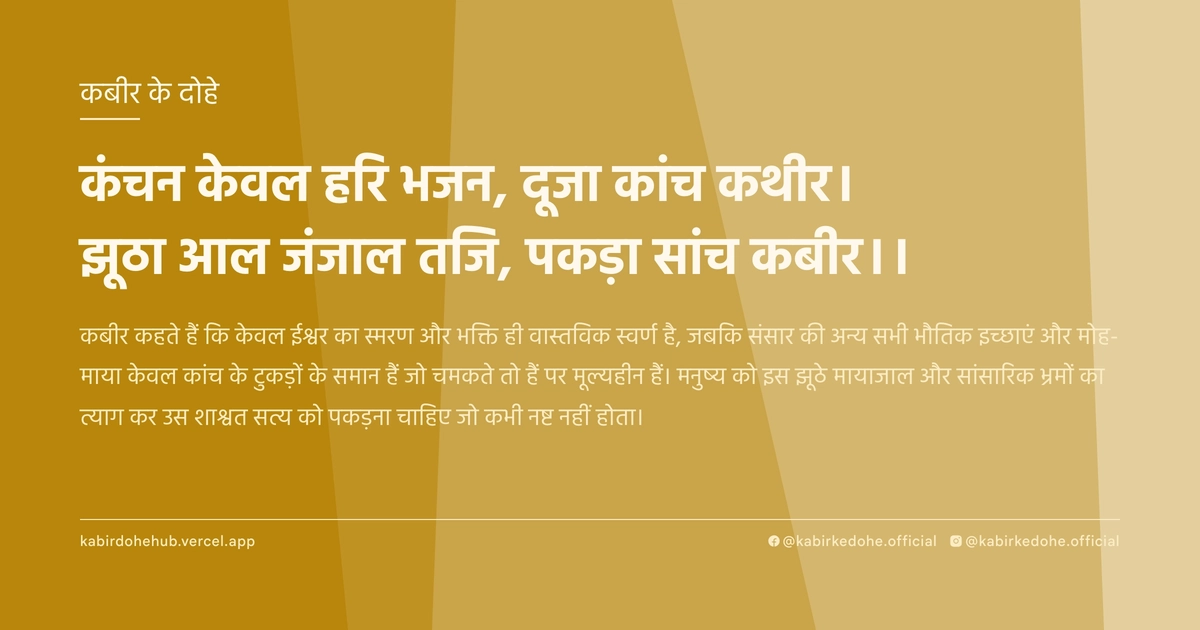
कंचन केवल हरि भजन, दूजा कांच कथीर।
झूठा आल जंजाल तजि, पकड़ा सांच कबीर।।
Kanchan keval hari bhajan, dooja kaanch katheer. Jhootha aal janjal taji, pakda saanch kabir.
इस पृष्ठ पर इस कबीर दोहे का अर्थ (meaning), हिंदी व्याख्या और अंग्रेज़ी अनुवाद, दार्शनिक विश्लेषण और व्यावहारिक जीवन सीख दी गई है। यह दोहा वैराग्य (Detachment) विषय से जुड़ा है — Kabir doha meaning and explanation in Hindi and English.
अर्थ (Meaning):
कबीर कहते हैं कि केवल ईश्वर का स्मरण और भक्ति ही वास्तविक स्वर्ण है, जबकि संसार की अन्य सभी भौतिक इच्छाएं और मोह-माया केवल कांच के टुकड़ों के समान हैं जो चमकते तो हैं पर मूल्यहीन हैं। मनुष्य को इस झूठे मायाजाल और सांसारिक भ्रमों का त्याग कर उस शाश्वत सत्य को पकड़ना चाहिए जो कभी नष्ट नहीं होता।
Kabir asserts that devotion to the Divine is the only true gold, while all other worldly desires and attachments are merely shards of glass—shiny but worthless. He urges the seeker to abandon the deceptive web of illusion and worldly entanglements to grasp the Eternal Truth that remains immutable and timeless.
व्याख्या (Interpretation):
इस दोहे का शाब्दिक अर्थ भौतिक संपदा और आध्यात्मिक संपदा के बीच अंतर करना है। 'कंचन' यहाँ शुद्ध चेतना का प्रतीक है, जबकि 'कांच' माया के छलावे को दर्शाता है। निर्गुण भक्ति के परिप्रेक्ष्य में, हरि केवल एक व्यक्ति नहीं बल्कि वह निराकार ब्रह्म है जो कण-कण में व्याप्त है। अद्वैत वेदांत के अनुसार, जब साधक यह जान लेता है कि वह स्वयं ब्रह्म है, तब संसार का 'जंजाल' स्वतः समाप्त हो जाता है। यहाँ विरोधाभास यह है कि सत्य को पाने के लिए कुछ नया अर्जित नहीं करना है, बल्कि उस झूठ को छोड़ना है जिसे हमने अपनी पहचान मान लिया है। यह आत्मा और परमात्मा के मिलन की वह अवस्था है जहाँ द्वैत समाप्त हो जाता है।
The literal meaning distinguishes between material wealth and spiritual treasure. 'Kanchan' (gold) symbolizes pure consciousness, while 'Kaanch' (glass) represents the deceptive glitter of Maya. In the context of Nirgun Bhakti, 'Hari' is not a anthropomorphic deity but the formless Brahman permeating every atom. According to Advaita Vedanta, when the seeker realizes their identity as Brahman, the 'janjal' or web of illusion dissolves. The central paradox lies in the fact that attaining Truth requires no acquisition, but rather the shedding of the falsehoods we mistake for our identity. It is the state of non-duality where the distinction between the Atman and the Universal Soul vanishes completely.
दार्शनिक विश्लेषण (Philosophical Analysis):
कबीर का यह दोहा उस कालखंड का प्रतिनिधित्व करता है जब समाज कर्मकांडों और बाहरी आडंबरों में उलझा हुआ था। कबीर ने स्पष्ट रूप से मंदिर, मस्जिद और जातिगत श्रेष्ठता के दावों को 'कांच' कहकर खारिज किया। उनका दर्शन सूफी मत के 'फना' (अहंकार का विनाश) और वेदांत के 'माया' सिद्धांत का एक अनूठा संगम है। वे तर्क देते हैं कि जब तक मनुष्य अपनी पहचान बाहरी वस्तुओं, पद या प्रतिष्ठा से जोड़ता है, वह वास्तव में एक कांच के घर में रह रहा होता है जो किसी भी क्षण टूट सकता है।
दार्शनिक स्तर पर, 'झूठा आल' उस मनोवैज्ञानिक प्रक्षेपण को कहते हैं जिसे हम अपनी इच्छाएं और अहंकार कहते हैं। कबीर यहाँ मनोवैज्ञानिक रूपांतरण की बात कर रहे हैं, जहाँ व्यक्ति अपनी बाहरी पहचान (Persona) को त्याग कर अपनी आंतरिक वास्तविकता (Essence) की ओर मुड़ता है। यह केवल वैराग्य नहीं है, बल्कि एक जागरूक चुनाव है।
सूफीवाद के साथ इसका संबंध इस बात में है कि जैसे एक प्रेमी अपने महबूब के अलावा सब कुछ भूल जाता है, वैसे ही भक्त को संसार की नश्वरता को पहचानकर केवल उस एक शाश्वत तत्व पर ध्यान केंद्रित करना चाहिए। यह 'एकता' का अनुभव ही मोक्ष है।
कबीर की अस्वीकृति केवल भौतिक वस्तुओं की नहीं, बल्कि उस मानसिक स्थिति की है जो वस्तुओं को सुख का स्रोत मानती है। वे समझाते हैं कि सुख वस्तु में नहीं, बल्कि उस चेतना में है जो वस्तु को देख रही है।
अंततः, यह दोहा हमें सिखाता है कि सत्य (सांच) वह है जो समय, स्थान और परिस्थिति से परे है। जो कुछ भी बदलता है, वह कांच है; जो अपरिवर्तित रहता है, वही स्वर्ण है।
This couplet represents an era where society was deeply entrenched in rituals and outward displays of piety. Kabir explicitly rejects the claims of temple, mosque, and caste superiority, labeling them as 'glass'—fragile and deceptive. His philosophy is a unique synthesis of the Sufi concept of 'Fana' (annihilation of the ego) and the Vedantic theory of 'Maya' (illusion).
On a philosophical level, 'Jhootha aal' refers to the psychological projection we call desire and ego. Kabir advocates for a psychological transformation where the individual sheds their external persona to return to their inner essence. This is not mere asceticism, but a conscious choice of alignment with Truth.
The connection to Sufism lies in the total absorption of the lover in the Beloved; similarly, the devotee must recognize the transience of the world to focus on the one Eternal Element. This experience of 'Oneness' is the ultimate liberation.
Kabir's rejection is not of material objects themselves, but of the mental state that perceives objects as the source of lasting happiness. He posits that joy resides not in the object, but in the consciousness observing the object.
Ultimately, the doha teaches that Truth (Saanch) is that which transcends time, space, and circumstance. Whatever is subject to change is glass; that which remains immutable is the gold of spiritual realization.
मूल संदेश (Core Message):
- बाहरी चमक अक्सर आंतरिक रिक्तता का मुखौटा होती है।
- सत्य वह है जो समय की कसौटी पर अपरिवर्तित रहे।
- अहंकार का त्याग ही वास्तविक आध्यात्मिक उपलब्धि है।
- भक्ति कोई क्रिया नहीं, बल्कि एक आंतरिक अवस्था है।
- माया का भ्रम केवल जागरूकता के एक क्षण से टूटता है।
- स्वयं को जानना ही ईश्वर को जानने का एकमात्र मार्ग है।
- External glitter is often a mask for internal emptiness.
- Truth is that which remains unchanged by the passage of time.
- The annihilation of ego is the only true spiritual achievement.
- Devotion is not a ritualistic act, but an internal state of being.
- The illusion of Maya is shattered by a single moment of awareness.
- Knowing oneself is the only path to knowing the Divine.
व्यावहारिक उदाहरण (Practical Example):
वाराणसी के घाटों पर रहने वाले एक वृद्ध विधवा, रमा देवी की कहानी है। उन्होंने अपना पूरा जीवन धार्मिक अनुष्ठानों, कठिन उपवासों और दूसरों की नजरों में 'आदर्श सती' दिखने की कोशिश में बिता दिया। उनके लिए धर्म का अर्थ था—नियमों का पालन और सामाजिक मर्यादा।
रमा देवी का मन हमेशा इस बात से अशांत रहता था कि लोग उनके बारे में क्या कहेंगे। वे अपनी पवित्रता को बाहरी कपड़ों और कठोर नियमों में ढूंढती थीं, जो वास्तव में उनके लिए एक मानसिक 'जंजाल' बन गया था।
एक दिन, उन्होंने एक साधारण से फकीर को देखा जो बिना किसी माला या तिलक के, बस एक गहरी शांति में डूबा हुआ था। जब रमा ने उनसे पूछा कि इतनी शांति कहाँ से आती है, तो फकीर ने मुस्कुराकर कहा, 'माँ, तुम कांच के टुकड़ों को सोना समझकर सहेज रही हो। तुम्हारी मर्यादाएं और नियम केवल कांच हैं, असली सोना तो वह प्रेम है जो तुम्हारे भीतर है और जिसे तुम बाहर ढूंढ रही हो।'
यह बात रमा के हृदय पर गहरी चोट कर गई। उन्होंने महसूस किया कि उनकी पूरी 'धार्मिक' पहचान वास्तव में एक अहंकार था, एक मुखौटा था जिसे उन्होंने दुनिया को दिखाने के लिए पहना था।
उन्होंने धीरे-धीरे उन कठोर नियमों को छोड़ दिया जो उन्हें दूसरों से अलग करते थे। उन्होंने पाया कि जब वे बिना किसी दिखावे के गरीबों की सेवा करती हैं, तो उन्हें वह शांति मिलती है जो वर्षों के उपवासों से नहीं मिली थी।
उनकी आंतरिक यात्रा अब 'दिखने' से 'होने' की ओर मुड़ गई। उन्होंने समझा कि ईश्वर किसी विशेष विधि या नियम में नहीं, बल्कि सरल और निस्वार्थ प्रेम में बसता है।
रमा देवी ने अब अपनी पहचान एक 'दुखी विधवा' के रूप में नहीं, बल्कि एक 'मुक्त आत्मा' के रूप में गढ़ी। उन्होंने अपने जीवन के अंतिम वर्षों में वह आनंद पाया जो उन्होंने कभी नहीं सोचा था।
यह 'कबीर ट्विस्ट' था—जब उन्होंने बाहरी कांच (सामाजिक छवि) को तोड़ा, तब उनके भीतर का स्वर्ण (दिव्य प्रेम) चमक उठा। उनका व्यवहार अब उपदेशात्मक नहीं, बल्कि करुणामयी हो गया था।
Consider the story of Rama Devi, an elderly widow living on the ghats of Varanasi. She spent her entire life immersed in religious rituals, rigorous fasting, and striving to be seen as the 'ideal ascetic' in the eyes of society. For her, religion meant strict adherence to rules and social propriety.
Rama Devi's mind was perpetually restless, worried about public perception. She sought her purity in external garments and rigid restrictions, which had effectively become a mental 'janjal' or web of entanglement.
One day, she encountered a simple wandering dervish who sat in profound silence, devoid of any prayer beads or sectarian marks. When Rama asked the secret of his peace, the dervish smiled and said, 'Mother, you are treasuring shards of glass, believing them to be gold. Your rituals and rules are but glass; the real gold is the love within you, which you seek outside.'
These words struck a deep chord in Rama's heart. She realized that her entire 'religious' identity was actually a form of ego—a mask she wore for the world to validate her piety.
Slowly, she began to discard the rigid rules that separated her from others. She discovered that serving the poor without any pretense brought her a peace that years of fasting had never provided.
Her internal journey shifted from 'appearing' to 'being.' She understood that the Divine does not reside in a specific method or rule, but in simple, selfless love.
Rama Devi no longer identified as a 'suffering widow' but as a 'liberated soul.' In the final years of her life, she found a joy she had never previously imagined.
This was the 'Kabir Twist'—once she shattered the external glass (social image), the internal gold (divine love) began to shine. Her behavior shifted from being prescriptive to being profoundly compassionate.
अभ्यास मार्गदर्शन (Practice Guidance):
- दैनिक चिंतन: प्रतिदिन 15 मिनट मौन बैठें और विचार करें कि आपकी कौन सी पहचान (पद, प्रतिष्ठा, संबंध) 'कांच' की तरह है—जो अस्थायी है और जिसे आप स्थायी मान रहे हैं।
- आत्म-पूछताछ जर्नल: एक डायरी लिखें जिसमें उन क्षणों को दर्ज करें जब आपने केवल दूसरों को प्रभावित करने के लिए कोई कार्य किया। पूछें: 'क्या यह कार्य स्वर्ण था या कांच?'
- व्यवहारिक परिवर्तन: सप्ताह में एक बार ऐसा कार्य करें जिसमें कोई बाहरी प्रशंसा न मिले और जिसे कोई न देखे, ताकि आप बाहरी मान्यता की भूख (अहंकार) को कम कर सकें।
- निदान चेकलिस्ट: यदि आप किसी की आलोचना से विचलित होते हैं या अपनी उपलब्धियों पर अत्यधिक गर्व करते हैं, तो समझ लें कि आप अभी भी 'कांच' को पकड़कर बैठे हैं।
- Daily Contemplation: Spend 15 minutes in silence daily, reflecting on which parts of your identity (status, reputation, relationships) are like 'glass'—temporary yet mistaken for permanent.
- Self-Inquiry Journal: Maintain a diary recording moments where you acted solely to impress others. Ask yourself: 'Was this action gold or glass?'
- Behavioral Shift: Once a week, perform an act of kindness that brings no external praise and is witnessed by no one, to diminish the hunger for external validation (ego).
- Diagnostic Checklist: If you find yourself deeply disturbed by criticism or excessively proud of achievements, recognize that you are still clinging to the 'glass'.
चिंतन प्रश्न (Reflection Questions):
- मेरी वह कौन सी सामाजिक छवि है जिसे बनाए रखने के लिए मैं अपनी आंतरिक शांति का बलिदान कर रहा हूँ?
- यदि मेरी सारी उपलब्धियाँ और पद आज छीन लिए जाएँ, तो मेरे पास 'स्वर्ण' के रूप में क्या बचेगा?
- क्या मेरी आध्यात्मिकता वास्तव में मुक्ति का मार्ग है, या यह केवल एक नया 'धार्मिक अहंकार' बन गया है?
- मैं किन 'कांच के टुकड़ों' (अस्थायी सुखों) को पकड़कर बैठा हूँ, यह सोचकर कि वे मुझे पूर्ण करेंगे?
- मेरे जीवन का वह कौन सा हिस्सा है जहाँ मैं सत्य के बजाय सुविधा को चुनता हूँ?
- क्या मैं वास्तव में ईश्वर की खोज कर रहा हूँ, या केवल अपनी इच्छाओं की पूर्ति के लिए एक माध्यम ढूंढ रहा हूँ?
- Which social image am I maintaining at the cost of my internal peace?
- If all my achievements and titles were stripped away today, what 'gold' would remain within me?
- Is my spirituality truly a path to liberation, or has it simply become a new 'religious ego'?
- Which 'shards of glass' (temporary pleasures) am I clinging to, believing they will make me whole?
- In which areas of my life do I choose convenience over truth?
- Am I truly seeking the Divine, or merely searching for a medium to fulfill my personal desires?