
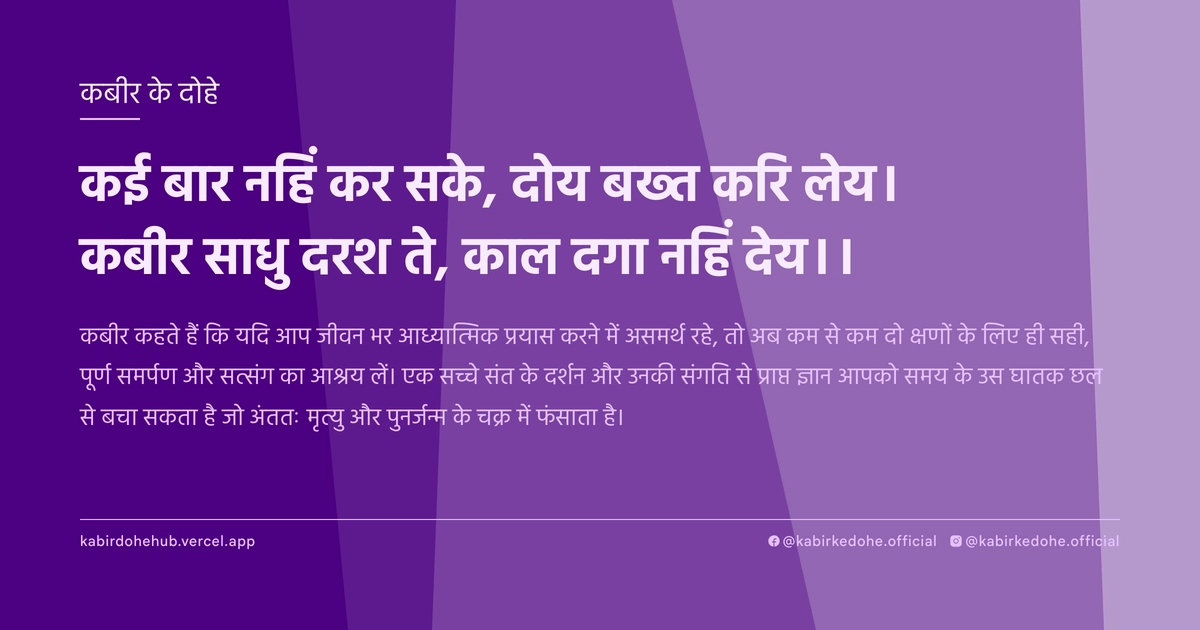
कई बार नहिं कर सके, दोय बख्त करि लेय।
कबीर साधु दरश ते, काल दगा नहिं देय।।
Kai baar nahin kar sake, doy bakht kari ley. Kabir sadhu darash te, kaal daga nahin dey.
इस पृष्ठ पर इस कबीर दोहे का अर्थ (meaning), हिंदी व्याख्या और अंग्रेज़ी अनुवाद, दार्शनिक विश्लेषण और व्यावहारिक जीवन सीख दी गई है। यह दोहा सत्संग (Satsang) विषय से जुड़ा है — Kabir doha meaning and explanation in Hindi and English.
अर्थ (Meaning):
कबीर कहते हैं कि यदि आप जीवन भर आध्यात्मिक प्रयास करने में असमर्थ रहे, तो अब कम से कम दो क्षणों के लिए ही सही, पूर्ण समर्पण और सत्संग का आश्रय लें। एक सच्चे संत के दर्शन और उनकी संगति से प्राप्त ज्ञान आपको समय के उस घातक छल से बचा सकता है जो अंततः मृत्यु और पुनर्जन्म के चक्र में फंसाता है।
Kabir suggests that if you have failed to pursue spiritual growth throughout your life, you should at least dedicate a few moments now to seek the company of a true saint. The insight gained from a genuine spiritual master can shield you from the deceptive nature of time and the inevitable trap of mortality and cyclic existence.
व्याख्या (Interpretation):
इस दोहे का शाब्दिक अर्थ है कि समय सीमित है और यदि लंबी साधना संभव नहीं, तो संक्षिप्त लेकिन गहन अनुभव भी जीवन बदल सकता है। रूपकात्मक स्तर पर, 'दो बख्त' (दो समय) केवल समय की इकाई नहीं, बल्कि जागरूकता की उस तीव्र स्थिति को दर्शाते हैं जहाँ अहंकार का विसर्जन होता है। यह निर्गुण भक्ति का सार है, जहाँ बाहरी कर्मकांडों के बजाय आंतरिक बोध को प्राथमिकता दी जाती है। यहाँ 'काल' केवल समय नहीं, बल्कि वह मायावी शक्ति है जो मनुष्य को सांसारिक मोह में उलझाकर सत्य से दूर रखती है। साधु का दर्शन वास्तव में अपनी ही अंतरात्मा के शुद्ध स्वरूप का दर्शन है। यह अद्वैत वेदांत के उस सिद्धांत को पुष्ट करता है कि एक क्षण का पूर्ण आत्म-साक्षात्कार युगों की तपस्या से अधिक मूल्यवान है। अंततः, यह दोहा मानवीय अस्तित्व के विरोधाभास को दर्शाता है: हम अनंत काल की खोज में क्षणभंगुरता को भूल जाते हैं।
Literally, the verse suggests that if long-term spiritual practice was missed, a brief but intense encounter with truth can suffice. Metaphorically, 'two moments' refers not to chronological time, but to a state of acute consciousness where the ego dissolves. This aligns with Nirgun Bhakti, prioritizing internal realization over external rituals. 'Kaal' (Time) is personified here as the deceptive force of Maya, which keeps the soul entangled in worldly illusions and the cycle of rebirth. Seeking a 'Sadhu' is not merely meeting a person, but encountering the mirror of one's own pure Atman. This echoes Advaita Vedanta, asserting that a single moment of absolute non-dual awareness is superior to centuries of mechanical piety. The central paradox highlighted is the human tendency to chase eternity while ignoring the potency of the present moment.
दार्शनिक विश्लेषण (Philosophical Analysis):
कबीर का यह दोहा उस सामाजिक और धार्मिक परिवेश की प्रतिक्रिया है जहाँ धर्म केवल लंबी तीर्थयात्राओं और जटिल अनुष्ठानों तक सीमित था। कबीर ने इस विचार को चुनौती दी कि मोक्ष केवल कठिन तपस्या या जन्मजात उच्च जाति के लोगों के लिए है। उन्होंने 'साधु' को किसी विशेष वस्त्र या पद से नहीं, बल्कि उस व्यक्ति के रूप में परिभाषित किया जिसने सत्य को जान लिया है। यह दृष्टिकोण सूफी मत के 'पीर' और वेदांत के 'गुरु' की अवधारणाओं का संगम है, जहाँ गुरु केवल एक माध्यम है जो शिष्य के भीतर सोई हुई चेतना को जगाता है।
दार्शनिक रूप से, यहाँ 'काल' का अर्थ समय के साथ-साथ अज्ञानता (Avidya) से भी है। जब मनुष्य यह मानता है कि उसके पास बहुत समय है, तो वह प्रमाद में रहता है। कबीर इस प्रमाद को नष्ट करने के लिए तात्कालिकता (Urgency) का आह्वान करते हैं। यह मनोवैज्ञानिक परिवर्तन की प्रक्रिया है, जहाँ व्यक्ति बाहरी दुनिया के शोर से हटकर आंतरिक मौन की ओर मुड़ता है।
यह शिक्षण स्पष्ट करता है कि आध्यात्मिक प्रगति रैखिक (Linear) नहीं होती। यह एक छलांग (Quantum Leap) है। एक सच्चा सत्संग व्यक्ति के मानसिक ढाँचे को क्षण भर में बदल सकता है, जिससे वह माया के जाल को देख सके। यह कर्मकांडीय धर्म के विरुद्ध एक सशक्त प्रहार है, जो यह सिखाता है कि सत्य किसी मंदिर या मस्जिद में नहीं, बल्कि जागरूकता के एक क्षण में निहित है।
अद्वैत वेदांत के संदर्भ में, यह दोहा आत्मा और ब्रह्म की एकता की याद दिलाता है। जब साधु का दर्शन होता है, तो वास्तव में साधक अपनी ही विस्मृत पहचान को पहचानता है। यह 'अहं ब्रह्मास्मि' का अनुभव है, जो समय और स्थान की सीमाओं को तोड़ देता है।
अंततः, कबीर यहाँ यह चेतावनी दे रहे हैं कि समय सबसे बड़ा धोखेबाज है। वह हमें यह विश्वास दिलाता है कि हम कल बदलेंगे, जबकि परिवर्तन केवल 'अभी' में संभव है। यह अहंकार के विसर्जन की पुकार है, क्योंकि अहंकार ही वह पर्दा है जो हमें काल के छल से बचाता है या उसमें फंसाता है।
This Doha is a direct response to the socio-religious climate of Kabir's era, where spirituality was often reduced to prolonged pilgrimages and rigid rituals. Kabir challenged the notion that liberation was reserved for those capable of lifelong asceticism or those born into high castes. He redefined the 'Sadhu' not by attire or title, but as one who has realized the Truth. This perspective merges the Sufi concept of the 'Pir' with the Vedantic 'Guru', where the teacher acts as a catalyst to awaken the dormant consciousness within the seeker.
Philosophically, 'Kaal' represents both chronological time and spiritual ignorance (Avidya). When humans believe they have an abundance of time, they lapse into spiritual procrastination. Kabir invokes a sense of urgency to shatter this complacency. This is a psychological shift from the external noise of the world to the internal silence of the self.
The teaching emphasizes that spiritual progress is not linear but occurs in quantum leaps. A single encounter with a realized soul can dismantle a lifetime of conditioning, allowing the seeker to perceive the illusions of Maya. This is a potent critique of ritualistic religion, asserting that Truth resides not in structures of stone, but in a moment of absolute awareness.
In the context of Advaita Vedanta, the verse points toward the non-duality of Atman and Brahman. The 'vision of the saint' is actually the recognition of one's own forgotten divinity. It is the experience of 'Aham Brahmasmi', which transcends the limitations of time and space.
Ultimately, Kabir warns that Time is the ultimate deceiver. It lures us into the belief that transformation can be postponed until tomorrow, whereas change is only possible in the 'Now'. This is a call for the annihilation of the ego, as the ego is the very veil that makes us susceptible to the deception of time.
मूल संदेश (Core Message):
- समय का भ्रम सबसे बड़ा आध्यात्मिक अवरोध है।
- सत्य की प्राप्ति के लिए वर्षों की नहीं, बल्कि एक क्षण की पूर्ण जागरूकता पर्याप्त है।
- बाहरी गुरु केवल आंतरिक प्रकाश को जगाने का एक माध्यम है।
- अहंकार को मिटाकर ही काल के चक्र से मुक्ति संभव है।
- वर्तमान क्षण ही एकमात्र द्वार है जहाँ आत्मा और परमात्मा का मिलन होता है।
- The illusion of time is the greatest spiritual obstacle.
- Realization requires not years of effort, but one moment of absolute awareness.
- The external guru is merely a catalyst to ignite the internal light.
- Liberation from the cycle of time is possible only through the annihilation of ego.
- The present moment is the only gateway where the individual soul merges with the Universal Truth.
व्यावहारिक उदाहरण (Practical Example):
वाराणसी के घाटों पर रहने वाले एक वृद्ध नाविक, माधव की कहानी है। माधव ने अपना पूरा जीवन दूसरों को पार उतारने में बिता दिया, लेकिन वह स्वयं जीवन के पार नहीं जा सका। वह हमेशा सोचता था कि जब वह बूढ़ा हो जाएगा और उसकी कमाई पर्याप्त होगी, तब वह संन्यास लेगा और ईश्वर को खोजेगा।
वर्षों बीत गए, और माधव की कमर झुक गई। वह अब भी उसी भ्रम में था कि 'कल' वह आध्यात्मिक होगा। एक दिन, उसकी नाव पर एक साधारण सा दिखने वाला संन्यासी सवार हुआ, जिसकी आँखों में एक अजीब सी शांति थी।
नाव चलाते समय माधव ने संन्यासी से पूछा, 'महाराज, क्या अब भी मेरी मुक्ति संभव है? मैंने तो अपना पूरा जीवन केवल नाव चलाने में बिता दिया।' संन्यासी मुस्कुराया और कहा, 'माधव, नाव चलाना ही तुम्हारी साधना थी, यदि तुम यह जान पाते कि तुम और यह नदी एक ही हैं।'
यह सरल वाक्य माधव के भीतर बिजली की तरह कौंधा। उसे अहसास हुआ कि उसने वर्षों तक जिस 'कल' का इंतज़ार किया, वह वास्तव में एक छलावा था। उसने महसूस किया कि वह जिसे 'नाव चलाना' कह रहा था, वह वास्तव में उसके अहंकार की यात्रा थी।
उस क्षण, माधव ने अपनी नाव के प्रति मोह और भविष्य की चिंता को त्याग दिया। उसने महसूस किया कि वह संन्यासी कोई बाहरी व्यक्ति नहीं, बल्कि उसके अपने भीतर की जागृत चेतना का प्रतिबिंब था।
उसने अपनी पूरी ज़िंदगी की थकान को उस एक क्षण के बोध में विलीन होते देखा। अब वह केवल नाव नहीं चला रहा था, बल्कि वह हर लहर में उस निराकार ईश्वर को देख पा रहा था।
माधव का व्यवहार बदल गया। वह अब यात्रियों से पैसे के लिए नहीं, बल्कि उनके चेहरे की शांति देखने के लिए नाव चलाता था। उसका क्रोध और लालच समाप्त हो गया।
उसने जान लिया कि मोक्ष के लिए हिमालय जाने की ज़रूरत नहीं है; बस एक क्षण के लिए अपनी आँखें खोलकर सत्य को देखना पर्याप्त है। यह उसकी ज़िंदगी का वह 'दो बख्त' था जिसने उसे काल के धोखे से मुक्त कर दिया।
Consider the story of Madhav, an elderly boatman on the ghats of Varanasi. Madhav spent his entire life ferrying others across the river, yet he never crossed the river of his own existence. He always believed that once he grew old and had saved enough money, he would embrace renunciation and seek God.
Years passed, and Madhav's back grew bent. He remained under the illusion that 'tomorrow' he would become spiritual. One day, a simple-looking monk with an extraordinary peace in his eyes boarded his boat.
While rowing, Madhav asked the monk, 'Maharaj, is liberation still possible for me? I have spent my entire life doing nothing but rowing this boat.' The monk smiled and replied, 'Madhav, rowing the boat was your spiritual practice, had you only realized that you and the river are one.'
This simple sentence struck Madhav like a bolt of lightning. He realized that the 'tomorrow' he had been waiting for was a grand deception. He understood that what he called 'rowing the boat' was actually the journey of his own ego.
In that moment, Madhav surrendered his attachment to the boat and his anxiety about the future. He felt that the monk was not an external entity, but a reflection of the awakened consciousness within himself.
He watched the exhaustion of his entire life dissolve into that single moment of realization. He was no longer just rowing a boat; he began to see the formless Divine in every ripple of the water.
Madhav's behavior transformed. He no longer rowed for money, but to witness the peace on his passengers' faces. His anger and greed vanished.
He learned that liberation does not require a journey to the Himalayas; it only requires opening one's eyes to the Truth for a single moment. This was his 'two moments' of grace that freed him from the deception of time.
अभ्यास मार्गदर्शन (Practice Guidance):
- प्रतिदिन 15 मिनट के लिए 'साक्षी भाव' का अभ्यास करें, जहाँ आप अपने विचारों को बिना किसी निर्णय के केवल देखें, जैसे आप किसी और को देख रहे हों।
- एक डायरी लिखें जिसमें आप उन सभी 'कल' की सूचियाँ बनाएँ जिन्हें आपने टाल दिया है, और विश्लेषण करें कि वह कौन सा डर या अहंकार था जिसने आपको 'अभी' में जीने से रोका।
- सचेत उपस्थिति (Mindfulness) का अभ्यास करें: दिन में तीन बार अलार्म लगाएँ और उस क्षण में पूरी तरह उपस्थित होकर यह पूछें, 'क्या मैं इस समय अपनी असली पहचान में हूँ या अपनी सामाजिक भूमिका में?'
- निदान चेकलिस्ट: यदि आप बार-बार भविष्य की चिंता कर रहे हैं या अतीत के पछतावे में हैं, तो आप 'काल के दगा' (समय के छल) के प्रभाव में हैं। यदि आप वर्तमान क्षण में पूर्ण शांति महसूस करते हैं, तो आप जागृति की ओर हैं।
- Practice 'Witness Consciousness' (Sakshi Bhava) for 15 minutes daily, observing your thoughts without judgment, as if you are watching a stranger.
- Maintain a journal listing all the 'tomorrows' you have postponed, analyzing the specific fear or ego-driven resistance that prevented you from living in the 'Now'.
- Implement Mindfulness Triggers: Set three alarms a day to snap back into the present and ask, 'Am I currently existing as my true essence or merely playing a social role?'
- Diagnostic Checklist: If you are frequently consumed by future anxiety or past regret, you are under the influence of 'Kaal's deception'. If you feel absolute peace in the present moment, you are aligning with awakening.
चिंतन प्रश्न (Reflection Questions):
- मैं अपनी आध्यात्मिक यात्रा को 'कल' पर क्यों टालता हूँ, जबकि मेरा शरीर और समय निरंतर घट रहे हैं?
- मेरा वह कौन सा 'डिजिटल अहंकार' है जो मुझे वास्तविक मौन और आत्म-चिंतन से दूर रखता है?
- यदि मुझे पता चले कि यह मेरा अंतिम क्षण है, तो क्या मेरी वर्तमान प्राथमिकताएँ वास्तव में सार्थक होंगी?
- मैं किन सामाजिक मुखौटों के पीछे अपनी वास्तविक आत्मा को छिपाए हुए हूँ?
- क्या मैं वास्तव में सत्य की खोज कर रहा हूँ, या मैं केवल सत्य के बारे में चर्चा करने के सुख में लिप्त हूँ?
- Why do I postpone my spiritual journey to 'tomorrow' while my body and time are continuously diminishing?
- What is the 'digital ego' that keeps me distracted from real silence and self-contemplation?
- If I knew this was my final moment, would my current priorities actually hold any meaning?
- Behind which social masks am I hiding my authentic soul?
- Am I truly seeking the Truth, or am I merely indulging in the pleasure of discussing the Truth?