
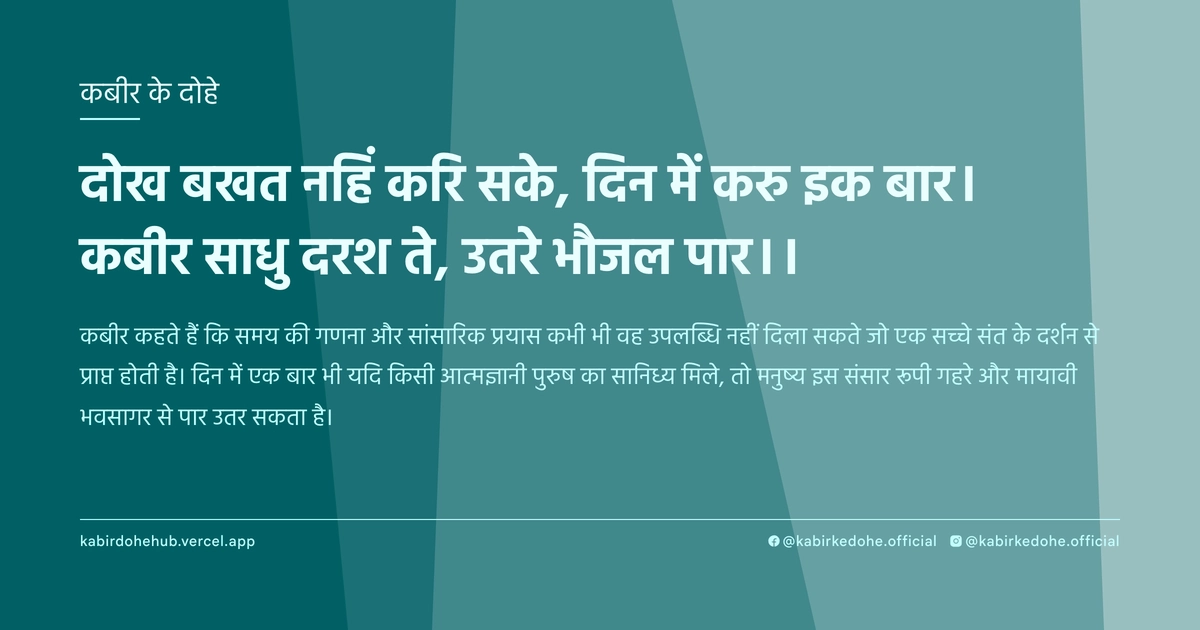
दोख बखत नहिं करि सके, दिन में करु इक बार।
कबीर साधु दरश ते, उतरे भौजल पार।।
Dokh bakhat nahin kar sake, din mein karu ik baar. Kabir sadhu darash te, utre bhaujal paar.
इस पृष्ठ पर इस कबीर दोहे का अर्थ (meaning), हिंदी व्याख्या और अंग्रेज़ी अनुवाद, दार्शनिक विश्लेषण और व्यावहारिक जीवन सीख दी गई है। यह दोहा गुरु महत्व (The Guru's Importance) विषय से जुड़ा है — Kabir doha meaning and explanation in Hindi and English.
अर्थ (Meaning):
कबीर कहते हैं कि समय की गणना और सांसारिक प्रयास कभी भी वह उपलब्धि नहीं दिला सकते जो एक सच्चे संत के दर्शन से प्राप्त होती है। दिन में एक बार भी यदि किसी आत्मज्ञानी पुरुष का सानिध्य मिले, तो मनुष्य इस संसार रूपी गहरे और मायावी भवसागर से पार उतर सकता है।
Kabir asserts that mere temporal efforts and the passage of time cannot achieve the spiritual liberation that a single encounter with a true enlightened soul can provide. Even a brief glimpse or a moment's company of a realized master once a day is sufficient to navigate and transcend the turbulent ocean of worldly existence.
व्याख्या (Interpretation):
इस दोहे का शाब्दिक अर्थ है कि समय की लंबी अवधि भी वह परिणाम नहीं दे सकती जो एक संत का दर्शन देता है। रूपक के स्तर पर, 'भौजल' (भवसागर) उस मायावी संसार का प्रतीक है जहाँ मनुष्य वासनाओं और अज्ञान के कारण फँसा रहता है। यहाँ 'साधु' का अर्थ किसी बाहरी वेशभूषा वाले व्यक्ति से नहीं, बल्कि उस 'सतगुरु' या आत्मज्ञानी से है जिसने अपनी देह और अहंकार का विसर्जन कर दिया है। यह निर्गुण भक्ति का सार है, जहाँ बाहरी कर्मकांडों के बजाय आंतरिक रूपांतरण पर बल दिया गया है। यह अद्वैत वेदांत के उस सिद्धांत को पुष्ट करता है कि ज्ञान का उदय केवल एक 'स्पार्क' या प्रेरणा से हो सकता है, जो एक जागृत चेतना के संपर्क से आता है। यह विरोधाभास है कि वर्षों की तपस्या के बाद भी जो शांति नहीं मिलती, वह एक सच्चे गुरु के एक शब्द या दर्शन से प्राप्त हो सकती है क्योंकि वह शब्द सीधे आत्मा को झकझोरता है।
Literally, the verse suggests that chronological time and routine efforts are insufficient compared to the transformative power of a saint's presence. Metaphorically, 'Bhaujal' (the worldly ocean) represents the cycle of Samsara, where the soul is adrift in the currents of desire and ignorance. The 'Sadhu' here is not a mere ascetic, but the embodiment of the Formless Divine—a realized master who has dissolved the ego. This aligns with Nirgun Bhakti, emphasizing internal awakening over external ritualism. It echoes Advaita Vedanta, suggesting that the transition from ignorance (Avidya) to enlightenment (Vidya) often requires a catalyst—a 'spiritual spark'—provided by one who has already crossed the shore. The central paradox is that while spiritual growth is a lifelong journey, the pivotal shift in consciousness can happen in a fleeting moment of authentic connection, bypassing years of mechanical practice.
दार्शनिक विश्लेषण (Philosophical Analysis):
कबीर का यह दोहा उस युग की प्रतिक्रिया है जहाँ धर्म केवल कर्मकांडों, तीर्थों और लंबी तपस्याओं में सिमट गया था। उन्होंने स्पष्ट किया कि केवल समय बिताने या धार्मिक अनुष्ठान करने से मोक्ष नहीं मिलता। यह दृष्टिकोण सूफी मत के 'पीर' और वेदांत के 'गुरु' की अवधारणा का संगम है, जहाँ गुरु केवल शिक्षक नहीं, बल्कि एक जीवित सेतु है।
दार्शनिक रूप से, कबीर यहाँ 'माया' के प्रभाव की चर्चा कर रहे हैं। माया वह पर्दा है जो आत्मा को उसके वास्तविक स्वरूप (ब्रह्म) से अलग करता है। इस पर्दे को हटाने के लिए एक ऐसी शक्ति की आवश्यकता होती है जो स्वयं माया से मुक्त हो। जब एक साधु का दर्शन होता है, तो वह बाहरी रूप नहीं, बल्कि उसकी आंतरिक शांति और सत्य का प्रभाव होता है जो साधक के भीतर सोई हुई चेतना को जगाता है।
कबीर जाति और वर्ण व्यवस्था का खंडन करते हुए यह बताते हैं कि सत्य किसी विशेष कुल में नहीं, बल्कि उस अनुभव में है जिसे एक 'साधु' ने प्राप्त किया है। उनके लिए 'साधु' वह है जिसने 'मन' को जीत लिया है। यह मनोवैज्ञानिक रूपांतरण की प्रक्रिया है जहाँ अहंकार का विसर्जन होता है और व्यक्ति स्वयं को ब्रह्मांडीय चेतना का हिस्सा मानने लगता है।
अद्वैत वेदांत के अनुसार, हम पहले से ही मुक्त हैं, लेकिन अज्ञान के कारण स्वयं को बंधन में देखते हैं। संत का दर्शन उस अज्ञान को नष्ट करने वाला प्रहार है। यह 'अंधेरे में दीपक' जलाने जैसा है; जैसे ही दीपक जलता है, अंधेरा तुरंत गायब हो जाता है, चाहे वह अंधेरा सदियों पुराना क्यों न हो।
अंततः, यह दोहा हमें यह सिखाता है कि गुणवत्ता, मात्रा से श्रेष्ठ है। घंटों की प्रार्थना से अधिक प्रभावी एक क्षण की सच्ची जागरूकता है। कबीर हमें बाहरी आडंबरों से हटाकर उस जीवंत सत्य की ओर ले जाते हैं जो वर्तमान क्षण में, एक जागृत आत्मा के माध्यम से अनुभव किया जा सकता है।
Kabir’s verse is a critique of the ritualistic rigidity of his era, where spirituality was reduced to mechanical pilgrimages and prolonged austerities. He argues that spiritual liberation is not a product of chronological endurance but of qualitative transformation. This perspective merges the Sufi concept of the 'Pir' with the Vedantic 'Guru,' positioning the master as a living bridge between the finite and the infinite.
Philosophically, Kabir addresses the veil of 'Maya'—the cosmic illusion that obscures the Atman's identity as Brahman. To pierce this veil, one requires a catalyst who has already transcended it. The 'darshan' (vision) of a saint is not about visual observation but about the transmission of a frequency of peace and truth that resonates with the dormant divinity within the seeker.
By emphasizing the 'Sadhu' over the scripture, Kabir dismantles the caste-based monopoly on spiritual knowledge. He asserts that truth is found in realized experience, not in inherited status. A 'Sadhu' is defined not by robes, but by the annihilation of the ego (Fana in Sufism), making the encounter a psychological shock that disrupts the seeker's conditioned patterns.
In the framework of Advaita Vedanta, liberation is the realization of an already existing truth. The saint acts as the mirror that reflects the seeker's true nature. Just as a single spark can ignite a forest, a moment of authentic alignment with a realized soul can incinerate lifetimes of accumulated ignorance (Avidya).
Ultimately, the poem posits that spiritual efficacy is not additive but transformative. It shifts the focus from the quantitative (how many hours spent in prayer) to the qualitative (the depth of awareness). Kabir urges a move away from the dead letter of the law toward the living spirit of truth, accessible through the grace of a realized being.
मूल संदेश (Core Message):
- समय की मात्रा नहीं, चेतना की गुणवत्ता महत्वपूर्ण है।
- बाहरी कर्मकांड आत्मा की प्यास नहीं बुझा सकते।
- एक जागृत आत्मा का सानिध्य अज्ञान के अंधेरे को तुरंत मिटा देता है।
- सत्य किसी प्रक्रिया में नहीं, बल्कि एक क्षणिक बोध में है।
- अहंकार का विसर्जन ही भवसागर से पार उतरने का एकमात्र मार्ग है।
- Quality of consciousness outweighs the quantity of time spent.
- External rituals cannot quench the soul's thirst for truth.
- The presence of an awakened soul instantly dissolves the darkness of ignorance.
- Truth is not a destination reached by a process, but a realization in a moment.
- The dissolution of the ego is the only vessel that crosses the ocean of existence.
व्यावहारिक उदाहरण (Practical Example):
राजस्थान के एक छोटे से गाँव में रामू नाम का एक किसान रहता था। वह बहुत मेहनती था और दिन-भर खेतों में पसीना बहाता था, लेकिन उसका मन हमेशा अशांत रहता था। वह सोचता था कि शांति पाने के लिए उसे बहुत बड़े तीर्थों पर जाना होगा या वर्षों तक कठिन व्रत रखने होंगे। वह हर साल अपनी कमाई का एक हिस्सा मंदिर के दान में देता और घंटों पूजा करता, फिर भी उसके भीतर का क्रोध और असंतोष कम नहीं होता था।
एक दिन गाँव के चौराहे पर एक फकीर आया। वह फकीर न तो कोई उपदेश दे रहा था और न ही कुछ माँग रहा था। वह बस एक पेड़ के नीचे शांत बैठा था। उसकी आँखों में एक ऐसी गहराई और चेहरे पर ऐसा तेज था जिसे रामू ने पहले कभी नहीं देखा था। रामू उसके पास गया और बस चुपचाप उसके सामने बैठ गया।
उस फकीर ने रामू की ओर देखा और बस एक मुस्कान दी। उस एक मुस्कान में ऐसी करुणा और शांति थी कि रामू को अचानक महसूस हुआ कि वह अब तक जिस शांति को बाहर ढूँढ रहा था, वह वास्तव में उसके भीतर ही थी। उसे लगा जैसे उसके मन का सारा बोझ अचानक उतर गया हो।
उस क्षण रामू को समझ आया कि वर्षों की पूजा और तीर्थयात्राएं केवल बाहरी दिखावा थीं। उस फकीर के एक दर्शन ने उसे वह सत्य दिखा दिया जो हज़ारों किताबों में नहीं मिला था। रामू ने महसूस किया कि उसकी समस्या बाहरी नहीं, बल्कि आंतरिक थी।
उस दिन के बाद रामू का व्यवहार बदल गया। उसने अब क्रोध करना छोड़ दिया और अपने पड़ोसियों की मदद बिना किसी स्वार्थ के करने लगा। वह अब भी खेती करता था, लेकिन अब वह काम बोझ नहीं, बल्कि एक साधना बन गया था।
गाँव के लोग हैरान थे कि रामू इतना शांत कैसे हो गया। जब उन्होंने पूछा, तो रामू ने बस उस फकीर की ओर इशारा किया और कहा, 'मैंने अब तक केवल समय बिताया था, लेकिन उस एक पल में मैंने जीवन को जीना सीख लिया।'
रामू ने जान लिया कि सत्य किसी लंबी प्रक्रिया में नहीं, बल्कि एक सही दिशा और सही सानिध्य में है। उसने अपने अहंकार को उस फकीर की शांति में विसर्जित कर दिया था।
यह 'कबीर ट्विस्ट' था—जहाँ वर्षों की यांत्रिक धार्मिकता एक क्षण के जीवंत अनुभव से हार गई और एक साधारण किसान एक शांत योगी बन गया।
In a small village in Rajasthan lived a farmer named Ramu. He was hardworking, spending his days sweating in the fields, yet his mind was a storm of unrest. He believed that peace could only be attained through arduous pilgrimages or years of severe fasting. Every year, he donated a portion of his earnings to temples and spent hours in ritual prayer, yet his inner anger and dissatisfaction remained untouched.
One day, a wandering dervish arrived at the village square. This man neither preached nor begged; he simply sat in profound stillness beneath a banyan tree. There was a depth in his eyes and a radiance on his face that Ramu had never encountered before. Drawn by an unseen force, Ramu approached and sat silently before him.
The dervish looked at Ramu and offered a simple, knowing smile. In that single smile lay such immense compassion and serenity that Ramu suddenly felt the peace he had been searching for externally was actually residing within him. It felt as if a heavy shroud had been lifted from his soul in an instant.
At that moment, Ramu realized that his years of ritualistic piety and pilgrimages were merely external shells. The single 'darshan' of the dervish revealed a truth that thousands of scriptures had failed to convey. He understood that his conflict was not with the world, but with his own perception.
From that day forward, Ramu's behavior transformed. He ceased his outbursts of anger and began helping his neighbors without expectation of reward. He continued to farm, but the labor was no longer a burden; it became a form of meditation.
The villagers were bewildered by his sudden tranquility. When questioned, Ramu simply pointed toward the dervish and said, 'Until now, I was merely spending time; in that one moment, I learned how to live.'
Ramu discovered that truth does not reside in a long, mechanical process, but in the right alignment and the company of a realized soul. He had dissolved his ego into the silence of the master.
This was the 'Kabir Twist'—where years of mechanical religiosity were eclipsed by a single moment of living experience, turning a frustrated farmer into a serene sage.
अभ्यास मार्गदर्शन (Practice Guidance):
- प्रतिदिन 20 मिनट मौन रहकर यह चिंतन करें कि आपके भीतर का 'साक्षी' (Witness) कौन है, जो आपके विचारों को देख रहा है।
- एक 'अहंकार डायरी' बनाएँ: दिन भर में जब भी आप अपनी श्रेष्ठता या दूसरों की हीनता महसूस करें, उसे लिखें और विश्लेषण करें कि वह कौन सा 'मुखौटा' था।
- व्यवहार परिवर्तन: किसी ऐसे व्यक्ति की सेवा करें जिसे आप नापसंद करते हैं, यह देखने के लिए कि क्या आप उनके भीतर उसी 'दिव्य तत्व' को देख पा रहे हैं जिसे आप संत में देखते हैं।
- डायग्नोस्टिक चेकलिस्ट: क्या मैं अभी भी परिणामों (फल) के लिए समय की गणना कर रहा हूँ? क्या मेरी शांति बाहरी परिस्थितियों पर निर्भर है? क्या मैं सत्य को केवल किताबों में ढूँढ रहा हूँ या अपने अनुभवों में?
- Spend 20 minutes daily in absolute silence, contemplating the 'Witness' within who observes your thoughts without judgment.
- Maintain an 'Ego Journal': Record moments when you felt superior to others or clung to your identity, analyzing which 'mask' was operating at that time.
- Behavioral Shift: Perform an act of selfless service for someone you dislike, testing whether you can perceive the same 'divine element' in them as you do in a saint.
- Diagnostic Checklist: Am I still calculating time to achieve peace? Is my serenity dependent on external conditions? Am I seeking truth only in texts or in the living experience of the present?
चिंतन प्रश्न (Reflection Questions):
- क्या मैं वास्तव में सत्य की खोज कर रहा हूँ, या मैं केवल अपनी धार्मिक पहचान (Religious Identity) को पुष्ट करने के लिए अनुष्ठान कर रहा हूँ?
- मेरे जीवन में 'साधु' कौन है—वह जो मुझे मेरी गलतियाँ बताता है, या वह जो मुझे मेरी पूर्णता का अहसास कराता है?
- यदि आज मेरा सारा सामाजिक पद और डिजिटल पहचान छीन ली जाए, तो मेरे भीतर क्या बचेगा?
- मैं किन मानसिक बेड़ियों को 'परंपरा' या 'संस्कार' का नाम देकर ढो रहा हूँ?
- क्या मैं अपनी शांति को भविष्य की किसी उपलब्धि से जोड़कर वर्तमान को नष्ट कर रहा हूँ?
- Am I truly seeking truth, or am I performing rituals merely to reinforce my religious identity?
- Who is the 'Saint' in my life—the one who points out my flaws, or the one who awakens my inherent wholeness?
- If my social status and digital persona were stripped away today, what would remain of my essence?
- Which mental shackles am I carrying under the guise of 'tradition' or 'values'?
- Am I sacrificing my present peace by tying it to a future achievement or a specific timeline?