
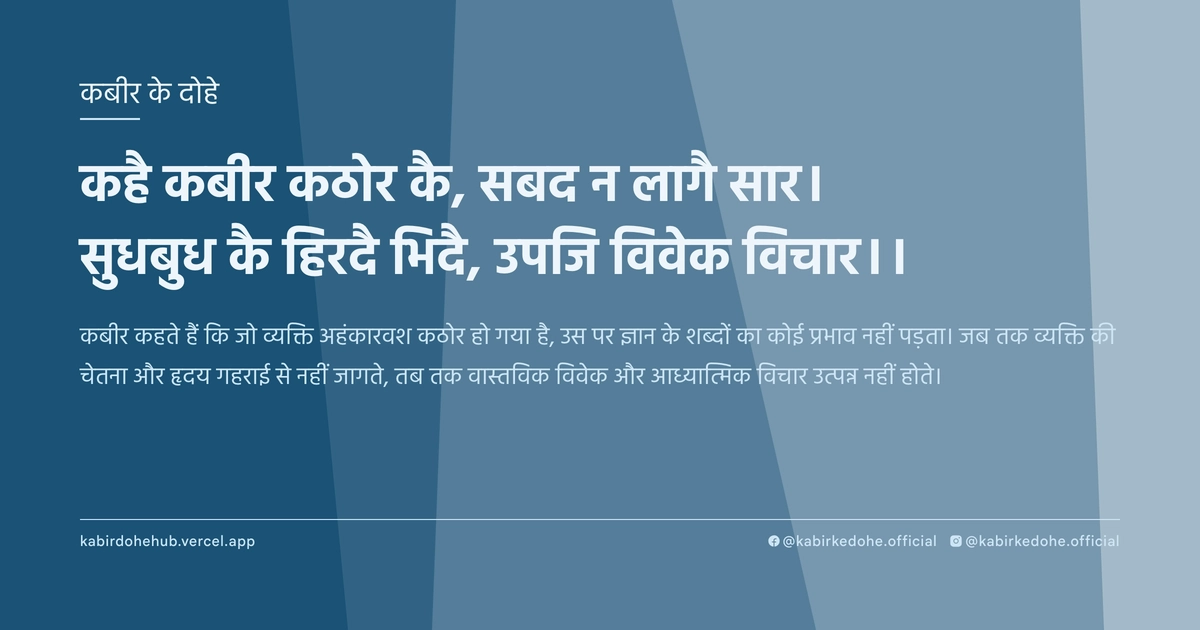
कहै कबीर कठोर कै, सबद न लागै सार।
सुधबुध कै हिरदै भिदै, उपजि विवेक विचार।।
Kahai Kabir kathor kai, sabad na laagai saar. Sudhbudh kai hirdai bhidai, upaji vivek vichaar.
इस पृष्ठ पर इस कबीर दोहे का अर्थ (meaning), हिंदी व्याख्या और अंग्रेज़ी अनुवाद, दार्शनिक विश्लेषण और व्यावहारिक जीवन सीख दी गई है। यह दोहा आत्मनिरीक्षण (Self-introspection) विषय से जुड़ा है — Kabir doha meaning and explanation in Hindi and English.
अर्थ (Meaning):
कबीर कहते हैं कि जो व्यक्ति अहंकारवश कठोर हो गया है, उस पर ज्ञान के शब्दों का कोई प्रभाव नहीं पड़ता। जब तक व्यक्ति की चेतना और हृदय गहराई से नहीं जागते, तब तक वास्तविक विवेक और आध्यात्मिक विचार उत्पन्न नहीं होते।
Kabir asserts that for one whose heart has become hardened by ego, the essence of spiritual words remains ineffective. Only when the consciousness penetrates the depths of the heart does true discernment and spiritual wisdom emerge.
व्याख्या (Interpretation):
इस दोहे का शाब्दिक अर्थ है कि कठोर हृदय वाले व्यक्ति को उपदेश नहीं समझ आते। रूपकात्मक रूप से, 'कठोरता' यहाँ अज्ञान और अहंकार (माया) का प्रतीक है जो आत्मा और परमात्मा के बीच एक दीवार खड़ी कर देता है। निर्गुण भक्ति के अनुसार, ईश्वर किसी बाहरी कर्मकांड से नहीं, बल्कि आंतरिक कोमलता और समर्पण से प्राप्त होता है। जब 'सुध-बुध' यानी पूर्ण जागरूकता हृदय में उतरती है, तब द्वैत समाप्त होता है और अद्वैत वेदांत की स्थिति प्राप्त होती है। यह विरोधाभास है कि जिसे हम बाहरी मजबूती समझते हैं, वह वास्तव में आध्यात्मिक अंधता है। विवेक का उदय तभी होता है जब अहंकार का विसर्जन होता है।
Literally, the verse suggests that a hardened heart is deaf to wisdom. Metaphorically, 'hardness' represents the calcification of the ego and the veil of Maya, which obstructs the realization of the Atman. In the context of Nirgun Bhakti, the Divine is not reached through ritual but through the softening of the heart. When 'Sudh-budh'—absolute mindfulness—pierces the heart, the duality between the seeker and the sought dissolves, aligning with Advaita Vedanta. The central paradox is that the psychological armor we build for protection becomes the very prison that prevents liberation. True 'Vivek' (discernment) is not an intellectual achievement but a spiritual awakening that occurs only after the ego's collapse.
दार्शनिक विश्लेषण (Philosophical Analysis):
कबीर का यह कथन उनके समय के धार्मिक कट्टरपंथ और बाहरी आडंबरों पर एक गहरा प्रहार है। उन्होंने देखा कि लोग शास्त्रों को रटते तो थे, लेकिन उनके व्यवहार में करुणा और विनम्रता का अभाव था। यह विश्लेषण सूफी मत के 'फना' (अहंकार का विनाश) के करीब है, जहाँ साधक को अपनी पहचान मिटानी पड़ती है ताकि वह ईश्वर में विलीन हो सके।
अद्वैत वेदांत के परिप्रेक्ष्य में, यह कठोरता 'अविद्या' है। जब तक व्यक्ति स्वयं को शरीर या सामाजिक पद मानता है, वह सत्य के प्रति अंधा रहता है। कबीर यहाँ यह स्पष्ट कर रहे हैं कि ज्ञान केवल सूचना नहीं है; यदि वह हृदय को स्पर्श नहीं करता, तो वह केवल एक बौद्धिक व्यायाम है।
सामाजिक स्तर पर, कबीर जाति और वर्ण व्यवस्था द्वारा निर्मित श्रेष्ठता के बोध को 'कठोरता' कहते हैं। जो व्यक्ति स्वयं को दूसरों से ऊपर समझता है, वह वास्तव में सत्य से सबसे दूर है क्योंकि उसका हृदय अहंकार के पत्थरों से ढका है।
मनोवैज्ञानिक रूप से, यह दोहा रक्षा तंत्र (defense mechanisms) की बात करता है। मनुष्य अपने दुखों और डर को छिपाने के लिए कठोरता का मुखौटा पहन लेता है, जिससे वह अपनी वास्तविक प्रकृति—जो कि प्रेम और करुणा है—से कट जाता है।
अंततः, कबीर यह संदेश देते हैं कि आध्यात्मिक रूपांतरण के लिए 'विवेक' अनिवार्य है। विवेक वह तलवार है जो अज्ञान के बंधनों को काटती है, लेकिन यह तलवार तभी काम करती है जब हृदय समर्पण के लिए तैयार हो।
Kabir's assertion is a profound critique of the religious dogmatism and external rituals prevalent in his era. He observed that while people memorized scriptures, they lacked compassion and humility in practice. This analysis closely aligns with the Sufi concept of 'Fana' (annihilation of the self), where the seeker must erase their ego to merge with the Divine.
From the lens of Advaita Vedanta, this 'hardness' is 'Avidya' (ignorance). As long as an individual identifies with the body or social status, they remain blind to the ultimate truth. Kabir clarifies that knowledge is not merely information; if it does not touch the heart, it remains a sterile intellectual exercise.
On a social level, Kabir identifies the sense of superiority bred by the caste system as a form of spiritual hardness. Those who perceive themselves as superior are, in reality, the furthest from the truth because their hearts are shielded by the stones of arrogance.
Psychologically, the verse addresses defense mechanisms. Humans often adopt a facade of hardness to mask vulnerability and fear, which alienates them from their true nature—which is innate love and compassion.
Ultimately, Kabir emphasizes that spiritual transformation requires 'Vivek' (discernment). Vivek is the sword that severs the bonds of ignorance, but this sword is only effective when the heart is open and surrendered.
मूल संदेश (Core Message):
- अहंकार सत्य के मार्ग में सबसे बड़ी बाधा है।
- बौद्धिक ज्ञान तब तक व्यर्थ है जब तक वह हृदय को न छुए।
- विनम्रता ही वह द्वार है जिससे विवेक प्रवेश करता है।
- कठोरता सुरक्षा नहीं, बल्कि आध्यात्मिक कारागार है।
- आत्मा का मिलन केवल कोमल हृदय से ही संभव है।
- Ego is the primary obstacle on the path to Truth.
- Intellectual knowledge is futile unless it resonates in the heart.
- Humility is the only gateway through which discernment enters.
- Hardness is not protection, but a spiritual prison.
- Union with the Divine is possible only through a softened heart.
व्यावहारिक उदाहरण (Practical Example):
एक समय की बात है, बनारस के घाटों पर रामदीन नाम का एक पुराना नाविक रहता था। वह अपने काम में निपुण था, लेकिन स्वभाव से अत्यंत क्रोधी और कठोर था। वह मानता था कि उसकी ताकत ही उसकी पहचान है और वह किसी की सलाह सुनना पसंद नहीं करता था।
एक दिन उसकी नाव में एक शांत साधु सवार हुए। साधु ने रामदीन के व्यवहार को देखा और उससे जीवन की नश्वरता और प्रेम के बारे में बात करने की कोशिश की। रामदीन ने उपहास करते हुए कहा, "ये किताबी बातें मेरे काम की नहीं, मुझे केवल लहरों से लड़ना आता है।"
साधु मुस्कुराए और चुप रहे। कुछ दिनों बाद, एक भीषण तूफान आया और रामदीन की नाव एक चट्टान से टकराकर टूट गई। वह पानी में डूब रहा था और उसकी सारी ताकत बेकार हो गई। तभी उसी साधु ने अपनी जान जोखिम में डालकर उसे बचाया।
जब रामदीन होश में आया, तो उसने देखा कि जिस साधु का वह मजाक उड़ा रहा था, उसी ने उसे जीवनदान दिया। उसे एहसास हुआ कि उसकी 'कठोरता' वास्तव में उसकी कमजोरी थी, जिसने उसे दूसरों से अलग कर दिया था।
उस रात, रामदीन ने पहली बार महसूस किया कि उसकी बुद्धि केवल बाहरी दुनिया के लिए थी, हृदय के लिए नहीं। उसने साधु के चरणों में गिरकर क्षमा मांगी।
उसने महसूस किया कि अब तक वह केवल 'नाव' चला रहा था, लेकिन अपने 'जीवन' की दिशा से अनजान था। उसकी आँखों से आँसू बहने लगे और उसका हृदय पिघल गया।
अब रामदीन बदल चुका था। वह अब केवल नाव नहीं चलाता था, बल्कि हर यात्री के साथ करुणा और प्रेम से बात करता था।
उसने सीखा कि असली ताकत लहरों से लड़ने में नहीं, बल्कि अपने भीतर के अहंकार को जीतने में है।
गाँव के लोग हैरान थे कि वह कठोर नाविक अब सबसे विनम्र व्यक्ति बन गया था। यही कबीर का वह 'विवेक' था जिसने उसके जीवन को बदल दिया।
Once, on the ghats of Varanasi, lived an old boatman named Ramdeen. He was skilled in his craft but possessed a temperament of extreme anger and rigidity. He believed his strength was his identity and refused to listen to anyone's advice.
One day, a serene monk boarded his boat. Observing Ramdeen's behavior, the monk attempted to discuss the transience of life and the power of love. Ramdeen mocked him, saying, "These bookish words are useless to me; I only know how to fight the waves."
The monk smiled and remained silent. A few days later, a violent storm struck, and Ramdeen's boat crashed against a rock and shattered. He began to drown, and all his physical strength proved futile.
At that moment, the same monk risked his own life to pull Ramdeen from the churning waters. When Ramdeen regained consciousness, he realized that the man he had ridiculed had saved his life.
He understood that his 'hardness' was actually his greatest weakness, as it had isolated him from the collective human experience. That night, Ramdeen felt for the first time that his intellect was only for the external world, not for the heart.
He fell at the monk's feet and begged for forgiveness. He realized he had been steering a boat, but had been blind to the direction of his own life.
Tears flowed from his eyes, and the frozen layers of his heart finally melted. Ramdeen was transformed.
He no longer just transported passengers; he engaged with every traveler with profound compassion and love.
He learned that true strength lies not in fighting the waves of the river, but in conquering the waves of the ego. The villagers were amazed that the harshest man had become the most humble. This was the 'Vivek' Kabir spoke of, triggering a concrete transformation.
अभ्यास मार्गदर्शन (Practice Guidance):
- प्रतिदिन 15 मिनट मौन रहकर यह विचार करें कि आपके जीवन में कौन सा व्यवहार 'कठोर' है और वह किस डर से उपजा है।
- एक 'अहंकार डायरी' लिखें: उन क्षणों को दर्ज करें जब आपने किसी की बात को केवल इसलिए ठुकराया क्योंकि आप स्वयं को श्रेष्ठ समझ रहे थे।
- सक्रिय करुणा का अभ्यास: दिन भर में कम से कम एक ऐसे व्यक्ति की मदद करें जिससे आपका वैचारिक मतभेद हो।
- निदान चेकलिस्ट: क्या मैं दूसरों की आलोचना तुरंत करता हूँ? क्या मैं अपनी गलती मानने में संकोच करता हूँ? क्या मुझे लगता है कि मैं सब जानता हूँ? यदि हाँ, तो हृदय अभी भी कठोर है।
- Spend 15 minutes daily in silence, contemplating which parts of your behavior are 'hardened' and what fear fuels that rigidity.
- Maintain an 'Ego Journal': Record moments where you dismissed someone's insight simply because you perceived yourself as superior.
- Practice Active Compassion: Perform one act of kindness for someone with whom you have a fundamental ideological disagreement.
- Diagnostic Checklist: Do I criticize others instantly? Do I hesitate to admit mistakes? Do I feel I already know everything? If yes, the heart remains hardened.
चिंतन प्रश्न (Reflection Questions):
- मेरी वह कौन सी 'मजबूती' है जो वास्तव में मेरा अहंकार है और मुझे दूसरों से अलग करती है?
- क्या मैं सत्य की खोज कर रहा हूँ, या केवल अपनी पहले से बनी मान्यताओं की पुष्टि करना चाहता हूँ?
- मेरे डिजिटल व्यक्तित्व (Social Media) की कठोरता मेरे वास्तविक आंतरिक शून्य को कैसे छिपाती है?
- यदि मेरा सारा सामाजिक पद और ज्ञान छीन लिया जाए, तो क्या मेरे भीतर कुछ भी कोमल बचेगा?
- मैं किन लोगों को 'अयोग्य' मानता हूँ, और यह निर्णय मेरे किस पूर्वाग्रह से उपजा है?
- Which of my perceived 'strengths' is actually an ego-shield that isolates me from others?
- Am I truly seeking the Truth, or am I merely seeking confirmation of my existing biases?
- How does the hardness of my digital persona mask the internal void within me?
- If all my social status and knowledge were stripped away, would anything tender remain within me?
- Whom do I deem 'unworthy,' and from which hidden prejudice does this judgment arise?