
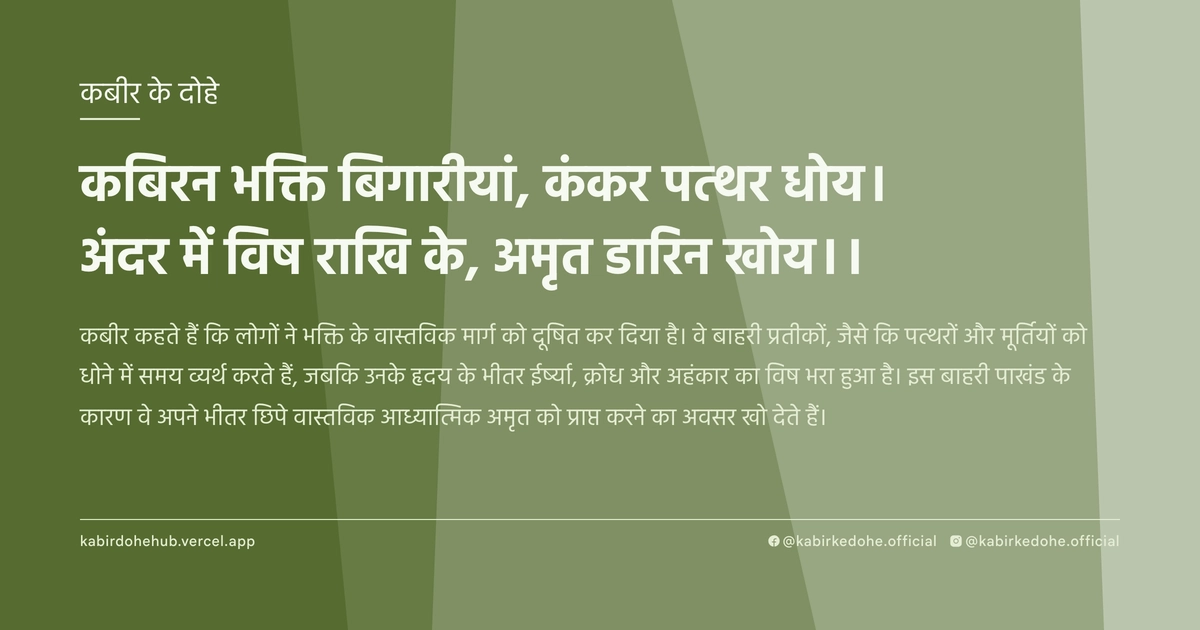
कबिरन भक्ति बिगारीयां, कंकर पत्थर धोय।
अंदर में विष राखि के, अमृत डारिन खोय।।
Kabiran bhakti bigariyan, kankar patthar dhoy. Andar me vish rakhi ke, amrit darin khoy.
इस पृष्ठ पर इस कबीर दोहे का अर्थ (meaning), हिंदी व्याख्या और अंग्रेज़ी अनुवाद, दार्शनिक विश्लेषण और व्यावहारिक जीवन सीख दी गई है। यह दोहा कर्मकांड विरोध (Critique of Ritualism) विषय से जुड़ा है — Kabir doha meaning and explanation in Hindi and English.
अर्थ (Meaning):
कबीर कहते हैं कि लोगों ने भक्ति के वास्तविक मार्ग को दूषित कर दिया है। वे बाहरी प्रतीकों, जैसे कि पत्थरों और मूर्तियों को धोने में समय व्यर्थ करते हैं, जबकि उनके हृदय के भीतर ईर्ष्या, क्रोध और अहंकार का विष भरा हुआ है। इस बाहरी पाखंड के कारण वे अपने भीतर छिपे वास्तविक आध्यात्मिक अमृत को प्राप्त करने का अवसर खो देते हैं।
Kabir asserts that people have corrupted the true essence of devotion. They waste their efforts washing external symbols, such as pebbles and stones, while harboring the poison of hatred, greed, and ego within their hearts. By obsessing over these outward rituals, they lose the opportunity to discover and experience the divine nectar of spiritual awakening residing within themselves.
व्याख्या (Interpretation):
यह दोहा बाहरी कर्मकांड और आंतरिक शुद्धि के बीच के गहरे विरोधाभास को दर्शाता है। कबीर 'कंकर पत्थर' को उन सभी मृत प्रतीकों और रूढ़ियों के रूप में देखते हैं जिन्हें लोग ईश्वर मान लेते हैं। 'विष' यहाँ अविद्या और अहंकार का प्रतीक है जो आत्मा को परमात्मा से अलग करता है। निर्गुण भक्ति के अनुसार, ईश्वर किसी पत्थर में नहीं बल्कि चेतना के उच्चतम स्तर पर स्थित है। जब तक साधक अपने भीतर के द्वेष को समाप्त नहीं करता, बाहरी पूजा केवल एक मानसिक भ्रम है। यह अद्वैत वेदांत के उस सत्य की ओर संकेत करता है जहाँ आत्मा और ब्रह्म एक हैं, लेकिन माया के पर्दे और आंतरिक मलिनता इस एकता को छुपा देती है। अंततः, यह दोहा हमें चेतावनी देता है कि वास्तविक तीर्थयात्रा बाहर नहीं, बल्कि अपने भीतर की यात्रा है।
This couplet highlights the profound paradox between external ritualism and internal purification. Kabir views 'pebbles and stones' as metaphors for dead symbols and rigid dogmas that people mistake for the Divine. The 'poison' represents Avidya (ignorance) and the ego, which create a perceived separation between the Atman and Brahman. In the tradition of Nirgun Bhakti, the Divine is not confined to an idol but is the formless consciousness pervading all existence. When a seeker prioritizes the washing of a stone over the cleansing of the heart, they remain trapped in Maya, the cosmic illusion. This reflects the Advaita Vedanta principle that the realization of non-duality is impossible as long as the internal 'poison' of duality persists. Ultimately, the verse suggests that the only authentic pilgrimage is the inward journey from the ego to the essence.
दार्शनिक विश्लेषण (Philosophical Analysis):
कबीर का यह दृष्टिकोण उनके समय के सामाजिक और धार्मिक परिवेश की एक तीखी प्रतिक्रिया था। मध्यकालीन भारत में, धर्म अक्सर केवल बाहरी दिखावे, जातिगत श्रेष्ठता और जटिल अनुष्ठानों तक सीमित हो गया था। कबीर ने इस 'संस्थागत धर्म' को चुनौती दी और घोषणा की कि ईश्वर किसी मंदिर या मस्जिद का मोहताज नहीं है। उनका दर्शन सूफीवाद के 'फना' (अहंकार का विनाश) और वेदांत के 'अहं ब्रह्मास्मि' का एक अनूठा संगम है। वे तर्क देते हैं कि यदि हृदय में करुणा नहीं है, तो हज़ारों बार स्नान करना भी व्यर्थ है।
दार्शनिक स्तर पर, कबीर यहाँ 'साधन' और 'साध्य' के बीच के अंतर को स्पष्ट कर रहे हैं। पत्थर धोना एक 'साधन' हो सकता है, लेकिन यदि वह साधक के अहंकार को बढ़ाता है, तो वह साध्य (मोक्ष) से उसे दूर ले जाता है। यह मनोवैज्ञानिक रूपांतरण की बात है; जहाँ व्यक्ति को अपनी छाया (Shadow) का सामना करना चाहिए न कि उसे धार्मिक प्रतीकों के पीछे छुपाना चाहिए।
कबीर की अस्वीकृति केवल मूर्तियों की नहीं, बल्कि उस मानसिक जड़ता की है जो मनुष्य को सत्य की खोज से रोकती है। वे 'अमृत' को उस सहज ज्ञान के रूप में देखते हैं जो हर मनुष्य में जन्मजात है, लेकिन सामाजिक कंडीशनिंग और मानसिक विकारों के कारण दब गया है।
सूफी संतों की तरह, कबीर भी हृदय की पवित्रता पर बल देते हैं। उनके लिए भक्ति कोई क्रिया नहीं, बल्कि एक अवस्था है। जब 'मैं' (अहंकार) मिट जाता है, तब केवल 'वह' (परमात्मा) बचता है। यही वह बिंदु है जहाँ विष अमृत में बदल जाता है।
अंततः, यह विश्लेषण हमें सिखाता है कि आध्यात्मिकता का अर्थ नियमों का पालन करना नहीं, बल्कि स्वयं के झूठ से मुक्त होना है। कबीर का मार्ग कठिन है क्योंकि यह हमें हमारे अपने अंधेरे का सामना करने के लिए मजबूर करता है, न कि हमें किसी बाहरी देवता के सामने झुकने का आसान रास्ता देता है।
Kabir's perspective was a visceral reaction to the socio-religious climate of medieval India, where spirituality had devolved into mere external displays, caste hierarchies, and rigid ritualism. He challenged this 'institutionalized religion,' proclaiming that the Divine is not confined to the walls of a temple or mosque. His philosophy represents a unique synthesis of the Sufi concept of 'Fana' (the annihilation of the self) and the Vedantic realization of 'Aham Brahmasmi' (I am Brahman).
On a philosophical level, Kabir distinguishes between the 'means' (Sadhana) and the 'end' (Sadhya). Washing a stone may be a ritualistic means, but if it reinforces the practitioner's ego or sense of superiority, it becomes an obstacle to the ultimate goal of liberation. This is a call for psychological transformation; the seeker must confront their 'shadow' rather than masking it with religious piety.
Kabir's rejection is not merely of idols, but of the mental inertia that prevents a human from seeking truth. He views 'Amrit' (nectar) as the innate spiritual wisdom present in every being, which has been suppressed by social conditioning and mental impurities.
Similar to the Sufi mystics, Kabir emphasizes the purity of the heart. For him, Bhakti is not an act to be performed but a state of being to be realized. When the 'I' (ego) is dissolved, only the 'Thou' (the Divine) remains. This is the precise moment where the poison of duality is transmuted into the nectar of unity.
Ultimately, this analysis reveals that spirituality is not about adhering to a set of rules, but about liberating oneself from internal deception. Kabir's path is demanding because it forces the individual to face their own darkness rather than offering the easy solace of external worship.
मूल संदेश (Core Message):
- बाहरी दिखावा आंतरिक रिक्तता को कभी नहीं भर सकता।
- अहंकार का विष अमृत के अनुभव में सबसे बड़ी बाधा है।
- सच्ची भक्ति मूर्तियों में नहीं, बल्कि मनुष्य के आचरण में है।
- हृदय की शुद्धि के बिना किया गया कोई भी अनुष्ठान व्यर्थ है।
- परमात्मा को पाने का मार्ग स्वयं के विकारों को मिटाने से शुरू होता है।
- External piety cannot fill the void of internal emptiness.
- The poison of ego is the primary obstacle to experiencing divine nectar.
- True devotion resides in human conduct, not in stone idols.
- Any ritual performed without heart-purification is a futile exercise.
- The path to the Divine begins with the eradication of internal vices.
व्यावहारिक उदाहरण (Practical Example):
वाराणसी के एक पुराने घाट पर माधव नाम का एक वृद्ध व्यक्ति रहता था। माधव शहर का सबसे बड़ा धर्मशास्त्री माना जाता था। वह प्रतिदिन ब्रह्म मुहूर्त में उठकर गंगा स्नान करता, घंटों तक पत्थरों की मूर्तियों को महंगे इत्र और दूध से नहलाता और शास्त्रों के कठिन श्लोक रटता था। पूरे शहर में उसकी ख्याति एक 'पवित्र' पुरुष की थी।
किंतु, माधव के भीतर एक गहरा अंधेरा था। वह अपने ही परिवार के सदस्यों से घृणा करता था और अपने शिष्यों को उनकी जाति के आधार पर नीचा दिखाता था। उसके मन में यह अहंकार था कि वह दूसरों से अधिक शुद्ध है। वह बाहर से तो अमृत की बातें करता था, लेकिन उसके शब्दों में दूसरों के लिए विष था।
एक दिन, एक साधारण सा बुनकर उसके पास आया और उससे एक सरल प्रश्न पूछा, "बाबा, यदि गंगा शरीर की गंदगी धोती है, तो मन के भीतर जमी नफरत को कौन धोता है?" माधव ने उसे झिड़क दिया और अपनी श्रेष्ठता का प्रदर्शन करने लगा।
उस रात माधव को एक सपना आया। उसने देखा कि वह एक विशाल सोने के मंदिर में खड़ा है, लेकिन मंदिर की दीवारों से काला विष रिस रहा है। वह जितना अधिक मूर्तियों को धोता, विष उतना ही बढ़ता जाता। अचानक उसे महसूस हुआ कि वह विष मूर्तियों से नहीं, बल्कि उसके अपने हाथों और हृदय से निकल रहा है।
वह घबराकर जागा और उसने महसूस किया कि उसकी सारी पूजा केवल एक ढोंग थी। उसने महसूस किया कि उसने जीवन भर 'पत्थरों' को तो चमकाया, लेकिन अपनी आत्मा को सड़ने दिया।
अगली सुबह, माधव ने अपनी महंगी पोशाकें त्याग दीं। उसने उन लोगों से क्षमा मांगी जिन्हें उसने नीचा दिखाया था। उसने पाया कि जब उसने अपने भीतर की नफरत (विष) को स्वीकार किया और उसे करुणा से धोया, तब उसे वह शांति मिली जो उसे हज़ारों स्नान में नहीं मिली थी।
उसने अब मूर्तियों की पूजा छोड़ दी और लोगों की सेवा में लग गया। उसने समझा कि असली मंदिर मनुष्य का हृदय है।
माधव का जीवन अब दिखावे से मुक्त था। वह अब एक 'पवित्र' व्यक्ति नहीं, बल्कि एक 'सच्चा' व्यक्ति बन गया था।
उसने अंततः जान लिया कि अमृत बाहर से नहीं आता, वह तब प्रकट होता है जब भीतर का विष समाप्त हो जाता है।
In the ancient ghats of Varanasi lived an elderly man named Madhav. Madhav was regarded as the city's foremost scholar of scriptures. Every day, he woke during the Brahma Muhurta, bathed in the Ganges, spent hours bathing stone idols with expensive perfumes and milk, and recited complex Sanskrit shlokas. The entire city revered him as a 'holy' man.
However, within Madhav resided a profound darkness. He harbored deep resentment toward his own family and routinely belittled his students based on their caste. He carried a towering ego, believing himself to be spiritually superior to all others. While his lips spoke of divine nectar, his heart leaked poison toward his fellow humans.
One day, a simple weaver approached him and asked a piercing question: "Baba, if the Ganges washes the dirt from the body, who washes the hatred accumulated within the mind?" Madhav dismissed him with a sneer, asserting his scholarly superiority.
That night, Madhav had a vivid dream. He saw himself standing in a magnificent golden temple, but black poison was seeping from the walls. The more he scrubbed the idols, the more the poison spread. Suddenly, he realized the poison was not coming from the stones, but from his own hands and heart.
He woke up trembling, realizing that his entire spiritual practice had been a facade. He saw that he had spent a lifetime polishing stones while allowing his own soul to decay.
The next morning, Madhav discarded his ornate robes. He sought forgiveness from those he had demeaned. He discovered that once he acknowledged the hatred (poison) within and washed it with genuine compassion, he experienced a peace that thousands of ritual baths had never provided.
He ceased his obsession with idols and dedicated himself to the service of the suffering. He understood that the only true temple is the human heart.
Madhav's life was no longer a performance. He was no longer a 'holy' man in the eyes of society, but he had finally become a 'truthful' man.
He finally understood that the nectar of divinity does not come from without; it manifests only when the internal poison is eradicated.
अभ्यास मार्गदर्शन (Practice Guidance):
- प्रतिदिन 20 मिनट मौन रहकर यह निरीक्षण करें कि आपके मन में किन लोगों के प्रति क्रोध या ईर्ष्या है। इसे बिना किसी निर्णय के केवल देखें।
- एक 'छाया पत्रिका' (Shadow Journal) बनाएँ जहाँ आप अपनी उन बुराइयों को लिखें जिन्हें आप दुनिया से छुपाते हैं। स्वीकारोक्ति ही विषहरण की पहली सीढ़ी है।
- जब भी आप किसी बाहरी धार्मिक अनुष्ठान में शामिल हों, तो स्वयं से पूछें: "क्या यह क्रिया मेरे अहंकार को बढ़ा रही है या मुझे विनम्र बना रही है?"
- डायग्नोस्टिक चेकलिस्ट: यदि आप दूसरों की गलतियों पर तुरंत प्रतिक्रिया देते हैं लेकिन अपनी गलतियों को 'दैवीय इच्छा' बताकर टालते हैं, तो आप अभी भी 'पत्थर धो रहे हैं'।
- Spend 20 minutes in silence daily, observing the specific feelings of anger or jealousy you hold toward others. Observe these emotions without judgment.
- Maintain a 'Shadow Journal' where you record the flaws and biases you hide from the world. Honest acknowledgment is the first step in neutralizing the internal poison.
- Whenever engaging in an external religious ritual, ask yourself: "Is this act inflating my ego or cultivating genuine humility within me?"
- Diagnostic Checklist: If you react instantly to others' flaws but excuse your own as 'divine will' or 'destiny,' you are still merely 'washing stones' while ignoring the poison.
चिंतन प्रश्न (Reflection Questions):
- मेरे जीवन में वे कौन से 'पत्थर' (बाहरी प्रतीक) हैं जिन्हें मैं अपनी आंतरिक कमियों को छुपाने के लिए ढाल बनाता हूँ?
- यदि आज मेरी सारी धार्मिक पहचान छीन ली जाए, तो क्या मेरे भीतर कोई वास्तविक करुणा शेष रहेगी?
- मैं किन लोगों को 'अपवित्र' मानता हूँ, और क्या यह धारणा मेरे अपने अहंकार का प्रतिबिंब है?
- मेरे शब्दों में मिठास है, लेकिन क्या मेरे विचारों में दूसरों के लिए गुप्त विष है?
- क्या मेरी आध्यात्मिकता मुझे दूसरों के प्रति अधिक सहिष्णु बना रही है, या अधिक निर्णयात्मक?
- मैं अपनी छवि को 'अच्छा' दिखाने के लिए कितनी ऊर्जा व्यर्थ करता हूँ, जबकि मेरा आंतरिक जगत अस्त-व्यस्त है?
- What are the 'stones' (external symbols) in my life that I use as shields to hide my internal deficiencies?
- If all my religious and social identities were stripped away today, would any genuine compassion remain within me?
- Who do I perceive as 'impure,' and is this perception merely a reflection of my own ego?
- There may be sweetness in my words, but is there a hidden poison in my thoughts toward others?
- Is my spirituality making me more tolerant of others, or more judgmental of them?
- How much energy do I waste projecting a 'good' image while my internal world remains in chaos?