
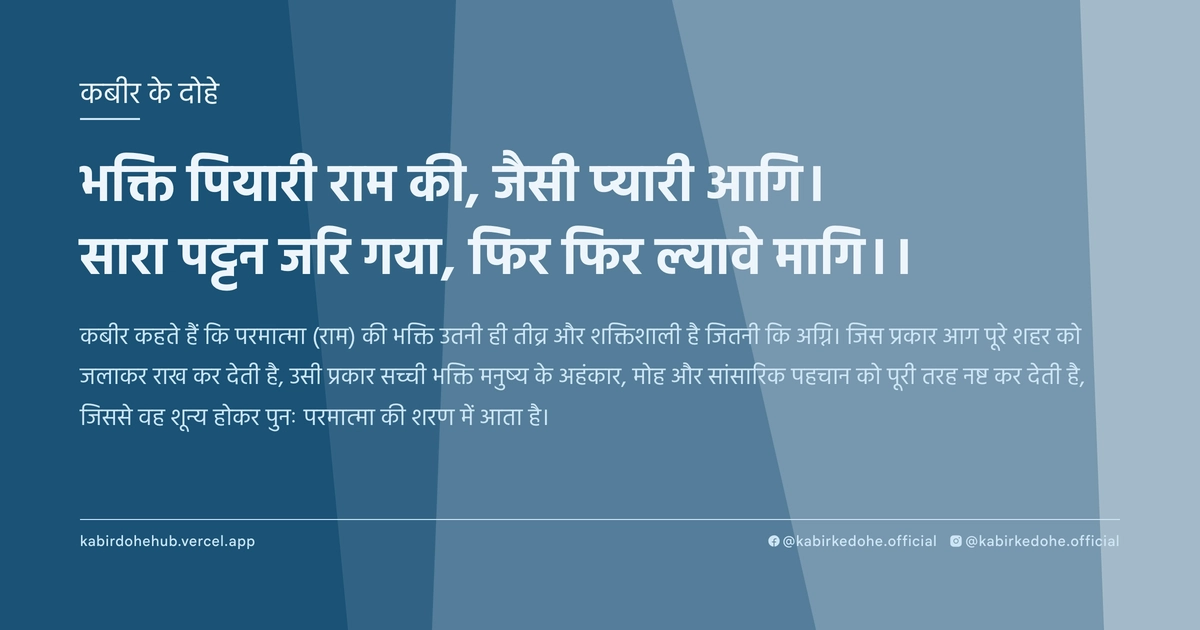
भक्ति पियारी राम की, जैसी प्यारी आगि।
सारा पट्टन जरि गया, फिर फिर ल्यावे मागि।।
Bhakti piyari ram ki, jaisi pyari aagi. Sara pattan jari gaya, phir phir lyave magi.
इस पृष्ठ पर इस कबीर दोहे का अर्थ (meaning), हिंदी व्याख्या और अंग्रेज़ी अनुवाद, दार्शनिक विश्लेषण और व्यावहारिक जीवन सीख दी गई है। यह दोहा भक्ति (Bhakti) विषय से जुड़ा है — Kabir doha meaning and explanation in Hindi and English.
अर्थ (Meaning):
कबीर कहते हैं कि परमात्मा (राम) की भक्ति उतनी ही तीव्र और शक्तिशाली है जितनी कि अग्नि। जिस प्रकार आग पूरे शहर को जलाकर राख कर देती है, उसी प्रकार सच्ची भक्ति मनुष्य के अहंकार, मोह और सांसारिक पहचान को पूरी तरह नष्ट कर देती है, जिससे वह शून्य होकर पुनः परमात्मा की शरण में आता है।
Kabir asserts that devotion to the Divine (Ram) is as intense and consuming as fire. Just as a raging fire reduces an entire city to ashes, true spiritual devotion incinerates the ego, worldly attachments, and the false sense of identity, leaving the seeker in a state of absolute surrender and longing.
व्याख्या (Interpretation):
इस दोहे का शाब्दिक अर्थ है कि भक्ति की अग्नि सब कुछ जला देती है। आध्यात्मिक स्तर पर, 'पट्टन' या शहर हमारे अहंकार और सामाजिक मुखौटों का प्रतीक है। निर्गुण भक्ति में, राम कोई व्यक्ति नहीं बल्कि वह निराकार चेतना है जो सर्वव्यापी है। जब साधक इस सत्य का अनुभव करता है, तो उसकी 'मैं' की भावना नष्ट हो जाती है। यह अद्वैत वेदांत के उस सिद्धांत से मिलता है जहाँ जीव और ब्रह्म का भेद मिट जाता है। माया का पर्दा जल जाता है और केवल शुद्ध आत्मा शेष रहती है। यह एक विरोधाभास है कि सब कुछ खोकर ही वास्तव में सब कुछ प्राप्त किया जाता है।
Literally, the verse speaks of devotion as a consuming fire. Metaphorically, the 'city' represents the fortified walls of the ego and the social masks we wear. In Nirgun Bhakti, 'Ram' is not a mythological figure but the formless, omnipresent consciousness. When a seeker experiences this truth, the illusion of a separate 'I' is incinerated. This aligns with Advaita Vedanta, where the duality between the individual soul (Atman) and the universal spirit (Brahman) dissolves. The veil of Maya is burnt away, leaving only pure existence. It presents the central paradox: only through total annihilation of the self can one achieve true wholeness.
दार्शनिक विश्लेषण (Philosophical Analysis):
कबीर का यह दोहा उस समय के धार्मिक पाखंड और कर्मकांडों पर एक गहरा प्रहार है। उन्होंने बाहरी पूजा-पाठ के बजाय आंतरिक रूपांतरण पर जोर दिया। उनके समय में धर्म को बाहरी दिखावे और जातिगत श्रेष्ठता से जोड़ा गया था, जिसे कबीर ने 'अग्नि' के माध्यम से चुनौती दी। उनके लिए भक्ति कोई शांत प्रक्रिया नहीं, बल्कि एक क्रांतिकारी परिवर्तन है।
यह विचार सूफीवाद के 'फना' (Fana) के सिद्धांत के बहुत करीब है, जहाँ प्रेमी अपने अस्तित्व को ईश्वर की इच्छा में विलीन कर देता है। जब तक 'मैं' जीवित है, तब तक 'वह' (परमात्मा) प्रकट नहीं हो सकता। यह अहंकार का विनाश ही वास्तविक मोक्ष है।
अद्वैत वेदांत के परिप्रेक्ष्य में, यह अग्नि 'ज्ञान' की अग्नि है। अज्ञानता ही वह शहर है जिसे जलाना आवश्यक है। कबीर यह समझाते हैं कि भक्ति केवल प्रार्थना नहीं, बल्कि एक मानसिक शल्य चिकित्सा है जो आत्मा को अशुद्धियों से मुक्त करती है।
सांस्कृतिक रूप से, कबीर ने यह संदेश दिया कि ईश्वर तक पहुँचने का मार्ग किसी मंदिर या मस्जिद से नहीं, बल्कि हृदय की तीव्रता से होकर गुजरता है। उन्होंने यह स्पष्ट किया कि जो व्यक्ति अपनी पहचान को पकड़ कर रखता है, वह कभी भी सत्य का अनुभव नहीं कर सकता।
अंततः, यह दोहा मनोवैज्ञानिक रूपांतरण की बात करता है। यह बताता है कि जब हम अपनी पुरानी पहचान (सामाजिक स्थिति, नाम, उपलब्धियां) को खो देते हैं, तब हम वास्तव में स्वतंत्र होते हैं। यह विनाश रचनात्मक है क्योंकि यह एक नए, शुद्ध मनुष्य के जन्म का मार्ग प्रशस्त करता है।
Kabir's verse is a profound critique of the ritualistic hypocrisy and caste-based hierarchies prevalent during his era. He emphasizes internal transformation over external piety. In a society where religion was reduced to outward displays of superiority, Kabir introduces 'fire' as a metaphor for a radical, purifying force that destroys social and spiritual pretension.
This concept closely mirrors the Sufi doctrine of 'Fana' (annihilation), where the seeker's ego is completely dissolved in the Divine Will. The core philosophy is that as long as the 'I' exists, the 'Thou' cannot be realized. The destruction of the ego is not a loss, but the ultimate liberation.
From the lens of Advaita Vedanta, this fire is the 'fire of knowledge' (Jnana Agni). The 'city' is the accumulated ignorance and the false identification with the body and mind. Kabir suggests that devotion is not a passive state of prayer but a psychological surgery that removes the impurities of the soul.
Culturally, Kabir democratized spirituality, asserting that the path to the Divine does not lie through temples or mosques, but through the intensity of the heart. He argues that anyone clinging to their identity—be it high-caste or scholarly—is merely guarding a city that must eventually burn.
Ultimately, this is an analysis of psychological transmutation. It posits that the loss of one's social persona and mental constructs is the only way to experience the Universal Truth. This destruction is creative; it clears the ground for the emergence of a consciousness that is no longer fragmented by desire or pride.
मूल संदेश (Core Message):
- अहंकार वह दीवार है जो हमें सत्य से अलग करती है।
- सच्ची भक्ति शांति नहीं, बल्कि एक पवित्र विनाश है।
- जब तक 'मैं' है, तब तक परमात्मा का अनुभव असंभव है।
- विनाश ही सृजन की पहली शर्त है।
- बाहरी आडंबरों को जलाकर ही आंतरिक प्रकाश मिलता है।
- समर्पण का अर्थ है अपनी पूरी पहचान को शून्य कर देना।
- The ego is the wall that separates us from the Truth.
- True devotion is not peace, but a sacred incineration.
- As long as the 'I' exists, the Divine experience is impossible.
- Annihilation is the primary condition for spiritual creation.
- Inner light emerges only after burning external pretenses.
- Surrender means reducing one's entire identity to zero.
व्यावहारिक उदाहरण (Practical Example):
एक समय की बात है, वाराणसी के घाटों पर माधव नाम का एक अत्यंत अभिमानी विद्वान रहता था। माधव को संस्कृत के वेदों और शास्त्रों का गहरा ज्ञान था और वह अपनी विद्वत्ता के कारण शहर के सबसे सम्मानित व्यक्तियों में से एक था। वह अक्सर दूसरों को नीचा दिखाता था और मानता था कि केवल उसके जैसा ज्ञानी ही ईश्वर तक पहुँच सकता है।
माधव का जीवन उसके ज्ञान के 'शहर' की तरह था—मजबूत, भव्य और अभेद्य। वह हर बात को तर्क की कसौटी पर कसता था और भक्ति को केवल अनपढ़ों का सहारा मानता था। उसके लिए ईश्वर एक विषय था जिसे पढ़ा जा सकता था, अनुभव नहीं।
एक दिन उसकी मुलाकात एक साधारण बुनकर से हुई, जिसने उसे एक छोटा सा दोहा सुनाया। उस दोहे ने माधव के भीतर एक अजीब सी बेचैनी पैदा कर दी। उसे महसूस हुआ कि उसका सारा ज्ञान केवल एक बोझ है जो उसे स्वयं से दूर कर रहा है।
धीरे-धीरे, माधव के जीवन में ऐसी परिस्थितियाँ आईं कि उसने अपना सब कुछ खो दिया। एक पारिवारिक विवाद और आर्थिक संकट ने उसे सड़क पर ला खड़ा किया। जिन लोगों ने उसकी विद्वत्ता की प्रशंसा की थी, उन्होंने उसका साथ छोड़ दिया।
उस समय, माधव का अहंकार—वह भव्य शहर जिसे उसने वर्षों से बनाया था—टूटने लगा। वह पहली बार असहाय महसूस कर रहा था। उसने महसूस किया कि उसकी सारी डिग्रियाँ और शास्त्र उसे इस आंतरिक शून्य से नहीं बचा सकते थे।
वह पूरी तरह टूट गया। एक रात, गंगा के किनारे बैठे हुए, उसने पहली बार बिना किसी तर्क के, बिना किसी शास्त्र के, केवल एक पुकार लगाई। उसने महसूस किया कि वह अब तक जिस 'मैं' को बचा रहा था, वह वास्तव में एक जेल थी।
उसकी विद्वत्ता की अग्नि ने उसके अहंकार को जला दिया। वह अब एक 'ज्ञानी' नहीं, बल्कि एक 'साधक' बन गया था। उसने पाया कि जब उसके पास देने के लिए कोई ज्ञान नहीं बचा, तब उसने वास्तव में सुनना शुरू किया।
माधव ने अब दूसरों को उपदेश देना बंद कर दिया और उनकी सेवा में लग गया। उसने सीखा कि असली ज्ञान वह नहीं है जो किताबों में है, बल्कि वह है जो अहंकार को मिटा दे।
उसका जीवन अब एक खुले मैदान की तरह था, जहाँ कोई दीवार नहीं थी। वह अब हर इंसान में उसी एक नूर को देखता था।
अंत में, माधव ने पाया कि जिस 'शहर' के जलने से वह डरा हुआ था, उसी की राख से उसके वास्तविक आध्यात्मिक जीवन का जन्म हुआ।
Once, on the ghats of Varanasi, lived a scholar named Madhav, consumed by immense pride. Madhav possessed profound knowledge of the Vedas and Shastras and was one of the most respected men in the city. He often belittled others, believing that only a scholar of his caliber could reach the Divine.
Madhav's life was like a 'city' of knowledge—strong, grand, and impenetrable. He filtered every experience through logic and viewed devotion as a crutch for the uneducated. For him, God was a subject to be studied, not a presence to be experienced.
One day, he encountered a simple weaver who recited a short couplet to him. That verse planted a seed of restlessness in Madhav's heart. He began to feel that his vast knowledge was merely a burden distancing him from his own essence.
Over time, circumstances shifted. A series of family disputes and a severe financial collapse stripped him of everything. The very people who had praised his intellect abandoned him in his hour of need.
At that moment, Madhav's ego—the grand city he had spent years constructing—began to crumble. For the first time, he felt truly helpless. He realized that his degrees and scriptures could not shield him from this internal void.
He broke completely. One night, sitting by the Ganges, he cried out to the Divine for the first time without logic, without scripture, and without pride. He realized that the 'I' he had been protecting was actually a prison.
The fire of true longing incinerated his intellectual arrogance. He ceased to be a 'scholar' and became a 'seeker'. He discovered that only when he had no knowledge left to flaunt did he actually begin to listen to the silence.
Madhav stopped preaching and started serving. He learned that true wisdom is not what is contained in books, but that which annihilates the ego.
His life became like an open field, devoid of walls. He began to see the same divine light in every human being, regardless of their status.
In the end, Madhav realized that the burning of the 'city' he had feared was the only event that allowed his true spiritual life to be born from the ashes.
अभ्यास मार्गदर्शन (Practice Guidance):
- दैनिक आत्म-निरीक्षण: प्रतिदिन 20 मिनट मौन बैठें और उन विचारों को पहचानें जहाँ 'मैं' (अहंकार) सबसे अधिक प्रभावी है।
- अहंकार का विसर्जन: दिन में कम से कम एक बार ऐसा कार्य करें जिसमें आपको अपनी पहचान या प्रतिष्ठा का त्याग करना पड़े, जैसे किसी अजनबी की निस्वार्थ सेवा।
- जर्नलिंग प्रॉम्प्ट: लिखें, "यदि मेरी सामाजिक पहचान, पद और उपलब्धियां आज छीन ली जाएं, तो मेरे भीतर क्या बचेगा?"
- निदान चेकलिस्ट: क्या मैं अभी भी दूसरों को सही साबित करने की कोशिश कर रहा हूँ? क्या मैं अपनी उपलब्धियों के माध्यम से प्यार पाना चाहता हूँ? यदि हाँ, तो 'शहर' अभी भी खड़ा है।
- Daily Self-Inquiry: Sit in silence for 20 minutes daily and identify the specific thoughts where the 'I' (ego) is most dominant.
- Ego Dissolution: Perform at least one act daily that requires you to set aside your identity or status, such as selfless service to a stranger.
- Journaling Prompt: Write, "If my social identity, titles, and achievements were stripped away today, what would remain within me?"
- Diagnostic Checklist: Am I still trying to prove others wrong? Do I seek love through my achievements? If yes, the 'city' is still standing.
चिंतन प्रश्न (Reflection Questions):
- मेरे व्यक्तित्व का वह कौन सा हिस्सा है जिसे मैं खोने से सबसे ज्यादा डरता हूँ?
- क्या मेरी आध्यात्मिकता वास्तव में मेरे अहंकार को मिटा रही है, या यह मेरे अहंकार को एक 'आध्यात्मिक' पहचान दे रही है?
- मैं अपनी डिजिटल पहचान (सोशल मीडिया) के माध्यम से किस 'शहर' का निर्माण कर रहा हूँ?
- जब मैं किसी की मदद करता हूँ, तो क्या मैं वास्तव में निस्वार्थ होता हूँ, या मैं अपनी 'दाता' वाली छवि को पुष्ट कर रहा होता हूँ?
- क्या मैं सत्य को खोजने के लिए तैयार हूँ, भले ही वह मेरी वर्तमान मान्यताओं को पूरी तरह नष्ट कर दे?
- Which part of my personality am I most terrified of losing?
- Is my spirituality actually erasing my ego, or is it giving my ego a 'spiritual' identity?
- What kind of 'city' am I constructing through my digital identity and social media presence?
- When I help others, am I truly selfless, or am I reinforcing my image as a 'benefactor'?
- Am I truly ready for the Truth, even if it completely incinerates my current belief systems?