
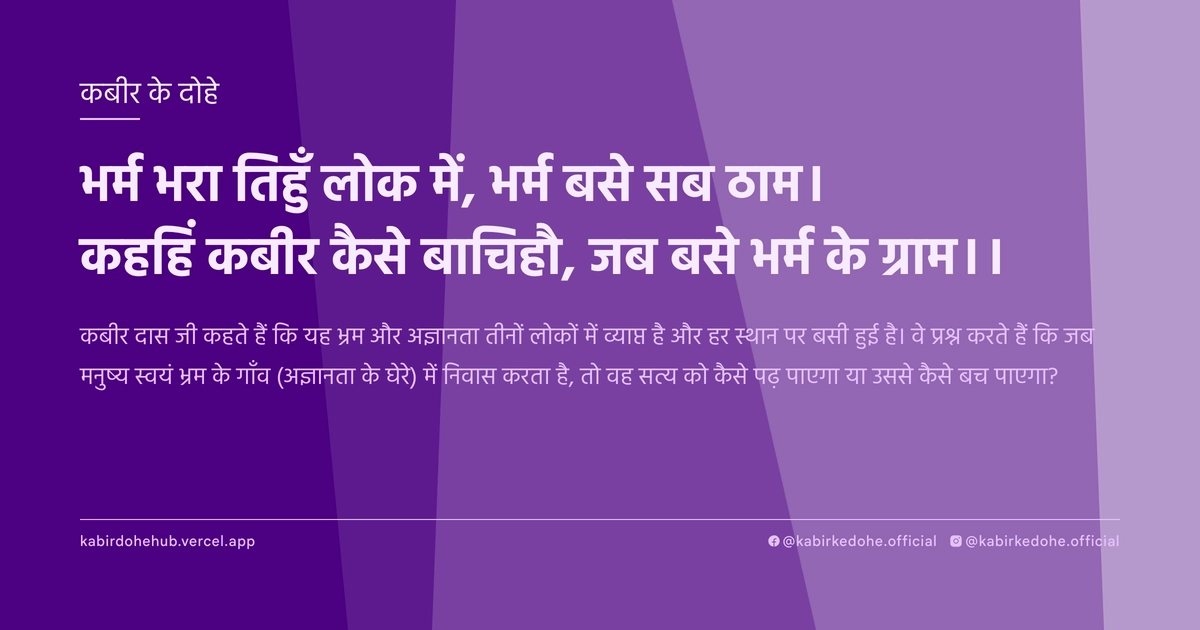
भर्म भरा तिहुँ लोक में, भर्म बसे सब ठाम।
कहहिं कबीर कैसे बाचिहौ, जब बसे भर्म के ग्राम।।
Bhram bhara tihu loka me, bhram base sab thaam. Kahahin kabir kaise bachihau, jab base bhram ke gram.
इस पृष्ठ पर इस कबीर दोहे का अर्थ (meaning), हिंदी व्याख्या और अंग्रेज़ी अनुवाद, दार्शनिक विश्लेषण और व्यावहारिक जीवन सीख दी गई है। यह दोहा माया (Maya) विषय से जुड़ा है — Kabir doha meaning and explanation in Hindi and English.
अर्थ (Meaning):
कबीर दास जी कहते हैं कि यह भ्रम और अज्ञानता तीनों लोकों में व्याप्त है और हर स्थान पर बसी हुई है। वे प्रश्न करते हैं कि जब मनुष्य स्वयं भ्रम के गाँव (अज्ञानता के घेरे) में निवास करता है, तो वह सत्य को कैसे पढ़ पाएगा या उससे कैसे बच पाएगा?
Kabir asserts that illusion and ignorance permeate all three realms of existence and reside everywhere. He questions how one can possibly read the truth or escape the cycle of suffering when they are fundamentally residing within the village of delusion itself.
व्याख्या (Interpretation):
साब्दिक अर्थ यह है कि संसार भ्रम से भरा है। गहराई में, 'तिहुँ लोक' केवल भौतिक जगत नहीं, बल्कि चेतना की विभिन्न अवस्थाएँ हैं। 'भर्म' यहाँ माया का प्रतीक है जो आत्मा को उसके वास्तविक स्वरूप (ब्रह्म) से अलग करती है। जब कबीर 'भर्म के ग्राम' की बात करते हैं, तो वे उस मानसिक स्थिति की ओर इशारा कर रहे हैं जहाँ व्यक्ति अपनी पहचान को शरीर, नाम और सामाजिक पद से जोड़ लेता है। यह एक विरोधाभास है: हम सत्य को बाहर खोजते हैं, जबकि हमारी दृष्टि ही भ्रमित है। निर्गुण भक्ति के अनुसार, जब तक यह अज्ञान का पर्दा नहीं हटता, तब तक निराकार ईश्वर का अनुभव असंभव है।
Literally, the world is filled with delusion. Deeply, the 'three realms' represent not just physical worlds but various states of consciousness. 'Bharm' symbolizes Maya, the cosmic illusion that separates the Atman from Brahman. When Kabir mentions the 'village of delusion,' he refers to the psychological state where an individual identifies solely with the body, name, and social status. This creates a central paradox: we seek truth externally while our very lens of perception is distorted. In Nirgun Bhakti, until this veil of ignorance is lifted, the experience of the formless Divine remains an impossibility.
दार्शनिक विश्लेषण (Philosophical Analysis):
कबीर का यह दोहा उस युग की प्रतिक्रिया है जहाँ धर्म केवल कर्मकांडों और बाहरी आडंबरों तक सीमित था। वे तर्क देते हैं कि चाहे कोई मंदिर जाए या मस्जिद, यदि उसका मन 'भ्रम' से भरा है, तो वह केवल अपनी अज्ञानता को पुष्ट कर रहा है। यह विचार अद्वैत वेदांत के 'अविद्या' सिद्धांत से मेल खाता है, जहाँ अज्ञान ही बंधन का मूल कारण है।
सूफीवाद के संदर्भ में, यह 'नफ्स' (अहंकार) के विनाश की बात है। जब तक व्यक्ति यह मानता है कि वह एक अलग इकाई है, वह सत्य के 'ग्राम' में प्रवेश नहीं कर सकता। कबीर यहाँ जाति और धर्म की सीमाओं को तोड़कर सीधे चेतना की बात करते हैं।
उनका प्रहार उन विद्वानों पर है जो केवल शास्त्रों को पढ़ते हैं लेकिन अनुभव शून्य हैं। उनके लिए 'बाचिहौ' (पढ़ना) का अर्थ केवल अक्षरों को पढ़ना नहीं, बल्कि जीवन के सत्य को आत्मसात करना है।
मनोवैज्ञानिक स्तर पर, यह 'कॉग्निटिव बायस' या संज्ञानात्मक पूर्वाग्रह की बात है। हम वही देखते हैं जो हम विश्वास करते हैं। यदि हमारा आधार ही भ्रम है, तो हमारा निष्कर्ष भी भ्रमित होगा।
अंततः, कबीर यह संदेश देते हैं कि मुक्ति किसी बाहरी स्थान पर जाने से नहीं, बल्कि आंतरिक भ्रम के विनाश से मिलती है। यह 'स्व' का विसर्जन है ताकि 'सर्व' का उदय हो सके।
This couplet is a reaction to an era where religion was confined to rituals and external displays. Kabir argues that whether one visits a temple or a mosque, if the mind is filled with 'Bharm,' they are merely reinforcing their own ignorance. This aligns with the Advaita Vedanta concept of 'Avidya,' where ignorance is the root cause of bondage.
In the context of Sufism, this refers to the annihilation of the 'Nafs' (ego). As long as an individual perceives themselves as a separate entity, they cannot enter the 'village' of ultimate truth. Kabir transcends caste and creed to speak directly to the nature of consciousness.
He specifically targets scholars who read scriptures but lack experiential realization. For him, 'Baachihau' (reading) is not about literacy, but about assimilating the truth of existence into one's being.
Psychologically, this addresses cognitive biases. We perceive the world through the filters we possess. If the foundation of our perception is delusion, our conclusions will inevitably be distorted.
Ultimately, Kabir suggests that liberation does not come from traveling to a distant place, but from the destruction of internal illusion. It is the dissolution of the 'I' so that the 'All' may emerge.
मूल संदेश (Core Message):
- अज्ञानता का पर्दा सत्य को देखने से रोकता है।
- बाहरी खोज व्यर्थ है यदि आंतरिक दृष्टि भ्रमित है।
- अहंकार ही वह गाँव है जहाँ सत्य खो जाता है।
- सत्य को पढ़ने के लिए पहले भ्रम को मिटाना होगा।
- द्वैत का अंत ही वास्तविक ज्ञान की शुरुआत है।
- The veil of ignorance prevents the vision of truth.
- External quests are futile if the internal lens is distorted.
- The ego is the village where the truth is lost.
- To read the truth, one must first erase the delusion.
- The end of duality is the beginning of real knowledge.
व्यावहारिक उदाहरण (Practical Example):
एक समय की बात है, बनारस के घाटों पर रहने वाली एक वृद्ध विधवा, जानकी, का जीवन केवल कठिन तपस्या और नियमों के पालन में बीत रहा था। वह मानती थी कि केवल कठोर उपवास और घंटों की माला जप से ही उसे मोक्ष मिलेगा।
वह हर दिन अन्य भक्तों को देखती और मन ही मन सोचती कि वे कितने पापी हैं क्योंकि वे नियमों का पालन नहीं करते। उसका पूरा अस्तित्व 'शुद्धता' और 'अशुद्धता' के भ्रम में बसा था।
एक दिन, उसने एक फकीर को देखा जो बिना किसी माला के, बस शांत बैठा था और उसके चेहरे पर एक असीम शांति थी। जानकी ने उससे पूछा, "आप इतनी तपस्या नहीं करते, फिर भी इतने शांत कैसे हैं?"
फकीर ने मुस्कुराकर कहा, "माँ, तुम जिस किनारे पर खड़ी होकर मोक्ष खोज रही हो, वह किनारा ही एक भ्रम है। तुम नियमों की दीवारें खड़ी कर रही हो, जबकि सत्य उन दीवारों के पार है।"
जानकी को लगा कि वह बहुत ज्ञानी है, लेकिन फकीर ने उससे पूछा, "यदि तुम्हारी आँखें पट्टी से बंधी हों, तो क्या तुम यह बता सकती हो कि सामने सूर्य है या चंद्रमा?"
जानकी ने कहा, "नहीं, मैं नहीं देख पाऊँगी।" फकीर ने उत्तर दिया, "तुम्हारा अहंकार और तुम्हारी शुद्धता का दावा ही वह पट्टी है। तुम भ्रम के गाँव में रहती हो और सोचती हो कि तुम सत्य पढ़ रही हो।"
यह बात जानकी के हृदय पर गहरे प्रहार की तरह लगी। उसे समझ आया कि उसकी 'पवित्रता' वास्तव में उसके अहंकार का एक सूक्ष्म रूप थी, जिसने उसे दूसरों से अलग कर दिया था।
उस दिन के बाद, जानकी ने कठोर नियमों को छोड़कर करुणा को अपनाया। उसने देखा कि ईश्वर मंदिर की सीढ़ियों में नहीं, बल्कि उस भूखे व्यक्ति की सेवा में है जिसे वह अब तक 'अशुद्ध' मानकर अनदेखा करती थी।
उसका व्यवहार बदल गया। वह अब दूसरों के दोष नहीं देखती थी, बल्कि अपनी ही त्रुटियों को पहचानने लगी। उसका जीवन अब कर्मकांड से हटकर प्रेम और सेवा की ओर मुड़ गया।
अंततः, जानकी ने पाया कि जब उसने 'शुद्ध होने' का भ्रम छोड़ा, तभी वह वास्तव में शुद्ध हुई। उसका मोक्ष किसी नियम में नहीं, बल्कि इस बोध में था कि सब एक ही ब्रह्म का अंश हैं।
Once, in the ghats of Varanasi, lived an elderly widow named Janki, whose life was consumed by rigorous penance and strict adherence to rules. She believed that only through harsh fasting and hours of chanting beads could she attain salvation.
She would watch other devotees daily and think to herself how sinful they were for not following the rules. Her entire existence was built upon the illusion of 'purity' and 'impurity.'
One day, she saw a wandering dervish who sat in absolute silence without any prayer beads, yet his face radiated an infinite peace. Janki asked him, "You do not perform such penance, yet how are you so peaceful?"
The dervish smiled and said, "Mother, the very shore from which you are searching for salvation is itself an illusion. You are building walls of rules, while the truth lies beyond those walls."
Janki felt she was very knowledgeable, but the dervish asked, "If your eyes were blindfolded, could you tell if the sun or the moon was in front of you?"
Janki replied, "No, I would not be able to see." The dervish answered, "Your ego and your claim to purity are that blindfold. You live in the village of delusion and think you are reading the truth."
These words struck Janki's heart like a deep blow. She realized that her 'purity' was actually a subtle form of ego that had separated her from others.
After that day, Janki abandoned the rigid rules and embraced compassion. She realized that God was not in the steps of the temple, but in the service of the hungry person she had previously ignored as 'impure.'
Her behavior transformed. She stopped seeing the faults in others and began recognizing her own errors. Her life shifted from ritualism toward love and service.
Ultimately, Janki found that when she let go of the illusion of 'being pure,' she actually became pure. Her salvation lay not in a rule, but in the realization that all are fragments of the same Brahman.
अभ्यास मार्गदर्शन (Practice Guidance):
- प्रतिदिन 20 मिनट का मौन अभ्यास करें, जहाँ आप अपने विचारों को केवल एक दर्शक की तरह देखें, बिना किसी निर्णय के।
- एक 'भ्रम पत्रिका' (Illusion Journal) बनाएँ। लिखें कि आज आपने किन बातों को 'सत्य' मान लिया जो वास्तव में आपके पूर्वाग्रह थे।
- जब भी आप किसी के प्रति निर्णय (Judgment) लें, तो रुकें और स्वयं से पूछें: "क्या यह सत्य है, या यह मेरे मन का बनाया हुआ भ्रम है?"
- निदान चेकलिस्ट: यदि आप अभी भी दूसरों को बदलने की कोशिश कर रहे हैं या अपनी पहचान को अपनी उपलब्धियों से जोड़ रहे हैं, तो आप अभी भी 'भ्रम के ग्राम' में हैं।
- Practice 20 minutes of daily silence, observing your thoughts as a witness without attaching any judgment to them.
- Maintain an 'Illusion Journal.' Record instances where you accepted something as 'truth' which was actually just a personal bias.
- Whenever you find yourself judging someone, pause and ask: "Is this an objective truth, or is it a delusion constructed by my mind?"
- Diagnostic Checklist: If you are still trying to change others or linking your identity to your achievements, you are still residing in the 'village of delusion.'
चिंतन प्रश्न (Reflection Questions):
- मेरे जीवन का वह कौन सा 'सत्य' है, जो वास्तव में केवल मेरी सामाजिक कंडीशनिंग का परिणाम है?
- मैं अपनी डिजिटल पहचान (Social Media Persona) को कितना वास्तविक मानता हूँ, और यह भ्रम मुझे कैसे नियंत्रित करता है?
- क्या मेरी धार्मिक या नैतिक श्रेष्ठता की भावना वास्तव में मुझे सत्य के करीब ले जा रही है, या वह एक नई दीवार बन गई है?
- यदि मैं अपनी सभी उपाधियों और रिश्तों को हटा दूँ, तो जो बचेगा, क्या वह सत्य है या केवल एक और गहरा भ्रम?
- मैं किन लोगों को 'अज्ञानी' मानता हूँ, और क्या वह निर्णय मेरे अपने भ्रम का प्रतिबिंब है?
- Which 'truth' in my life is actually just a result of my social conditioning?
- How real do I perceive my digital identity to be, and how does this illusion control me?
- Is my sense of religious or moral superiority bringing me closer to truth, or has it become a new wall?
- If I strip away all my titles and relationships, is what remains the truth, or just another deeper delusion?
- Whom do I label as 'ignorant,' and is that judgment merely a reflection of my own delusion?