
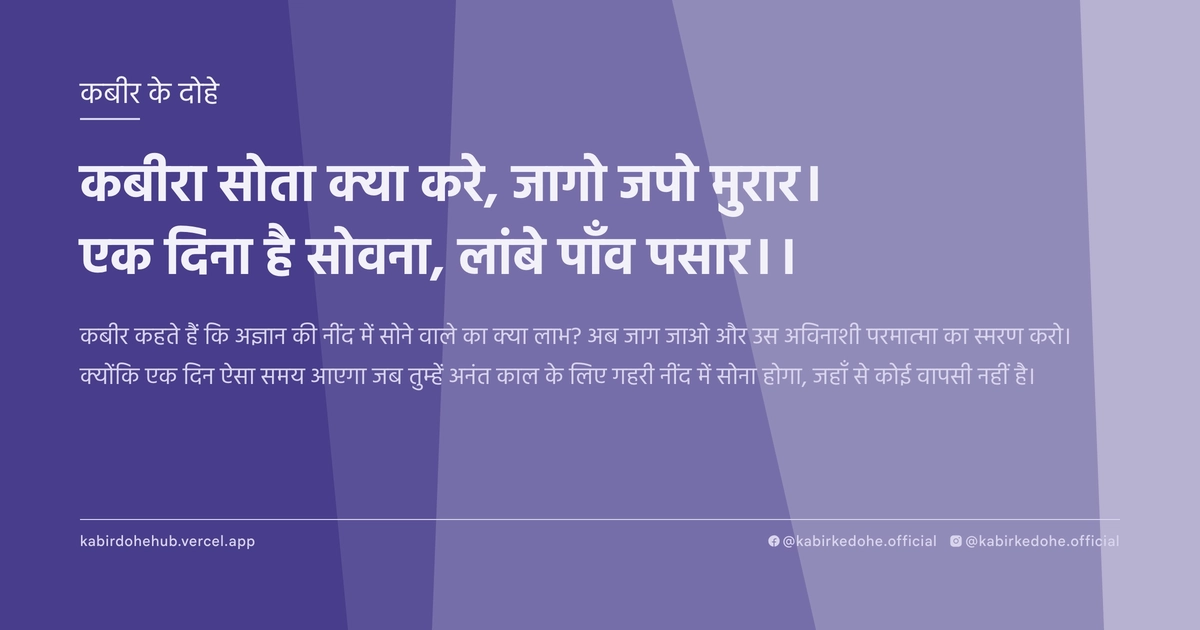
कबीरा सोता क्या करे, जागो जपो मुरार।
एक दिना है सोवना, लांबे पाँव पसार।।
Kabira sota kya kare, jaago japo murar. Ek dina hai sovna, laambe paon pasar.
इस पृष्ठ पर इस कबीर दोहे का अर्थ (meaning), हिंदी व्याख्या और अंग्रेज़ी अनुवाद, दार्शनिक विश्लेषण और व्यावहारिक जीवन सीख दी गई है। यह दोहा जागृति (The Wake-up Call) विषय से जुड़ा है — Kabir doha meaning and explanation in Hindi and English.
अर्थ (Meaning):
कबीर कहते हैं कि अज्ञान की नींद में सोने वाले का क्या लाभ? अब जाग जाओ और उस अविनाशी परमात्मा का स्मरण करो। क्योंकि एक दिन ऐसा समय आएगा जब तुम्हें अनंत काल के लिए गहरी नींद में सोना होगा, जहाँ से कोई वापसी नहीं है।
Kabir asks what use is there in remaining asleep in the slumber of ignorance. He urges the seeker to awaken and meditate upon the Eternal Divine, for a day will inevitably come when one must sleep the final, eternal sleep, stretching out one's limbs in permanent stillness.
व्याख्या (Interpretation):
यहाँ 'सोना' शारीरिक निद्रा नहीं, बल्कि आध्यात्मिक जड़ता और माया के प्रभाव में होने का प्रतीक है। कबीर चेतावनी देते हैं कि मनुष्य संसार की नश्वरता को भूलकर मोह-माया में लीन है। 'जागने' का अर्थ है आत्म-बोध या साक्षित्व की प्राप्ति, जहाँ व्यक्ति यह जान लेता है कि वह शरीर नहीं बल्कि शुद्ध चेतना है। यह निर्गुण भक्ति का सार है, जहाँ बाहरी कर्मकांडों के बजाय आंतरिक जागरूकता पर बल दिया गया है। जब व्यक्ति 'मुरार' (परमात्मा) का जाप करता है, तो वह वास्तव में अपने भीतर के उस अंश को खोजता है जो ब्रह्म के साथ अभिन्न है। अंततः, 'लांबे पाँव पसारना' मृत्यु की अपरिहार्यता और भौतिक अस्तित्व के पूर्ण विलीनीकरण को दर्शाता है। यह विरोधाभास है कि केवल वही जाग सकता है जिसने अपनी अहंकारपूर्ण नींद को त्याग दिया है।
In this verse, 'sleep' does not refer to physical slumber but symbolizes spiritual inertia and the veil of Maya. Kabir warns that humanity remains immersed in worldly attachments, oblivious to the transient nature of existence. 'Awakening' signifies the attainment of self-realization or consciousness, where the individual recognizes they are not the body but pure awareness. This is the essence of Nirgun Bhakti, emphasizing internal alertness over external ritualism. When the poet urges the chanting of 'Murar' (the Divine), he is directing the seeker toward the discovery of the spark within that is non-dual with Brahman. Ultimately, 'stretching the legs' represents the inevitability of death and the total dissolution of the physical ego. The central paradox lies in the fact that only he who abandons the sleep of the ego can truly awaken to the eternal reality.
दार्शनिक विश्लेषण (Philosophical Analysis):
कबीर का यह दोहा उस कालखंड की उपज है जब समाज कर्मकांडों और बाहरी आडंबरों में जकड़ा हुआ था। उन्होंने स्पष्ट किया कि मोक्ष किसी मंदिर या मस्जिद में नहीं, बल्कि स्वयं के भीतर जागने में है। यह विचार अद्वैत वेदांत के 'अविद्या' (अज्ञान) के सिद्धांत से मेल खाता है, जहाँ अज्ञान ही बंधन का कारण है और ज्ञान ही मुक्ति। कबीर यहाँ 'मुरार' शब्द का प्रयोग करते हैं, जो कृष्ण का एक नाम है, लेकिन उनका संकेत सगुण मूर्ति नहीं बल्कि उस निराकार तत्व की ओर है जो कण-कण में व्याप्त है।
सूफी मत के 'फना' (अहंकार का विनाश) के समान, कबीर यहाँ भी व्यक्ति को अपनी झूठी पहचान को मिटाने के लिए प्रेरित करते हैं। उनके अनुसार, जब तक मनुष्य यह मानता है कि वह एक अलग इकाई है, वह सो रहा है। जागने का अर्थ है इस द्वैत को समाप्त करना और यह अनुभव करना कि आत्मा और परमात्मा एक ही हैं। यह मनोवैज्ञानिक रूपांतरण की प्रक्रिया है जहाँ भय मृत्यु से हटकर अज्ञान की ओर मुड़ जाता है।
कबीर ने जाति और धर्म के भेदों को नकारते हुए एक सार्वभौमिक सत्य प्रस्तुत किया। उनके लिए 'जागना' एक क्रांतिकारी कार्य है क्योंकि यह स्थापित सामाजिक और धार्मिक ढांचों को चुनौती देता है जो मनुष्य को केवल डर और पुरस्कार के माध्यम से नियंत्रित करते हैं। वे सिखाते हैं कि आध्यात्मिक अनुशासन केवल माला जपने में नहीं, बल्कि निरंतर सजगता में है।
यहाँ 'मृत्यु' को एक अंत के रूप में नहीं, बल्कि एक अंतिम सत्य के रूप में प्रस्तुत किया गया है जो जीवन को अर्थ देता है। यदि मृत्यु न होती, तो जागने की कोई तात्कालिकता नहीं होती। यह 'मोमेंटो मोरी' (मृत्यु को याद रखना) का एक भारतीय संस्करण है, जो व्यक्ति को वर्तमान क्षण में पूरी तरह उपस्थित होने के लिए विवश करता है।
अंततः, यह विश्लेषण दर्शाता है कि कबीर का मार्ग अत्यंत व्यावहारिक है। वे किसी काल्पनिक स्वर्ग का वादा नहीं करते, बल्कि वर्तमान जीवन में ही उस परम शांति की प्राप्ति की बात करते हैं जो केवल अहंकार के विसर्जन और सत्य के साक्षात्कार से संभव है।
Kabir's couplet emerges from an era where society was shackled by rigid rituals and external displays of piety. He clarifies that liberation is found not in temples or mosques, but in the awakening of the self. This aligns with the Advaita Vedanta concept of 'Avidya' (ignorance), where ignorance is the root of bondage and knowledge is the path to liberation. While he uses the term 'Murar'—a name for Krishna—his reference is not to a form-bound deity but to the formless (Nirgun) element pervading every atom of existence.
Similar to the Sufi concept of 'Fana' (annihilation of the ego), Kabir urges the seeker to erase their false identity. According to him, as long as a human perceives themselves as a separate entity, they remain asleep. Awakening means dissolving this duality and experiencing the non-duality of Atman and Brahman. This is a process of psychological transformation where fear shifts from the prospect of death to the horror of remaining ignorant.
By rejecting caste and religious divisions, Kabir presents a universal truth. For him, 'awakening' is a revolutionary act because it challenges established social and religious structures that control humans through fear and reward. He teaches that spiritual discipline is not found in the mechanical repetition of beads, but in constant, vivid awareness.
Death is presented here not as a tragedy, but as the ultimate truth that gives life its meaning. Without the certainty of death, there would be no urgency to awaken. This is an Indian iteration of 'Memento Mori', compelling the individual to be fully present in the current moment.
Ultimately, this analysis reveals that Kabir's path is profoundly pragmatic. He does not promise a distant paradise but advocates for the realization of supreme peace within this very life, achievable only through the dissolution of the ego and the encounter with Truth.
मूल संदेश (Core Message):
- अज्ञान की नींद सबसे गहरा अंधकार है।
- जागरूकता ही एकमात्र वास्तविक प्रार्थना है।
- मृत्यु का भय केवल अज्ञान का परिणाम है।
- अहंकार का विसर्जन ही वास्तविक जागरण है।
- वर्तमान क्षण में जीना ही परमात्मा से मिलना है।
- बाहरी कर्मकांड आंतरिक शून्यता को नहीं भर सकते।
- The sleep of ignorance is the deepest darkness.
- Awareness is the only true form of prayer.
- Fear of death is merely a result of ignorance.
- The dissolution of ego is the only true awakening.
- Living fully in the present is the union with the Divine.
- External rituals cannot fill internal emptiness.
व्यावहारिक उदाहरण (Practical Example):
वाराणसी के एक पुराने घाट पर रहने वाले रामदीन नाम के एक वृद्ध बुनकर थे। रामदीन अपनी पूरी जिंदगी केवल कपड़े बुनने और परिवार पालने में बिता चुके थे। वे एक धार्मिक व्यक्ति थे, लेकिन उनका धर्म केवल परंपराओं का पालन करना था—सुबह स्नान करना, मंदिर जाना और दूसरों को उपदेश देना। उनके मन में एक गहरा अहंकार था कि वे बहुत 'पवित्र' हैं क्योंकि वे नियमों का पालन करते हैं।
एक दिन, रामदीन ने देखा कि उनका एक पुराना मित्र, जो समाज द्वारा बहिष्कृत था, एक पेड़ के नीचे शांत बैठा था। वह मित्र न तो मंदिर जाता था और न ही कोई दिखावा करता था, लेकिन उसके चेहरे पर एक ऐसी शांति थी जो रामदीन ने कभी महसूस नहीं की थी। रामदीन ने उससे पूछा, 'तुम बिना पूजा-पाठ के इतनी शांति कैसे पा लेते हो?'
उस मित्र ने मुस्कुराते हुए कहा, 'रामदीन, तुम मंदिर की सीढ़ियाँ तो चढ़ते हो, लेकिन क्या तुम अपने भीतर की नींद से जागे हो? तुम नियमों को पकड़कर सो रहे हो, जबकि सत्य तो तुम्हारी सांसों में छिपा है।'
यह बात रामदीन के दिल पर चोट कर गई। उन्होंने महसूस किया कि उनकी पूरी 'धार्मिकता' वास्तव में एक ढाल थी, जिसके पीछे वे अपने डर और अहंकार को छिपा रहे थे। वे केवल एक मशीन की तरह जीवन जी रहे थे, यह भूलकर कि समय तेजी से बीत रहा है।
उस रात रामदीन सो नहीं पाए। उन्हें कबीर का वह दोहा याद आया कि एक दिन सबको लंबी नींद सोना है। उन्होंने सोचा, 'क्या मैं पूरी उम्र केवल बाहरी दिखावे की नींद में सोया रहा?'
अगले कुछ महीनों में, रामदीन का व्यवहार बदलने लगा। उन्होंने दूसरों को उपदेश देना बंद कर दिया। अब वे कपड़े बुनते समय भी अपने भीतर की चेतना के प्रति सजग रहने लगे। उन्होंने महसूस किया कि हर धागा जो वे बुन रहे थे, वह उनके जीवन के क्षणों की तरह था।
उन्होंने अपने घर के दरवाजे उन लोगों के लिए खोल दिए जिन्हें समाज अछूत मानता था। उन्होंने पाया कि जब वे दूसरों में उसी परमात्मा को देखने लगे, तो उनका अपना अहंकार पिघलने लगा।
रामदीन अब केवल एक बुनकर नहीं थे, वे एक 'जागे हुए' इंसान बन गए थे। उनकी शांति अब बाहरी नियमों पर निर्भर नहीं थी, बल्कि उनके भीतर के मौन से उपज रही थी।
जब अंततः उनका समय आया, तो वे डरे हुए नहीं थे। उन्होंने शांति से अपनी आँखें बंद कीं, यह जानते हुए कि उन्होंने अपनी नींद त्याग दी है और अब वे उस अनंत नींद में प्रवेश कर रहे हैं जहाँ कोई द्वैत नहीं है।
यह 'कबीर ट्विस्ट' था—जहाँ एक व्यक्ति ने धार्मिकता के भ्रम को तोड़कर वास्तविक जागरूकता को अपनाया और अपने जीवन के अंतिम क्षणों को भयमुक्त बनाया।
In the ancient ghats of Varanasi lived an elderly weaver named Ramdeen. Ramdeen had spent his entire life weaving cloth and supporting his family. He was a religious man, but his faith consisted solely of following traditions—bathing in the river, visiting temples, and lecturing others. He harbored a deep ego, believing himself to be 'pure' because he adhered strictly to the rules.
One day, Ramdeen noticed an old friend, a man shunned by society, sitting peacefully under a banyan tree. This friend neither visited temples nor performed any outward displays of piety, yet his face radiated a serenity that Ramdeen had never experienced.
Ramdeen asked him, 'How do you find such peace without any rituals or prayers?'
The friend smiled and replied, 'Ramdeen, you climb the temple stairs, but have you awakened from the sleep within? You are sleeping while clinging to rules, whereas the Truth is hidden in your very breath.'
These words struck a chord in Ramdeen's heart. He realized that his entire 'religiosity' was actually a shield, behind which he hid his fears and ego. He had been living like a machine, forgetting that time was slipping away.
That night, Ramdeen could not sleep. He recalled Kabir's verse about the inevitable long sleep of death. He thought, 'Have I spent my entire life asleep in the illusion of external appearances?'
Over the next few months, Ramdeen's behavior began to change. He stopped lecturing others. Now, even while weaving, he remained alert to the consciousness within. He realized that every thread he wove was like a moment of his life.
He opened the doors of his home to those whom society deemed untouchable. He discovered that when he began to see the same Divine in others, his own ego began to melt away.
Ramdeen was no longer just a weaver; he had become an 'awakened' human being. His peace was no longer dependent on external rules but sprang from the silence within.
When his time finally came, he was not afraid. He closed his eyes peacefully, knowing that he had abandoned his spiritual slumber and was now entering that infinite sleep where no duality exists.
This was the 'Kabir Twist'—where a man broke the illusion of ritualistic piety to embrace true awareness, rendering his final moments fearless and luminous.
अभ्यास मार्गदर्शन (Practice Guidance):
- प्रतिदिन 20 मिनट 'साक्षी भाव' का अभ्यास करें: अपने विचारों को बिना किसी निर्णय के केवल एक दर्शक की तरह देखें, जैसे आप किसी और के सपने देख रहे हों।
- आत्म-पूछताछ जर्नल: हर रात लिखें कि आज दिन भर में किन क्षणों में आप 'अहंकार की नींद' में थे (जैसे क्रोध, निर्णय या ईर्ष्या) और कैसे आप सजग हो सकते थे।
- व्यवहारिक परिवर्तन: दिन में तीन बार रुककर अपनी सांसों पर ध्यान केंद्रित करें और स्वयं से पूछें, 'क्या मैं इस क्षण में वास्तव में जाग रहा हूँ या केवल आदतों के वश में हूँ?'
- डायग्नोस्टिक चेकलिस्ट: यदि आप छोटी बातों पर विचलित होते हैं, दूसरों को बदलने की कोशिश करते हैं, या मृत्यु के विचार से डरते हैं, तो आप अभी भी 'सो रहे हैं'। यदि आप शांति महसूस करते हैं और सभी में एक ही तत्व देखते हैं, तो आप जाग रहे हैं।
- Practice 'Witness Consciousness' for 20 minutes daily: Observe your thoughts without judgment, as if you are watching someone else's dream.
- Self-Inquiry Journaling: Every night, record the moments you were 'asleep in ego' (e.g., moments of anger, judgment, or jealousy) and how you could have remained aware.
- Behavioral Shift: Three times a day, pause and focus on your breath, asking yourself, 'Am I truly awake in this moment, or am I merely operating on autopilot?'
- Diagnostic Checklist: If you are easily agitated by trifles, strive to change others, or fear the thought of death, you are still 'asleep.' If you feel an inner stillness and perceive the same essence in everyone, you are awakening.
चिंतन प्रश्न (Reflection Questions):
- मेरी कौन सी सामाजिक पहचान (पद, प्रतिष्ठा, धर्म) मुझे यह विश्वास दिलाने में मदद करती है कि मैं 'जागा हुआ' हूँ, जबकि मैं वास्तव में सो रहा हूँ?
- यदि आज मेरी मृत्यु हो जाए, तो क्या मैं अपने पीछे केवल एक 'नियमों का पालन करने वाला' व्यक्ति छोड़ूँगा या एक 'जागा हुआ' मनुष्य?
- मेरे जीवन का वह कौन सा हिस्सा है जहाँ मैं अभी भी दूसरों के निर्णयों के आधार पर अपनी खुशी ढूँढ रहा हूँ?
- क्या मेरी भक्ति वास्तव में परमात्मा के लिए है, या यह मेरे अपने अहंकार को संतुष्ट करने का एक तरीका है?
- मैं अपनी डिजिटल पहचान (सोशल मीडिया) के माध्यम से किस प्रकार की 'छवि' बना रहा हूँ, और वह मेरी वास्तविक आंतरिक स्थिति से कितनी दूर है?
- क्या मैं वास्तव में मौन में रहने का साहस रखता हूँ, या मैं शोर का उपयोग अपनी आंतरिक शून्यता से बचने के लिए करता हूँ?
- Which social identity (status, prestige, religion) convinces me that I am 'awake' while I am actually slumbering?
- If I were to die today, would I leave behind merely a 'follower of rules' or a truly 'awakened' human being?
- In which area of my life am I still seeking happiness based on the validation and judgments of others?
- Is my devotion truly for the Divine, or is it a mechanism to satisfy my own ego?
- What kind of 'image' am I constructing through my digital identity, and how far is it from my actual internal state?
- Do I possess the courage to remain in absolute silence, or do I use noise to escape my internal void?