
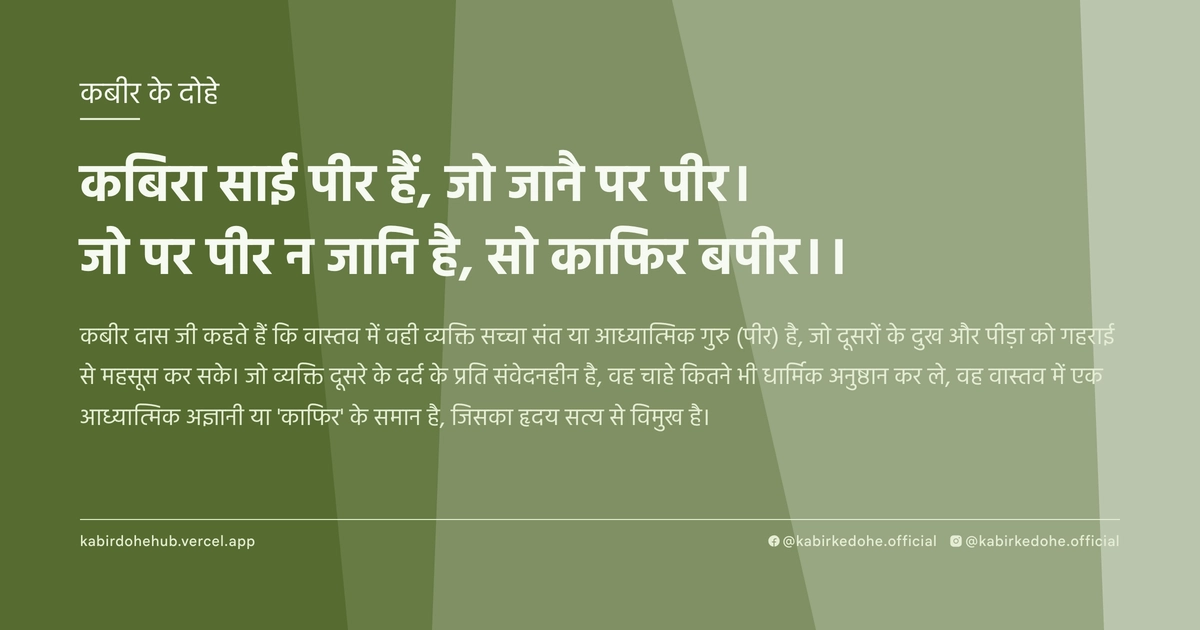
कबिरा साई पीर हैं, जो जानै पर पीर।
जो पर पीर न जानि है, सो काफिर बपीर।।
Kabira sai peer hain, jo jaanai par peer. Jo par peer na jaani hai, so kafir bapeer.
इस पृष्ठ पर इस कबीर दोहे का अर्थ (meaning), हिंदी व्याख्या और अंग्रेज़ी अनुवाद, दार्शनिक विश्लेषण और व्यावहारिक जीवन सीख दी गई है। यह दोहा करुणा (Compassion) विषय से जुड़ा है — Kabir doha meaning and explanation in Hindi and English.
अर्थ (Meaning):
कबीर दास जी कहते हैं कि वास्तव में वही व्यक्ति सच्चा संत या आध्यात्मिक गुरु (पीर) है, जो दूसरों के दुख और पीड़ा को गहराई से महसूस कर सके। जो व्यक्ति दूसरे के दर्द के प्रति संवेदनहीन है, वह चाहे कितने भी धार्मिक अनुष्ठान कर ले, वह वास्तव में एक आध्यात्मिक अज्ञानी या 'काफिर' के समान है, जिसका हृदय सत्य से विमुख है।
Kabir asserts that a true saint or spiritual guide is one who possesses the profound capacity to feel the pain of others. He posits that anyone who remains indifferent to the suffering of fellow beings is essentially a spiritual outsider or 'kaafir', regardless of their outward religious adherence, for their heart remains closed to the ultimate truth of compassion.
व्याख्या (Interpretation):
इस दोहे का शाब्दिक अर्थ सहानुभूति से शुरू होता है, लेकिन यह जल्द ही एक गहरे आध्यात्मिक सत्य की ओर ले जाता है। यहाँ 'पीर' शब्द के दो अर्थ हैं: एक 'दुख' और दूसरा 'गुरु'। कबीर एक विरोधाभास प्रस्तुत करते हैं कि गुरु बनने की पहली शर्त स्वयं को मिटाकर दूसरे के दुख में विलीन होना है। यह निर्गुण भक्ति का सार है, जहाँ ईश्वर किसी मंदिर या मस्जिद में नहीं, बल्कि मानवता की सेवा और करुणा में निवास करता है। जब हम दूसरे के दर्द को अपना समझते हैं, तो 'मैं' और 'तू' का भेद समाप्त हो जाता है, जो अद्वैत वेदांत के आत्म-ब्रह्म एकता का प्रतिबिंब है। माया हमें यह विश्वास दिलाती है कि हम अलग हैं, लेकिन करुणा इस भ्रम को तोड़ती है। अंततः, यह दोहा सिखाता है कि बिना संवेदनशीलता के ज्ञान केवल अहंकार का विस्तार है।
The literal meaning begins with empathy but swiftly transitions into a profound metaphysical truth. Kabir employs a linguistic play on 'Peer', meaning both 'pain' and 'spiritual guide'. He presents a paradox: the primary qualification for spiritual mastery is the annihilation of the self to absorb the suffering of others. This is the essence of Nirgun Bhakti, where the Divine resides not in idols or structures, but in the act of compassion. When we perceive another's pain as our own, the duality of 'I' and 'Thou' dissolves, mirroring the Advaita Vedanta concept of Atman-Brahman non-duality. Maya creates the illusion of separation, but compassion is the tool that shatters this veil. Ultimately, the verse teaches that knowledge without empathy is merely an extension of the ego.
दार्शनिक विश्लेषण (Philosophical Analysis):
कबीर का यह दोहा उस सामाजिक और धार्मिक परिवेश में लिखा गया था जहाँ कर्मकांड और बाहरी पहचान (जाति, धर्म) को आध्यात्मिकता का पैमाना माना जाता था। कबीर ने इस व्यवस्था को चुनौती देते हुए 'मानवता' को ही सर्वोच्च धर्म घोषित किया। उनका दृष्टिकोण सूफीवाद के 'इश्क-ए-हकीकी' (ईश्वरीय प्रेम) से गहराई से प्रभावित है, जहाँ प्रेम केवल ईश्वर के लिए नहीं, बल्कि उसकी रचना के हर अंश के लिए होना चाहिए।
दार्शनिक स्तर पर, यह दोहा अद्वैत वेदांत के उस सिद्धांत का समर्थन करता है कि चेतना एक ही है। यदि हम सभी एक ही सार्वभौमिक चेतना के अंश हैं, तो दूसरे का दुख वास्तव में मेरा अपना दुख है। जो व्यक्ति इसे नहीं समझता, वह 'काफिर' है—यहाँ काफिर का अर्थ केवल गैर-मुस्लिम नहीं, बल्कि वह है जो सत्य (हक) से पर्दा डाले हुए है।
कबीर ritualism (कर्मकांड) का खंडन करते हैं क्योंकि वे देखते थे कि लोग माला जपते हैं लेकिन उनके मन में दूसरों के प्रति घृणा है। उनके लिए, एक व्यक्ति जो भूखे को भोजन कराता है, वह उस पंडित या मौलवी से कहीं अधिक पवित्र है जो केवल शास्त्रों का पाठ करता है। यह मनोवैज्ञानिक रूपांतरण की मांग करता है, जहाँ व्यक्ति अपने संकीर्ण 'अहं' से निकलकर 'सर्व' की भावना में प्रवेश करे।
यहाँ 'पीर' का अनुभव करना केवल भावनात्मक सहानुभूति नहीं है, बल्कि एक आध्यात्मिक उपलब्धि है। यह अहंकार के विसर्जन (annihilation of ego) की प्रक्रिया है। जब 'मैं' मरता है, तभी 'करुणा' जन्म लेती है। यह सूफी मत के 'फना' होने जैसा है, जहाँ साधक अपनी व्यक्तिगत पहचान को ईश्वर की इच्छा और प्रेम में विलीन कर देता है।
अक्सर लोग इस दोहे को केवल एक नैतिक उपदेश मान लेते हैं, लेकिन यह वास्तव में एक कठोर आध्यात्मिक कसौटी है। कबीर स्पष्ट करते हैं कि मोक्ष या ज्ञान का मार्ग बौद्धिक विमर्श से नहीं, बल्कि हृदय के विस्तार से होकर गुजरता है। यदि आपका हृदय दूसरे के लिए नहीं तड़पता, तो आपकी सारी साधना व्यर्थ है।
This couplet was composed in a socio-religious climate where ritualism and external markers of identity—caste and creed—were mistaken for spiritual attainment. Kabir challenged this hegemony by elevating 'humanity' as the supreme religion. His perspective is deeply intertwined with the Sufi concept of 'Ishq-e-Haqiqi' (Divine Love), suggesting that love for the Creator is incomplete without love for the creation.
Philosophically, the verse aligns with Advaita Vedanta's premise of a singular, universal consciousness. If all beings are manifestations of the same Brahman, then the suffering of another is fundamentally one's own. He uses the term 'Kaafir' not in a sectarian sense, but to describe one who is 'veiled' from the Truth (Haq), remaining ignorant of the interconnectedness of existence.
Kabir vehemently rejects ritualism because he observed a disconnect between spiritual practice and ethical conduct. For him, a person feeding the hungry is more sacred than a scholar reciting scriptures without compassion. This demands a psychological transformation: moving from the narrow 'I' to the expansive 'All'.
Experiencing 'Peer' is not merely emotional empathy; it is a spiritual milestone. It represents the process of ego-annihilation. Only when the 'I' dies can true compassion be born. This mirrors the Sufi state of 'Fana', where the seeker dissolves their individual identity into the Divine Will and Love.
Common literalist interpretations often reduce this to a moral lesson on kindness. However, Kabir presents it as a rigorous spiritual litmus test. He asserts that the path to liberation or Gnosis does not lie in intellectual discourse, but in the expansion of the heart. Without the capacity to ache for another, all spiritual disciplines are hollow.
मूल संदेश (Core Message):
- बाहरी धार्मिकता एक मुखौटा है; वास्तविक भक्ति करुणा में निहित है।
- दूसरों के दर्द को महसूस करना ही अहंकार के विनाश का एकमात्र मार्ग है।
- सच्चा गुरु वह नहीं जो मंत्र दे, बल्कि वह जो दुख बाँट ले।
- मानवता की सेवा ही ईश्वर की सबसे बड़ी और सच्ची इबादत है।
- जब 'मैं' मिटता है, तभी सार्वभौमिक प्रेम का उदय होता है।
- External religiosity is a mask; true devotion resides in compassion.
- Feeling the pain of others is the only path to the annihilation of ego.
- A true guide is not one who gives mantras, but one who shares burdens.
- Service to humanity is the highest and truest worship of the Divine.
- When the 'I' vanishes, universal love finally dawns.
व्यावहारिक उदाहरण (Practical Example):
वाराणसी के एक पुराने घाट पर, माधव नाम का एक वृद्ध नाई रहता था। माधव का जीवन बहुत साधारण था, लेकिन वह शहर के सबसे बड़े पंडितों और धनी व्यापारियों के बाल काटता था। वह हमेशा विनम्र रहता था, लेकिन उसके मन में एक गहरी टीस थी क्योंकि वह देखता था कि लोग धर्म के नाम पर केवल दिखावा करते हैं।
एक दिन, घाट की सीढ़ियों पर एक अत्यंत वृद्ध और बीमार भिखारी आया, जिसके पास सहारा देने वाला कोई नहीं था। वह भूख और ठंड से कांप रहा था। वहां से कई लोग गुजरे, जिनमें रेशमी वस्त्र पहने कुछ धार्मिक विद्वान भी थे, जिन्होंने उसे अनदेखा कर दिया और अपनी 'शुद्धता' बनाए रखने के लिए उससे दूर चले गए।
माधव ने जब उस वृद्ध को देखा, तो उसे लगा जैसे उसके अपने पिता का शरीर उस अवस्था में हो। उसे उस व्यक्ति की पीड़ा अपने भीतर महसूस हुई। वह तुरंत अपनी दुकान छोड़कर भागा, अपना इकलौता कंबल उस वृद्ध को ओढ़ा दिया और उसे अपने घर ले गया।
माधव के पास बहुत कम संसाधन थे। उसने अपनी दिनभर की कमाई से उसके लिए दवाइयां और भोजन खरीदा। उसने कई रातों तक उस अजनबी की सेवा की, बिना यह सोचे कि वह व्यक्ति कौन है या किस जाति का है।
एक शाम, शहर का एक प्रतिष्ठित विद्वान माधव के पास आया। उसने देखा कि माधव एक 'अछूत' माने जाने वाले व्यक्ति की सेवा में लीन है। विद्वान ने उपहास करते हुए कहा, "माधव, तुम अपनी पवित्रता खो रहे हो। क्या तुम्हें नहीं पता कि यह धर्म के विरुद्ध है?"
माधव ने शांति से उत्तर दिया, "महाराज, मैंने किताबों में धर्म नहीं पढ़ा, लेकिन इस वृद्ध की आँखों के आँसुओं में मुझे मेरा ईश्वर दिखा। यदि मैं इसकी पीड़ा नहीं समझ सकता, तो मेरी सारी पूजा केवल एक ढोंग है।"
विद्वान यह सुनकर स्तब्ध रह गया। उसे पहली बार अहसास हुआ कि वह वर्षों से वेदों का पाठ कर रहा था, लेकिन उसका हृदय पत्थर का हो चुका था। वह माधव की निस्वार्थ करुणा के सामने खुद को छोटा महसूस करने लगा।
उस दिन विद्वान का अहंकार टूट गया। उसने महसूस किया कि वास्तविक 'पीर' या गुरु वह नहीं जो ऊँचे आसन पर बैठे, बल्कि वह है जो सबसे निचले स्तर पर गिर चुके व्यक्ति का हाथ थाम ले।
माधव के इस छोटे से कार्य ने उस विद्वान के जीवन की दिशा बदल दी। उसने बाहरी कर्मकांडों को छोड़कर सेवा मार्ग को अपनाया।
यह 'कबीर ट्विस्ट' था—जहाँ एक साधारण नाई ने अपनी करुणा से एक बड़े विद्वान को वास्तविक आध्यात्मिकता का पाठ पढ़ाया, यह सिद्ध करते हुए कि दूसरों का दर्द समझना ही सबसे बड़ी इबादत है।
On an ancient ghat in Varanasi lived an elderly barber named Madhav. His life was simple, yet he served the city's most prominent priests and wealthy merchants. He remained humble, but within him grew a quiet sorrow as he observed people performing religion as a mere social spectacle.
One day, an extremely frail and ill beggar arrived on the ghat steps, with no one to support him. He was shivering from hunger and cold. Many passed by, including religious scholars in silk robes, who ignored him and steered clear to maintain their 'ritual purity'.
When Madhav saw the old man, he felt as if it were his own father in that wretched state. He felt the man's agony vibrating within his own chest. He immediately abandoned his shop, wrapped his only blanket around the stranger, and carried him to his humble home.
Madhav had very few resources. He spent his entire day's earnings on medicines and food for the stranger. He nursed the man for several nights, never questioning his identity or caste.
One evening, a prestigious scholar visited Madhav. He saw Madhav immersed in the service of a man considered 'untouchable'. The scholar mocked him, saying, "Madhav, you are losing your purity. Do you not know this is against the tenets of faith?"
Madhav replied calmly, "Sir, I have not read religion in books, but in the tears of this old man, I saw my God. If I cannot feel his pain, then all my prayers are merely a facade."
The scholar was stunned. He realized that while he had spent years reciting Vedas, his heart had turned to stone. He felt diminished in the presence of Madhav's selfless compassion.
In that moment, the scholar's ego shattered. He understood that a true 'Peer' or guide is not one who sits on a high pedestal, but one who reaches down to hold the hand of the fallen.
Madhav's small act of kindness shifted the trajectory of the scholar's life. He abandoned hollow rituals and embraced the path of service.
This was the 'Kabir Twist'—where a simple barber taught a great scholar the essence of spirituality, proving that feeling the pain of others is the highest form of worship.
अभ्यास मार्गदर्शन (Practice Guidance):
- दैनिक करुणा ध्यान: प्रतिदिन 15 मिनट मौन बैठें और अपने जीवन में उन लोगों के बारे में सोचें जिन्हें आप नापसंद करते हैं। उनकी पीड़ा को महसूस करने का प्रयास करें और मानसिक रूप से उन्हें शांति भेजें।
- आत्म-पूछताछ जर्नल: हर रात लिखें—'आज मैंने किसकी पीड़ा को अनदेखा किया?' और 'मैं अपनी सुविधा के दायरे से बाहर निकलकर किसी की मदद कैसे कर सकता था?'
- व्यवहारिक परिवर्तन: सप्ताह में एक बार किसी ऐसे व्यक्ति की मदद करें जिससे आपको कोई व्यक्तिगत लाभ न मिले और जो आपको सामाजिक रूप से 'निम्न' या 'अलग' लगता हो।
- निदान चेकलिस्ट: यदि आप किसी की समस्या सुनकर तुरंत निर्णय (judge) लेते हैं या उसे 'उसका कर्म है' कहकर टाल देते हैं, तो समझें कि आपका हृदय अभी 'काफिर' अवस्था में है। यदि आप दूसरे के दुख से विचलित होते हैं और उसे दूर करने की तड़प महसूस करते हैं, तो आप 'पीर' की ओर बढ़ रहे हैं।
- Daily Compassion Meditation: Sit in silence for 15 minutes daily. Visualize people you dislike or find difficult. Attempt to feel their hidden pain and mentally send them peace and healing.
- Self-Inquiry Journaling: Every night, record: 'Whose suffering did I ignore today?' and 'How could I have stepped outside my comfort zone to alleviate another's burden?'
- Behavioral Shift: Once a week, perform an act of service for someone from whom you gain no personal advantage and whom society deems 'inferior' or 'different'.
- Diagnostic Checklist: If you find yourself judging someone's struggle or dismissing it as 'their karma', recognize that your heart is in the 'kaafir' state. If you feel a visceral ache for another's suffering and a genuine urge to help, you are aligning with the 'Peer' consciousness.
चिंतन प्रश्न (Reflection Questions):
- क्या मेरी धार्मिक पहचान मुझे दूसरों से जोड़ती है, या यह मेरे और दूसरों के बीच एक दीवार बन गई है?
- जब मैं किसी की मदद करता हूँ, तो क्या मैं वास्तव में उसकी पीड़ा महसूस कर रहा हूँ, या मैं केवल अपनी 'अच्छाई' की छवि को पुष्ट कर रहा हूँ?
- मेरे जीवन में वह कौन सा 'अदृश्य' व्यक्ति है जिसे मैं अपनी सुविधा के लिए अनदेखा करता रहता हूँ?
- क्या मैं दूसरों के दुखों को उनके 'कर्मों' का परिणाम बताकर अपनी संवेदनहीनता को सही ठहराता हूँ?
- यदि मेरा पूरा सामाजिक दर्जा और पहचान छीन ली जाए, तो क्या मेरे भीतर केवल करुणा शेष रहेगी?
- Does my religious identity connect me to others, or has it become a wall between me and the world?
- When I help someone, am I truly feeling their pain, or am I merely reinforcing an image of my own 'goodness'?
- Who is the 'invisible' person in my daily life whom I consistently ignore for the sake of my own convenience?
- Do I justify my indifference by labeling others' suffering as a result of their 'karma'?
- If all my social status and identity were stripped away, would compassion be the only thing remaining within me?