
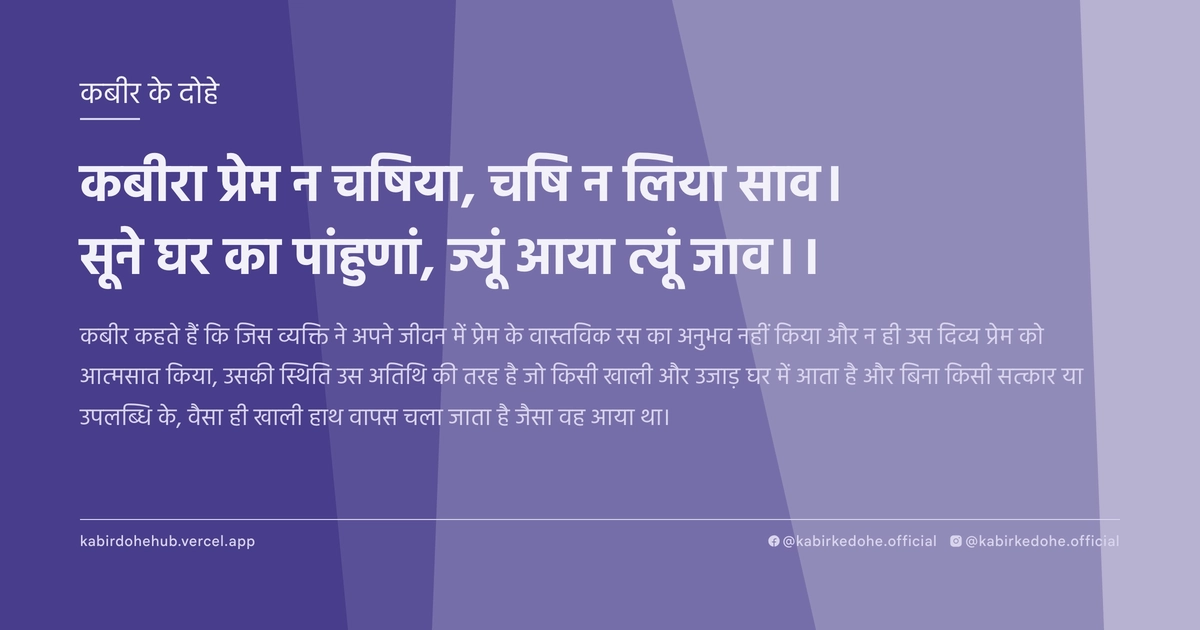
कबीरा प्रेम न चषिया, चषि न लिया साव।
सूने घर का पांहुणां, ज्यूं आया त्यूं जाव।।
Kabira prem na chashiya, chashi na liya saav. Soone ghar ka paanhuna, jyun aaya tyun jaav.
इस पृष्ठ पर इस कबीर दोहे का अर्थ (meaning), हिंदी व्याख्या और अंग्रेज़ी अनुवाद, दार्शनिक विश्लेषण और व्यावहारिक जीवन सीख दी गई है। यह दोहा भक्ति (Bhakti) विषय से जुड़ा है — Kabir doha meaning and explanation in Hindi and English.
अर्थ (Meaning):
कबीर कहते हैं कि जिस व्यक्ति ने अपने जीवन में प्रेम के वास्तविक रस का अनुभव नहीं किया और न ही उस दिव्य प्रेम को आत्मसात किया, उसकी स्थिति उस अतिथि की तरह है जो किसी खाली और उजाड़ घर में आता है और बिना किसी सत्कार या उपलब्धि के, वैसा ही खाली हाथ वापस चला जाता है जैसा वह आया था।
Kabir asserts that one who has not tasted the essence of divine love, nor internalized its transformative power, is akin to a guest who visits a desolate, empty house. Having found no sustenance or warmth, such a person departs from the earthly existence exactly as they entered—void of spiritual fulfillment and devoid of the soul's true treasure.
व्याख्या (Interpretation):
यह दोहा प्रेम की अनुपस्थिति में जीवन की निरर्थकता को दर्शाता है। यहाँ 'प्रेम' केवल मानवीय आसक्ति नहीं, बल्कि 'ईश्वर-प्रेम' या 'प्रेम-भक्ति' है। literal अर्थ में, यह एक खाली घर में आए मेहमान की बात करता है, लेकिन रूपक के स्तर पर, 'घर' मानव शरीर है और 'पाहुणा' (अतिथि) जीवात्मा है। यदि शरीर रूपी घर में प्रेम का वास नहीं है, तो आत्मा का इस संसार में आना व्यर्थ है। यह निर्गुण भक्ति के उस सिद्धांत को पुष्ट करता है जहाँ प्रेम ही एकमात्र माध्यम है जिससे माया का पर्दा हटता है और आत्मा का परमात्मा (ब्रह्म) से मिलन होता है। बिना इस अनुभव के, जन्म और मृत्यु का चक्र केवल एक यांत्रिक प्रक्रिया बनकर रह जाता है, जिसमें कोई आध्यात्मिक विकास नहीं होता।
This couplet illuminates the existential futility of a life devoid of divine love. Here, 'Prem' refers not to mundane attachment, but to the transcendental love for the Formless (Nirgun). Literally, it describes a guest in a desolate house; metaphorically, the 'house' is the human body and the 'guest' is the soul. If the vessel of the body does not contain the nectar of love, the soul's incarnation is wasted. This aligns with the core of Nirgun Bhakti, where love is the sole catalyst to dissolve the veil of Maya and realize the non-duality of Atman and Brahman. Without this realization, the cycle of birth and death remains a mechanical tragedy, a journey without a destination, where the soul departs as empty as it arrived.
दार्शनिक विश्लेषण (Philosophical Analysis):
कबीर का यह दर्शन 15वीं शताब्दी के सामाजिक और धार्मिक परिवेश की प्रतिक्रिया है, जहाँ धर्म केवल कर्मकांडों, बाहरी दिखावे और जातिगत श्रेष्ठता तक सीमित था। कबीर ने इस 'शुष्क धर्म' का खंडन किया और 'प्रेम' को सर्वोच्च सत्य घोषित किया। उनके लिए प्रेम कोई भावना नहीं, बल्कि एक आध्यात्मिक साधना है जो अहंकार का विनाश करती है।
अद्वैत वेदांत के परिप्रेक्ष्य में, यह दोहा अज्ञान (Avidya) की स्थिति को दर्शाता है। जब तक व्यक्ति स्वयं को शरीर मानता है, वह 'सूने घर' की तरह है। प्रेम वह सेतु है जो व्यक्ति को उसकी सीमित पहचान से मुक्त कर अनंत ब्रह्म से जोड़ता है। सूफी मत के 'इश्क-ए-हकीकी' (ईश्वरीय प्रेम) के समान, कबीर का प्रेम भी आत्मा की तड़प और समर्पण पर आधारित है।
यहाँ 'चषिया' (चखना) शब्द अत्यंत महत्वपूर्ण है। यह इंगित करता है कि सत्य बौद्धिक विमर्श या शास्त्रों के पढ़ने से नहीं, बल्कि प्रत्यक्ष अनुभव (Anubhava) से प्राप्त होता है। जो केवल ज्ञान की बातें करता है लेकिन प्रेम का अनुभव नहीं करता, वह आध्यात्मिक रूप से अक्षम है।
कबीर ritualism (कर्मकांड) का विरोध करते हुए यह समझाते हैं कि मंदिर, मस्जिद या तीर्थयात्राएँ तब तक व्यर्थ हैं जब तक हृदय में करुणा और प्रेम का संचार न हो। बाहरी आडंबर उस 'खाली घर' की सजावट की तरह हैं, जबकि भीतर आत्मा प्यासी है।
अंततः, यह विश्लेषण अहंकार के विलीनीकरण की प्रक्रिया है। जब 'मैं' मिटता है, तभी 'प्रेम' का आगमन होता है। जो व्यक्ति अपनी पहचान और अहंकार को पकड़े रहता है, वह उस अतिथि की तरह है जिसे घर का मालिक (परमात्मा) पहचान नहीं पाता और वह बिना किसी उपलब्धि के विदा हो जाता है।
Kabir’s philosophy emerges as a visceral reaction to the 15th-century socio-religious landscape, where spirituality was reduced to rigid rituals, outward displays of piety, and caste hierarchies. He dismantled this 'arid religion,' proposing that Love is the ultimate truth and the only valid currency of the soul.
From the lens of Advaita Vedanta, this doha depicts the state of Avidya (ignorance). As long as the individual identifies with the ego and the physical form, they remain a 'desolate house.' Love is the bridge that transcends the limited 'I' to merge with the infinite Brahman. This mirrors the Sufi concept of 'Ishq-e-Haqiqi' (Divine Love), where the soul's longing and total surrender lead to annihilation in the Beloved.
The term 'Chashiya' (to taste) is pivotal. It suggests that spiritual truth is not reached through intellectual discourse or the rote reading of scriptures, but through direct, visceral experience (Anubhava). One who possesses theoretical knowledge but lacks the experience of love is spiritually bankrupt.
Kabir rejects ritualism, arguing that temples, mosques, and pilgrimages are meaningless if the heart remains devoid of compassion. External piety is merely decorating the walls of an empty house while the inhabitant starves for essence.
Ultimately, this is an analysis of the dissolution of the ego. Love can only enter when the 'I' is vacated. He who clings to his identity and pride is like the guest who remains a stranger to the Host (the Divine), departing the world without ever having truly arrived.
मूल संदेश (Core Message):
- बिना प्रेम के धार्मिकता केवल एक बोझ है।
- अनुभव ही वास्तविक ज्ञान का एकमात्र प्रमाण है।
- अहंकार का त्याग ही प्रेम के द्वार खोलता है।
- मानव शरीर एक अवसर है, इसे प्रेम से भरें।
- सत्य शब्दों में नहीं, हृदय के भावों में बसता है।
- Religiosity without love is a spiritual burden.
- Direct experience is the only valid proof of truth.
- The dissolution of ego is the prerequisite for love.
- The human body is an opportunity; fill it with love.
- Truth resides not in words, but in the heart's vibration.
व्यावहारिक उदाहरण (Practical Example):
वाराणसी के एक पुराने घाट पर रहने वाले एक वृद्ध विधवा, जानकी, का जीवन अत्यंत एकाकी था। उन्होंने अपना पूरा जीवन कठोर नियमों, उपवासों और केवल धार्मिक ग्रंथों के पाठ में बिता दिया था। उनके लिए धर्म का अर्थ था—शुद्धता का पालन करना और दूसरों को उनकी गलतियों के लिए टोकना।
जानकी का घर भौतिक रूप से तो साफ था, लेकिन वहां कोई हंसी या स्नेह नहीं था। वह स्वयं को बहुत पवित्र मानती थीं क्योंकि वह किसी 'अपवित्र' व्यक्ति से बात नहीं करती थीं। उनके भीतर एक आध्यात्मिक अहंकार था कि वह ईश्वर के सबसे करीब हैं क्योंकि वह नियमों का पालन करती हैं।
एक दिन, उनके पड़ोस में एक छोटा बच्चा आया जो एक अनाथालय से भागा था। वह बच्चा भूखा था और उसने जानकी के आंगन में प्रवेश कर लिया। जानकी ने पहले उसे दुत्कारना चाहा, क्योंकि वह बच्चा 'अशुद्ध' था और उनके नियमों के विरुद्ध था।
लेकिन उस बच्चे की आंखों में एक ऐसी बेबसी और मासूमियत थी जिसने जानकी के भीतर कुछ तोड़ दिया। पहली बार, उन्होंने अपनी पवित्रता के नियमों को भुलाकर उस बच्चे को गले लगाया और उसे अपने हिस्से की रोटी खिलाई।
उस क्षण, जानकी को महसूस हुआ कि जिस ईश्वर को उन्होंने दशकों तक मंत्रों और उपवासों में खोजा, वह उस बच्चे की मुस्कुराहट में था। उन्हें अहसास हुआ कि उनका अब तक का जीवन एक 'सूने घर' की तरह था—नियमों से भरा हुआ, लेकिन प्रेम से खाली।
इस 'कबीर ट्विस्ट' ने जानकी के जीवन को बदल दिया। उन्होंने अब केवल ग्रंथों को पढ़ना नहीं, बल्कि उन्हें जीना शुरू किया। उन्होंने अपने घर के दरवाजे सभी के लिए खोल दिए, चाहे उनकी जाति या स्थिति कुछ भी हो।
वह अब केवल एक 'पवित्र विधवा' नहीं थीं, बल्कि एक ऐसी माँ बन गईं जिसने प्रेम के रस को चख लिया था। उनकी कठोरता करुणा में बदल गई और उनका एकाकीपन एक सामूहिक उत्सव बन गया।
मृत्यु के समय, जब उनके आसपास पूरा मोहल्ला इकट्ठा था, जानकी के चेहरे पर एक ऐसी तृप्ति थी जो उन्हें उनके वर्षों के उपवासों से कभी नहीं मिली थी। अब वह 'खाली हाथ' नहीं जा रही थीं; वह प्रेम की पूंजी लेकर जा रही थीं।
In the ancient alleys of Varanasi lived Janaki, an elderly widow whose life was a fortress of austerity. She spent her decades adhering to rigid purity laws, fasting strictly, and reciting scriptures with mechanical precision. For her, spirituality was a checklist of prohibitions and the avoidance of the 'impure.'
Janaki’s home was physically spotless, yet it was a spiritual vacuum. There was no laughter, no warmth, only the cold silence of discipline. She harbored a subtle pride, believing her adherence to rules made her superior and closer to the Divine than the common folk.
One afternoon, a young boy, an escapee from a nearby orphanage, stumbled into her courtyard. He was filthy, starving, and trembling. Janaki’s first instinct was to recoil; the child was a violation of her purity codes, a smudge on her sterile world.
However, as she looked into the boy's eyes, she saw a raw, aching vulnerability that bypassed her intellectual defenses. For the first time in years, Janaki ignored the rules of 'shuddhi' (purity) and pulled the child into a fierce, protective embrace, feeding him the only bread she had.
In that singular moment of compassion, Janaki experienced a spiritual rupture. She realized that the God she had sought through sterile mantras was residing in the hunger of a child. She saw that her life had been a 'desolate house'—well-maintained on the outside, but utterly empty of love.
This 'Kabir Twist' transformed her existence. She stopped treating the scriptures as laws and started treating them as poems of love. She opened her doors to the marginalized, the broken, and the forgotten of the ghats.
She ceased to be merely a 'pious widow' and became a sanctuary of grace. Her rigidity dissolved into tenderness, and her loneliness evolved into a shared communion with humanity.
When her time finally came to depart, she was surrounded by a community that loved her. The serenity on her face was not the result of her fasts, but of her fullness. She was no longer the guest leaving empty-handed; she departed wealthy in the only currency that matters: Love.
अभ्यास मार्गदर्शन (Practice Guidance):
- दैनिक चिंतन: प्रतिदिन 15 मिनट मौन बैठें और विचार करें कि क्या आपके कार्य केवल कर्तव्य (Duty) से प्रेरित हैं या उनमें वास्तविक प्रेम और करुणा का भाव है।
- आत्म-पूछताछ जर्नल: लिखें कि दिन भर में आपने कितनी बार अपनी 'पवित्रता' या 'सही होने' के अहंकार को किसी के प्रति प्रेम दिखाने से ऊपर रखा।
- व्यवहार परिवर्तन: सप्ताह में एक बार किसी ऐसे व्यक्ति की निस्वार्थ मदद करें जिससे आपका कोई संबंध नहीं है और जिससे आपको बदले में कुछ मिलने की उम्मीद न हो।
- निदान चेकलिस्ट: क्या आप दूसरों की गलतियों पर तुरंत निर्णय लेते हैं? क्या आप धर्म को केवल नियमों के रूप में देखते हैं? यदि हाँ, तो आपका 'घर' अभी भी सूना है।
- Daily Contemplation: Spend 15 minutes in silence, questioning whether your actions are driven by mere duty or by a genuine current of love and compassion.
- Self-Inquiry Journaling: Document instances where you prioritized your 'righteousness' or 'spiritual ego' over an opportunity to show unconditional love.
- Behavioral Shift: Once a week, perform an act of selfless service for a stranger, ensuring there is no expectation of gratitude or reciprocity.
- Diagnostic Checklist: Do you judge others instantly? Do you view spirituality as a set of rules rather than a state of heart? If yes, your 'house' remains desolate.
चिंतन प्रश्न (Reflection Questions):
- क्या मेरी धार्मिक पहचान वास्तव में मुझे विनम्र बना रही है, या यह मेरे अहंकार को एक नया मुखौटा दे रही है?
- यदि आज मेरा जीवन समाप्त हो जाए, तो क्या मैं प्रेम की स्मृतियों के साथ जाऊंगा या केवल नियमों के पालन की सूची के साथ?
- मैं किन लोगों को 'अपात्र' मानकर अपने प्रेम के दायरे से बाहर रखता हूँ, और यह निर्णय मेरे किस डर से उपजा है?
- क्या मैं प्रेम को एक भावना मानता हूँ या एक ऐसी शक्ति जो मुझे मेरे सीमित 'स्व' से मुक्त कर सकती है?
- मेरे जीवन का 'सूनापन' वास्तव में क्या है—संसाधनों की कमी या संवेदनाओं का अभाव?
- Does my religious identity truly cultivate humility, or is it merely a sophisticated mask for my ego?
- If my life ended today, would I depart with memories of love or merely a checklist of obeyed rules?
- Whom do I deem 'unworthy' of my love, and from which hidden fear does this judgment stem?
- Do I perceive love as a mere emotion, or as a transcendental force capable of liberating me from the limited 'I'?
- What is the true nature of the 'emptiness' in my life—a lack of resources or a lack of resonance?