
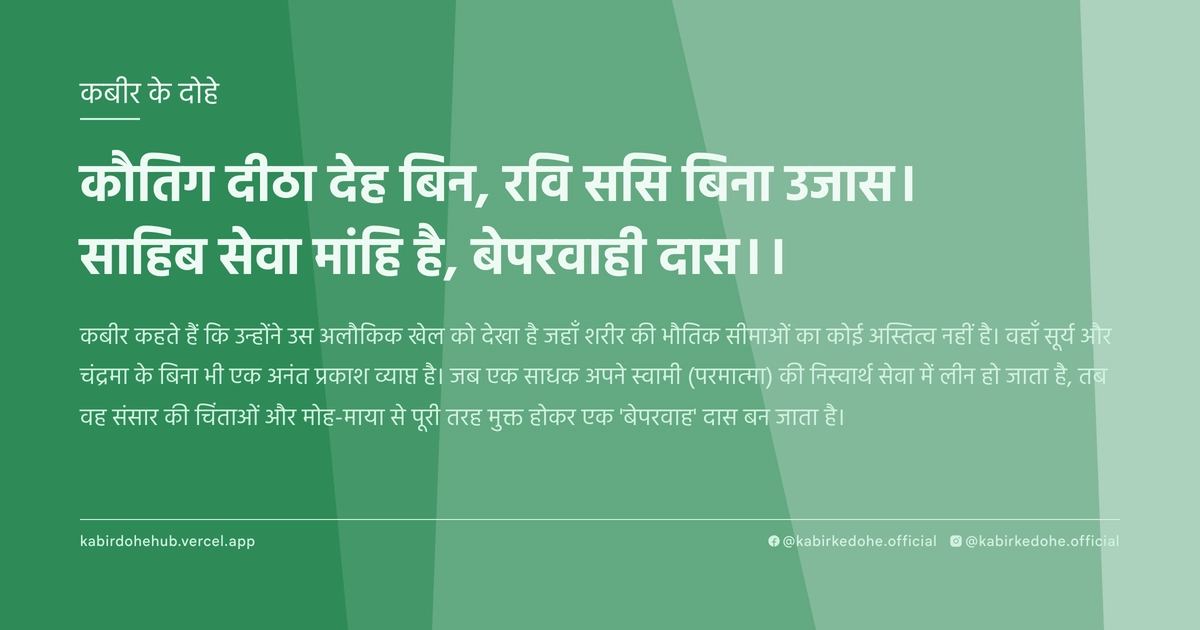
कौतिग दीठा देह बिन, रवि ससि बिना उजास।
साहिब सेवा मांहि है, बेपरवाही दास।।
Kautig deetha deh bin, ravi sasi bina ujas. Sahib seva maahi hai, beparvahi das.
इस पृष्ठ पर इस कबीर दोहे का अर्थ (meaning), हिंदी व्याख्या और अंग्रेज़ी अनुवाद, दार्शनिक विश्लेषण और व्यावहारिक जीवन सीख दी गई है। यह दोहा निर्गुण ब्रह्म (Nirguna Brahman) विषय से जुड़ा है — Kabir doha meaning and explanation in Hindi and English.
अर्थ (Meaning):
कबीर कहते हैं कि उन्होंने उस अलौकिक खेल को देखा है जहाँ शरीर की भौतिक सीमाओं का कोई अस्तित्व नहीं है। वहाँ सूर्य और चंद्रमा के बिना भी एक अनंत प्रकाश व्याप्त है। जब एक साधक अपने स्वामी (परमात्मा) की निस्वार्थ सेवा में लीन हो जाता है, तब वह संसार की चिंताओं और मोह-माया से पूरी तरह मुक्त होकर एक 'बेपरवाह' दास बन जाता है।
Kabir describes a transcendental vision where he has witnessed the divine play beyond the constraints of the physical body. In that realm, there is a luminous radiance that exists independently of the sun and moon. He asserts that through selfless devotion and service to the Divine Master, the seeker becomes a 'carefree servant,' liberated from the anxieties and attachments of the material world.
व्याख्या (Interpretation):
यह दोहा भौतिक जगत और आध्यात्मिक जगत के बीच के अंतर को स्पष्ट करता है। 'देह बिन' का अर्थ है अहंकार और स्थूल शरीर का विसर्जन, जहाँ आत्मा अपनी शुद्ध अवस्था में होती है। 'रवि ससि बिना उजास' उस आत्म-प्रकाश (Self-luminous consciousness) की ओर संकेत करता है जो बाहरी स्रोतों पर निर्भर नहीं है, बल्कि अंतरात्मा का स्वभाव है। यह निर्गुण भक्ति का सार है, जहाँ ईश्वर किसी मूर्ति या आकार में नहीं, बल्कि एक सर्वव्यापी प्रकाश के रूप में अनुभव किया जाता है। यहाँ 'बेपरवाही' का अर्थ लापरवाही नहीं, बल्कि वैराग्य और पूर्ण समर्पण है। जब साधक यह जान लेता है कि वह और उसका स्वामी एक ही हैं (अद्वैत), तब वह द्वैत के भय से मुक्त हो जाता है। यह अवस्था माया के पर्दे के हटने और ब्रह्म के साक्षात्कार की है।
This couplet delineates the boundary between the empirical world and the metaphysical realm. 'Deh bin' signifies the dissolution of the ego and the physical vessel, where the soul exists in its primordial purity. The 'light without sun or moon' refers to the Self-luminous consciousness (Swayamprakash), which does not rely on external sensory input but is the inherent nature of the Atman. This is the essence of Nirgun Bhakti, where the Divine is experienced not as a form, but as an all-pervasive radiance. The term 'beparvahi' (carefreeness) does not imply negligence, but rather a state of profound detachment (Vairagya) and total surrender. Once the seeker realizes the non-duality of the self and the Master (Advaita), the fear born of duality vanishes. This state represents the lifting of the veil of Maya and the direct realization of Brahman.
दार्शनिक विश्लेषण (Philosophical Analysis):
कबीर का यह दृष्टिकोण उनके युग के कर्मकांडीय धर्म के विरुद्ध एक सशक्त प्रहार था। जहाँ तत्कालीन समाज मंदिर, मस्जिद और बाहरी अनुष्ठानों में ईश्वर को खोज रहा था, कबीर ने 'भीतर के प्रकाश' की बात की। यह दर्शन सूफी मत के 'फना' (अहंकार का विनाश) और अद्वैत वेदांत के 'अहं ब्रह्मास्मि' का संगम है। कबीर यहाँ यह समझा रहे हैं कि जब तक मनुष्य स्वयं को शरीर मानता है, वह जन्म-मृत्यु और भय के चक्र में फँसा रहता है।
ऐतिहासिक रूप से, कबीर ने जाति और धर्म की दीवारों को तोड़कर एक ऐसे मार्ग का 제시 किया जो केवल प्रेम और सेवा पर आधारित था। उनके लिए 'साहिब' कोई बाहरी व्यक्ति नहीं, बल्कि वह चेतना है जो कण-कण में व्याप्त है। यह विश्लेषण दर्शाता है कि आध्यात्मिक प्रगति के लिए बाहरी प्रतीकों का त्याग आवश्यक है।
मनोवैज्ञानिक स्तर पर, 'बेपरवाही' की स्थिति मानसिक तनाव और सामाजिक दबावों से मुक्ति की स्थिति है। जब व्यक्ति अपनी पहचान को सामाजिक पद या शारीरिक रूप से हटाकर सार्वभौमिक आत्मा से जोड़ लेता है, तो वह अवसाद और चिंता से ऊपर उठ जाता है।
यह दोहा यह भी स्पष्ट करता है कि ज्ञान केवल शास्त्रों को पढ़ने से नहीं, बल्कि 'अनुभव' (Experience) से आता है। 'दीठा' शब्द का प्रयोग यह दर्शाता है कि कबीर ने इसे स्वयं देखा है, यह केवल एक सैद्धांतिक चर्चा नहीं है।
अंततः, यह संदेश देता है कि वास्तविक स्वतंत्रता तब मिलती है जब हम अपनी सीमित पहचान (Small Self) को मिटाकर उस अनंत प्रकाश (Universal Self) में विलीन हो जाते हैं। यह विलीनीकरण ही मोक्ष है, जो जीवित रहते हुए भी संभव है।
Kabir's perspective serves as a potent critique of the ritualistic religion of his era. While the contemporary society sought the Divine in temples, mosques, and external rites, Kabir emphasized the 'inner light.' This philosophy is a confluence of the Sufi concept of 'Fana' (annihilation of the ego) and the Advaita Vedanta realization of 'Aham Brahmasmi' (I am Brahman). Kabir argues that as long as a human identifies solely with the body, they remain trapped in the cycle of birth, death, and fear.
Historically, Kabir dismantled the barriers of caste and creed, proposing a path rooted exclusively in love and selfless service. For him, the 'Sahib' (Master) is not an external entity but the consciousness pervading every atom. This analysis reveals that for true spiritual progression, the abandonment of external symbols is imperative.
Psychologically, the state of 'beparvahi' represents liberation from mental stress and societal pressures. When an individual shifts their identity from a social role or physical form to the universal soul, they transcend depression and anxiety.
This couplet further clarifies that true knowledge is derived not from scholarly study of texts, but from direct 'Anubhava' (Experience). The use of the word 'deetha' (witnessed) underscores that Kabir is speaking from a place of direct realization, not theoretical speculation.
Ultimately, the message is that true freedom is attained when we dissolve the limited identity (the small self) into the infinite radiance (the Universal Self). This merging is liberation (Moksha), which is achievable even while inhabiting a physical body.
मूल संदेश (Core Message):
- शरीर की सीमाएं केवल एक भ्रम हैं, आत्मा अनंत है।
- सच्चा प्रकाश बाहरी दुनिया में नहीं, अंतर्मन में है।
- अहंकार का विसर्जन ही वास्तविक स्वतंत्रता का एकमात्र मार्ग है।
- ईश्वर की सेवा का अर्थ है स्वयं के भीतर की दिव्यता को पहचानना।
- वैराग्य का अर्थ सब कुछ छोड़ना नहीं, बल्कि किसी भी चीज़ से न बंधना है।
- जब द्वैत समाप्त होता है, तब भय और चिंता स्वतः मिट जाते हैं।
- Physical limitations are a mere illusion; the soul is infinite.
- True radiance resides within the inner self, not in the external world.
- The dissolution of ego is the only path to genuine liberation.
- Serving the Divine means recognizing the divinity within oneself.
- Detachment is not about abandoning everything, but about not being bound by anything.
- When duality ends, fear and anxiety vanish spontaneously.
व्यावहारिक उदाहरण (Practical Example):
एक समय की बात है, वाराणसी के घाटों पर माधव नाम का एक वृद्ध बुनकर रहता था। माधव अपनी पूरी जिंदगी रेशमी धागों को बुनने में बिता चुका था, लेकिन उसका मन हमेशा अशांत रहता था। वह अपनी गरीबी, अपने परिवार की उम्मीदों और समाज में अपनी छोटी सी पहचान को लेकर हमेशा चिंतित रहता था। वह हर दिन मंदिर जाता, घंटों प्रार्थना करता, लेकिन उसके भीतर का डर कभी कम नहीं हुआ।
एक दिन उसकी मुलाकात एक घुमक्कड़ फकीर से हुई, जिसने माधव को कबीर का यह दोहा सुनाया। फकीर ने उससे पूछा, "माधव, तुम इस कपड़े को बुन रहे हो, लेकिन क्या तुमने उस बुनकर को देखा है जिसने इस संसार को बुना है?"
माधव ने हैरान होकर कहा, "मैं तो केवल धागे देखता हूँ, प्रकाश नहीं।"
फकीर ने उसे अपनी आँखें बंद करने और अपनी सांसों के पीछे छिपे उस मौन को सुनने की सलाह दी। उसने कहा, "जब तक तुम खुद को केवल एक 'गरीब बुनकर' मानोगे, तुम दुखी रहोगे। जिस दिन तुम जान जाओगे कि तुम वह प्रकाश हो जिसे न सूर्य की जरूरत है न चंद्रमा की, उस दिन तुम वास्तव में आजाद हो जाओगे।"
माधव ने अगले कुछ महीनों तक हर दिन एक घंटा मौन रहकर अपने भीतर झांकना शुरू किया। उसने महसूस किया कि उसकी चिंताएं केवल उसके 'अहंकार' की उपज थीं—यह अहंकार कि वह एक असफल व्यक्ति है।
धीरे-धीरे, माधव के काम करने का तरीका बदल गया। अब वह केवल पैसे कमाने के लिए नहीं, बल्कि एक ध्यान की तरह कपड़े बुनने लगा। उसने देखा कि जब वह पूरी तरह से वर्तमान क्षण में लीन होता है, तो वह समय और शरीर की सीमाओं को भूल जाता है।
एक दिन, उसके घर में आग लग गई और उसकी सारी जमापूंजी जल गई। उसके पड़ोसी दौड़कर आए और बोले, "माधव, तुम बर्बाद हो गए! अब तुम क्या करोगे?"
माधव के चेहरे पर एक ऐसी शांति थी जो किसी ने पहले कभी नहीं देखी थी। उसने मुस्कुराकर कहा, "जला क्या है? केवल वह जो मेरा था ही नहीं। मैं तो उस प्रकाश का हिस्सा हूँ जिसे आग नहीं छू सकती।"
गाँव वाले दंग थे। माधव अब एक 'बेपरवाह दास' बन चुका था। उसने अपनी गरीबी को अपनी कमजोरी नहीं, बल्कि अपनी मुक्ति का मार्ग बना लिया था।
उसकी यह मानसिक स्थिति उसे और अधिक रचनात्मक बना गई। उसके द्वारा बुने गए कपड़ों में अब एक ऐसी दिव्यता थी कि दूर-दूर से लोग उन्हें खरीदने आने लगे, लेकिन माधव अब लाभ के लिए नहीं, बल्कि प्रेम के लिए काम करता था।
माधव की कहानी यह सिखाती है कि जब हम अपनी पहचान को भौतिक नुकसान और लाभ से ऊपर उठा लेते हैं, तब हम उस शाश्वत प्रकाश को पा लेते हैं जो हमें हर परिस्थिति में स्थिर रखता है।
Once, in the ghats of Varanasi, lived an elderly weaver named Madhav. Madhav had spent his entire life weaving silk threads, yet his mind was perpetually restless. He was constantly anxious about his poverty, the expectations of his family, and his insignificance in the eyes of society. He visited the temple daily and prayed for hours, but the fear within him never subsided.
One day, he encountered a wandering fakir who recited this specific couplet of Kabir to him. The fakir asked, "Madhav, you weave this cloth, but have you seen the Weaver who wove this entire universe?"
Madhav replied in bewilderment, "I see only threads, not light."
The fakir advised him to close his eyes and listen to the silence hidden behind his breath. He said, "As long as you identify yourself merely as a 'poor weaver,' you will remain miserable. The day you realize you are that light which needs neither sun nor moon, you will be truly free."
For the next few months, Madhav began spending an hour every day in silence, peering into his own inner being. He realized that his anxieties were merely products of his 'ego'—the ego that told him he was a failure.
Gradually, Madhav's approach to his work changed. He no longer wove for money alone, but as a form of meditation. He discovered that when he was completely immersed in the present moment, he forgot the limitations of time and the physical body.
One day, a fire broke out in his house, destroying all his savings and materials. His neighbors rushed to him and cried, "Madhav, you are ruined! What will you do now?"
There was a serenity on Madhav's face that no one had ever seen before. He smiled and said, "What has been burnt? Only that which was never truly mine. I am a part of that light which fire cannot touch."
The villagers were stunned. Madhav had become a 'carefree servant' (beparvahi daas). He had turned his poverty not into a weakness, but into a gateway for liberation.
This mental state made him even more creative. The fabrics he wove now possessed a divinity that attracted people from far and wide, yet Madhav worked for love, not for profit.
Madhav's story teaches us that when we elevate our identity above material loss and gain, we find that eternal light that keeps us steady in every storm.
अभ्यास मार्गदर्शन (Practice Guidance):
- प्रतिदिन 20 मिनट 'शून्य ध्यान' का अभ्यास करें, जहाँ आप अपने शरीर की संवेदनाओं को केवल एक साक्षी (Witness) की तरह देखें, बिना किसी निर्णय के।
- एक डायरी लिखें जिसमें आप उन सामाजिक पहचानों (जैसे पद, प्रतिष्ठा, रिश्ता) की सूची बनाएं जो आपको मानसिक तनाव देती हैं, और फिर उनके सामने लिखें: "मैं यह नहीं हूँ, मैं वह प्रकाश हूँ।"
- दिन में तीन बार 'चेक-इन' करें: क्या मैं अभी अपनी देह (शरीर/अहंकार) के माध्यम से सोच रहा हूँ या अपनी आत्मा के माध्यम से?
- डायग्नोस्टिक चेकलिस्ट: यदि आप छोटी बातों पर विचलित हो रहे हैं या दूसरों की राय से आपकी खुशी तय हो रही है, तो इसका अर्थ है कि आप अभी भी 'देह' के बंधन में हैं। यदि आप नुकसान में भी शांत हैं, तो आप 'बेपरवाही' की ओर बढ़ रहे हैं।
- Practice 20 minutes of 'Zero Meditation' daily, observing your bodily sensations as a mere witness without judgment.
- Maintain a journal listing the social identities (status, reputation, relationships) that cause you stress, and write beside them: "I am not this; I am that Light."
- Perform three 'check-ins' during the day: "Am I currently thinking through the lens of the body (ego) or through the lens of the soul?"
- Diagnostic Checklist: If you are easily agitated by trivialities or if your happiness depends on others' opinions, you are still bound by the 'body.' If you remain calm even in loss, you are moving toward 'beparvahi' (carefreeness).
चिंतन प्रश्न (Reflection Questions):
- यदि आज आपकी सारी सामाजिक पहचान (नाम, पद, संपत्ति) छीन ली जाए, तो आपके भीतर क्या बचेगा?
- आप किस 'बाहरी सूर्य' (प्रशंसा या मान्यता) के प्रकाश में अपनी खुशी खोज रहे हैं?
- क्या आपकी 'बेपरवाही' वास्तव में आध्यात्मिक है, या यह केवल जिम्मेदारियों से भागने का एक तरीका है?
- वह कौन सा डर है जो आपको यह मानने से रोकता है कि आप शरीर से परे एक दिव्य प्रकाश हैं?
- क्या आप अपनी डिजिटल पहचान (सोशल मीडिया इमेज) को ही अपना वास्तविक अस्तित्व मान बैठे हैं?
- आपके जीवन का वह कौन सा हिस्सा है जहाँ आप अभी भी 'दास' हैं, न कि 'मुक्त आत्मा'?
- If all your social identities (name, title, assets) were stripped away today, what would remain within you?
- Which 'external sun' (praise or validation) are you using to illuminate your happiness?
- Is your 'carefreeness' truly spiritual, or is it merely a way to escape responsibilities?
- What is the specific fear that prevents you from believing you are a divine light beyond the body?
- Have you mistaken your digital identity (social media image) for your actual existence?
- In which area of your life are you still a 'slave' rather than a 'free soul'?